Gas exchange in the alveoli
Introduced| English | Meaning |
|---|---|
| diffusion/dɪˈfjuːʒn/ | The net movement of particles from higher to lower concentration due to their random motion. |
| surface area/ˈsɜːfɪs ˈeərɪə/ | The total area of the outer surfaces of a three-dimensional object. |
| gas exchange/ɡæs eksˈtʃeɪndʒ/ | The movement of gases, such as oxygen and carbon dioxide, between an organism and its environment or between internal regions. |
| concentration gradient/ˌkɒnsənˈtreɪʃn ˈɡreɪdɪənt/ | A change in a substance's concentration across a distance or between regions. |
Where the air meets the blood
- The alveoli are where oxygen enters the blood and carbon dioxide leaves it.
- Their structure makes them brilliant exchange surfaces.
- The swap happens entirely by diffusion 扩散.
Alveoli have a large surface area and very thin walls for fast gas exchange.
Difficulty 1/5 · 100 coins + a small bonus on first completion today
A large surface area, thin walls, a rich blood supply and a moist lining all speed up gas exchange.
Why alveoli are ideal
- a very large total surface area 表面积 (millions of tiny sacs),
- very thin walls — alveolus and capillary each one cell thick → a tiny distance to cross,
- a rich blood supply from the capillary network,
- a moist lining, so gases dissolve before crossing.
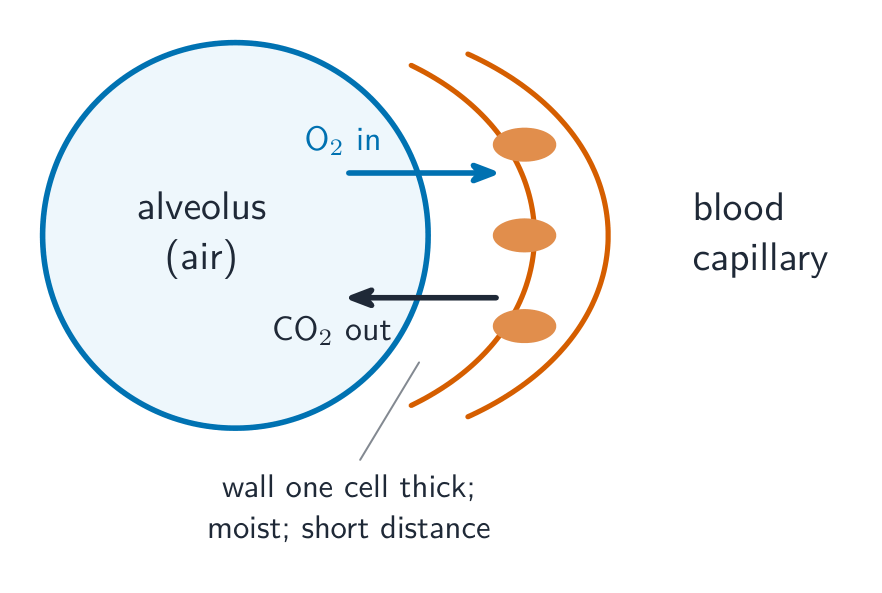
Gas exchange 气体交换 between an alveolus and a capillary
At the alveolus
Tap each part. Oxygen and carbon dioxide swap across a wall just one cell thick, between the air and the blood.
Which feature makes alveoli good for gas exchange?
Difficulty 1/5 · 100 coins + a small bonus on first completion today
Large surface area, thin walls, a rich blood supply and a moist lining all speed up gas exchange.
Match each alveolar feature to why it helps.
Difficulty 2/5 · 140 coins + a small bonus on first completion today
Every alveolar adaptation makes diffusion faster — more area, shorter distance, steeper gradient.
Diffusion of the gases
- Oxygen is high in the alveolar air, low in the blood — so it diffuses air → blood.
- Carbon dioxide is high in the blood, low in the air — so it diffuses blood → air to be breathed out.
- Both move down their concentration gradients 浓度梯度.
Oxygen diffuses:
Difficulty 1/5 · 100 coins + a small bonus on first completion today
Oxygen is higher in the alveolar air than in the blood, so it diffuses air → blood.
Carbon dioxide diffuses from the blood into the alveolar ______, to be breathed out.
Difficulty 1/5 · 100 coins + a small bonus on first completion today
CO₂ is higher in the blood, so it diffuses blood → air and is then exhaled.
Keeping exchange fast
- Breathing brings fresh air, keeping alveolar oxygen high and CO₂ low.
- Flowing blood carries gases away as fast as they cross.
- Both keep the concentration gradients steep, so diffusion stays rapid.
Breathing and the flow of blood keep gas exchange fast because they:
Difficulty 1/5 · 100 coins + a small bonus on first completion today
Fresh air and moving blood keep concentrations different on each side, so the gradients stay steep.
You've got it
- alveoli: large surface area, thin walls (one cell each), rich blood supply, moist lining
- oxygen diffuses air → blood; carbon dioxide diffuses blood → air (down the gradients)
- breathing + blood flow keep the gradients steep, so exchange stays fast
Write from oxygen entering the blood
- Alveolar air is rich in oxygen.
- Blood arriving at the lungs has a lower oxygen concentration. The alveolar wall is very thin.
Which way does oxygen diffuse?
Oxygen moves down its concentration gradient into the blood.
Where does oxygen go at an alveolus?
Difficulty 1/5 · 100 coins + a small bonus on first completion today
Alveolar air has the higher oxygen concentration.