Water potential and living cells
Introduced| English | Meaning |
|---|---|
| water potential/ˈwɔːtə pəˈtenʃl/ | A measure of the tendency of water to move, determined by its free energy relative to pure water under specified conditions. |
| solute/ˈsɒljuːt/ | A substance dissolved in a solvent to form a solution. |
| turgid/ˈtɜːdʒɪd/ | Describing a plant cell swollen and firm because water entering by osmosis produces pressure against its cell wall. |
| plasmolysis/plæzˈmɒləsɪs/ | The separation of a plant cell's membrane from its cell wall when water loss causes the protoplast to shrink. |
| haemolysis/hiːˈmɒləsɪs/ | The rupture of red blood cells, releasing their contents into the surrounding fluid. |
Which way will water move?
- Water potential 水势 measures how likely water is to leave a solution.
- It decides which way water moves by osmosis.
- It explains why a wilted plant perks up in water — and why a cell can burst.
What changes water potential
- Pure water has the highest water potential.
- Adding a solute 溶质 (a dissolved substance) lowers it.
- Water always moves by osmosis from higher to lower water potential.
- To estimate the water potential of plant tissue: soak pieces in sucrose solutions; the one causing no change in mass/length matches the tissue.
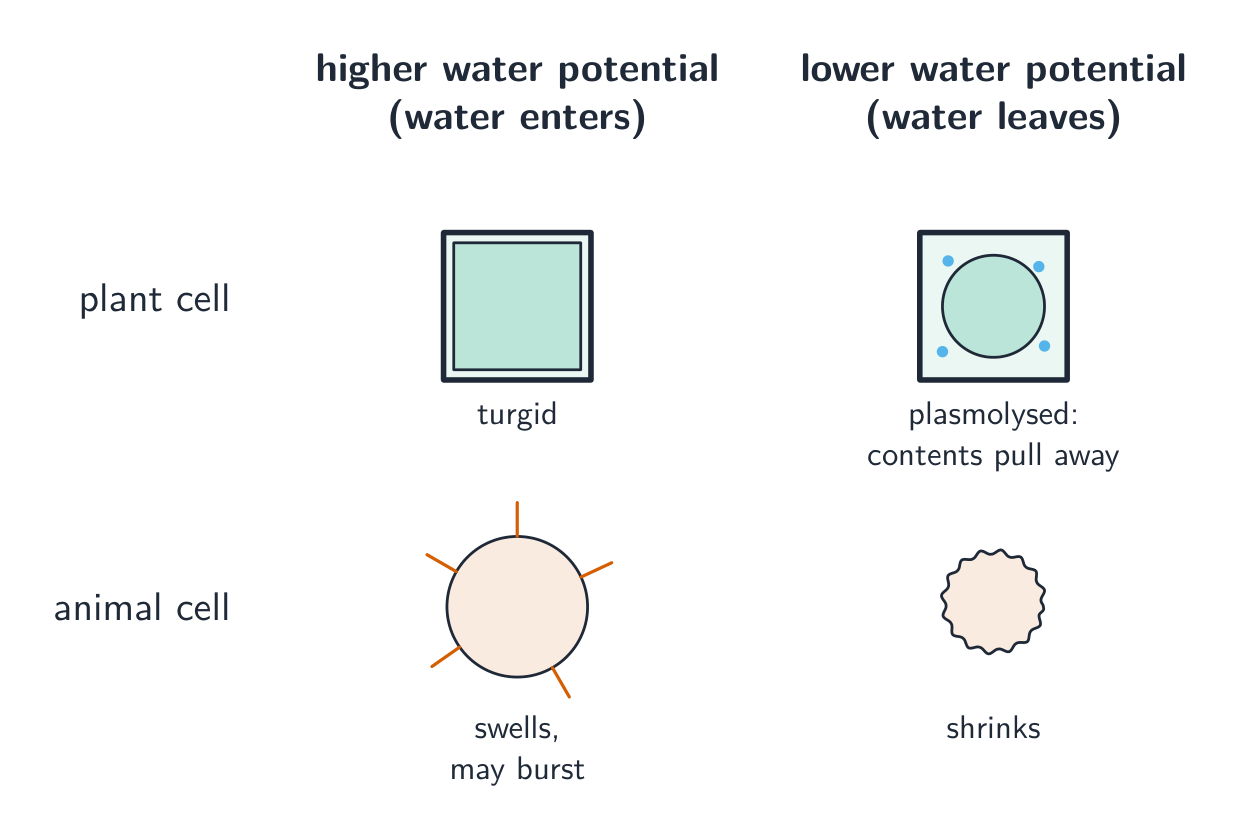
How plant and animal cells respond to solutions of different water potential
Water potential
water follows the gradient
Drag the concentrations. A water-potential gradient drives net movement — it stops only when the two sides match.
Adding a solute to pure water:
Difficulty 1/5 · 100 coins + a small bonus on first completion today
Pure water has the highest water potential; dissolving a solute lowers it.
Pure water has the lowest possible water potential.
Difficulty 1/5 · 100 coins + a small bonus on first completion today
False. Pure water has the highest water potential, defined as 0 kPa. Adding solute lowers it, making it negative.
When estimating the water potential of plant tissue, the matching solution causes ______ change in mass or length.
Difficulty 1/5 · 100 coins + a small bonus on first completion today
No net osmosis (no mass/length change) means the solution and tissue have the same water potential.
Plant cells
- In a higher water potential (e.g. distilled water): water enters, the cell swells and becomes turgid 膨胀 — the strong cell wall stops it bursting.
- In a lower water potential: water leaves, the contents shrink and the membrane pulls away from the wall — plasmolysis 质壁分离.
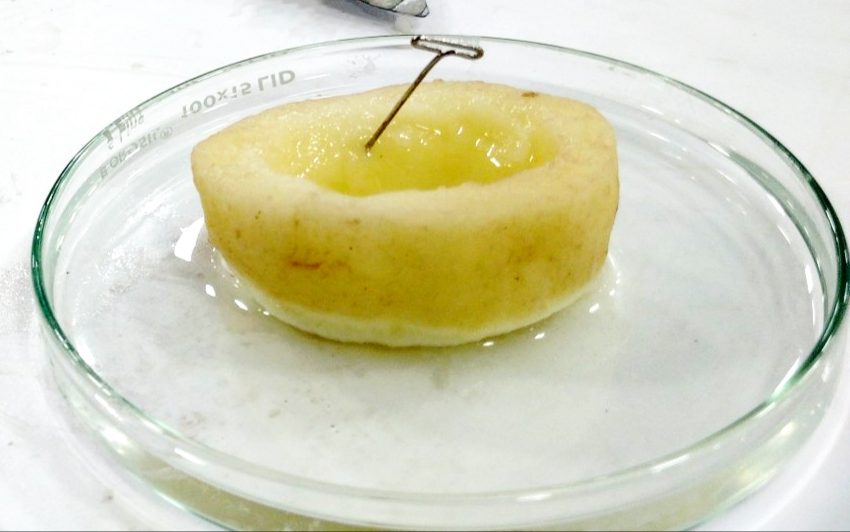
A potato osmometer: sugar solution rises up the tube as water enters by osmosis.
A plant cell placed in distilled water becomes turgid rather than bursting because:
Difficulty 1/5 · 100 coins + a small bonus on first completion today
Water enters (higher water potential outside), but the rigid cell wall stops the cell bursting — it becomes turgid.
Plasmolysis happens when a plant cell is in a solution of LOWER water potential, because:
Difficulty 1/5 · 100 coins + a small bonus on first completion today
Water leaves down the water-potential gradient; the contents shrink and the membrane peels away from the wall.
Animal cells
- Animal cells have no cell wall to protect them.
- In a higher water potential: water enters and the cell may burst — in a red blood cell this is haemolysis 溶血.
- In a lower water potential: water leaves and the cell shrinks.
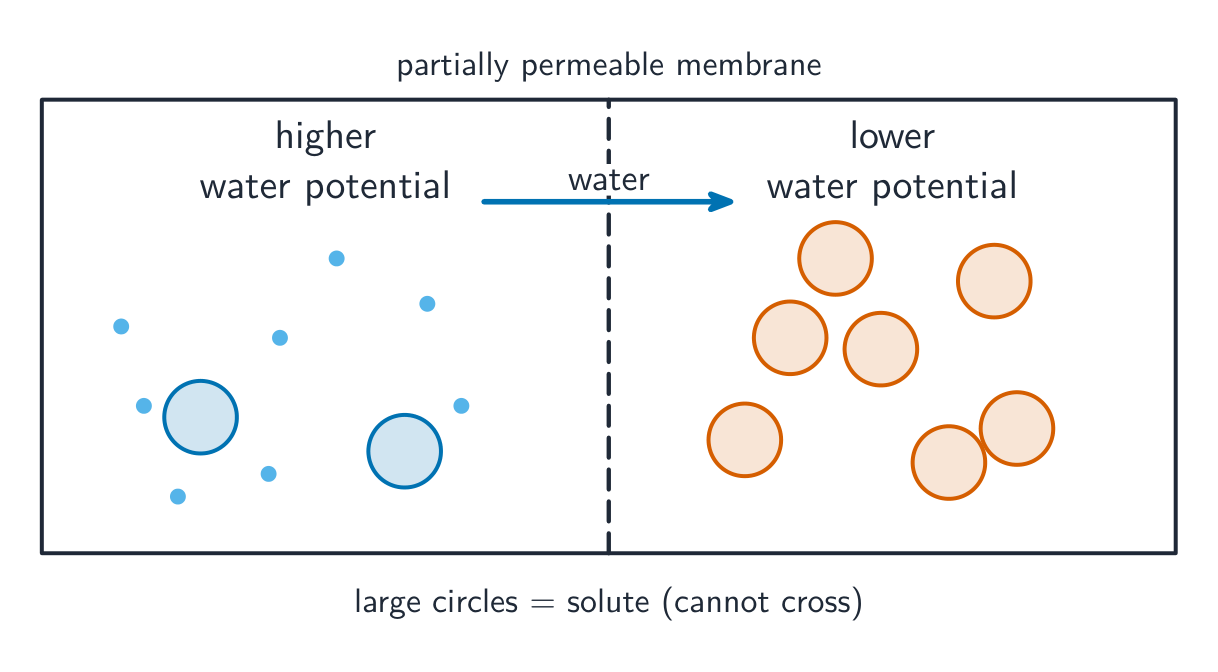
Osmosis: water crosses a partially permeable membrane to the lower water potential
Match each cell and solution to what happens.
Difficulty 2/5 · 140 coins + a small bonus on first completion today
The wall protects plant cells; without one, a red blood cell bursts in pure water and shrinks in a concentrated solution.
A red blood cell placed in pure water may undergo haemolysis. This is because it:
Difficulty 1/5 · 100 coins + a small bonus on first completion today
With no protective wall, water entering by osmosis swells the cell until the membrane bursts (haemolysis).
Worked examples
1. A plant cell has a water potential of $-400$ kPa and is placed in a solution of $-600$ kPa. Water moves from higher (less negative) to lower water potential, so it leaves the cell; if enough leaves, the membrane pulls away from the wall (plasmolysis).
2. Two neighbouring cells have water potentials of $-300$ kPa and $-500$ kPa. Water moves by osmosis from the $-300$ kPa cell into the $-500$ kPa cell, until the two are equal.
Which way does water move?
Water moves down the water-potential gradient.
What happens to the cell in this solution?
Difficulty 1/5 · 100 coins + a small bonus on first completion today
The outside water potential is lower.
You've got it
- pure water = highest water potential; solute lowers it; water moves higher → lower
- estimate tissue water potential by the no-change solution (mass/length)
- plant cell: turgid (high WP, wall protects) ↔ plasmolysis (low WP)
- animal cell (no wall): bursts/haemolysis (high WP) ↔ shrinks (low WP)
Write from water leaving a cell
- A plant cell is placed in a solution.
- The solution has a more negative water potential than the cell contents.