Vmax, Km and inhibitors
Introduced| English | Meaning |
|---|---|
| maximum rate/ˈmæksɪməm reɪt/ | maximum rate |
| Michaelis–Menten constant/ˈmaɪkəliz ˈmentn ˈkɒnstənt/ | The substrate concentration giving half the limiting reaction rate when Michaelis–Menten kinetics applies. |
| affinity/əˈfɪnɪti/ | The tendency or strength with which one molecule binds to another, such as oxygen binding to haemoglobin. |
| competitive/kəmˈpetɪtɪv/ | competitive |
| non-competitive/nɒn kəmˈpetɪtɪv/ | non-competitive |
| immobilised enzyme/ɪˈməʊbəlaɪzd ˈenzaɪm/ | An enzyme held on or within a support material so it can be separated from products and used again. |
Vmax and Km
- When every active site is full, the reaction hits a top speed — the maximum rate 最大速率, $V_{max}$.
- The curve of rate against substrate concentration climbs and then flattens at $V_{max}$.
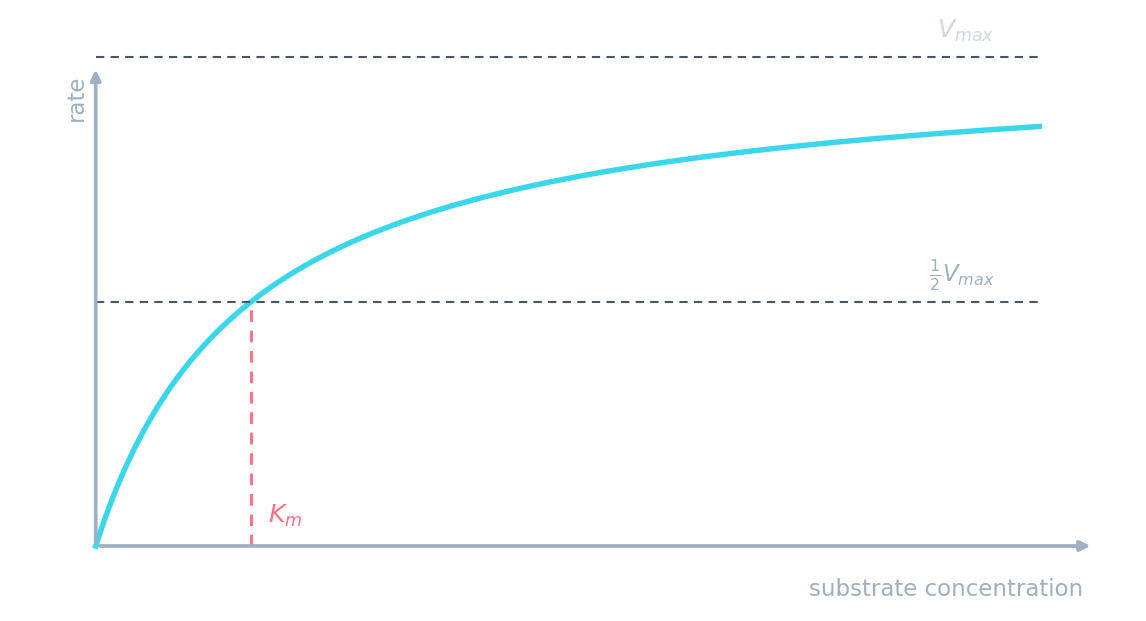
What does V_max represent?
Difficulty 1/5 · 100 coins + a small bonus on first completion today
V_max is the top rate; the curve flattens there because every active site is busy.
What Km tells you
- The Michaelis–Menten constant 米氏常数, $K_m$, is the substrate concentration that gives half of $V_{max}$.
- It measures the enzyme's affinity 亲和力 (pulling power) for its substrate:
- low $K_m$ → reaches half-speed at low substrate → high affinity.
- high $K_m$ → needs lots of substrate → low affinity.
- So $K_m$ lets you compare how strongly different enzymes hold their substrates.
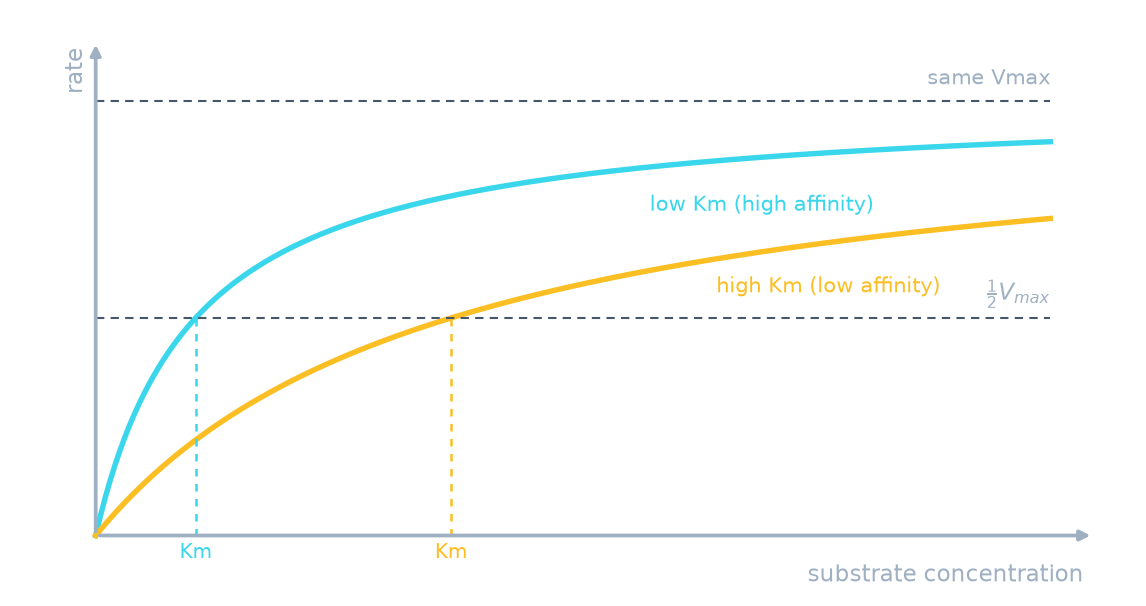
Both reach the same $V_{max}$, but the low-$K_m$ enzyme gets to half-speed on far less substrate — it grips its substrate more tightly.
Vmax and Km
rate = Vmax·[S] / (Km + [S])
Drag the substrate. The rate approaches Vmax; the substrate that gives half of Vmax is Km — a measure of how tightly the enzyme binds.
An enzyme has V_max = 80 units. At a substrate concentration equal to its Km, what is the rate?
Difficulty 2/5 · 140 coins + a small bonus on first completion today
By definition Km is the substrate concentration that gives half of V_max, so the rate is 80 ÷ 2 = 40 units.
A LOW Km means the enzyme only reaches half its maximum rate at a HIGH substrate concentration.
Difficulty 1/5 · 100 coins + a small bonus on first completion today
The opposite: low Km means half-speed is reached at LOW substrate — a high affinity, gripping the substrate tightly.
Reversible inhibitors
- An inhibitor slows an enzyme; a reversible one can leave again. Two types:
| Type | Binds | Add more substrate? | $V_{max}$ | $K_m$ |
|---|---|---|---|---|
| competitive 竞争性 | the active site (similar shape to substrate) | out-competes it — effect drops | unchanged | rises |
| non-competitive 非竞争性 | a different site (changes the active site) | does not help | falls | unchanged |
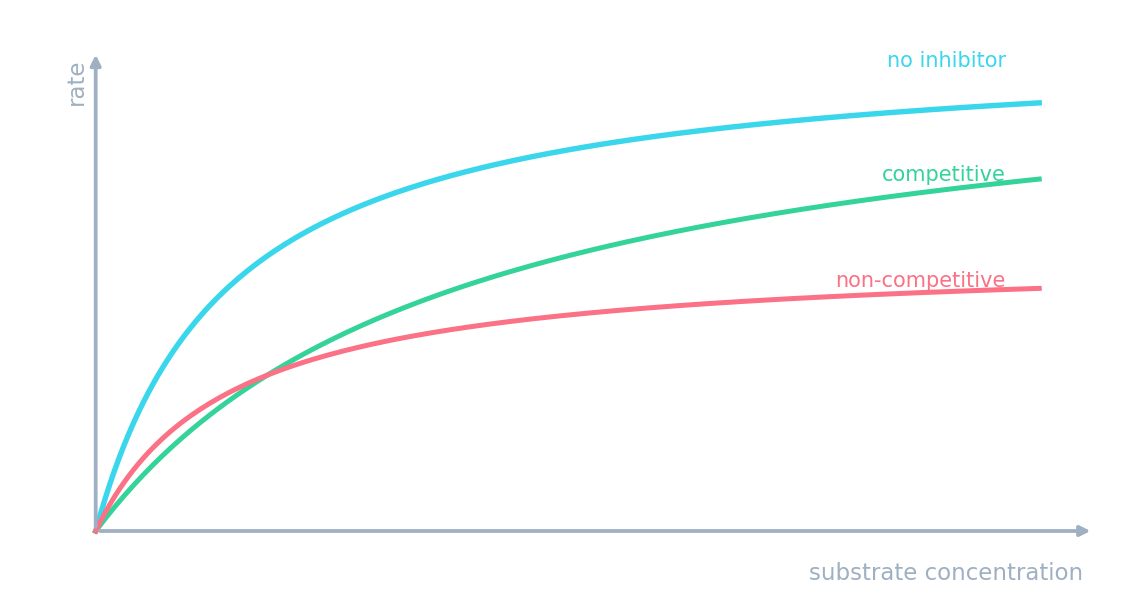
Match each inhibitor effect to the right outcome.
Difficulty 2/5 · 140 coins + a small bonus on first completion today
A competitive inhibitor blocks the active site (raises Km, same Vmax); a non-competitive one binds elsewhere and lowers Vmax (Km unchanged).
Adding more substrate overcomes a competitive inhibitor but not a non-competitive one. Why?
Difficulty 1/5 · 100 coins + a small bonus on first completion today
A competitive inhibitor blocks the active site, so flooding with substrate wins the competition. A non-competitive inhibitor binds elsewhere, so substrate cannot displace it.
Immobilised enzymes 固定化酶
- An immobilised enzyme is fixed in place — e.g. trapped in alginate beads — while substrate flows past.
- A free enzyme works a little faster, but immobilising it brings big practical wins:
- it is not washed away, so it can be reused.
- the product is pure (not mixed with enzyme).
- it is more stable to changes in temperature and pH.
- the process can run continuously.
- Used industrially — e.g. lactase beads make lactose-free milk.
Select all the advantages of immobilising an enzyme (e.g. in alginate beads).
Difficulty 2/5 · 140 coins + a small bonus on first completion today
Immobilised enzymes are reusable, give a pure product and are more stable — but a free enzyme actually works a little faster.
An enzyme fixed in place (e.g. trapped in alginate beads) so it can be reused is described as ______.
Difficulty 1/5 · 100 coins + a small bonus on first completion today
Immobilising the enzyme lets it be recovered and reused, and keeps the product enzyme-free.
You've got it
- $V_{max}$ = top rate (all active sites full); $K_m$ = substrate concentration giving half $V_{max}$
- low $K_m$ = high affinity; high $K_m$ = low affinity
- competitive inhibitor: active site, raises $K_m$, $V_{max}$ unchanged (more substrate overcomes it)
- non-competitive inhibitor: other site, lowers $V_{max}$, $K_m$ unchanged
- immobilised enzymes: reusable, pure product, more stable, continuous
Write from a rate of 30 at Km
- An enzyme has Vmax of 60 units.
- The substrate concentration equals Km. The lesson enzyme has Vmax 80 and rate 40 at Km.
What is the rate?
Km is the substrate concentration at half Vmax.
What is the rate at Km if Vmax is 60?
Difficulty 1/5 · 100 coins + a small bonus on first completion today
Half of 60 is 30. Other options — 40 (the lesson enzyme); 60 (the full Vmax).