Prokaryotic cells and viruses
Introduced| English | Meaning |
|---|---|
| prokaryotic/ˌprɒkərɪˈɒtɪk/ | Describing cells that lack a membrane-bound nucleus and other membrane-bound organelles. |
| unicellular/ˌjuːnɪˈseljʊlə/ | unicellular |
| peptidoglycan/ˈpeptɪdɒɡlɪkən/ | A material made of sugar chains cross-linked by short peptides that gives most bacterial cell walls their strength. |
| nucleic acid/njuːˈklɪɪk ˈæsɪd/ | A polymer of nucleotides that stores or transmits genetic information, such as DNA or RNA. |
| capsid/ˈkæpsɪd/ | The protein coat surrounding a virus's genetic material. |
| envelope/ˈenvələʊp/ | A membrane-based covering; in an enveloped virus, a lipid layer surrounds the capsid. |
| host/həʊst/ | An organism in or on which another organism or infectious agent lives or reproduces. |
Prokaryotes and viruses
- Not all cells are eukaryotic. Bacteria are prokaryotic 原核 — smaller and simpler.
- Viruses are not even cells.
- Knowing the differences is a favourite exam comparison.
Prokaryotic cells (bacteria)
- A prokaryotic cell is unicellular 单细胞 and small (about $1$–$5\ \mu\text{m}$).
- It has no nucleus — its circular DNA lies free in the cytoplasm.
- It has smaller (70S) ribosomes and a cell wall of peptidoglycan 肽聚糖 (not cellulose). It may also contain plasmids, small extra circles of DNA.
- No double-membrane organelles — so no nucleus, no mitochondria, no chloroplasts.
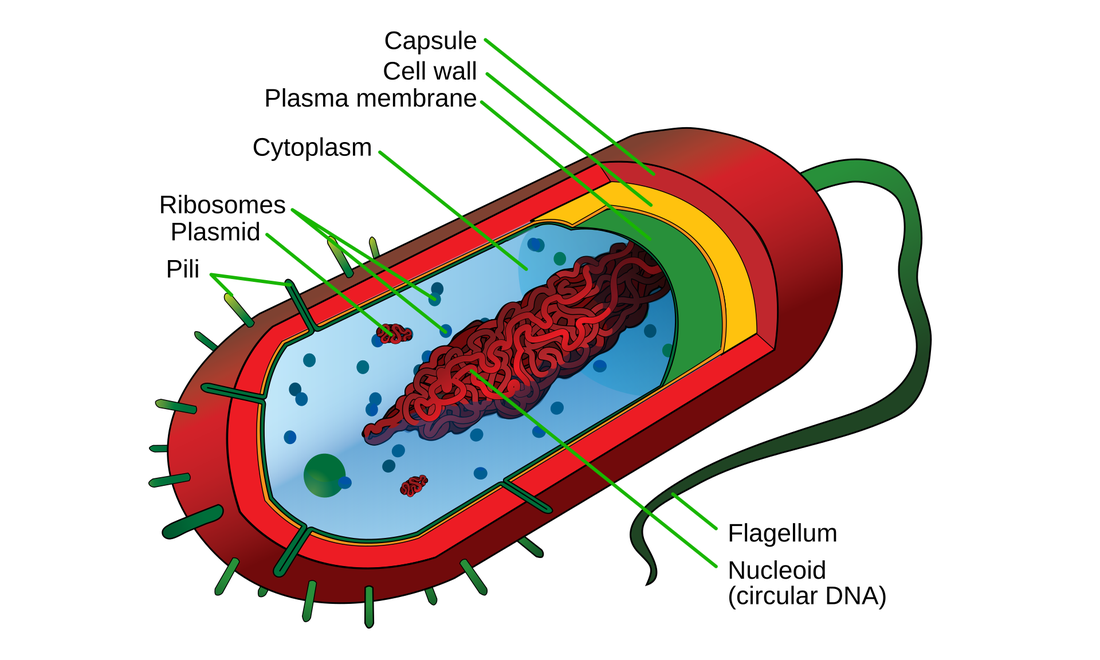
A prokaryotic cell: circular DNA lies free, with no nucleus or membrane-bound organelles
Explore a bacterium
Tap each part of this prokaryotic cell — note there is no nucleus and no membrane-bound organelles.
A key feature of a prokaryotic cell is that it:
Difficulty 1/5 · 100 coins + a small bonus on first completion today
Prokaryotes have no nucleus and no double-membrane organelles; their DNA is circular and free.
Prokaryotes have larger 80S ribosomes, while the cytoplasm of eukaryotes has smaller 70S ribosomes.
Difficulty 1/5 · 100 coins + a small bonus on first completion today
False. Prokaryotes have the smaller 70S ribosomes; the eukaryotic cytoplasm has 80S. Mitochondria and chloroplasts also contain 70S ribosomes.
The small extra ring of DNA in a bacterium, separate from its main loop, is a ______.
Difficulty 1/5 · 100 coins + a small bonus on first completion today
Plasmids carry extra genes (e.g. antibiotic resistance) and can be passed between bacteria.
Prokaryote vs eukaryote
| Feature | Prokaryote | Eukaryote |
|---|---|---|
| size | ~1–5 µm | ~10–100 µm |
| main DNA | circular, not enclosed in a nucleus | linear chromosomes inside a nucleus |
| nucleus | none | present |
| double-membrane organelles | none | mitochondria (+ chloroplasts) |
| ribosomes | 70S | 80S in cytoplasm; 70S inside mitochondria and chloroplasts |
Match each feature to the cell type it belongs to.
Difficulty 2/5 · 140 coins + a small bonus on first completion today
The defining difference is the nucleus — absent in prokaryotes, present in eukaryotes, which also have membrane-bound organelles and 80S ribosomes.
Viruses
- All viruses are non-cellular — not made of cells.
- Each has a core of nucleic acid 核酸 (a genome of either DNA or RNA) inside a protein coat (capsid 衣壳); some have a lipid envelope 包膜.
- A virus has no cytoplasm, organelles or ribosomes — it cannot respire or make proteins, and can only copy itself inside a living host 宿主 cell.
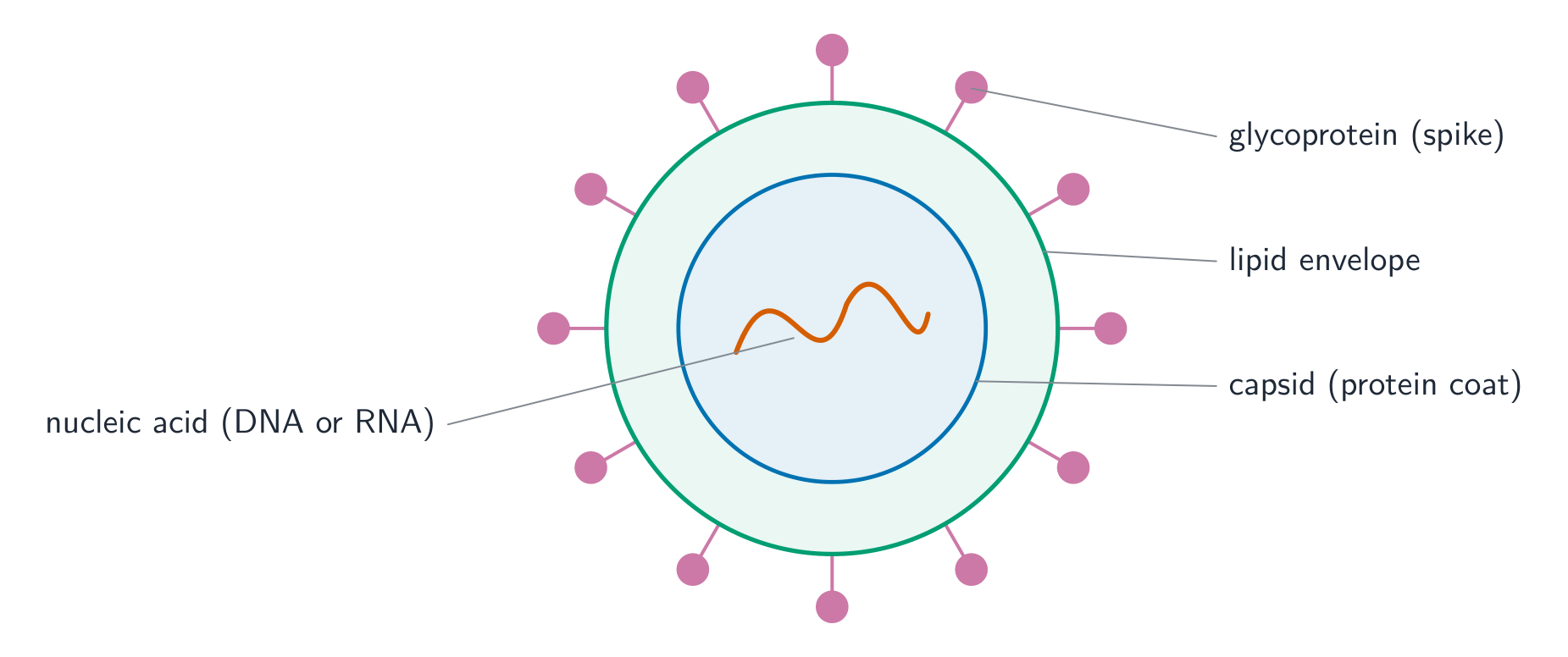
A generalised virus: a nucleic acid core inside a protein capsid, with a lipid envelope in some viruses
A virus consists of:
Difficulty 1/5 · 100 coins + a small bonus on first completion today
Viruses are non-cellular: nucleic acid + capsid (± lipid envelope), with no organelles.
The protein coat that surrounds a virus's nucleic acid is called the ______.
Difficulty 1/5 · 100 coins + a small bonus on first completion today
The capsid is the protein coat; some viruses also have an outer lipid envelope.
Why can a virus only reproduce inside a host cell?
Difficulty 1/5 · 100 coins + a small bonus on first completion today
With no ribosomes/organelles, a virus must hijack a host cell's machinery to copy itself.
Compare the same feature on both sides
- For DNA, compare organisation and location separately: a typical bacterium has circular DNA not enclosed in a nucleus; a typical animal cell has linear chromosomes within a nuclear envelope.
- Do not write that all eukaryotic DNA is nuclear. Mitochondria and chloroplasts contain small circular DNA, and their 70S ribosomes mean that finding a 70S ribosome alone does not identify a whole cell as bacterial.
- A 3 µm specimen has a cell membrane, cytoplasm, a peptidoglycan wall, circular DNA and 70S ribosomes, but no nucleus. The combination supports a bacterial cell.
- A tiny particle has a protein capsid and an RNA genome but no cytoplasm or ribosomes. This supports a virus: a protein shell is not a bacterial cell wall, and a virus is not a small prokaryotic cell.
Sample A has a peptidoglycan wall, cytoplasm, ribosomes and circular DNA. Sample B has an RNA genome inside a protein coat, with no cytoplasm or ribosomes. Classify the samples and explain why A can make proteins whereas B must use a host cell.
A is a typical bacterial cell; its ribosomes carry out protein synthesis. B is a virus; its protein coat is a capsid and it has no ribosomes, so it uses host-cell machinery to make proteins. The absence of a nucleus in A does not prevent its ribosomes from functioning.
You've got it
- prokaryotes = small, no nucleus, circular free DNA, 70S ribosomes, peptidoglycan wall, no double-membrane organelles
- typical eukaryotic cells = larger, nuclear linear DNA, 80S cytoplasmic ribosomes; mitochondria and chloroplasts also contain circular DNA and 70S ribosomes
- viruses are non-cellular: nucleic acid (DNA or RNA) + capsid (± envelope)
- a virus needs a host cell to replicate
An animal epithelial cell and a typical bacterial cell are compared. Give one difference in the organisation of their main DNA and one difference in its location. Explain why “the animal cell has DNA and the bacterium does not” is wrong.
The epithelial cell has linear chromosomes inside a nucleus bounded by a nuclear envelope. The bacterium has circular DNA not enclosed in a nucleus. Both contain DNA; lack of a nucleus does not mean lack of genetic material. Mitochondria in the epithelial cell also contain small circular DNA.
A small structure contains circular DNA and 70S ribosomes. Which conclusion is justified from those two observations alone?
Difficulty 1/5 · 100 coins + a small bonus on first completion today
Both bacteria and mitochondria contain circular DNA and 70S ribosomes. Look for cell boundaries and organelle context; viruses have no ribosomes.
An experimental substance inhibits bacterial 70S ribosomes but does not inhibit 80S ribosomes. A student says it cannot affect any structure in an animal cell. Explain why the claim is too strong.
Animal-cell cytoplasmic ribosomes are 80S, but mitochondria contain 70S ribosomes. Those ribosomes could be a target if the substance reaches them and acts on them. The ribosome types identify a potential concern; they do not prove the effect of a real drug.