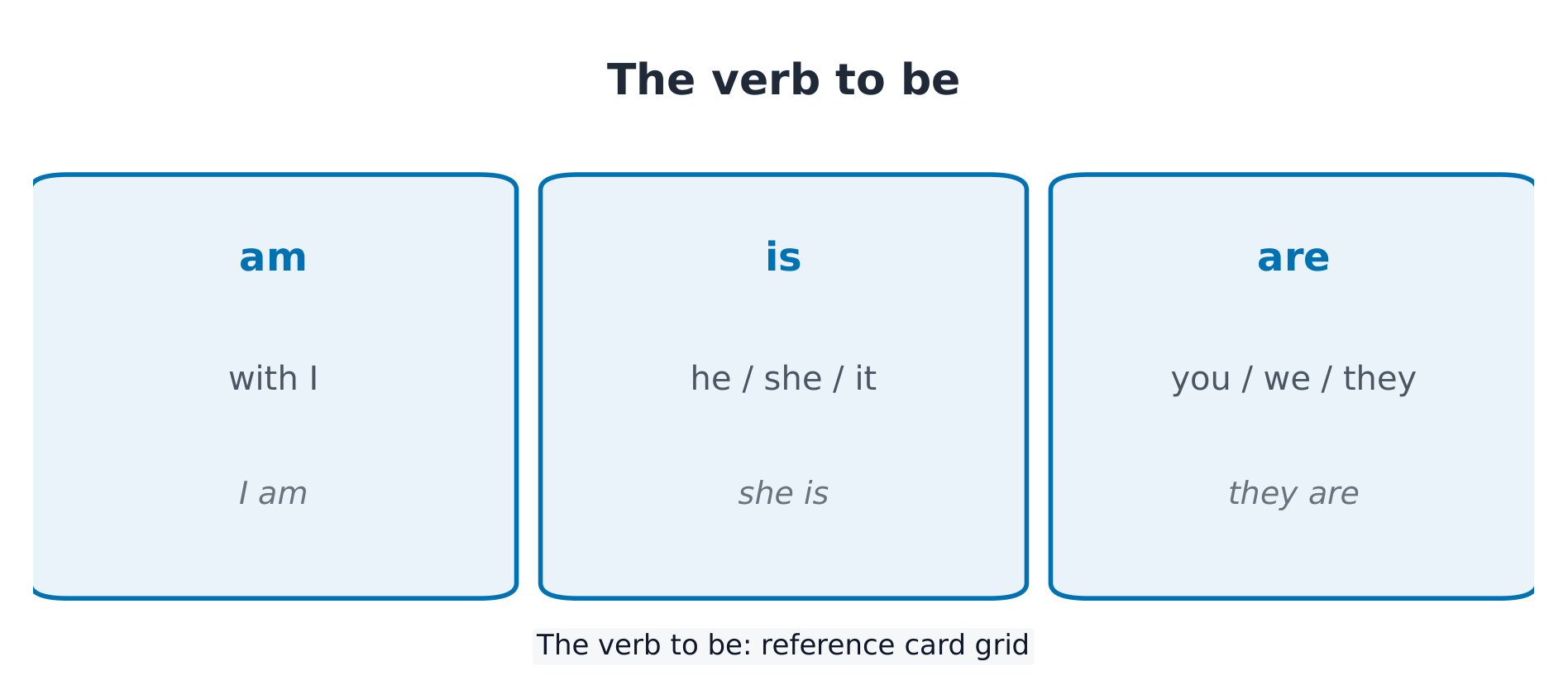
be 동사(the verb to be)는 '이다/있다'를 나타냅니다. 주어에 따라 세 가지 형태로 변합니다:
I → am
he / she / it → is
you / we / they → are
我I是am一名a学生student.
나는 학생입니다.
她She是is开心happy.
그녀는 매우 기쁩니다.
他们They(是)are来自from中国China.
그들은 중국에서 왔습니다.
주의 구어에서는 약형을 자주 사용합니다: I'm, you're, he's, she's, it's, we're, they're.
1.2
부정 및 의문형
부정: be 동사 뒤에 not(주로 약형)을 붙입니다.
他He不是is not一名a老师teacher.
그는 선생님이 아닙니다. (= He isn't a teacher.)
의문: be 동사를 주어 앞에 배치합니다.
(是吗)Are你you准备好ready?
준비되었습니까?
간단한 답변:Yes, I am. / No, I'm not.
주의 부정 약형: is not → isn't, are not → aren't; 그러나 am not은 I'm not으로만 약형되며 ~~amn't~~는 사용하지 않습니다.
자주 하는 실수
❌ ~~He busy.~~ → ✓ He is busy. — 중국어에서 "他很忙"은 동사가 없어도 되지만, 영어 문장에는 반드시 동사가 필요합니다. 서술어가 형용사나 명사이고 다른 동사가 없는 경우에만 be 동사를 사용하여 연결합니다(He is busy); 문장에 이미 일반 동사가 있는 경우에는 be 동사를 추가하지 않습니다(I go to school)。
❌ ~~I am go to school.~~ → ✓ I go to school. — be 동사와 일반 동사는 함께 사용할 수 없습니다; "가다"는 go만 사용합니다。
❌ ~~They is my friends.~~ → ✓ They are my friends. — 복수 주语(you / we / they)에는 are를 사용합니다。
❌ ~~I am agree.~~ → ✓ I agree. — agree(동의하다) 자체는 동사이므로, 앞에 am을 붙이지 않습니다。
❌ ~~Are you ready? — Yes, I'm.~~ → ✓ Yes, I am. —肯定简短回答的末尾不能用缩写(说 Yes, I am);但否定简短回答通常以否定缩写结尾(No, he isn't / No, I can't;第一人称是 No, I'm not,因为没有 amn't)。
Present simple (present simple) describes habits and facts. The base form is the infinitive (base verb).
我I喜欢like茶tea.
I like tea.
When the subject is he / she / it, add -s to the verb:
他He踢plays足球football.
He plays football.
Spelling rules:
Generally add -s: like → likes.
Words ending in -s / -sh / -ch / -x / -o add -es: go → goes, watch → watches.
Consonant + y ending: change y to i and add -es: study → studies.
Note: Only he / she / it take -s; I / you / we / they use the base form: They like tea.
8.2
Negation and Interrogative
For negatives and questions, use auxiliary verbs do / does (does for he / she / it).
Negative: Subject + don't / doesn't + base verb.
我I不don't喜欢like咖啡coffee.
I don't like coffee.
Question:Do / Does + Subject + base verb ?
(助动词)Does她she住live这里here?
Does she live here?
Note: When using do / does, the verb returns to its base form (no -s): ~~Does she lives~~ ✗ → Does she live ✓.
Common Errors
❌ ~~He go to school by bus.~~ → ✓ He goes to school by bus. — Forgetting to add -s in third person singular is the most frequent error; check your work afterwards.
❌ ~~She doesn't likes coffee.~~ → ✓ She doesn't like coffee. — When using does / doesn't, the verb returns to its base form.
❌ ~~I very like English.~~ → ✓ I like English very much. — "Very much" in Chinese cannot be translated literally; very cannot directly modify a verb.
❌ ~~You like tea?~~ → ✓ Do you like tea? — Questions must start with do / does; rising intonation alone is insufficient.