Skip to content · ⁨본문 바로가기⁩

Selection and evolution · ⁨선택 및 진화⁩

A-Level Biology · ⁨A-Level 생물학⁩ · Topic 17 · ⁨주제 17⁩

Video lesson for this topic · ⁨이 주제용 영상 수업⁩ Open the video page · ⁨영상 페이지 열기⁩
8:23

Variation and Evolution

In the early eighteen hundreds, almost every peppered moth in England was pale and speckled, which hid it beautifully on lichen-covered bark. Then the…

English narration · English + 中文 subtitles burned in · ⁨영어 내레이션 · 영어 + 중국어 자막 burned-in⁩

17.1

Variation · ⁨변이(Variation)⁩

Syllabus
English
  1. explain, with examples, that phenotypic variation is due to genetic factors or environmental factors or a combination of genetic and environmental factors
  2. explain what is meant by discontinuous variation and continuous variation
  3. explain the genetic basis of discontinuous variation and continuous variation
  4. use the t-test to compare the means of two different samples (the formula for the t-test will be provided, as shown in the Mathematical requirements)
한국어
  1. 형질 변이가 유전적 요인이나 환경적 요인 또는 그 조합에 의해 발생함을 예시를 들어 설명한다
  2. 불연속 변이와 연속 변이의 의미를 설명한다
  3. 불연속 변이와 연속 변이의 유전학적 기전을 설명한다
  4. 두 서로 다른 표본의 평균을 비교하기 위해 t-검정을 사용한다 (t-검정의 공식은 수학 요구 사항에 제시된 바와 같이 제공됨)

Source: Cambridge International syllabus · ⁨출처: Cambridge International syllabus⁩

English

Variation 变异 means the differences between individuals. It has three possible causes:

  • genetic factors only — set by the alleles 等位基因 you inherit (for example human blood group).
  • environmental factors 环境因素 only — set by your surroundings (for example a scar, or the language you speak).
  • a combination of both — most features, such as height and body mass, depend on genes and on diet and lifestyle.

There are two patterns of variation:

  • discontinuous variation 不连续变异 — clear, separate groups with nothing in between (for example blood group A, B, AB or O). It is usually controlled by one or a few genes 基因, with little effect from the environment.
  • continuous variation 连续变异 — a smooth range from one extreme to the other (for example height). It is controlled by many genes together, plus the environment.

To compare the means of two samples (for example the heights of plants in sun and in shade), you use the t-test, which tells you whether the difference is large enough to be real, or just due to chance.

한국어

**변이(Variation)**란 개체 간의 차이를 의미하며, 세 가지 원인이 있을 수 있습니다:

  • 유전적(genetic) 요인만 — inheritance하는 **알레인(alleles)**에 의해 결정됨 (예: 인간 혈액형).
  • 환경적(environmental) 요인만 — 주변 환경에 의해 결정됨 (예: 흉터, 또는 사용하는 언어).
  • 두 요인의 조합(combination) — 대부분의 특징, 예를 들어 신장과 체중은 유전자 및 식단 및 생활 방식에 의존합니다.
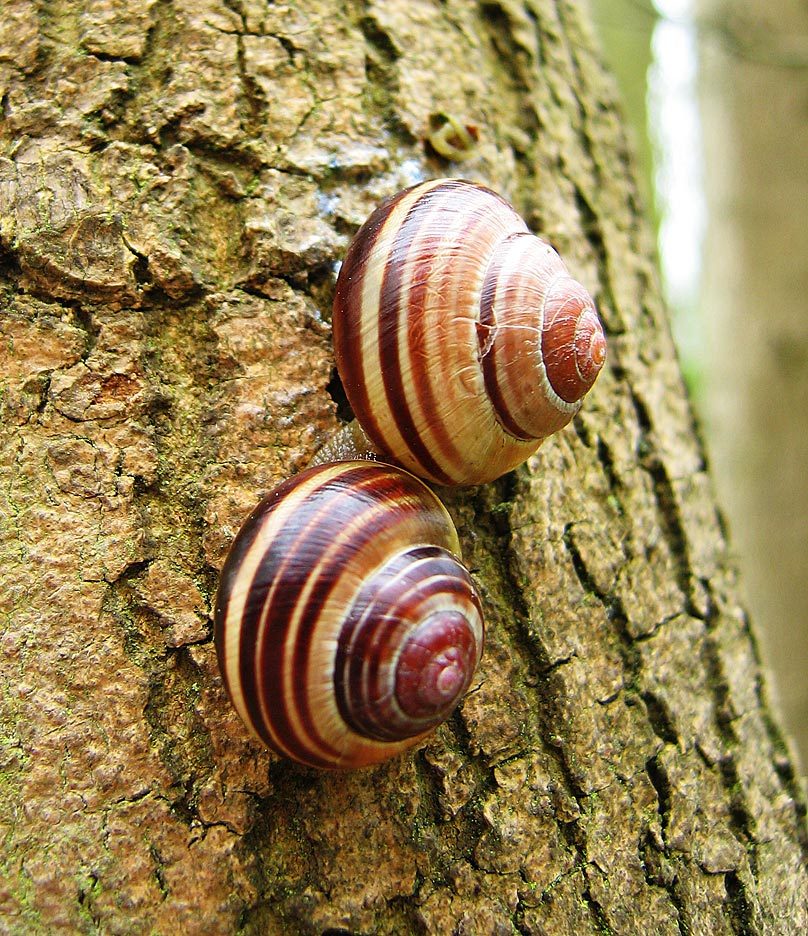
색상과 무늬가 다른 두 개의 줄무늬 달팽이
줄무늬 달팽이(Cepaea nemoralis)는 껍질의 색상과 무늬에서 뚜렷한 변이를 보입니다

변이의 두 가지 양상이 있습니다:

  • 불연속적 변이(discontinuous variation) — 중간 단계 없이 명확하게 구분된 그룹 (예: 혈액형 A, B, AB, O). 보통 한 개 또는 몇 개의 유전자에 의해 조절되며 환경의 영향은 적습니다.
  • 연속적 변이(continuous variation) — 한 극단에서 다른 극단으로 매끄러운 범위 (예: 신장). 여러 유전자의 collective 작용 plus 환경에 의해 조절됩니다.
두 개의 그래프: 별도의 막대로 표시된 혈액형 막대그래프(불연속적)와 매끄러운 종 모양 곡선으로 표시된 신장(연속적)
불연속적 변이는 개별 그룹으로 나뉘며, 연속적 변이는 매끄러운 범위입니다

두 샘플의 평균을 비교할 때(예: 햇볕과 그늘에 있는 식물의 신장), **t-검정(t-test)**을 사용합니다. 이는 차이가 실재하는 것일 만큼 큰지, 아니면 단순히 우연에 의한 것인지 알려줍니다.

Explore · ⁨탐색하기⁩

The t-distribution behind the t-test · ⁨t-검정 뒤에 있는 t-분포⁩

The t-test compares two sample means against a critical value you look up in a t-table. This is that table made live: the value depends on the degrees of freedom (here $n_1+n_2-2$). Drag df and watch the critical value change — small samples have heavier tails, so they need a larger difference to count as real. · ⁨t-검정은 두 표본 평균을 임계값과 비교합니다. 이 임계값은 t-표에서 찾아야 합니다. 이것이 실시간으로 작동하는 표입니다: 값은 자유도(여기서 $n_1+n_2-2$)에 따라 달라집니다. df를 드래그하면 임계값이 변하는 것을 볼 수 있습니다—작은 표본은 꼬리가 두껍기 때문에, 실제 차이를 인정받으려면 더 큰 차이가 필요합니다.⁩

Explore · ⁨탐색하기⁩

Variation type lab · ⁨변이 유형 실험⁩

Classify examples by the source and pattern of variation. · ⁨변이의 원인과 양상을 기준으로 예시를 분류하십시오.⁩

Vocabulary · ⁨어휘⁩ Train · ⁨연습하기⁩
English 한국어
variation/ˌveərɪˈeɪʃn/ 변화
allele/əˈliːl/ 대립유전자
environmental factor/enˌvaɪrənˈmentl ˈfæktə/ 환경 요인(environmental factor)
discontinuous variation/dɪskənˈtɪnjuːəs ˌveərɪˈeɪʃn/ 불연속적 변이
gene/dʒiːn/ 유전자
continuous variation/kənˈtɪnjuːəs ˌveərɪˈeɪʃn/ 연속적 변이
population/ˌpɒpjʊˈleɪʃn/ 인구
offspring/ˈɒfsprɪŋ/ 자손(offspring)
compete/kəmˈpiːt/ 경쟁하다(compete)
adapted/əˈdæptɪd/ 적응된
reproduce/rɪprəˈdjuːs/ 생식하다(reproduce)
17.2

Natural selection · ⁨자연선택(Natural selection)⁩

Syllabus
English
  1. explain that natural selection occurs because populations have the capacity to produce many offspring that compete for resources; in the ‘struggle for existence’, individuals that are best adapted are most likely to survive to reproduce and pass on their alleles to the next generation
  2. explain how environmental factors can act as stabilising, disruptive and directional forces of natural selection
  3. explain how selection, the founder effect and genetic drift, including the bottleneck effect, may affect allele frequencies in populations
  4. outline how bacteria become resistant to antibiotics as an example of natural selection
  5. use the Hardy–Weinberg principle to calculate allele and genotype frequencies in populations and state the conditions when this principle can be applied (the two equations for the Hardy–Weinberg principle will be provided, as shown in the Mathematical requirements)
  6. describe the principles of selective breeding (artificial selection)
  7. outline the following examples of selective breeding: • the introduction of disease resistance to varieties of wheat and rice • inbreeding and hybridisation to produce vigorous, uniform varieties of maize • improving the milk yield of dairy cattle
한국어
  1. 자연선택이 종群이 많은 자손을 생산하여 자원을 경쟁할 수 있는 능력 때문에 발생함을 설명한다. '생존을 위한 투쟁'에서 가장 잘 적응한 개체가 생존하여 번식하고 다음 세대에 자신의 대립유전자를 전달할 가능성이 가장 높다
  2. 환경적 요인이 안정화, 파괴 및 방향성 자연선택의 요인으로 작용하는 방식을 설명한다
  3. 선택, 창시자 효과 및 유전적 부동, 병목 효과를 포함하여 이들이 종群의 대립유전자 빈도에 미치는 영향을 설명한다
  4. 자연선택의 예시로 박테리아가 항생제에 내성을 얻는 과정을概述한다
  5. 하디-바인버그 법칙을 사용하여 종群의 대립유전자 및 유전자형 빈도를 계산하고 이 법칙이 적용될 수 있는 조건을 명시한다 (하디-바인버그 법칙의 두 식은 수학 요구 사항에 제시된 바와 같이 제공됨)
  6. **선별 교배(인공선택)**의 원리를 서술한다
  7. 선별 교배의 다음 예시를概述한다: • 밀과 벼 품종에 질병 저항성 도입 • 옥수수 견고하고 균일한 품종을 생산하기 위한 근친 교배 및 교잡 • 우유 생산량이 많은 우유용 소의 개량

Source: Cambridge International syllabus · ⁨출처: Cambridge International syllabus⁩

English
Natural selection: the peppered moth

A population 种群 produces far more offspring 后代 than can survive, so the offspring must compete 竞争 for resources such as food and space. This is the "struggle for existence". The individuals that are best adapted 适应 are most likely to survive, reproduce 繁殖, and pass on their alleles to the next generation. Over many generations, the helpful alleles become more common in the population. This is natural selection 自然选择.

Environmental conditions can push selection in three ways:

  • stabilising selection 稳定选择 favours the average and removes the extremes (the population stays the same).
  • directional selection 定向选择 favours one extreme, so the mean shifts that way.
  • disruptive selection 分裂选择 favours both extremes and removes the average.

Allele frequencies can also change in other ways:

  • the founder effect 奠基者效应 — a few individuals start a new population, so they carry only some of the alleles of the original group.
  • genetic drift 遗传漂变 — in a small population, allele frequencies change by chance from generation to generation.
  • the bottleneck effect 瓶颈效应 — a sudden fall in population size leaves few survivors, reducing the variety of alleles.

Antibiotic resistance as natural selection

A chance mutation 突变 makes a few bacteria resistant to an antibiotic 抗生素. When the antibiotic is used, the non-resistant bacteria die, but the resistant ones survive and reproduce. Over time the resistance 耐药性 spreads through the population. This is natural selection in action.

한국어
자연선택: 호랑나비

한 집단이 생존할 수 있는 개체보다 훨씬 많은 자손을 으므로, 자손들은 먹이와 서식지 같은 자원을 두고 경쟁하게 됩니다. 이를 '생존의 투쟁'이라고 합니다. 환경에 가장 잘 적응한 개체들이 생존하고 생식하여 다음 세대에 알레를 물려줄 가능성이 가장 높습니다. 여러 세대가 지나면서 유익한 알레가 집단 내에서 더 흔해집니다. 이것이 자연선택입니다.

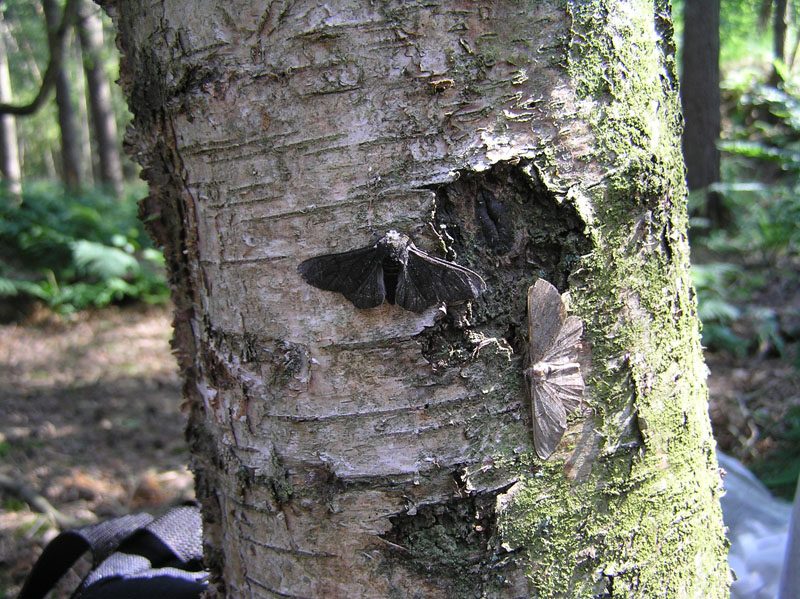
두 Peppered moth(벚나방)가 나무 줄기에 앉아 있는 모습: 왼쪽은 연한 이끼가 덮인 나무껍질 위에 검고 거의 검은색인 나방이, 오른쪽은 어두운 나무껍질 위에 연한 점박이가 있는 나방이 있습니다
Peppered moth(벚나방)는 자연선택의 예시입니다: 짙은 형태는 검고 매연이 묻은 나무껍질 위에 숨어있고, 연한 점박이 형태는 연한 이끼 위에 숨어 있는데, 새들은 두드러진 것을 먹이로 삼습니다

환경 조건은 다음 세 가지 방향으로 선택을 유도할 수 있습니다:

  • 안정화 선택(stabilising selection) 은 평균적인 형질을 선호하며 극단적인 형질을 제거하므로(집단은 동일함), 집단의 특성이 일정하게 유지됩니다.
  • 방향성 택(directional selection) 은 한쪽 극단만을 선호하므로 평균치가 그 방향으로 이동합니다.
  • 파괴적 선택(disruptive selection) 은 양쪽 극단을 모두 선호하고 평균형질을 제거합니다.
선택 전후의 형질 분포를 비교하는 세 개의 그래프: 안정화 선택은 분포를 좁히고, 방향성 선택은 한쪽으로 이동시키며, 파괴적 선택은 분포를 두 개의 봉우리로 나눕니다
안정화 선택은 범위를 좁히고, 방향성 선택은 평균치를 이동시키며, 파괴적 선택은 두 부분으로 나눕니다

알레 빈도는 다른 방법으로도 변화할 수 있습니다:

  • 창립자 효과(founder effect) — 몇몇 개체가 새로운 집단을 시작하므로, 이들은 원집단의 일부 알레만携带합니다.
  • 유전적 부동(genetic drift) — 작은 집단에서 대세대마다 우연에 의해 알레 빈도가 변합니다.
  • 병목 효과(bottleneck effect) — 집단 크기의 급격한 감소로 인해 few survivors(소수의 생존자)가 남게 되어 알레의 다양성이 감소합니다.
다양한 색상을 가진 큰 집단이 재앙을 겪어 소수만 생존하고, 다시 번식된 집단에는 두 세 가지 색상만 남게 되는 모습
병목 효과: 재앙 시 소수만 생존하므로 회복된 집단의 유전적 다양성이 줄어듭니다

항생제 내성: 자연선택의 사례

우연한 돌연변이로 인해 일부 세균이 항생제에 내성을 갖게 됩니다. 항생제를 사용하면 내성이 없는 세균은 죽지만 내성이 있는 세균은 생존하고 생식합니다. 시간이 지날수록 내성이 집단 전체로 퍼집니다. 이는 작동 중인 자연선택의 예입니다.

Explore · ⁨탐색하기⁩

Natural selection · ⁨자연 선택⁩

Step through Darwin's idea: variation + a selection pressure means the best-adapted survive and pass on their alleles. · ⁨다윈의 아이디어 단계별 설명: 변이 + 선택 압력은 가장 잘 적응한 개체가 생존하여 대립유전자를 전달함을 의미함.⁩

Vocabulary · ⁨어휘⁩ Train · ⁨연습하기⁩
English 한국어
natural selection/ˈnætʃərəl sɪˈlekʃn/ 자연선택
stabilising selection/ˈsteɪbəlaɪzɪŋ sɪˈlekʃn/ 안정화 선택
directional selection/daɪˈrekʃənl sɪˈlekʃn/ 방향성 선택
disruptive selection/dɪsˈrʌptɪv sɪˈlekʃn/ 파괴적(분열) 선택
founder effect/ˈfaʊndə ɪˈfekt/ 창시자 효과
genetic drift/dʒɪˈnetɪk drɪft/ 유전적 부동
bottleneck effect/ˈbɒtəlnek ɪˈfekt/ 병목 현상( Bottleneck effect)
mutation/mjuːˈteɪʃn/ 변이
antibiotic/ˌæntɪbaɪˈɒtɪk/ 항생제
resistance/rɪˈzɪstəns/ 저항
Watch lesson · ⁨수업 보기⁩
17.2

The Hardy–Weinberg principle · ⁨하디-위너그 평형 법칙⁩

English

The Hardy–Weinberg principle 哈迪-温伯格原理 lets you calculate the allele frequencies 等位基因频率 and genotype 基因型 frequencies in a population. It only holds true when there is a large population, mating is random, and there is no mutation, no migration and no natural selection.

Call the frequency of the dominant allele $p$ and the frequency of the recessive allele $q$. There are only two alleles, so:

$$p + q = 1.$$

The genotype frequencies then add up to 1, where $p^2$ is homozygous dominant, $2pq$ is heterozygous (the carriers), and $q^2$ is homozygous recessive:

$$p^2 + 2pq + q^2 = 1.$$

Worked example. A recessive condition affects $1$ in every $100$ people. Find the frequency of carriers.

Only the homozygous recessive genotype ($q^2$) shows the condition, so $q^2 = \tfrac{1}{100} = 0.01$, giving $q = \sqrt{0.01} = 0.1$. Then $p = 1 - q = 0.9$. The carriers are the heterozygotes:

$$2pq = 2 \times 0.9 \times 0.1 = 0.18.$$

So about $18\%$ of the population are carriers — far more than the $1\%$ who show the condition.

한국어

하디-위너그 법칙(Hardy–Weinberg principle) 을 이용하면 집단 내 알레 빈도와 형질빈도(genotype frequencies) 를 계산할 수 있습니다.集団이 크고, 교배가 무작위이며, 돌연변이, 이동, 자연선택이 없을 때만 성립합니다.

우성 알레 빈도를 $p$, 열성 알레 빈도를 $q$라고 합시다. 알레는 단 두 가지뿐이므로:

$$p + q = 1.$$

형질빈도의 합은 1이 되는데, 여기서 $p^2$는 동형접합 우성(homozygous dominant), $2pq$는 이형접합(heterozygous, 보인자), $q^2$는 동형접합 열성(homozygous recessive)입니다:

$$p^2 + 2pq + q^2 = 1.$$

풀이 예시. 우성 유전자 조건이 $1$명 중 $100$명에 발병합니다. 보유자 빈도를 구하십시오.

순열 우성 유전자형($q^2$)만이 해당 조건을 나타내므로, $q^2 = \tfrac{1}{100} = 0.01$, 즉 $q = \sqrt{0.01} = 0.1$가 됩니다. 따라서 $p = 1 - q = 0.9$입니다. 보유자는 이형접합체입니다:

$$2pq = 2 \times 0.9 \times 0.1 = 0.18.$$

따라서 집단 중 약 $18\%$가 보인자이며, 질환을 나타내는 $1\%$보다 훨씬 많습니다.

하디-위너그: 알레 빈도 p와 q가 형질빈도 p², 2pq, q²를 결정합니다
Vocabulary · ⁨어휘⁩ Train · ⁨연습하기⁩
English 한국어
Hardy–Weinberg principle/ˈhɑːdi ˈwaɪnbɜːɡ ˈprɪnsɪpl/ 하디-와인베르크 법칙
allele frequency/əˈliːl ˈfriːkwənsi/ 알리얼 빈도
genotype/ˈdʒenətaɪp/ 유전자형
17.2

Selective breeding (artificial selection) · ⁨인공선택(선택적 배양)⁩

English

In selective breeding 选择育种, also called artificial selection 人工选择, humans (not nature) choose which organisms breed, so that useful features are passed on. Examples:

  • breeding disease resistance 抗病性 into varieties of wheat and rice.
  • using inbreeding 近交 and hybridisation 杂交 (crossing different lines) to make vigorous, uniform maize.
  • breeding dairy cattle to improve their milk yield 产量.
한국어

택적 배양(selective breeding), 즉 인공선택(artificial selection) 에서는 인간(자연이 아닌)이 어떤 생물체를 교배시킬지 선정하여 유용한 형질이 물려지도록 합니다. 예시:

  • 밀과 벼 품종에 병해충 저항성을 도입하기 위해 교배함.
  • 근교교배(inbreeding) 와 교잡(hybridisation) (서로 다른 계통의 교배)을 사용하여强健하고 균일한 옥수수를 생산합니다.
  • 산유량이 높은 우유 소를 교배하여 산유량을 향상시킴.
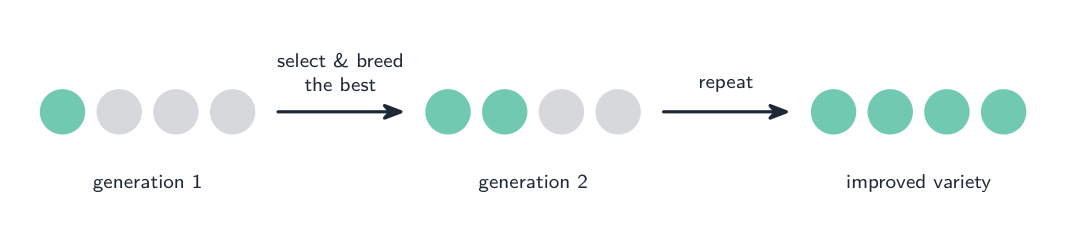
세 세대의 개체들: 매 세대마다 원하는 형질(초록색)을 가진 개체만 교배되므로 초록색 비율이 증가하여 최종적으로 전체 품종이 해당 형질을 가짐
선택적 배양: 각 세대마다 가장 좋은 개체만을 선택해 교배하면 원하는 형질이 점점 더 흔해집니다
Explore · ⁨탐색하기⁩

Selective breeding · ⁨선별 교배⁩

Step through it. Humans take the role of the environment — choosing the breeders, generation after generation. · ⁨단계별로 진행하시오. 인간이 환경의 역할을 대신하여, 세대를 거듭하여 교배자를 선택함.⁩

Vocabulary · ⁨어휘⁩ Train · ⁨연습하기⁩
English 한국어
selective breeding/sɪˈlektɪv ˈbriːdɪŋ/ 선별 교배
artificial selection/ˌɑːtɪˈfɪʃl sɪˈlekʃn/ 인공선택
disease resistance/dɪˈziːz rɪˈzɪstəns/ 병해 저항성(disease resistance)
inbreeding/ˈɪnbriːdɪŋ/ 인속 교배(근친交配)
hybridisation/ˌhaɪbrɪdaɪˈzeɪʃn/ 교잡(하이브리다이제이션)
yield/jiːld/ yield
17.3

Evolution · ⁨진화⁩

Syllabus
English
  1. outline the theory of evolution as a process leading to the formation of new species from pre-existing species over time, as a result of changes to gene pools from generation to generation
  2. discuss how DNA sequence data can show evolutionary relationships between species
  3. explain how speciation may occur as a result of genetic isolation by: • geographical separation (allopatric speciation) • ecological and behavioural separation (sympatric speciation)
한국어
  1. 진화 이론을 세대를 거쳐 gene pool의 변화로 인해 기존 종에서 새로운 종이 형성되는 과정으로概述한다
  2. DNA 서열 데이터가 종 간의 진화적 관계를 어떻게 나타낼 수 있는지 논의한다
  3. 유전적 격리로 인한 종 형성이 발생할 수 있는 방법을 설명한다: • 지리적 분리 (이주종 형성) • 생태학적 및 행동적 분리 (동주종 형성)

Source: Cambridge International syllabus · ⁨출처: Cambridge International syllabus⁩

English

Evolution 进化 is the slow formation of new species 物种 from earlier ones, as the gene pool 基因库 (all the alleles in a population) changes from generation to generation.

DNA sequence 序列 data can show how closely related two species are: the more similar their DNA sequences, the more recently they shared a common ancestor.

Speciation 物种形成 happens when two populations become genetically separated, so they can no longer breed together. This genetic isolation 隔离 can come about in two ways:

  • allopatric speciation 异域物种形成 — the populations are kept apart by a geographical separation 地理隔离, such as a sea or a mountain range.
  • sympatric speciation 同域物种形成 — the populations live in the same area but are separated by differences in behaviour or way of life.
한국어

진화(evolution) 는 이전 종에서 새로운 종(species) 이 천천히 형성되는 과정으로, gene pool(집단에 존재하는 모든 알레의 총합)이 대세대로 변하면서 일어납니다.

DNA 서열(sequence) 데이터는 두 종 간의 친밀도를 보여줍니다: DNA 서열이 더 유사할수록 최근까지 공통 조상을 공유했음을 의미합니다.

종분화(speciation) 는 두 집단이 유전적으로 분리되어 더 이상 교배하지 못하게 될 때 발생합니다. 이러한 유전적 격리(isolation) 는 두 가지 방식으로 발생할 수 있습니다:

  • 지리적 종분화(allopatric speciation) — 집단이 바다나 산맥과 같은 지리적 격리로 인해 서로 분리됩니다.
  • 동지리적 종분화(sympatric speciation) — 집단이 같은 지역에 살지만 행동이나 생활 방식의 차이로 인해 분리됩니다.
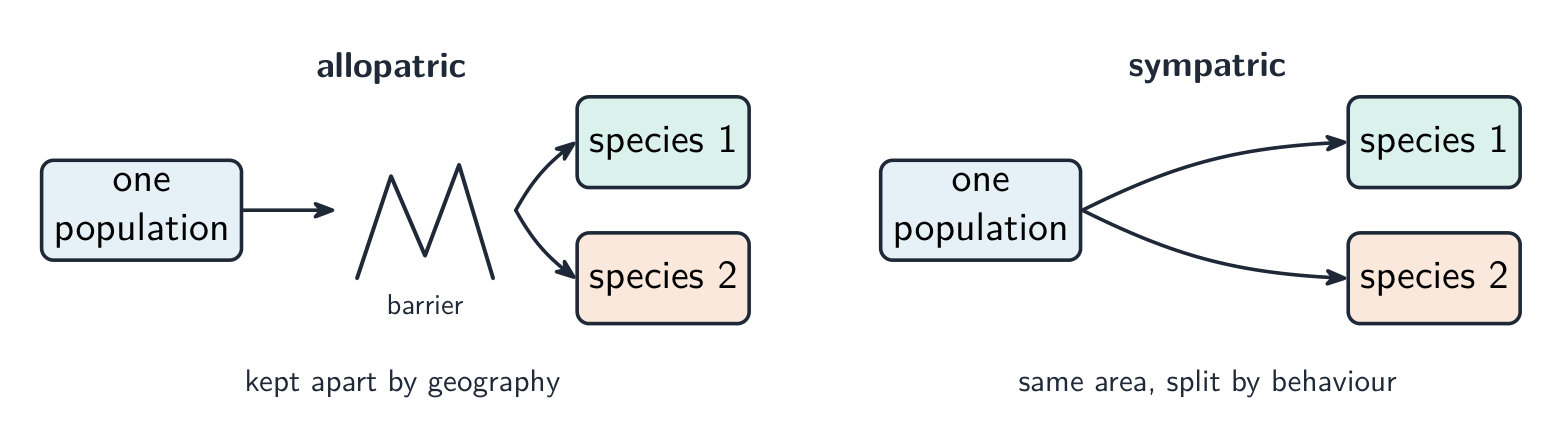
새로운 종으로 가는 두 경로: 지리적 장벽이 집단을 나누는 allopatric과, 같은 지역에서 행동에 의해 집단이 나뉘는 sympatric
Allopatric 종분화는 물리적 장벽이 필요하며, sympatric 종분화는 같은 지역에서 발생합니다
Explore · ⁨탐색하기⁩

Allopatric speciation · ⁨동역종분화(Allopatric speciation)⁩

Step through it. A barrier splits one population; the two halves diverge until they can no longer interbreed. · ⁨단계별로 확인하세요. 장벽이 하나의 집단을 나누면, 두 부분은 더 이상 교배할 수 없을 때까지 차이를 보입니다.⁩

Vocabulary · ⁨어휘⁩ Train · ⁨연습하기⁩
English 한국어
evolution/ɪvəˈluːʃn/ 진화
species/ˈspiːsiːz/ 종(species)
gene pool/dʒiːn puːl/ 유전자 풀(Gene pool)
sequence/ˈsiːkwəns/ 순서(시퀀스)
speciation/ˌspiːʃɪˈeɪʃn/ 종 분화(Speciation)
isolation/ˌaɪsəˈleɪʃn/ 고립
allopatric speciation/ˌæləˈpætrɪk ˌspiːʃɪˈeɪʃn/ 교토종형
geographical separation/ˌdʒɪəˈɡræfɪkl ˌsepəˈreɪʃn/ 지리적 분리(geographical separation)
sympatric speciation/ˈsɪmpətrɪk ˌspiːʃɪˈeɪʃn/ 교착종형
Watch lesson · ⁨수업 보기⁩
17.3

Exam tips · ⁨시험 팁⁩

English
  • Explain natural selection as a sequence: variation → selection pressure → the better-adapted survive and reproduce → allele frequency changes.
  • Use the Hardy–Weinberg equations ($p+q=1$, $p^2+2pq+q^2=1$); $q^2$ is the recessive-phenotype frequency — a common calculation.
  • Distinguish stabilising, directional and disruptive selection with an example of each.
  • Distinguish allopatric vs sympatric speciation (geographic vs reproductive isolation).
한국어
  • 자연선택을 일련의 단계로 설명하십시오: 변이 → 선택 압력 → 더 잘 적응한 개체가 생존하고 생식함 → 알레 빈도 변화.
  • **하디-위너그 공식($p+q=1$, $p^2+2pq+q^2=1$)**을 사용하십시오. $q^2$는 열성 표현형 빈도로, 흔히 나오는 계산 문제입니다.
  • 안정화, 방향성, 파괴적 선택을 구분하고 각각의 예시를 들십시오.
  • 지리적 종형성 vs 동거종형성을 구분하십시오(지리적 격리 vs 생식적 격리).

Interactive lessons on this topic · ⁨이 주제에 대한 인터랙티브 수업⁩

Work through it step by step, with instant-check exercises. · ⁨즉시 체크 기능 exercises를 통해 단계별로 진행하세요.⁩

Past Papers · ⁨과거 시험지⁩

More topics in A-Level Biology · ⁨A-Level 생물학⁩ · ⁨A-Level Biology · ⁨A-Level 생물학⁩ 내 추가 주제⁩

Log in or create account · ⁨로그인 또는 계정 만들기⁩

IGCSE, A-Level & AP