What this course is, and how to use it
This is the thirteenth course in University Medicine: clinical foundations 临床基础 — communication, reasoning and ethics. MED05–MED12 built the science; this course builds the consultation, the reasoning and the judgement that turn science into care.
Scope limit, stated once: a study course, not a medical degree; every consultation and case below is fictional, communication practice is role-play and not assessed clinical skill, ethics statements name their jurisdiction, and nothing here licenses or guides treatment.
- Units 13.1–13.3 are the encounter: history, examination, reasoning.
- Units 13.4–13.5 are the relationship: communication and ethics.
- Units 13.6–13.7 are the system: safety and public health.
The clinical habit: structure carries you when knowledge is incomplete — every framework below is a checklist you can hold under pressure, and every case is something you reason through, not look up.
The consultation and history-taking
Why it matters. The history is the diagnosis most of the time: symptoms, timing and context arrive as words before any test is ordered. A structured history is the clinical interview's grammar.
The idea, with a picture. The standard arc: introducing yourself and setting the agenda → the presenting complaint 主诉 in the patient's words → history of presenting complaint 现病史 (onset, character, radiation, timing, exacerbating/relieving, severity) → systems review 系统回顾 → past history, medication history (INN names, MED11), family and social history → summarising and ICE: ideas, concerns, expectations ✓.
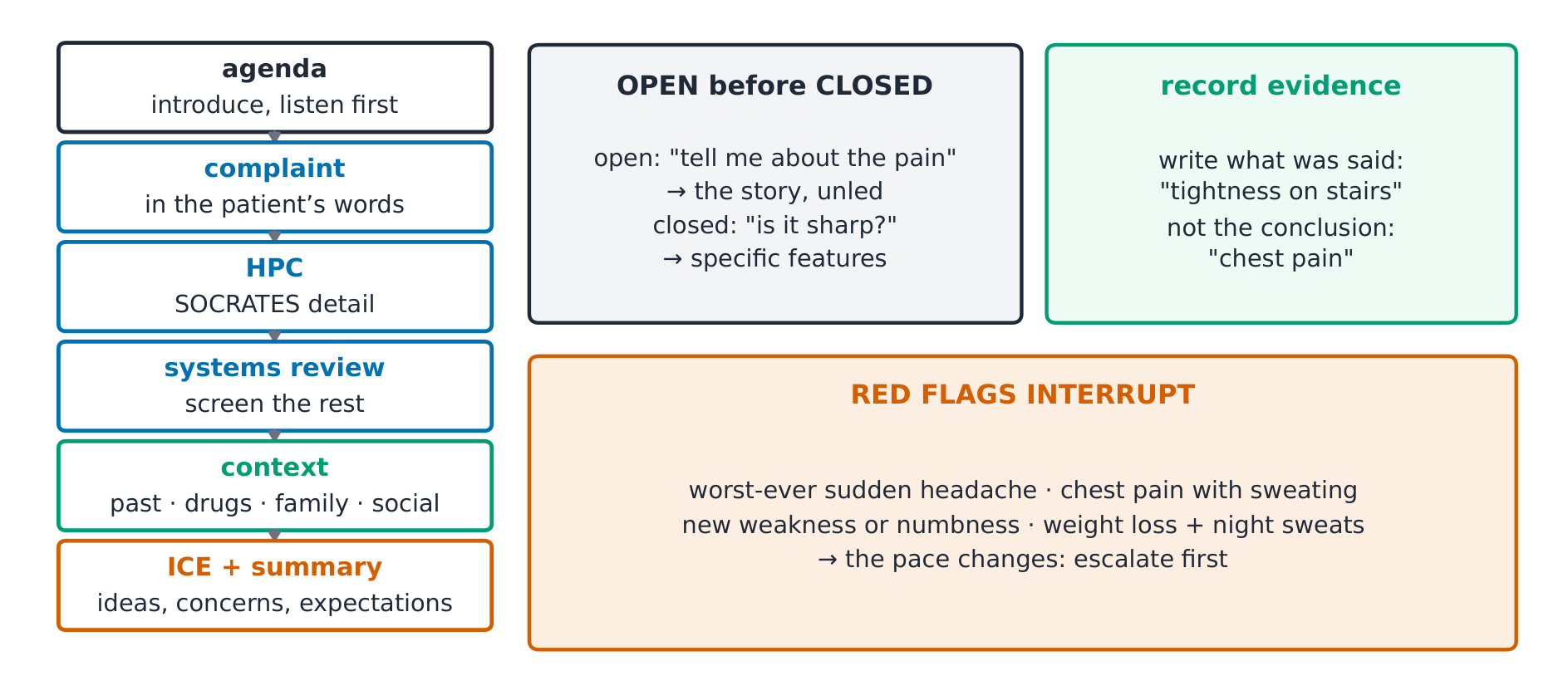
The derivation (why open before closed). Open questions ("tell me about the pain") elicit the patient's frame without leading; closed questions ("is it sharp?") harvest specific features. Reversing the order primes the patient's answers and loses the story's own sequence — and the sequence IS the diagnostic information (timing patterns from MED08's clocks) ✓.
Worked example 1 — the pain frame. (Fictional consultation, role-play text) "Tell me about the chest discomfort" → patient gives 40 seconds: central, tight, with stairs, two weeks, worse each morning. Six closed follow-ups place character, radiation, timing and associations. The SOCRATES frame is a checklist, not a script ✓.
Worked example 2 — clinical link: red flags interrupt. (Fictional) a headache history unearths "sudden, worst ever, with vomiting" — a red flag 危险信号 that changes the encounter's pace whatever the differential suggests ✓. Escalation criteria are taught as patterns (severity, speed, associated deficits), so the history actively screens for them.
Common mistakes. Writing the history as conclusions ("chest pain") instead of the patient's evidence ("tightness on stairs"). Skipping medication and social history (interactions from MED11; occupation and home drive risk). Never asking what the patient thinks is wrong (ICE) — you cannot align a plan with unvoiced fears.
Summary. Agenda → complaint in patient's words → SOCRATES detail → systems review → past/medication/family/social → ICE and summary; open before closed; red flags interrupt the routine; record in the standard sections.
Principles of physical examination
Why it matters. Examination is physiology made visible (MED05) on anatomy made palpable (MED03): each manoeuvre asks a question a history cannot answer.
The idea, with a picture. The four-step sequence: inspection 视诊 (look before touching: symmetry, colour, movement), palpation 触诊 (feel: position, size, tenderness, crepitus), percussion 叩诊 (tap: resonant lung, dull fluid, tympanic gut), auscultation 听诊 (listen: breath sounds, heart sounds, bruits) — ordered least to most intrusive so each step preserves the next ✓.
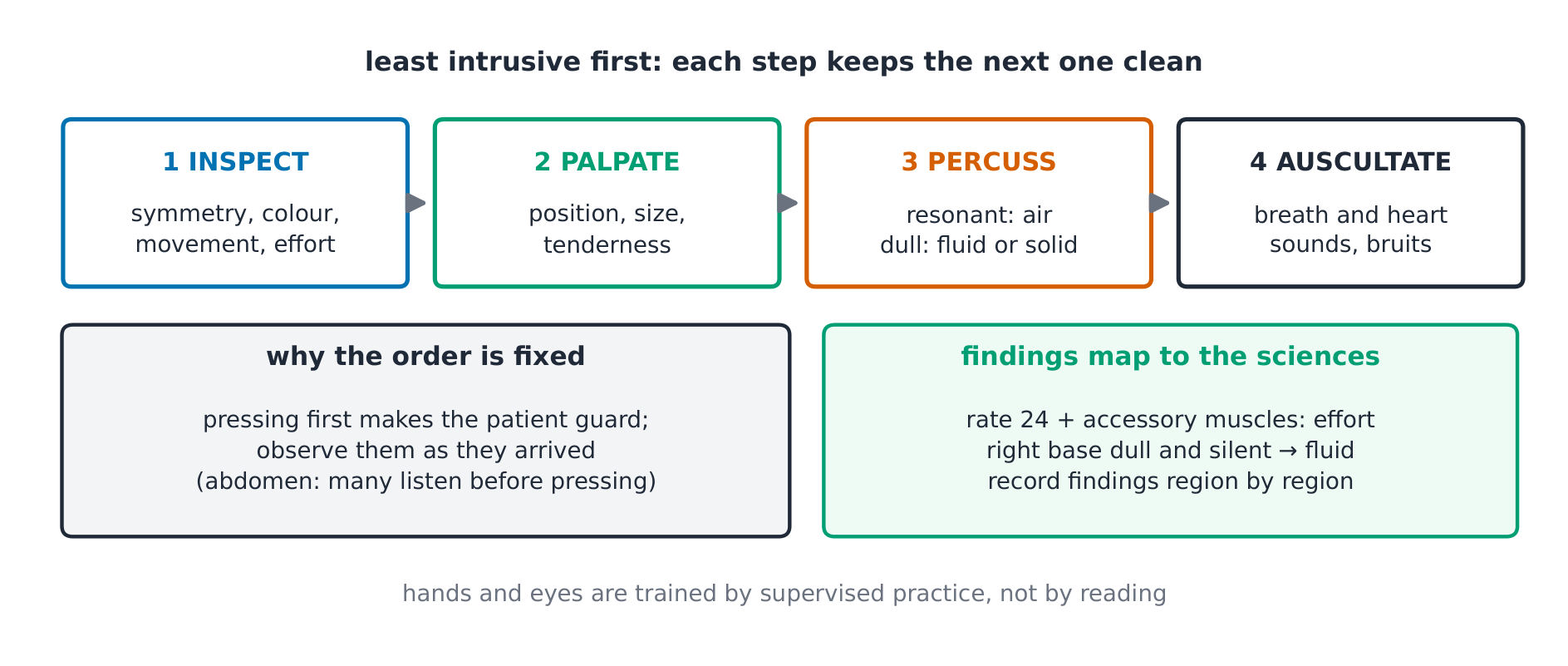
The derivation (why the order is fixed). Palpating a tender abdomen changes the patient's guarding and breath pattern before you inspect; percussing before auscultating the chest disturbs the sounds. The sequence is designed so that each observation is made in the state the patient arrived in ✓ — a checklist against contaminating your own data. (The abdomen is the usual exception: many clinicians auscultate before palpating, because pressing changes bowel sounds — the same principle.)
Worked example 1 — reading the respiratory pattern. (Fictional teaching case) respiratory rate 24 at rest, accessory muscle use on inspection, reduced expansion right side, dull to percussion at the right base, absent breath sounds there: each finding maps to MED05's ventilation arithmetic and MED10's dull-fluid rule — a pleural effusion read from the four steps ✓.
Worked example 2 — clinical link: what reading cannot replace. (As a statement of principle) volumes, consistency and comparative findings (the left side against the right, the patient against the expected) are perceptual skills built by supervised practice; the sequence and the questions are knowledge, the hands and eyes are training ✓.
Common mistakes. Skipping inspection (the single highest-yield step). Auscultating through clothing or before percussion. Examining the painful region first (guarding contaminates everything after). Recording "exam normal" instead of what was examined.
Summary. Inspect → palpate → percuss → auscultate, least intrusive first; compare sides and systems; every finding maps to MED03 anatomy and MED05 physiology; findings recorded per region, never as "normal".
Clinical reasoning and differential diagnosis
Why it matters. Reasoning is the bridge from findings to action — and knowing its failure modes (the biases) is patient safety for the mind.
The idea, with a picture. The differential diagnosis 鉴别诊断 funnel: anatomy of the complaint → broad candidate list → rank by probability × severity ("what is common, what can kill") → tests move probabilities (MED12's likelihood ratios!) → the working diagnosis → safe disposition of what remains ✓.
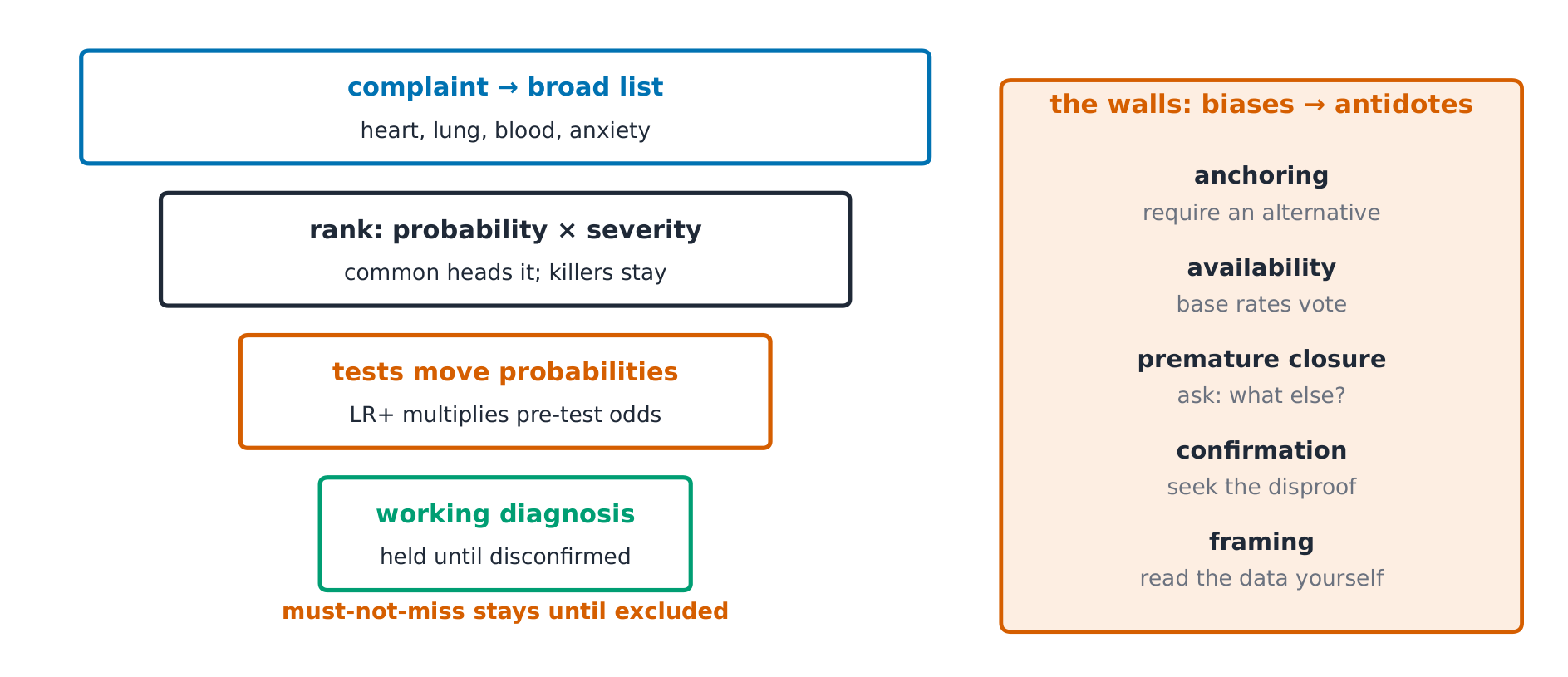
The derivation (why probability and severity both rank). Ranking by probability alone misses rare killers; by severity alone over-tests the common. The standard compromise: must-not-miss diagnoses stay on the list until excluded, however unlikely; probable benign diagnoses head the working list ✓. Each test updates with its LR (MED12 §4): a positive with LR+ 9 multiplies the pre-test odds by 9 — reasoning that computes.
Worked example 1 — the ranked list. (Fictional case) 58-year-old with acute breathlessness: candidates from anatomy (heart, lung, blood, anxiety) → ranked: heart failure, infection, clot (the must-not-miss), anaemia. Each finding and test reorders: orthopnoea raises failure; a sharp drop in oxygen saturation with a clear chest X-ray raises the clot ✓.
Worked example 2 — clinical link: the bias roll-call. (Named patterns) anchoring (first impression fixed), availability (yesterday's memorable case), premature closure 过早闭合 (too early a winner), confirmation bias (seeking agreement), framing (the referral letter's spin) ✓. Each bias has a structural antidote: "what else?" for closure, a required alternative for anchoring, blind first impressions for framing.
Common mistakes. Treating the working diagnosis as final (it is the current best, held until disconfirmed). Chasing rarity (the base rate always votes). Letting the first test decide (tests update odds, they rarely rewrite them alone — MED12's PPV arithmetic explains why).
Summary. Complaint → broad list → rank by probability × severity → tests as LR updates → working diagnosis + disposition; must-not-miss stays until excluded; biases: anchoring, availability, premature closure, confirmation, framing — each with its structural antidote.
Communicating with patients
Why it matters. Care travels through conversation: understanding, decisions, and bad news all have structures that keep the patient a partner rather than a target.
The idea, with a picture. The SPIKES sequence for difficult news: Setting (private, seated, uninterrupted) → Perception (what the patient already knows) → Invitation (how much they want to know) → Knowledge (a warning shot, then plain language, no jargon) → Empathy (respond to emotion) → Strategy and Summary ✓. Teach-back 反馈确认 closes the loop: "so I know I explained it well — what will you tell your family?" — checking the doctor's explanation, never testing the patient.
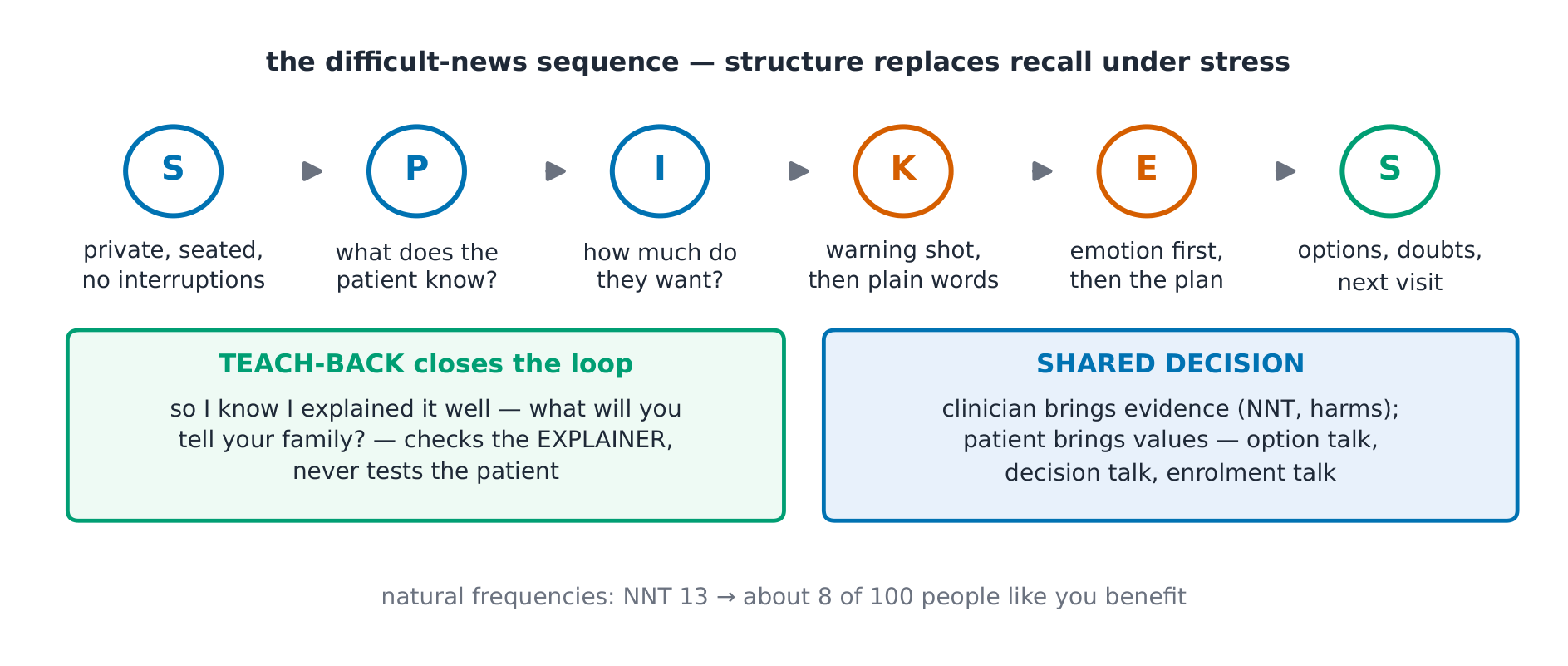
The derivation (why structure helps hardest conversations). Under stress both parties lose working memory; a sequence externalises the plan so no step depends on recall. Warning shots ("I'm afraid the news is not what we hoped") let the patient brace before the content; perception-first corrects the starting point; empathy-before-plan keeps the relationship while delivering facts ✓ — each step is cognitive first-aid.
Worked example 1 — the role-play script. (Fictional consultation) Setting: door closed, alarm off, sit level with the patient. Perception: "what is your understanding of why the tests were done?" Invitation: "do you want all the detail or the outline?" Knowledge: warning shot, two plain sentences, pause. Empathy: silence, then "this is not what you were hoping to hear." Strategy: options, uncertainty, next appointment ✓ — the script as role-play practice, labelled as such.
Worked example 2 — clinical link: shared decision-making. (Fictional) two options with different trade-offs, settled by shared decision-making 共同决策: the clinician brings the evidence (MED12's NNT, harms), the patient brings values; the decision is built together — option talk, decision talk, enrolment talk ✓. Numbers are framed as natural frequencies (an NNT of 13 from MED12 becomes "about 8 of 100 people like you benefit") because patients reason in counts.
Common mistakes. Delivering facts before perception (correcting the wrong picture or none). Using teach-back as a quiz ("do you understand?" measures politeness, not understanding). Offering options without evidence, or evidence without options.
Summary. SPIKES: Setting, Perception, Invitation, Knowledge, Empathy, Strategy; teach-back checks the explainer; shared decisions = evidence + values, numbers as natural frequencies; communication practice is role-play, not assessed skill.
Medical ethics: autonomy, consent and confidentiality
Why it matters. Ethics is the framework that keeps clinical decisions the patient's own: four principles, a capacity test, and the narrow, law-governed exceptions to confidentiality 保密.
The idea, with a picture. The four principles: autonomy 自主 (the patient's informed choice governs), beneficence 行善 (act for benefit), non-maleficence (avoid harm), justice (fair distribution) ✓. Consent is valid when the patient has capacity, is informed, and volunteers — and capacity 行为能力 is decision-specific: understand, retain, weigh, communicate ✓.
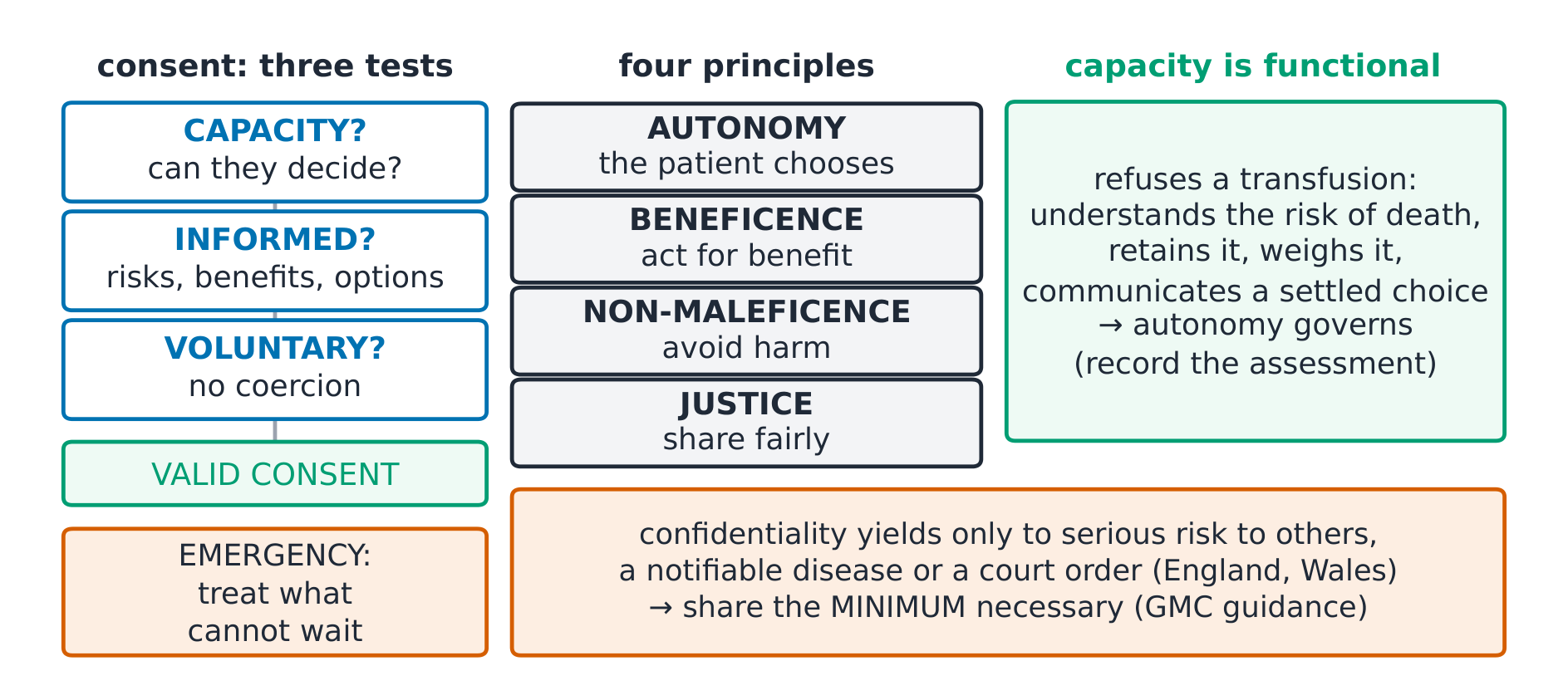
The derivation (why autonomy leads). The principles can conflict: a beneficent plan the patient refuses. Modern medical ethics resolves toward autonomy for competent adults — the patient's values are the arbiter of benefit — with beneficence shaping what is offered ✓. Capacity is not diagnosis-specific (a diagnosis does not remove it); it is functional and task-specific, tested per decision.
Worked example 1 — the capacity test in action. (Fictional) a patient refuses a transfusion. Do they understand the information (the transfusion, the serious risk of death without it), retain it long enough to decide, weigh it against their own values, and communicate a settled choice? Yes to all four → capacity → autonomy governs, and the team documents the assessment ✓.
Worked example 2 — clinical link: when confidentiality yields. (Declared jurisdiction: England and Wales) confidentiality may be breached without consent when there is a serious risk to others (e.g. a notifiable disease — Public Health (Control of Disease) Act 1984) or a legal requirement (a court order); the response must be the minimum necessary, and the GMC's guidance frames the judgment ✓. Where jurisdictions differ, the course names its frame rather than pretending one answer.
Common mistakes. Treating capacity as global (it is decision-by-decision; a patient may hold capacity for one decision and not another). Calling a consent form consent (the form records, the conversation consents). Breaching confidentiality on convenience — the threshold is serious harm and the route is the minimum necessary.
Summary. Autonomy, beneficence, non-maleficence, justice — autonomy leads for competent adults; consent = capacity + information + voluntariness; capacity: understand, retain, weigh, communicate, per decision; breach only for serious risk to others or law, minimum necessary (jurisdiction named; GMC framework cited).
Patient safety and quality
Why it matters. Errors are made by systems of people and tools; treating them as personal failings guarantees repetition. The systems view is the science of the near-miss 未遂事件.
The idea, with a picture. Reason's Swiss cheese model 瑞士奶酪模型: hazards meet layers of defence (design, barriers, procedures, people), each with holes; harm passes when the holes align ✓. The response to an incident is systemic: what allowed the hole, not who stood in it.
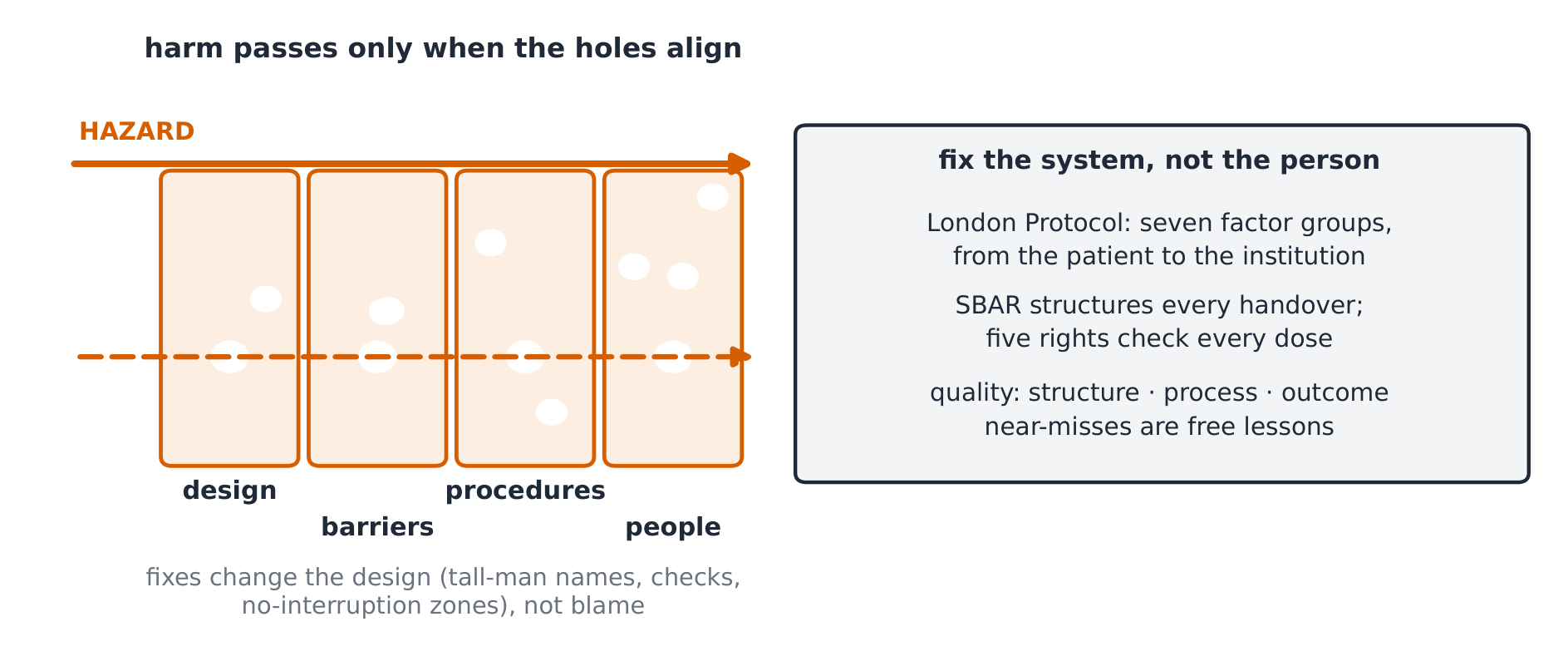
The derivation (why analysis must be structured). After an incident, memory reconstructs a tidy story; structured methods (the London Protocol's seven factor groups: patient, task and technology, individual, team, work environment, organisation and management, institutional context) force the search across every layer ✓. The same logic powers the tools: the SBAR handover SBAR 交接 (Situation, Background, Assessment, Recommendation) standardises what working memory drops under pressure — a checklist for conversations (MED11 §7's five rights for the bedside).
Worked example 1 — the tenfold near-miss. (Fictional, from MED11 §7) a tenfold dose reached the bedside and was caught: the London Protocol reads it as prescribing (similar names), dispensing (no independent check), administration (interruption at the bedside) — three holes that aligned ✓; the fixes are design changes (tall-man lettering, separate stocks, do-not-interrupt zones), not blame.
Worked example 2 — clinical link: measuring quality. (Structure– process–outcome) a service can be judged by its structure (staff, equipment), its process (were the right steps taken — checklists, handover compliance) and its outcome (results, risk-adjusted) ✓. Process measures respond fastest to improvement; outcome measures convince the sceptic — quality work reads both.
Common mistakes. Stopping at "human error" (the beginning of the analysis, not the end). Testing defences only when they fail (drills and near-miss reporting keep holes visible). Equating a checklist with safety (it is one layer; the culture that speaks up is another).
Summary. Swiss cheese: harm = aligned holes across layers; analyse with the London Protocol's seven factor groups; SBAR standardises handovers; five rights standardise the bedside; quality = structure + process + outcome, and near-misses are free lessons.
Public health and health systems
Why it matters. Medicine works one patient at a time; health works populations at a time — prevention levels, screening arithmetic and financing models decide what care exists to be delivered.
The idea, with a picture. Prevention levels: primary (prevent disease: vaccination — MED07), secondary (detect early: screening 疾病筛查), tertiary (limit damage: rehabilitation) ✓. Screening is judged by explicit criteria: important condition, treatable early stage, valid test, acceptable, and the programme's arithmetic (MED12's PPV — the pre-clinical pool governs the yield).

The derivation (why screening arithmetic decides). A screen tests the well: its yield is PPV, and PPV lives on prevalence (MED12 §4) — so the pre-clinical detectable pool (a screening interval short enough that the pool is real) is the design variable ✓. Over-diagnosis 过度诊断 (finding disease that would never have mattered) is the hidden cost the criteria guard against.
Worked example 1 — the levels in one disease. (Fictional teaching example) a smoking-related cancer: primary — cessation programmes; secondary — targeted screening of the high-risk (pool arithmetic); tertiary — rehabilitation and palliation ✓. Each level has its own denominator and its own success measure.
Worked example 2 — clinical link: financing shapes access. (Named models) general taxation (the Beveridge model — a national health service), social insurance (the Bismarck model — funds from wages), private insurance, out-of-pocket ✓. The models set who is covered, who pays at the point of care, and what gatekeeping exists — the macro-decisions that every consultation inherits.
Common mistakes. Calling any early test screening (screening tests the WELL; testing the symptomatic is diagnosis). Judging screening by cases found (count over-diagnosed harm too: the criteria demand both). Comparing systems by spending alone (coverage and outcomes differ at equal spend).
Summary. Primary/secondary/tertiary; screening criteria: important, treatable-early, valid, acceptable + pool arithmetic (PPV) with over-diagnosis counted; financing: Beveridge (tax), Bismarck (social insurance), private, out-of-pocket — each shaping coverage and access.