Scope and prerequisites
Digital SAT framework; original paper practice is nonadaptive and gives no scaled-score prediction.
- Choose a detail 细节 that directly supports or challenges a stated claim
- Use a table’s labels, quantities and comparison base 比较基准 correctly
- Separate relevance 相关性 from evidence 证据 that discriminates between explanations
Prerequisites: Read table headings; compare proportions and counts.
Explain and choose the method
First translate the target claim into an evidence requirement. A claim that repeated practice helps retention needs information about retention under differing practice conditions, not simply a statement that learners enjoyed the activity. An interesting related fact may fail to support the specific relationship asserted.
For textual evidence, identify whose claim is being tested and whether the task asks for support, challenge or completion. A quotation with familiar nouns is not enough. Ask what would become more credible or less credible if that detail were true, while preserving the passage’s actual degree of certainty.
For quantitative evidence, read title, axes or headers, units and groups before calculating. Use before/after differences when the claim concerns improvement, final values when it concerns outcomes and proportions when group sizes differ. A larger count can represent a smaller share in a larger group.
A numerical pattern may support a descriptive comparison without proving why it occurred. If no random assignment or controlled causal evidence is stated, avoid a causal conclusion. The original table in this lesson is a hypothetical teaching dataset, not a published study; its purpose is to practise reading the relationship.
Evidence must support the exact claim, including its comparison base. If 9 of 15 tasks succeed, $p=n_{success}/n_{total}=9/15=60\%$. A group with more successes may still have a lower success rate 速率. Before/after data describe changes; without controlled assignment they do not prove a cause.
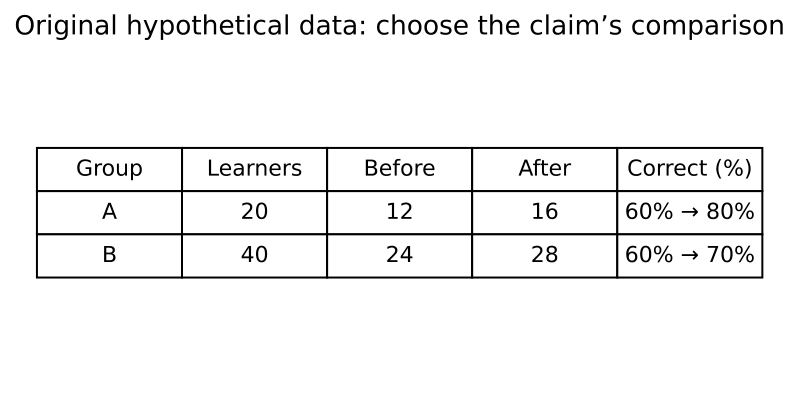
Existing worked example: Original hypothetical table: Group A has 20 learners, 12 correct before and 16 after; Group B has 40 learners, 24 correct before and 28 after. Both gain four correct responses, but A’s correct share rises from 60% to 80% (20 points), while B rises from 60% to 70% (10 points). This supports “A had the larger percentage-point improvement”, not “A had more correct final responses” or a causal claim about the method.
Complete original context
Original hypothetical study: Two groups used a revised catalogue for a second search session. No random assignment is reported. Group P had 30 users, with 12 successful searches before and 21 after. Group Q had 50 users, with 30 successful searches before and 35 after. Each user completed one search in each session. The researchers claimed that P showed the larger percentage-point improvement, while Q still had more successful searches in the second session. A separate comment said the revision must have caused every improvement.
Independent practice and checked reasoning
Transfer 1
Give the before and after success percentages and percentage-point changes for both groups.
Reasoning: $p_P=12/30=40\%$ before and $21/30=70\%$ after, a 30-point increase. $p_Q=30/50=60\%$ before and $35/50=70\%$ after, a 10-point increase. P has the larger change; both final rates are equal.
Transfer 2
Which claim is supported by 35 compared with 21, and which is supported by 30 points compared with 10 points?
Reasoning: The final counts support Q having more second-session successes. The percentage-point changes support P improving more. Exchanging those pieces of evidence would confuse final outcome with change and counts with proportions.
Transfer 3
Explain why the causal comment is too strong. Give one additional observation that would help investigate an alternative explanation.
Reasoning: Session order, practice or different tasks could contribute; no randomised comparison is described. A control group using the original catalogue in both sessions under otherwise matched conditions could estimate practice effects. It would help test causation, not automatically prove that every user's improvement has one cause.
Limits and next use
Use the quantity named by the claim. Raw counts, relative percentages and percentage-point changes answer different questions.
All tasks here are public original practice with authored guidance. They are not official questions or fresh diagnostics. Existing protected tests and mocks remain separate.