Scope and prerequisites
Digital SAT framework; original paper practice is nonadaptive and gives no scaled-score prediction.
- Interpret a sample estimate and its stated margin of error 误差范围
- Distinguish random sampling from random assignment 随机分组
- Identify the population and causal scope supported by a study
Prerequisites: Percentages; populations; random selection versus assignment.
Explain and choose the method
A sample statistic estimates a population quantity. A reported estimate of 58% with margin of error 4 percentage points gives an interval from 54% to 62% under the stated procedure. It does not mean 58% of respondents answered with an error of four percent, nor does it guarantee that every individual sample contains the true value.
A representative random sample helps generalise to the population from which it was drawn. Convenience or voluntary-response samples can be biased even when large. Increasing a well-designed sample generally reduces sampling variability and margin of error at the same confidence level, but cannot automatically cure a systematically excluded group.
Random assignment distributes participants among treatment groups and supports causal inference 推断 by balancing competing factors on average. Random sampling selects who participates. A randomised experiment conducted only with volunteers may support a treatment effect for its participants without establishing that all people share the same effect.
An observational study measures existing differences without assigning treatment; association can reflect confounding. A comparison of students who choose extra tutoring against those who do not may mix tutoring with motivation or prior attainment. To judge a claim, identify selection, assignment, comparison, measured outcome and the exact population before accepting causation or broad generalisation.
A margin of error is added and subtracted in percentage points. Estimate 63% with margin 4 points gives 59%–67%. It is an interval from a procedure, not a guarantee that each person's response is near 63%. Random sampling supports population inference; random assignment addresses treatment comparisons.
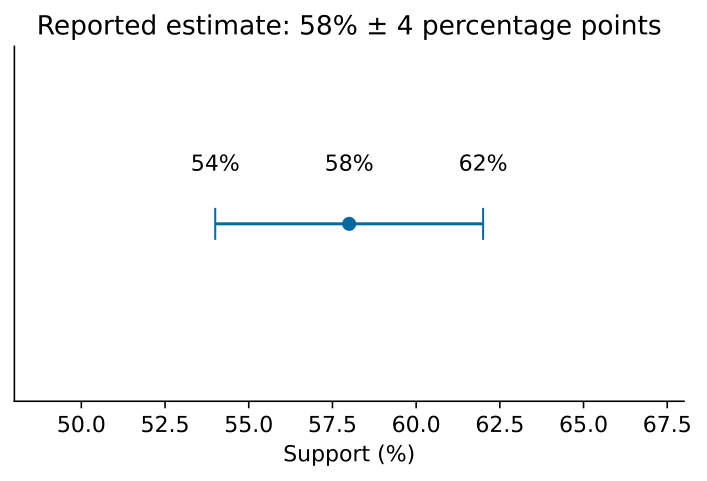
Existing worked example: A random sample of 400 school students yields 58% support ±4 percentage points: stated interval 54%–62%. This estimates the sampled school population, not all students worldwide. If volunteers are randomly assigned to two revision methods, a controlled outcome difference can support a causal comparison among participants; volunteer selection still limits wider generalisation.
Complete original context
Every transfer question states all data it needs.
Independent practice and checked reasoning
Transfer 1
A random sample of 500 registered library members reports 62% support for a change, with stated margin 4 percentage points. State the interval and population. Does it establish support among every town resident?
Reasoning: Interval is $62\%-4\%=58\%$ to $62\%+4\%=66\%$, where the subtraction denotes points. The population is registered members in the sampling frame. Nonmembers were not sampled, so the estimate does not establish all residents' support.
Transfer 2
Forty volunteers are randomly assigned to old or new instructions, with the same task and conditions. The new group finishes faster. What causal and population claims are reasonable?
Reasoning: Random assignment supports a causal comparison of the instruction versions for these participants under the tested conditions, subject to variation. Volunteer selection limits population generalisation. It does not establish that every future user will finish faster.
Transfer 3
A poll of 10000 website volunteers has a narrow reported margin. Explain why size alone cannot repair selection bias, and propose a better recruitment method.
Reasoning: People choosing to respond can differ systematically from those who do not. A margin for sampling variability does not remove that bias. Select randomly from the defined target population and follow up nonresponse; still report limitations.
Limits and next use
Sample size, random selection and random assignment are not interchangeable. A narrow margin does not remove selection bias.
All tasks here are public original practice with authored guidance. They are not official questions or fresh diagnostics. Existing protected tests and mocks remain separate.