Skip to content
Subjects
  • 1 Adjectives
    • 1.1 Adjectival complement "de budeliao"
    • 1.2 Adjectival complement "de hen"
    • 1.3 Expressing "a bit too"
    • 1.4 Saying "a lot" with "youdeshi"

    Adjectives →

  • 2 Adverbs
    • 2.1 Advanced uses of "dou"
    • 2.2 Advanced uses of "hai"
    • 2.3 Advanced uses of "zong"
    • 2.4 Expressing "after all" with "bijing"
    • 2.5 Expressing "almost" using "chadian mei"
    • 2.6 Expressing "anyway" with "fanzheng"
    • 2.7 Expressing "as much as possible" with "jinliang"
    • 2.8 Expressing "each other" with "huxiang"
    • 2.9 Expressing "feel free" with "jinguan"
    • 2.10 Expressing "just" do it with "gancui"
    • 2.11 Expressing "never again" with "zai ye bu"
    • 2.12 Expressing "once" with "cengjing"
    • 2.13 Expressing "over and over again" with "zaisan"
    • 2.14 Expressing "simply" with "jianzhi"
    • 2.15 Expressing "while you're at it" with "shunbian"
    • 2.16 Expressing a last chance with "zaibu... jiu..."
    • 2.17 Expressing difficulty with "hao (bu) rongyi"
    • 2.18 Expressing wasted efforts with "bai"
    • 2.19 Repeated actions in the past with "you"
    • 2.20 The opposite of "chabuduo" is "cha hen duo"

    Adverbs →

  • 3 Auxiliary Words
    • 3.1 Listing things with "a"

    Auxiliary Words →

  • 4 Conjunctions
    • 4.1 Expressing "how about" with "yaobu"

    Conjunctions →

  • 5 Nouns
    • 5.1 Expressing "among" with "dangzhong"
    • 5.2 Expressing "each other" with "bici"
    • 5.3 Expressing "ever since" with "yilai"
    • 5.4 Expressing "when" using "dang"
    • 5.5 Name-calling with "zhege"

    Nouns →

  • 6 Particles
    • 6.1 Advanced "le" after an object
    • 6.2 Advanced "le" with complements
    • 6.3 Marking a topic with "ma"
    • 6.4 Softening the tone of questions with "ne"

    Particles →

  • 7 Prepositional Phrase
    • 7.1 Defining upper and lower limits

    Prepositional Phrase →

  • 8 Prepositions
    • 8.1 Expressing "ever since" with "zicong"
    • 8.2 Expressing "for" with "wei"
    • 8.3 Expressing "for…" with "eryan"
    • 8.4 Expressing "including" with "zainei"
    • 8.5 Expressing "on the basis of" with "ping"
    • 8.6 Expressing "with regards to" with "zhiyu"
    • 8.7 Expressing passive voice with "gei"
    • 8.8 Limiting scope with "jiu"
    • 8.9 Opportune timing with "chen"

    Prepositions →

  • 9 Sentence Patterns
    • 9.1 Expressing "if it were not for" with "yaobushi"
    • 9.2 Expressing "thanks to" with "duokui"
    • 9.3 Expressing "that's all" with "eryi"
    • 9.4 Using "jiang" as a formal "ba"

    Sentence Patterns →

  • 10 Verbs
    • 10.1 Challenging a verb with "shenme"
    • 10.2 Comparing specifically with "xiang"
    • 10.3 Comparisons with "biqi"
    • 10.4 Comparisons with "buru"
    • 10.5 Making "-ize" and "-ify" verbs with "hua"
    • 10.6 Making judgments with "suan"
    • 10.7 Using "nanguai" as a verb

    Verbs →

  • 11 Auxiliary verbs
    • 11.1 Expressing future with "jiang"

    Auxiliary verbs →

  • 12 Verb phrases
    • 12.1 Expressing "hard to avoid" with "nanmian"
    • 12.2 Passive verbs with "shou"

    Verb phrases →

  • 13 "But" Statements
    • 13.1 Expressing "on the contrary" with "fan'er"

    "But" Statements →

  • 14 "Even If" Statements
    • 14.1 Expressing "even if…" with "jiushi"
    • 14.2 Expressing "even if…" with "jiusuan"
    • 14.3 Expressing "even if…" with "napa"

    "Even If" Statements →

  • 15 "If" Statements
    • 15.1 Expressing "if… then…" with "jiaru"
    • 15.2 Expressing "what if" with "wanyi"
    • 15.3 Marking a topic with "de hua"

    "If" Statements →

  • 16 Adverbs with Adjectives
    • 16.1 Expressing "especially" with "gewai"

    Adverbs with Adjectives →

  • 17 Cause/Effect Statements
    • 17.1 Stating the effect before the cause

    Cause/Effect Statements →

  • 18 Complements
    • 18.1 Advanced degree complements
    • 18.2 Advanced potential complements
    • 18.3 Advanced result complements "zhu", "kai", and "chulai"
    • 18.4 Complement "-huai le"
    • 18.5 Complement "-zhao"
    • 18.6 Tricky uses of "dao"
    • 18.7 Using "lai" and "qu" when "verbing around"

    Complements →

  • 19 Conditional Statements
    • 19.1 Expressing "once...then..." with "yidan...jiu..."

    Conditional Statements →

  • 20 Sentence Patterns
    • 20.1 Advanced uses of "ba"
    • 20.2 Basic comparisons with "bu bi"
    • 20.3 Conditions with "yao" and "jiu"
    • 20.4 Expressing "can't do without" with "shaobuliao"
    • 20.5 Expressing "equal to" with "dengyu"
    • 20.6 Expressing "from" with "cong... zhong"
    • 20.7 Expressing "no" (noun) "to" (verb) with "wu... ke..."
    • 20.8 Expressing "not only..., even..." using "budan..., shenzhi lian"
    • 20.9 Expressing "related to..." with "you guan de"
    • 20.10 Expressing "so-called" with "suowei"
    • 20.11 Expressing "within" a period of time using "zai... nei"
    • 20.12 Expressing "would rather" with "ningke"
    • 20.13 Expressing indifference with "jiu"
    • 20.14 Expressing purpose with "hao"
    • 20.15 Expressing simultaneous actions with "yimian"
    • 20.16 Expressing the only two possibilities

    Sentence Patterns →

  • 21 Complex Sentence Patterns
    • 21.1 Expressing "no wonder"

    Complex Sentence Patterns →

  • 22 Either… or
    • 22.1 Providing two options with double "huozhe"

    Either… or →

  • 23 Let alone
    • 23.1 Expressing "let alone" with "bie shuo"
    • 23.2 Expressing "let alone" with "geng buyong shuo"

    Let alone →

  • 24 Comparing similar adverbs
    • 24.1 Comparing "changchang" and "jingchang"

    Comparing similar adverbs →

  • 25 Comparing similar auxiliary words

    Original teaching practice. Read one pattern, cover its model and try the questions before checking the separate answer section. Examples adapted from Chinese Grammar Wiki (AllSet Learning, CC BY-NC-SA) retain the course-reference provenance.

    at long last总算zǒng suàn vs finally终于zhōng yú (finally)

    At long last

    • After three failed attempts, your cousin has finally passed her driving test.
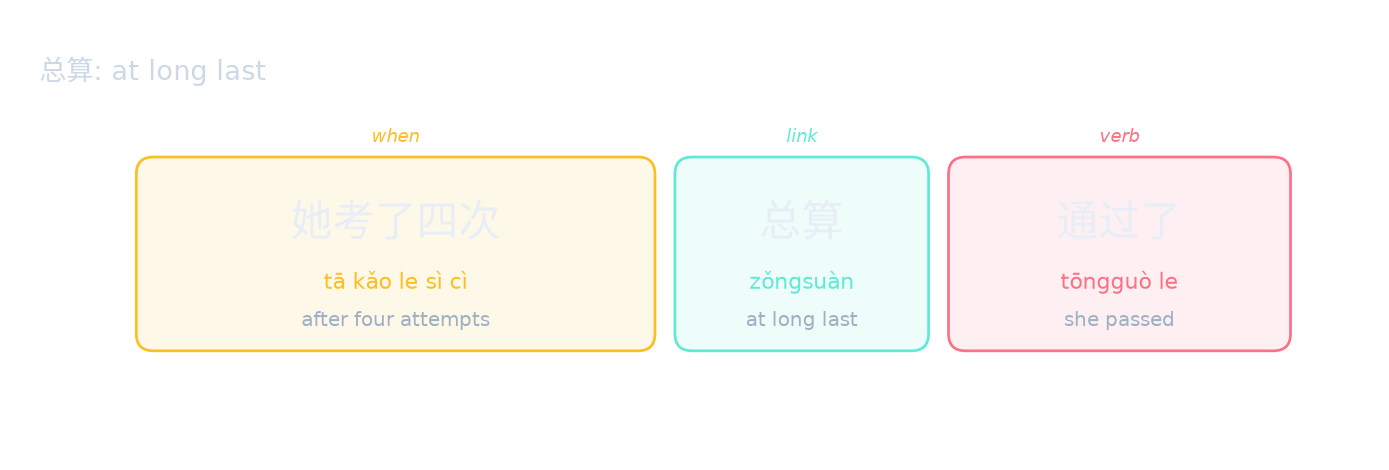
    • she / her她tāto check考kǎo(completed / change)了lefourth四次sì cì,at long last总算zǒng suànto pass through通过tōng guò(completed / change)了le! — "She took it four times and finally passed!"

    finally终于zhōng yú = finally, after a long process

    • finally终于zhōng yú + verb (+ (completed / change)了le) = at last, after waiting or effort; the result can be good or bad: he / him他tāfinally终于zhōng yúto come来lái(completed / change)了le, he / him他tāfinally终于zhōng yúto fall ill病倒bìng dào(completed / change)了le.
    • Neutral in tone; common in narration and writing.

    waited等děng了letwo两个liǎng gèhours小时xiǎo shí,the bus车chēfinally终于zhōng yúcame来lái了le。

    总算: at long last

    at long last总算zǒng suàn = finally (with relief)

    • at long last总算zǒng suàn also means "finally", with relief or satisfaction that a wanted result arrived: at long last总算zǒng suànperfect到家dào jiā(completed / change)了le!
    • It can also mean "more or less, considered as": 这次zhè cì考得kǎo déat long last总算zǒng suànstill / also还háican / may可以kě yǐ — "This time the result was at least OK."

    at last总算zǒng suànhome到家dào jiā了le!

    Bad outcomes take finally终于zhōng yú

    • at long last总算zǒng suàn is for welcome results; for an unwelcome one, use finally终于zhōng yú: he / him他tāfinally终于zhōng yú累病lèi bìng(completed / change)了le, not he / him他tāat long last总算zǒng suàn累病lèi bìng(completed / change)了le.
    • Both go after the subject, before the verb.

    Side by side

    • (literary) to rain雨yǔfinally终于zhōng yúto stop停tíng(completed / change)了le。 — "The rain finally stopped" (neutral report).
    • (literary) to rain雨yǔat long last总算zǒng suànto stop停tíng(completed / change)了le! — "Thank goodness, the rain has finally stopped!" (relief).

    the rain雨yǔat last总算zǒng suànstop停tíng了le。

    Recap

    • finally终于zhōng yú = finally (neutral, good or bad outcomes); at long last总算zǒng suàn = finally, with relief (welcome outcomes) / at least.
    • Unwelcome results: finally终于zhōng yú only.

    Practise this pattern step by step.

    Practice without the models

    at long last总算zǒng suàn vs finally终于zhōng yú (finally)

    2501.1 With relief: “Phew, I'm finally home!” …………perfect到家dào jiā(completed / change)了le!

    2501.2 “After a month of overwork he finally fell ill.” Which fits?

    • A. he / him他tāfinally终于zhōng yú累病lèi bìng(completed / change)了le。
    • B. he / him他tāat long last总算zǒng suàn累病lèi bìng(completed / change)了le。
    • C. he / him他tāat long last总算zǒng suàn病好bìng hǎo(completed / change)了le。
    • D. he / him他tāfinally终于zhōng yú不病bù bìng(completed / change)了le。

    2501.3 Build: “After two hours, the bus finally came.”

    Arrange all chunks: to come来lái(completed / change)了le。 / to wait for等děng(completed / change)了le两个liǎng gèhour小时xiǎo shí / , / war chariot (archaic)车chēfinally终于zhōng yú

    2501.4 (literary) to rain雨yǔat long last总算zǒng suànto stop停tíng(completed / change)了le sounds relieved.

    True or false? Explain or repair the statement.

    2501.5 After three failed attempts, your cousin has finally passed her driving test. Close the examples. Say a Mandarin response, then write it in Chinese. Explain briefly in English what the lesson’s pattern adds. Compare with the model, then change one detail and try again.

    Write or say your own response before reading the key.

    Answers and explanations

    at long last总算zǒng suàn vs finally终于zhōng yú (finally)

    2501.1 at long last总算zǒng suàn

    at long last总算zǒng suàn adds relief.

    2501.2 A. he / him他tāfinally终于zhōng yú累病lèi bìng(completed / change)了le。

    An unwelcome outcome takes finally终于zhōng yú.

    2501.3 to wait for等děng(completed / change)了le两个liǎng gèhour小时xiǎo shí,war chariot (archaic)车chēfinally终于zhōng yúto come来lái(completed / change)了le。

    Wait, then finally终于zhōng yú + result.

    2501.4 True.

    at long last总算zǒng suàn expresses relief at a welcome result.

    2501.5 One possible response: she / her她tāto check考kǎo(completed / change)了lefourth四次sì cì,at long last总算zǒng suànto pass through通过tōng guò(completed / change)了le!

    Check meaning and form:

    • My response conveys a message that fits the opening situation.
    • I can explain the meaning of the pattern, rather than only naming it.
    • at long last总算zǒng suàn is for welcome results; for an unwelcome one, use finally终于zhōng yú: he / him他tāfinally终于zhōng yú累病lèi bìng(completed / change)了le, not he / him他tāat long last总算zǒng suàn累病lèi bìng(completed / change)了le.
    • Both go after the subject, before the verb.
    • I tried a second response with a name, time, place, or description changed.

    This is supported productive practice. Compare meaning and structure; your answer need not copy the model. A partner or teacher must hear the spoken response to comment on pronunciation.

  • 26 Comparing similar conjunctions
    • 26.1 Comparing "gen" and "dui"

    Comparing similar conjunctions →

  • 27 Comparing similar prepositions
    • 27.1 Comparing "chao" "xiang" and "wang"
    • 27.2 Comparing "dui" and "duiyu"
    • 27.3 Comparing "duiyu" and "zhiyu"
    • 27.4 Comparing "gei" and "wei"

    Comparing similar prepositions →

  • 28 Comparing similar time words
    • 28.1 Comparing "pingshi" and "pingchang"
    • 28.2 Comparing "yihou" and "zhihou"

    Comparing similar time words →

  • 29 Comparing similar verbs
    • 29.1 Comparing "kanqilai" and "kanlai"
    • 29.2 Comparing "xiande" and "kanqilai"

    Comparing similar verbs →

Log in or create account

IGCSE, A-Level & AP