Skip to content
Subjects
  • 1 Adjectives
    • 1.1 Adjectival complement "de budeliao"
    • 1.2 Adjectival complement "de hen"
    • 1.3 Expressing "a bit too"
    • 1.4 Saying "a lot" with "youdeshi"

    Adjectives →

  • 2 Adverbs
    • 2.1 Advanced uses of "dou"
    • 2.2 Advanced uses of "hai"
    • 2.3 Advanced uses of "zong"
    • 2.4 Expressing "after all" with "bijing"
    • 2.5 Expressing "almost" using "chadian mei"
    • 2.6 Expressing "anyway" with "fanzheng"
    • 2.7 Expressing "as much as possible" with "jinliang"
    • 2.8 Expressing "each other" with "huxiang"
    • 2.9 Expressing "feel free" with "jinguan"
    • 2.10 Expressing "just" do it with "gancui"
    • 2.11 Expressing "never again" with "zai ye bu"
    • 2.12 Expressing "once" with "cengjing"
    • 2.13 Expressing "over and over again" with "zaisan"
    • 2.14 Expressing "simply" with "jianzhi"
    • 2.15 Expressing "while you're at it" with "shunbian"
    • 2.16 Expressing a last chance with "zaibu... jiu..."
    • 2.17 Expressing difficulty with "hao (bu) rongyi"
    • 2.18 Expressing wasted efforts with "bai"
    • 2.19 Repeated actions in the past with "you"
    • 2.20 The opposite of "chabuduo" is "cha hen duo"

    Adverbs →

  • 3 Auxiliary Words
    • 3.1 Listing things with "a"

    Auxiliary Words →

  • 4 Conjunctions
    • 4.1 Expressing "how about" with "yaobu"

    Conjunctions →

  • 5 Nouns
    • 5.1 Expressing "among" with "dangzhong"
    • 5.2 Expressing "each other" with "bici"
    • 5.3 Expressing "ever since" with "yilai"
    • 5.4 Expressing "when" using "dang"
    • 5.5 Name-calling with "zhege"

    Nouns →

  • 6 Particles
    • 6.1 Advanced "le" after an object
    • 6.2 Advanced "le" with complements
    • 6.3 Marking a topic with "ma"
    • 6.4 Softening the tone of questions with "ne"

    Particles →

  • 7 Prepositional Phrase
    • 7.1 Defining upper and lower limits

    Prepositional Phrase →

  • 8 Prepositions
    • 8.1 Expressing "ever since" with "zicong"
    • 8.2 Expressing "for" with "wei"
    • 8.3 Expressing "for…" with "eryan"
    • 8.4 Expressing "including" with "zainei"
    • 8.5 Expressing "on the basis of" with "ping"
    • 8.6 Expressing "with regards to" with "zhiyu"
    • 8.7 Expressing passive voice with "gei"
    • 8.8 Limiting scope with "jiu"
    • 8.9 Opportune timing with "chen"

    Prepositions →

  • 9 Sentence Patterns
    • 9.1 Expressing "if it were not for" with "yaobushi"
    • 9.2 Expressing "thanks to" with "duokui"
    • 9.3 Expressing "that's all" with "eryi"
    • 9.4 Using "jiang" as a formal "ba"

    Sentence Patterns →

  • 10 Verbs
    • 10.1 Challenging a verb with "shenme"
    • 10.2 Comparing specifically with "xiang"
    • 10.3 Comparisons with "biqi"
    • 10.4 Comparisons with "buru"
    • 10.5 Making "-ize" and "-ify" verbs with "hua"
    • 10.6 Making judgments with "suan"
    • 10.7 Using "nanguai" as a verb

    Verbs →

  • 11 Auxiliary verbs
    • 11.1 Expressing future with "jiang"

    Auxiliary verbs →

  • 12 Verb phrases
    • 12.1 Expressing "hard to avoid" with "nanmian"
    • 12.2 Passive verbs with "shou"

    Verb phrases →

  • 13 "But" Statements
    • 13.1 Expressing "on the contrary" with "fan'er"

    "But" Statements →

  • 14 "Even If" Statements
    • 14.1 Expressing "even if…" with "jiushi"
    • 14.2 Expressing "even if…" with "jiusuan"
    • 14.3 Expressing "even if…" with "napa"

    "Even If" Statements →

  • 15 "If" Statements
    • 15.1 Expressing "if… then…" with "jiaru"
    • 15.2 Expressing "what if" with "wanyi"
    • 15.3 Marking a topic with "de hua"

    "If" Statements →

  • 16 Adverbs with Adjectives
    • 16.1 Expressing "especially" with "gewai"

    Adverbs with Adjectives →

  • 17 Cause/Effect Statements
    • 17.1 Stating the effect before the cause

    Cause/Effect Statements →

  • 18 Complements
    • 18.1 Advanced degree complements
    • 18.2 Advanced potential complements
    • 18.3 Advanced result complements "zhu", "kai", and "chulai"
    • 18.4 Complement "-huai le"
    • 18.5 Complement "-zhao"
    • 18.6 Tricky uses of "dao"
    • 18.7 Using "lai" and "qu" when "verbing around"

    Complements →

  • 19 Conditional Statements
    • 19.1 Expressing "once...then..." with "yidan...jiu..."

    Conditional Statements →

  • 20 Sentence Patterns
    • 20.1 Advanced uses of "ba"
    • 20.2 Basic comparisons with "bu bi"
    • 20.3 Conditions with "yao" and "jiu"
    • 20.4 Expressing "can't do without" with "shaobuliao"
    • 20.5 Expressing "equal to" with "dengyu"
    • 20.6 Expressing "from" with "cong... zhong"
    • 20.7 Expressing "no" (noun) "to" (verb) with "wu... ke..."
    • 20.8 Expressing "not only..., even..." using "budan..., shenzhi lian"
    • 20.9 Expressing "related to..." with "you guan de"
    • 20.10 Expressing "so-called" with "suowei"
    • 20.11 Expressing "within" a period of time using "zai... nei"
    • 20.12 Expressing "would rather" with "ningke"
    • 20.13 Expressing indifference with "jiu"
    • 20.14 Expressing purpose with "hao"
    • 20.15 Expressing simultaneous actions with "yimian"
    • 20.16 Expressing the only two possibilities

    Sentence Patterns →

  • 21 Complex Sentence Patterns
    • 21.1 Expressing "no wonder"

    Complex Sentence Patterns →

  • 22 Either… or
    • 22.1 Providing two options with double "huozhe"

    Either… or →

  • 23 Let alone
    • 23.1 Expressing "let alone" with "bie shuo"
    • 23.2 Expressing "let alone" with "geng buyong shuo"

    Let alone →

  • 24 Comparing similar adverbs

    Original teaching practice. Read one pattern, cover its model and try the questions before checking the separate answer section. Examples adapted from Chinese Grammar Wiki (AllSet Learning, CC BY-NC-SA) retain the course-reference provenance.

    often常常cháng cháng vs often经常jīng cháng (often / regularly)

    How often?

    • A new friend asks about your exercise habits.
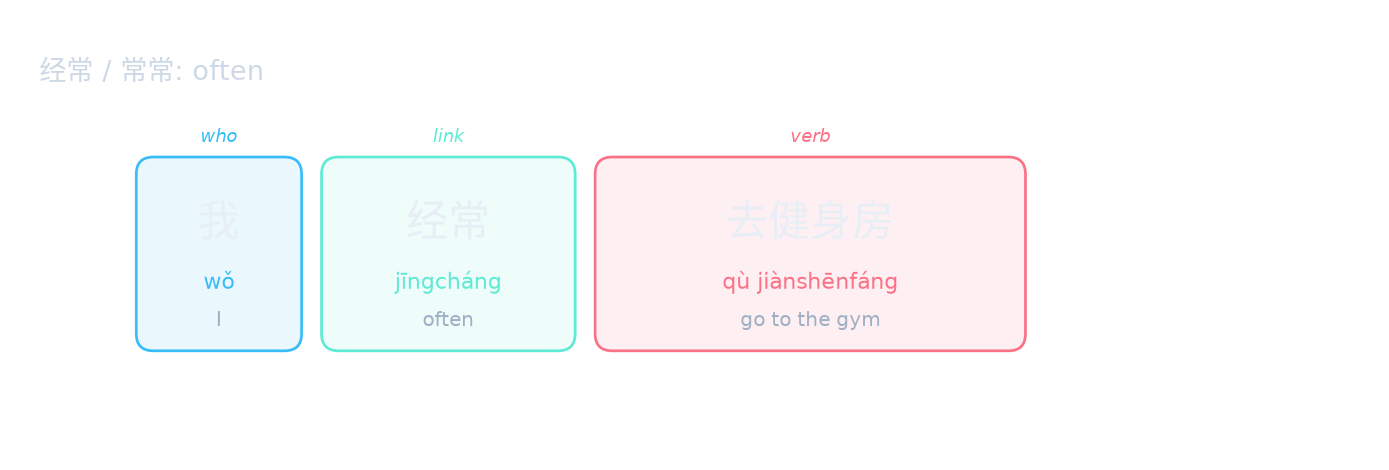
    • I / me我wǒoften经常jīng chángto go去qùgym健身房jiàn shēn fáng,weekend周末zhōu mòalso也yěoften常常cháng chángto go去qùswimming游泳yóu yǒng。 — "I go to the gym regularly, and at weekends I often go swimming too."

    Both mean "often"

    • often常常cháng cháng and often经常jīng cháng both describe frequent actions: I / me我wǒoften常常cháng cháng / often经常jīng chángto drink tea喝茶hē chá.
    • In many sentences they are interchangeable.

    he他tāregularly经常jīng chángworks overtime加班jiā bān。

    经常 / 常常: often

    Where they differ

    • often经常jīng cháng can be an adjective before a noun: 经常性jīng cháng xìng(modifier / structural particle)的dequestion问题wèn tí — "a recurring problem". often常常cháng cháng cannot.
    • often常常cháng cháng has a negative not不bùalways常cháng: I / me我wǒ不常去bù cháng qù. often经常jīng cháng's negative not不bùoften经常jīng cháng is fine too; not不bùoften常常cháng cháng is not used.

    I我wǒnot often不常bù chánggo去qùthe cinema电影院diàn yǐng yuàn。

    Negatives

    • Say not不bùalways常cháng or not不bùoften经常jīng cháng, not not不bùoften常常cháng cháng.
    • Both go before the verb, after the subject and time words: he / him他tāweekend周末zhōu mòoften经常jīng chángto work overtime加班jiā bān.

    Versus usually往往wǎng wǎng

    • often常常cháng cháng / often经常jīng cháng = often, simply a frequency.
    • usually往往wǎng wǎng = tends to, under a stated condition: 下雨天xià yǔ tiānusually往往wǎng wǎngtraffic jam堵车dǔ chē.

    on rainy days下雨天xià yǔ tiāntends to往往wǎng wǎnghave traffic jams堵车dǔ chē。

    Recap

    • often常常cháng cháng / often经常jīng cháng = often (mostly interchangeable); often经常jīng cháng can also describe nouns (经常性jīng cháng xìng).
    • Negatives: not不bùalways常cháng / not不bùoften经常jīng cháng, never not不bùoften常常cháng cháng. usually往往wǎng wǎng needs a condition.

    Practise this pattern step by step.

    Practice without the models

    often常常cháng cháng vs often经常jīng cháng (often / regularly)

    2401.1 Complete: “I don't often go to the cinema.” I / me我wǒnot不bù…………to go去qùcinema电影院diàn yǐng yuàn。

    2401.2 Which form is NOT used?

    • A. not不bùalways常cháng
    • B. not不bùoften常常cháng cháng
    • C. often经常jīng cháng
    • D. not不bùoften经常jīng cháng

    2401.3 Build: “He regularly works overtime at weekends.”

    Arrange all chunks: he / him他tāweekend周末zhōu mò / to work overtime加班jiā bān。 / often经常jīng cháng

    2401.4 usually往往wǎng wǎng needs a condition, unlike often常常cháng cháng.

    True or false? Explain or repair the statement.

    2401.5 A new friend asks about your exercise habits. Close the examples. Say a Mandarin response, then write it in Chinese. Explain briefly in English what the lesson’s pattern adds. Compare with the model, then change one detail and try again.

    Write or say your own response before reading the key.

    Answers and explanations

    often常常cháng cháng vs often经常jīng cháng (often / regularly)

    2401.1 always常cháng

    not不bùalways常cháng or not不bùoften经常jīng cháng; not不bùoften常常cháng cháng is not used.

    2401.2 B. not不bùoften常常cháng cháng

    The negative of often常常cháng cháng is not不bùalways常cháng or not不bùoften经常jīng cháng; not不bùoften常常cháng cháng is not used. often经常jīng cháng itself is fine but is positive.

    2401.3 he / him他tāweekend周末zhōu mòoften经常jīng chángto work overtime加班jiā bān。

    Subject + time + often经常jīng cháng + verb.

    2401.4 True.

    True. usually往往wǎng wǎng describes what tends to happen under a condition, so it needs one: 下雨天xià yǔ tiānusually往往wǎng wǎngtraffic jam堵车dǔ chē. often常常cháng cháng can describe simple frequency or the future: after以后yǐ hòuoften常常cháng chángto come来lái.

    2401.5 One possible response: I / me我wǒoften经常jīng chángto go去qùgym健身房jiàn shēn fáng,weekend周末zhōu mòalso也yěoften常常cháng chángto go去qùswimming游泳yóu yǒng。

    Check meaning and form:

    • My response conveys a message that fits the opening situation.
    • I can explain the meaning of the pattern, rather than only naming it.
    • Say not不bùalways常cháng or not不bùoften经常jīng cháng, not not不bùoften常常cháng cháng.
    • Both go before the verb, after the subject and time words: he / him他tāweekend周末zhōu mòoften经常jīng chángto work overtime加班jiā bān.
    • I tried a second response with a name, time, place, or description changed.

    This is supported productive practice. Compare meaning and structure; your answer need not copy the model. A partner or teacher must hear the spoken response to comment on pronunciation.

  • 25 Comparing similar auxiliary words
    • 25.1 Comparing "zongsuan" and “zhongyu"

    Comparing similar auxiliary words →

  • 26 Comparing similar conjunctions
    • 26.1 Comparing "gen" and "dui"

    Comparing similar conjunctions →

  • 27 Comparing similar prepositions
    • 27.1 Comparing "chao" "xiang" and "wang"
    • 27.2 Comparing "dui" and "duiyu"
    • 27.3 Comparing "duiyu" and "zhiyu"
    • 27.4 Comparing "gei" and "wei"

    Comparing similar prepositions →

  • 28 Comparing similar time words
    • 28.1 Comparing "pingshi" and "pingchang"
    • 28.2 Comparing "yihou" and "zhihou"

    Comparing similar time words →

  • 29 Comparing similar verbs
    • 29.1 Comparing "kanqilai" and "kanlai"
    • 29.2 Comparing "xiande" and "kanqilai"

    Comparing similar verbs →

Log in or create account

IGCSE, A-Level & AP