Skip to content
Subjects
  • 1 Adjectives
    • 1.1 Adjectives with "-ji le"
    • 1.2 Reduplication of adjectives
    • 1.3 Turning adjectives into adverbs

    Adjectives →

  • 2 Adverbs
    • 2.1 Expressing "again" in the past with "you"
    • 2.2 Expressing "all along" with "yizhi"
    • 2.3 Expressing "always" with "zongshi"
    • 2.4 Expressing "finally" with "zhongyu"
    • 2.5 Expressing "nearly" with "jihu"
    • 2.6 Expressing "only" with "zhi"
    • 2.7 Expressing duration of inaction
    • 2.8 Expressing lateness with "cai"
    • 2.9 Sequencing with "xian" and "zai"
    • 2.10 Simultaneous tasks with "yibian"
    • 2.11 Using "always" as a complaint with "laoshi"
    • 2.12 Using "cai" for small numbers

    Adverbs →

  • 3 Adverbs with Adjectives
    • 3.1 Adjectives with "name" and "zheme"
    • 3.2 Basic comparisons with "yiyang"
    • 3.3 Expressing "both A and B" with "you"
    • 3.4 Expressing "rather" with "bijiao"
    • 3.5 Intensifying with "duo"
    • 3.6 Modifying nouns with adjective + "de"

    Adverbs with Adjectives →

  • 4 Conjunctions
    • 4.1 Expressing "or" in statements
    • 4.2 Expressing "then…" with "name"
    • 4.3 Expressing "with" with "gen"
    • 4.4 Offering choices with "haishi"

    Conjunctions →

  • 5 Nouns
    • 5.1 Before a specific time with "yiqian"
    • 5.2 Expressing "before" in general with "yiqian"
    • 5.3 Expressing "just now" with "gangcai"
    • 5.4 Expressing "when" with "shi"
    • 5.5 In the future in general with "yihou"
    • 5.6 Sequencing past events with "houlai"

    Nouns →

  • 6 Numbers
    • 6.1 Approximating with sequential numbers
    • 6.2 Big numbers in Chinese
    • 6.3 Structure of times (advanced)
    • 6.4 Structure of times (basic)

    Numbers →

  • 7 Particles
    • 7.1 Aspect particle "zhe"
    • 7.2 Change of state with "le"
    • 7.3 Questions with "ne"
    • 7.4 Structural particle "de"

    Particles →

  • 8 Prepositions
    • 8.1 Expressing "about" with "guanyu"
    • 8.2 Expressing "all the way until" with "zhidao"
    • 8.3 Expressing "towards" with "xiang"

    Prepositions →

  • 9 Verbs
    • 9.1 Appearance with "kanqilai"
    • 9.2 Basic comparisons with "meiyou"
    • 9.3 Causative verbs
    • 9.4 Expressing "through" with "jingguo"

    Verbs →

  • 10 Auxiliary verbs
    • 10.1 Expressing "should" with "yinggai"

    Auxiliary verbs →

  • 11 Verb phrases
    • 11.1 Expressing "difficult" with "nan"
    • 11.2 Expressing duration with "le"
    • 11.3 Expressing ongoing duration with double "le"
    • 11.4 Inability with "mei banfa"
    • 11.5 Reduplication of verbs
    • 11.6 Special verbs with "hen"

    Verb phrases →

  • 12 Complements
    • 12.1 Direction complement
    • 12.2 Potential complement
    • 12.3 Result complement "-xiaqu"
    • 12.4 Result complements

    Complements →

  • 13 Conditional Statements
    • 13.1 Expressing "as long as" with "zhiyao"
    • 13.2 Expressing "only after" with "cai"
    • 13.3 Expressing "only if" with "zhiyou"

    Conditional Statements →

  • 14 Noun Phrases
    • 14.1 Using "youde" to mean "some"

    Noun Phrases →

  • 15 Numbers and Measure Words

    Original teaching practice. Read one pattern, cover its model and try the questions before checking the separate answer section. Examples adapted from Chinese Grammar Wiki (AllSet Learning, CC BY-NC-SA) retain the course-reference provenance.

    half半bàn (half / and a half)

    Half a cake left

    • After the party, your mum looks at the table and counts what is left.
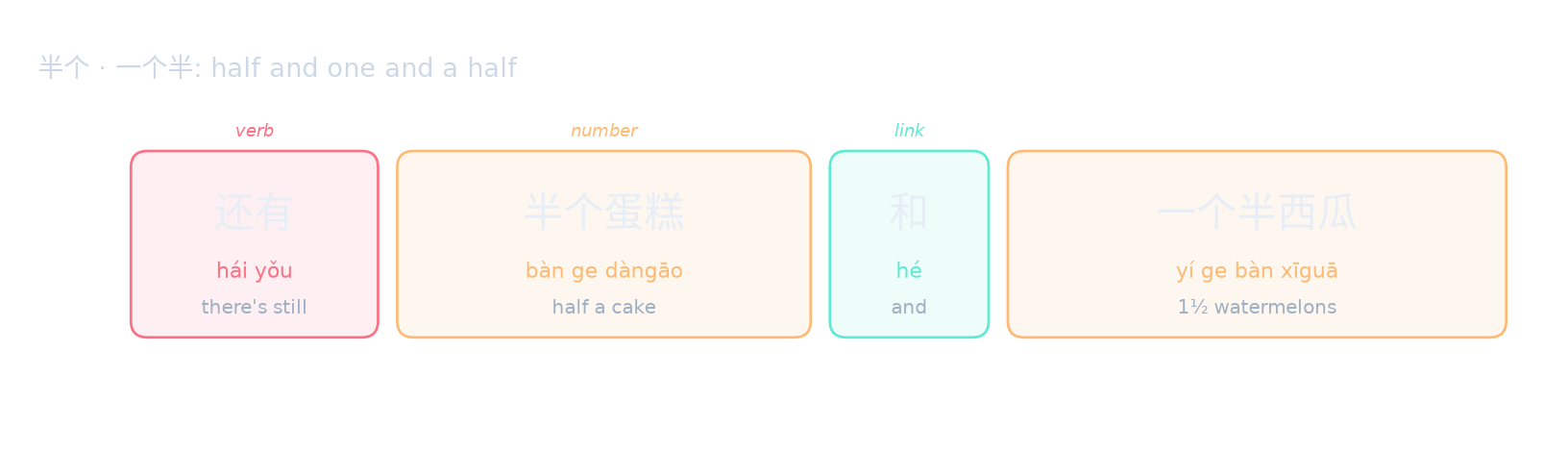
    • furthermore还有hái yǒuhalf of sth半个bàn gècake蛋糕dàn gāoand / with和héone and a half一个半yí gè bànwatermelon西瓜xī guā。 — "There's half a cake and one and a half watermelons left."

    half半bàn + measure word (half a …)

    • half半bàn + measure word + noun = half a …: half of sth半个bàn gèapple苹果píng guǒ, 半杯bàn bēiwater水shuǐ, half a year半年bàn nián.
    • half半bàn comes before the measure word, with no one / a一yī in front.

    I我wǒdrank喝hē了lehalf半bàna glass杯bēiof milk牛奶niú nǎi。

    半个 · 一个半: half and one and a half

    Number + measure word + half半bàn (… and a half)

    • Number + measure word + half半bàn = … and a half: one and a half一个半yí gè bànhour小时xiǎo shí (an hour and a half), 两年liǎng niánhalf半bàn (two and a half years).
    • With time: 三点sān diǎnhalf半bàn = half past three.

    I我wǒwaited等děng了leone一个yí gèand a half半bànhours小时xiǎo shí。

    Where half半bàn goes

    • Half a … : half半bàn before the measure word (half of sth半个bàn gèhour小时xiǎo shí). … and a half: half半bàn after it (one and a half一个半yí gè bànhour小时xiǎo shí).
    • Do not say half一半yí bàn(measure word)个gè or 一个yí gèhour小时xiǎo shíhalf半bàn: say half of sth半个bàn gè and one and a half一个半yí gè bànhour小时xiǎo shí.

    half一半yí bàn = half of something

    • half一半yí bàn is a noun: half (of a whole): half一半yí bàn(modifier / structural particle)的destudent学生xué shēngto be / is是shìschoolgirl女生nǚ shēng。 — "Half of the students are girls."
    • I / me我wǒonly只zhǐvariant of 吃吃chī(completed / change)了lehalf一半yí bàn — "I only ate half (of it)."

    half一半yí bàn的destudents学生xué shengare是shìgirls女生nǚ shēng。

    Recap

    • half半bàn + MW = half a …; Number + MW + half半bàn = … and a half; X点半diǎn bàn = half past X.
    • half一半yí bàn = half of something, a noun.

    Practise this pattern step by step.

    Practice without the models

    half半bàn (half / and a half)

    0516.1 Complete: “The film is two and a half hours long.” movie电影diàn yǐngto have / there is有yǒu两个liǎng gè…………hour小时xiǎo shí。

    0516.2 Which says “half an hour”?

    • A. hour小时xiǎo shíhalf半bàn
    • B. 一个yí gèhour小时xiǎo shíhalf半bàn
    • C. half一半yí bàn(measure word)个gèhour小时xiǎo shí
    • D. half of sth半个bàn gèhour小时xiǎo shí

    0516.3 Match each phrase to its meaning.

      1. half a year半年bàn nián
      1. 一年yī niánhalf半bàn
      1. half一半yí bàn
      1. 三点sān diǎnhalf半bàn
    • A. half past three

    • B. half a year

    • C. half (of it)

    • D. a year and a half

    0516.4 一个yí gèhour小时xiǎo shíhalf半bàn is the usual way to say “an hour and a half”.

    True or false? Explain or repair the statement.

    0516.5 After the party, your mum looks at the table and counts what is left. Close the examples. Say a Mandarin response, then write it in Chinese. Explain briefly in English what the lesson’s pattern adds. Compare with the model, then change one detail and try again.

    Write or say your own response before reading the key.

    Answers and explanations

    half半bàn (half / and a half)

    0516.1 half半bàn

    Number + MW + half半bàn + noun = two and a half hours.

    0516.2 D. half of sth半个bàn gèhour小时xiǎo shí

    half半bàn + MW + noun.

    0516.3 1–B: half a year半年bàn nián = half a year; 2–D: 一年yī niánhalf半bàn = a year and a half; 3–C: half一半yí bàn = half (of it); 4–A: 三点sān diǎnhalf半bàn = half past three

    half半bàn before the MW is “half a”; after it, “and a half”; half一半yí bàn is the noun.

    0516.4 False.

    Say one and a half一个半yí gè bànhour小时xiǎo shí.

    0516.5 One possible response: furthermore还有hái yǒuhalf of sth半个bàn gècake蛋糕dàn gāoand / with和héone and a half一个半yí gè bànwatermelon西瓜xī guā。

    Check meaning and form:

    • My response conveys a message that fits the opening situation.
    • I can explain the meaning of the pattern, rather than only naming it.
    • Half a … : half半bàn before the measure word (half of sth半个bàn gèhour小时xiǎo shí). … and a half: half半bàn after it (one and a half一个半yí gè bànhour小时xiǎo shí).
    • Do not say half一半yí bàn(measure word)个gè or 一个yí gèhour小时xiǎo shíhalf半bàn: say half of sth半个bàn gè and one and a half一个半yí gè bànhour小时xiǎo shí.
    • I tried a second response with a name, time, place, or description changed.

    This is supported productive practice. Compare meaning and structure; your answer need not copy the model. A partner or teacher must hear the spoken response to comment on pronunciation.

  • 16 Sentence Patterns
    • 16.1 Expressing "not even one"
    • 16.2 Expressing "the more... the more..." with "yue… yue…"
    • 16.3 Using "ba" sentences
    • 16.4 Using "bei" sentences

    Sentence Patterns →

  • 17 Basic/Simple Sentence Patterns
    • 17.1 Alternative existential sentences
    • 17.2 Expressing "as one likes" with "jiu"
    • 17.3 Expressing "every" with question words
    • 17.4 Expressing "more and more" with "yuelaiyue"
    • 17.5 Expressing "some" with question words
    • 17.6 Expressing purpose with "weile"

    Basic/Simple Sentence Patterns →

  • 18 Comparison Patterns
    • 18.1 Expressing "compared with" using "gen"
    • 18.2 Expressing "even more" with "geng" or "hai"
    • 18.3 Expressing "much more" in comparisons
    • 18.4 Expressing comparable degree with "you"

    Comparison Patterns →

  • 19 Complex Sentence Patterns
    • 19.1 Expressing "except" and "in addition" with "chule… yiwai"
    • 19.2 Expressing "if" with "ruguo... dehua"
    • 19.3 Expressing "if... then..." with "ruguo... jiu..."
    • 19.4 Expressing "not only... but also" with "budan... erqie..."

    Complex Sentence Patterns →

  • 20 Comparing similar adverbs
    • 20.1 Comparing "cai" and "jiu"
    • 20.2 Comparing "gang" and "gangcai"
    • 20.3 Comparing "youdian" and "yidian"
    • 20.4 Comparing "zai" and "you"

    Comparing similar adverbs →

  • 21 Comparing similar conjunctions
    • 21.1 Comparing "haishi" and "huozhe"

    Comparing similar conjunctions →

  • 22 Comparing similar time words
    • 22.1 Comparing "yihou" "ranhou" "houlai"

    Comparing similar time words →

Log in or create account

IGCSE, A-Level & AP