Skip to content

HL extensions · Culture, motivation, technology and data analysis

International Baccalaureate · IB Diploma · Psychology · HL · Topic 4

Video lesson for this topic Open the video page
7:56

HL extensions: culture, motivation, technology and data

In 2021 China limited online games for under-18s to one hour on Friday, Saturday and Sunday evenings and on public holidays. The rule rests on three claims…

English narration · English + 中文 subtitles burned in

4.1

HL extensions: culture, motivation, technology and data

IB Diploma Programme Psychology HL (the course first assessed in 2027). HL students study two extensions of 45 hours each. The first is the role of culture 文化, motivation 动机 and technology 技术 in shaping human behaviour. The second is data analysis and interpretation 数据分析与解读. Paper 3 (1 hour 45 minutes, 30 marks) joins them: you get four to six sources with research findings on one extension topic and answer four questions (3, 6, 6 and 15 marks). You read graphs, judge the research and decide how far the evidence supports a claim.

In 2021 China limited online games for under-18s to one hour on Friday, Saturday and Sunday evenings and on public holidays. The rule rests on claims about technology (games harm young people), motivation (games are designed to keep players playing) and culture (what families and schools expect of children). Are the claims true? A Paper 3 answer looks at the data before it agrees.

Must-know for this topic:

Idea Key content
culture cultural dimensions; WEIRD samples; emic and etic; attribution across cultures
motivation intrinsic and extrinsic; self-determination theory; the overjustification effect
technology social media and well-being; smartphones and attention; the Google effect
data analysis mean, median, standard deviation; graphs; correlation; p-values; thematic analysis
Paper 3 read the source; judge the research; weigh several sources against a claim
Vocabulary Train
English
culture/ˈkʌltʃə/
motivation/ˌməʊtɪˈveɪʃn/
technology/tekˈnɒlədʒi/
data analysis and interpretation
4.2

Culture and behaviour

Hofstede described cultural dimensions 文化维度, ways in which national cultures differ on average. The best known is individualism–collectivism 个人主义与集体主义: in individualist cultures people see themselves mainly as separate persons; in collectivist cultures mainly as members of groups. These are averages: many people in any country do not fit them.

Culture shapes how we explain behaviour. Morris and Peng (1994) compared reports of the same two murders in an English-language and a Chinese-language newspaper in the United States. The English reports blamed the killers' personalities more; the Chinese reports pointed more to the situation, such as the killer's relationships and pressures.

Culture also matters for research itself. Henrich et al. (2010) found that about 96% of participants in top psychology journals came from Western, industrialised countries, which hold only about 12% of the world's population. They called these samples WEIRD (Western, educated, industrialised, rich, democratic). An etic 客位 approach applies one idea in every culture; an emic 主位 approach studies a culture from the inside, in its own terms. Findings from WEIRD samples should be tested before they are applied to students in China.

Vocabulary Train
English
cultural dimensions
individualism–collectivism
etic
emic/ˈemɪk/
4.3

Motivation

Intrinsic motivation 内在动机 comes from enjoying the activity; extrinsic motivation 外在动机 comes from rewards or punishments. Self-determination theory 自我决定理论 (Deci and Ryan) says people are most motivated when three needs are met: autonomy 自主 (choice), competence 胜任 (feeling able) and relatedness 归属 (feeling connected to others).

Rewards can reduce intrinsic motivation. Lepper, Greene and Nisbett (1973) studied preschool children who liked to draw. Some were promised a certificate for drawing; others were not. One to two weeks later, in free time, the children who had expected the certificate spent about 9% of their time drawing, compared with about 17% to 18% in the other groups. This is the overjustification effect 过度理由效应: the reward becomes the reason, so without it the activity loses its pull. Game designers use the other side of this, with points, levels and streaks that reward players often.

Vocabulary Train
English
intrinsic motivation/ɪnˈtrɪnsɪk ˌməʊtɪˈveɪʃn/
extrinsic motivation/ekˈstrɪnsɪk ˌməʊtɪˈveɪʃn/
self-determination theory/self dɪˌtɜːmɪˈneɪʃn ˈθɪəri/
autonomy/ɔːˈtɒnəmi/
competence
relatedness
overjustification effect
4.4

Technology and behaviour

Many people believe social media makes teenagers unhappy. Orben and Przybylski (2019) analysed three large data sets with more than 350,000 teenagers. Technology use did have a negative link with well-being, but it explained at most 0.4% of the differences in well-being, about as much as eating potatoes did. The data were correlational, so they cannot show the direction of cause: unhappy teenagers may also use more social media.

Ward et al. (2017) gave students working-memory tests with their phone on the desk (face down, silent), in a bag, or in another room. Students did best with the phone in another room, even though they did not use it. Later studies did not always find the effect, which is a reason to wait for replications before changing school rules.

Sparrow et al. (2011), in Topic 2, showed that people remember where information is stored rather than the information itself when they expect to find it online.

4.5

Data analysis and interpretation

Describing numbers

Measure Meaning Use
mean 平均数 total divided by number of scores most data; affected by extreme scores
median 中位数 middle score data with extreme scores
mode 众数 most common score categories
range 极差 highest minus lowest quick idea of spread
standard deviation 标准差 typical distance of scores from the mean shows how much scores spread

A difference between two means is only meaningful if it is large compared with the standard deviation. Inferential tests 推断统计检验 give a p-value: the chance of a difference this big if the null hypothesis were true. Psychologists usually call a result statistically significant 统计显著 when p < 0.05. A significant result can still be a small effect, and a result from a small sample may not repeat.

A correlation coefficient 相关系数, r, runs from −1 to +1. A value near 0 means no linear relationship; ±0.5 is moderate; ±1 is perfect. A negative r means one variable goes down as the other goes up.

Describing words

Thematic analysis 主题分析 turns interview transcripts into themes. Content analysis 内容分析 counts how often coded categories appear, which turns words into numbers. Two coders working on the same data check each other.

Six steps of thematic analysis from transcription to defined themes, and two raters coding 20 statements with 16 agreements (80%)

Thematic analysis in six steps, and how two coders check their agreement

Vocabulary Train
English
mean/miːn/
median/ˈmiːdiːən/
mode/məʊd/
range/reɪndʒ/
standard deviation/ˈstændəd ˌdiːvɪˈeɪʃn/
inferential tests
statistically significant/stəˈtɪstɪkli sɪɡˈnɪfɪkənt/
correlation coefficient/ˌkɒrɪˈleɪʃn ˌkəʊɪˈfɪʃənt/
thematic analysis/θiːˈmætɪk əˈnæləsɪs/
content analysis
4.6

Paper 3: worked example

The claim: "The use of technology in school may have a negative effect on students' mental health." Two of the sources are shown below; the data are invented for practice.

Source A: bar chart of mean anxiety 14.2 with phones collected and 16.1 with phones allowed, error bars of about 5; Source B: scatter graph of sleep against screen time for 60 students with r = -0.56

Two practice sources: a group comparison and a correlation

1. Explain one issue that limits the interpretation of the data in Source A. (3 marks)

The two groups were two whole classes, not randomly allocated, so they may differ in other ways, such as teacher or timetable. The difference in means (1.9) is also small compared with the standard deviations (about 5), so it may be due to chance.

2. Analyse the findings in Source B and state a conclusion linked to the claim. (6 marks) Describe the pattern (r = −0.56: a moderate negative correlation; more screen time goes with less sleep), give the range (about 6 to 9 hours of sleep), then the limit: it is one survey of self-reported hours, and correlation does not show cause. Conclusion: Source B supports a link between screen time and sleep, and poor sleep can harm mental health, but it does not show that technology causes the harm.

3. Discuss how the researcher could improve the credibility of the findings. (6 marks) For quantitative sources: random allocation, larger samples, objective measures such as sleep trackers, replication. For qualitative sources: triangulation, a second coder, and checking the themes with the participants.

4. To what extent can we conclude the claim? (15 marks) Use all the sources. Group them: which support the claim, which do not, and how strong each is. Weigh them with the concepts (causality, measurement, bias). End with a judgement: for example, the sources suggest a small negative link, but the designs cannot show cause, so the claim is only partly supported.

4.7

Checklist

  • Culture: individualism–collectivism; attribution across cultures (Morris and Peng); WEIRD samples (Henrich); emic and etic.
  • Motivation: intrinsic and extrinsic; self-determination theory and its three needs; the overjustification effect (Lepper et al.).
  • Technology: social media and well-being (Orben and Przybylski); phones and working memory (Ward et al.); the Google effect (Sparrow et al.).
  • Data: mean, median, mode, range, standard deviation; p-values and significance; correlation coefficients; thematic and content analysis.
  • Paper 3: four questions (3, 6, 6, 15 marks); read the source, judge its quality, and weigh all the sources before a final judgement.
Additional notes PDF
Supported preparation: HL methods, ethics and transferability

Scope and prerequisites

IB Psychology HL, the course first assessed in 2027. This supplement goes with Topic 4: the HL extensions (culture, motivation and technology; data analysis and interpretation) and Paper 3.

Mapped preparation outcomes: ib_psychology_hl.4.1, ib_psychology_hl.4.2. Read the matching native lesson first. Actual approved choices, evidence and final learner work remain separate.

Source vocabulary

credibility 可信性; transferability 可迁移性.

Explanation and worked method

Evaluate quantitative and qualitative methods for their questions. Interviews investigate meanings; transparent recruitment, analytic decisions, supporting excerpts and researcher reflexivity support credibility. Large sample size alone does not establish it.

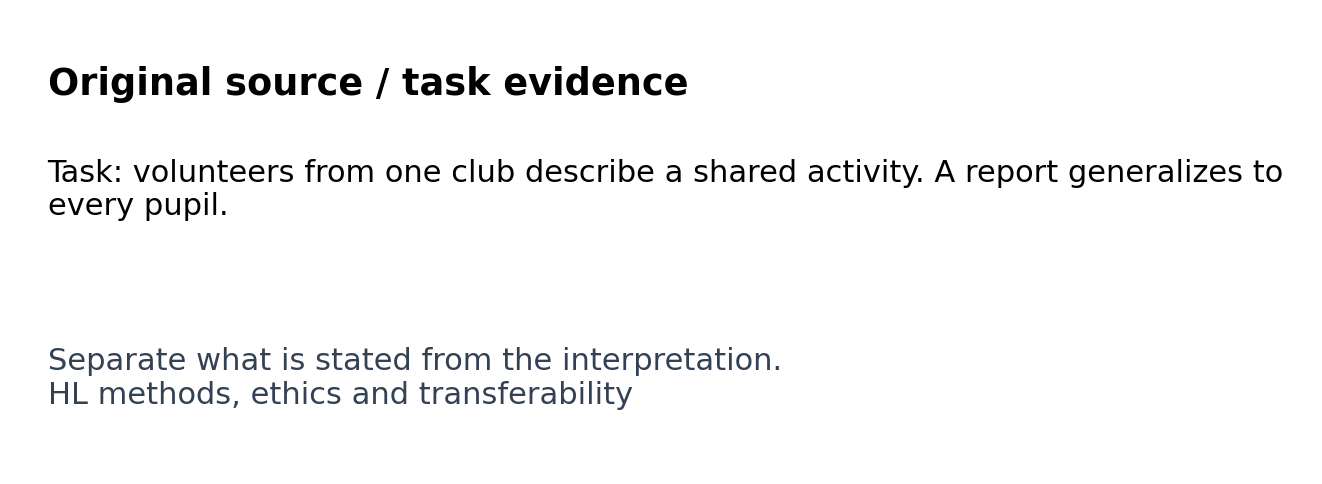
Original classroom evidence panel for HL methods, ethics and transferability

Task: volunteers from one club describe a shared activity. A report generalizes to every pupil. Revise and improve the analysis.

Limit the account to recruited participants and the investigated setting. Compare differing accounts, document how themes were developed and consider absent perspectives and the researcher's role. Seek approved contrasting recruitment where relevant.

Independent transfer

Why is a randomized treatment trial not the sole standard for an interview inquiry about meaning?

Attempt independently before reading the model.

Checked original model

The question concerns participants' interpretations, not an estimated treatment contrast. Evaluate recruitment, context, analytic transparency, supporting excerpts, reflexivity and ethics. Quantitative causal standards do not replace these checks, but qualitative labels do not excuse unsupported or overgeneralized claims.

These are authored formative expectations, not official IB descriptors. Accept other justified arguments with evidence and material limits.

Source and task holds

This supplement teaches the method for this part of the course. The full assessment criteria and any texts your school chooses come from your teacher.

Interactive lessons on this topic

Work through it step by step, with instant-check exercises.

More topics in International Baccalaureate · IB Diploma · Psychology · HL

Log in or create account

IGCSE, A-Level & AP