Skip to content
Subjects

International Baccalaureate · IB Diploma · Language A: Language and Literature · SL

  • 1

    Readers, writers and texts · English non-literary analysis

    Learning program coming soon

    Handout

    Scope and prerequisites

    IB Language A language and literature first assessment 2021; English focus. This supplemental reference covers only the listed preparation outcomes. School selections, full-guide procedures and required live or recorded performance are separate.

    • Analyse audience, purpose, register 语域 and multimodal choices
    • Support interpretations of a non-literary text with precise evidence 证据

    Prerequisites: Text type; audience and purpose; distinguish intended and measured effects.

    Explain and choose the method

    Identify text type, audience and purpose, then analyse how choices construct meaning.

    Visual hierarchy 视觉层级, diction 措辞, framing and register can guide attention and position the reader.

    Visual hierarchy makes some information prominent. The large invitation draws attention; the smaller safety limit narrows the promise. Link a visible choice to a possible reader response using “may” or “invites”. Do not claim an actual booking increase without response data. Analyse the supplied image as well as its words.
    Original diagram of the worked relationship; read the full wording and qualifications.
    Original diagram of the worked relationship; read the full wording and qualifications.

    Existing worked example: Only three days left combines a restrictive word with a time limit; the large countdown makes urgency visible. Explain how this could prompt quick action, while acknowledging that different readers may resist the message.

    Complete original context

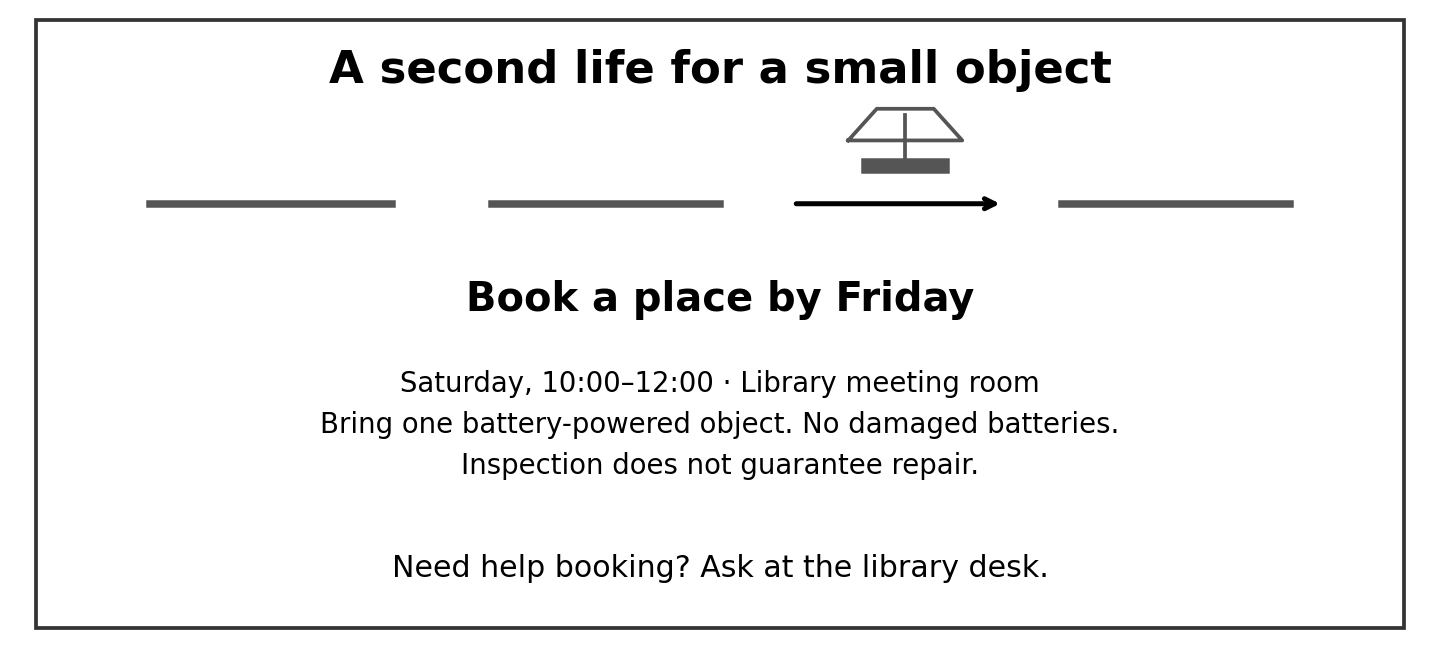
    Original non-literary stimulus — Library repair session notice. Use the actual supplied notice image with this text.

    Large heading: “A second life for a small object”. Main visual: a broken line becomes an unbroken line beside a lamp symbol. Prominent instruction: “Book a place by Friday”. Smaller text: “Saturday, 10:00–12:00. Library meeting room. Bring one battery-powered object. No damaged batteries. Inspection does not guarantee repair.” Footer: “Need help booking? Ask at the library desk.”

    The notice is an original classroom design, not a real event announcement. Its audience is local library users who may have a small broken object. Its purpose is to encourage a booking while communicating limits. A reader's actual response has not been measured.

    Independent practice and checked reasoning

    Transfer 1

    Analyse how heading, visual and booking instruction work together. Include two precise details and one qualification about audience response.

    Reasoning: The heading's “second life” frames repair as renewal, while the broken-to-unbroken line beside the lamp gives that change a visual form. “Book a place by Friday” converts interest into a specific action and deadline. These choices may prompt users with broken objects to book, but no response data establishes that every reader will do so.

    Transfer 2

    Explain the relationship between the invitation and the smaller limitations. Does “Inspection does not guarantee repair” contradict the notice's purpose?

    Reasoning: The invitation encourages participation, while the battery and repair limits define eligibility and avoid an unlimited promise. The qualification can support informed participation rather than cancel the purpose. Analyse its smaller prominence as a tension in how readily readers may notice it, without assuming they all miss it.

    Transfer 3

    Compare a reader comfortable booking online with one who needs help. Which visible feature broadens access, and what additional evidence would test its effect?

    Reasoning: The desk-help footer gives a route for readers needing assistance. Its effect could be tested by observing enquiries and bookings or asking readers whether they noticed and understood it. The notice alone supplies an invitation, not measured inclusion.

    Limits and next use

    Do not list techniques without their function or assume an effect occurs for every reader. HL analyses both unseen texts in Paper 1; SL chooses one. Practise complete analysis rather than doubling an SL answer.

    All tasks here are public original practice with authored guidance. They are not official questions or fresh diagnostics. Existing protected tests and mocks remain separate.
    Vocabulary
    English
    visual hierarchy/ˈvɪʒuːəl ˈhaɪərɑːki/
    evidence/ˈevɪdəns/
    register/ˈredʒɪstə/
    diction/ˈdɪkʃn/
  • 2

    Time and space; intertextuality · Literary comparison and context

    Learning program coming soon

    Handout

    Scope and prerequisites

    IB Language A language and literature first assessment 2021; English focus. This supplemental reference covers only the listed preparation outcomes. School selections, full-guide procedures and required live or recorded performance are separate.

    • Compare authorial choices across two selected literary works
    • Explain how contexts shape meaning without reducing a work to biography

    Prerequisites: Close reading 细读; comparative claim; context versus biography.

    Explain and choose the method

    Paper 2 compares two studied literary works in response to a question.

    Use topic-led comparison: connect a specific choice in one work to a related or contrasting choice in the other.

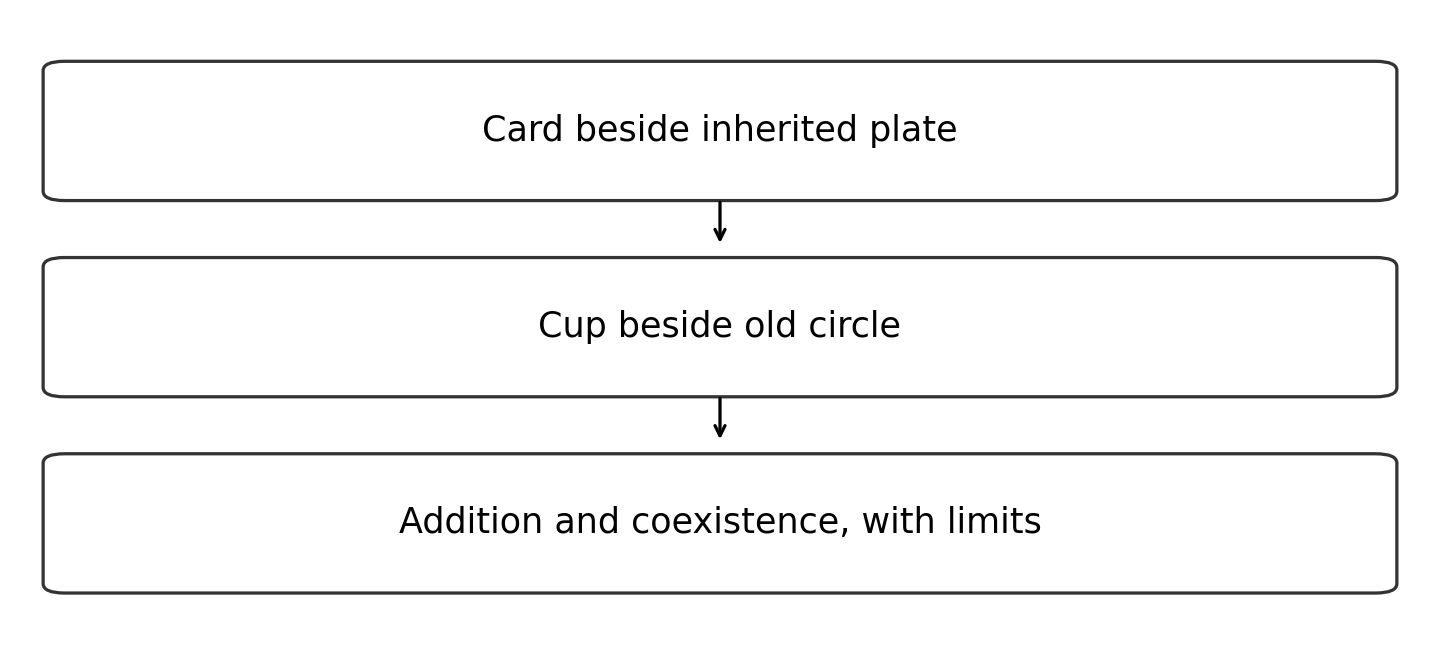
    A comparative argument 论证 比较论证 explains a relationship through both texts. Use a shared question, then analyse a distinct choice in each text. “Both concern belonging” is a start, not a developed comparison. The original classroom context supplies no biography; analyse wording before suggesting a broader interpretation.

    Original diagram of the worked relationship; read the full wording and qualifications.
    Original diagram of the worked relationship; read the full wording and qualifications.

    Existing worked example: One narrator may withhold a character's motives while another presents interior thought. Compare how these choices position readers to judge exclusion. Select precise evidence 证据 from the school's texts and connect it to your thesis.

    Complete original context

    Original classroom texts, written for this supplement. They are not school-selected assessed works.

    Text A — The label Every morning I polished the brass plate beside the door. It carried my father's name, and visitors asked for him even after I took charge of the shop. I answered their questions, found the parts, and wrapped each purchase. Still, at the door, they thanked the name on the plate. One afternoon I put a small card below it: “Ask for Leila.” The next visitor read the card aloud, hesitated, and then asked me where the hinges were. I left the brass plate shining. The card stayed too.

    Text B — A space on the shelf (original poem) I cleared a place beside the cup, not where the cup had been. The shelf kept its old circle; the new wood still looked clean. By evening, two rings darkened it. I did not rub them out.

    Context supplied for this exercise: both texts are contemporary original classroom writing in English. No author biography, translation 翻译 history or evidence about a real society is supplied. Compare what the wording permits; do not invent historical facts. A real course comparison must use the school's eligible studied works.

    Independent practice and checked reasoning

    Transfer 1

    Compare how both texts represent making a place for a new identity. Write a complete comparative paragraph with quotations.

    Reasoning: Both texts make identity visible through a small addition rather than complete replacement. In A, “Ask for Leila” gives the worker a public name beside the inherited brass plate, turning unnamed labour into recognition. In B, “beside” rather than “where” preserves the old cup's place while creating another. A's hesitation before a visitor speaks Leila's name stages a social adjustment; B's two darkened rings make coexistence visible without a visitor. The difference is between recognition through language and belonging through shared space, not a simple opposition between keeping and destroying the past.

    Transfer 2

    Identify one contrasting reading that complicates a wholly optimistic interpretation of A, without inventing biography.

    Reasoning: Leila must add a request to be recognised, and the visitor hesitates, so recognition is not automatic. Keeping the shining plate may suggest respect, but could also show the inherited name retains authority. Both readings need the supplied details and should remain interpretations, not claims about the author's family.

    Transfer 3

    Explain how you would transfer this method to two actual studied works and what must be verified before making historical-context claims.

    Reasoning: Choose a question-led comparison, select precise scenes and authorial choices from both works, and test a counter-reading. Verify editions, eligible works, reliable contextual evidence and the relevance 相关性 of that context to textual details. A general biography cannot replace analysis.

    Limits and next use

    Do not compare one literary and one non-literary text for Paper 2. Context informs an interpretation but cannot replace close reading or prove a single fixed meaning.

    All tasks here are public original practice with authored guidance. They are not official questions or fresh diagnostics. Existing protected tests and mocks remain separate.

    Vocabulary
    English
    comparative argument
    close reading/kləʊs ˈriːdɪŋ/
    translation/trænˈsleɪʃn/
    relevance/ˈrelɪvəns/
    evidence/ˈevɪdəns/
    argument/ˈɑːɡjuːmənt/
  • 3

    Individual oral · A global issue across literary and non-literary work

    Learning program coming soon

    Handout

    Scope and prerequisites

    IB Language A language and literature first assessment 2021; English focus. This supplemental reference covers only the listed preparation outcomes. School selections, full-guide procedures and required live or recorded performance are separate.

    • Form a focused global issue 全球性问题 and select relevant extracts
    • Balance extract analysis with whole-work or body-of-work discussion

    Prerequisites: Close reading 细读; distinguish literary work and non-literary body of work.

    Explain and choose the method

    The global issue should have wider significance and operate in local contexts.

    For this course, connect a literary work and a non-literary body of work; explain how choices construct the issue in extracts and beyond them.

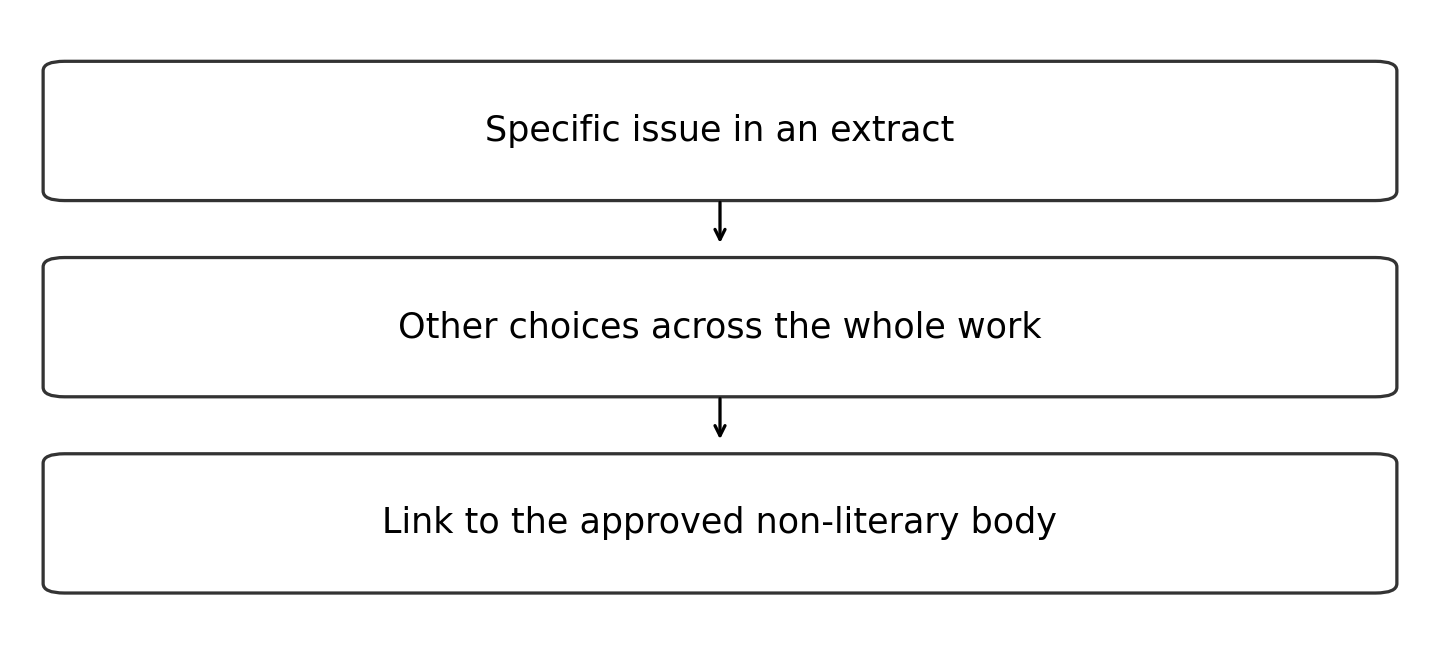
    A global issue must be focused enough to trace through specific choices. “Recognition of inherited and emerging identities” is more focused than “identity”. In Language and Literature, the assessed oral connects one eligible literary work with one eligible non-literary body of work. An original story and one classroom notice can rehearse links, but do not become the school's assessed pairing or a complete body of work.

    Original diagram of the worked relationship; read the full wording and qualifications.
    Original diagram of the worked relationship; read the full wording and qualifications.

    Existing worked example: Select an extract where labels shape a character's treatment and a related text from an approved non-literary body of work. Compare how diction 措辞 and framing operate, then show where the pattern continues or changes across each work.

    Complete original context

    Original classroom texts, written for this supplement. They are not school-selected assessed works.

    Text A — The label Every morning I polished the brass plate beside the door. It carried my father's name, and visitors asked for him even after I took charge of the shop. I answered their questions, found the parts, and wrapped each purchase. Still, at the door, they thanked the name on the plate. One afternoon I put a small card below it: “Ask for Leila.” The next visitor read the card aloud, hesitated, and then asked me where the hinges were. I left the brass plate shining. The card stayed too.

    Text B — A space on the shelf (original poem) I cleared a place beside the cup, not where the cup had been. The shelf kept its old circle; the new wood still looked clean. By evening, two rings darkened it. I did not rub them out.

    Context supplied for this exercise: both texts are contemporary original classroom writing in English. No author biography, translation 翻译 history or evidence 证据 about a real society is supplied. Compare what the wording permits; do not invent historical facts. A real course comparison must use the school's eligible studied works.

    Independent practice and checked reasoning

    Transfer 1

    Form a focused issue from Text A, and give an extract-level observation plus a whole-text connection.

    Reasoning: “How inherited names affect recognition of a new worker” is focused. At extract level, visitors thank the plate rather than Leila; the card makes her name visible. Across the whole short text, the movement from polishing the inherited name to keeping both labels complicates a simple rejection of inheritance. For a real oral, make whole-work connections across the actual studied work rather than treating this short story as the full qualification's reading.

    Transfer 2

    Using the repair notice from sheet 1 as a rehearsal 排练, propose a cautious connection to access and recognition. Explain why one notice is insufficient to claim an assessed body of work.

    Reasoning: The desk-help footer recognises readers who cannot independently book; its prominence can be compared with who is named and addressed in the story. The connection needs a clearly stated issue and evidence rather than asserting identical situations. A body of work and its eligibility require school selection and fuller source context; one original classroom notice cannot establish that requirement.

    Transfer 3

    Outline a balanced oral rehearsal and two follow-up questions. Separate what can be checked in writing from live evidence still needed.

    Reasoning: Introduce the issue; analyse the literary extract and wider work; analyse the non-literary extract and wider body; compare and qualify the findings. Ask “Which detail 细节 challenges your reading?” and “Where else does this issue change in the work?” Written planning can check focus and references. Teacher-led interaction, eligible sources, permitted notes and actual recorded performance remain required.

    Limits and next use

    The oral is supervised spoken assessment, not an essay submitted in its place. Teacher verifies text eligibility, extract limits, notes and scheduling against the guide.

    All tasks here are public original practice with authored guidance. They are not official questions or fresh diagnostics. Existing protected tests and mocks remain separate.

    Vocabulary
    English
    close reading/kləʊs ˈriːdɪŋ/
    global issue/ˈɡləʊbl ˈɪʃuː/
    translation/trænˈsleɪʃn/
    rehearsal/rɪˈhɜːsl/
    evidence/ˈevɪdəns/
    diction/ˈdɪkʃn/
    detail/ˈdiːteɪl/

Log in or create account

IGCSE, A-Level & AP