Skip to content

Historical investigation · Inquiry, evidence and methodological reflection

International Baccalaureate · IB Diploma · History · SL · Topic 3

Video lesson for this topic Open the video page
5:14

The historical investigation

On 30 June 1936 the Emperor of Ethiopia, Haile Selassie, spoke to the League of Nations in Geneva. Italy had invaded in October 1935. In December the British…

English narration · English + 中文 subtitles burned in

3.1

The historical investigation

IB Diploma Programme History SL (the guide first assessed in 2017, examined until the 2028 course replaces it). The internal assessment is the historical investigation 历史探究: a piece of your own historical research on a topic you choose. It has a limit of 2,200 words, and the bibliography does not count towards it. It is worth 25% of the SL grade. Your teacher marks it out of 25, and the IB moderates the marks.

On 30 June 1936 the Emperor of Ethiopia, Haile Selassie, stood in front of the League of Nations in Geneva. Italy had invaded his country in October 1935, using aircraft and poison gas. The League had called Italy the aggressor and voted for sanctions 制裁, but not on oil, which Italy's army needed most. In December 1935 the British and French foreign ministers, Samuel Hoare and Pierre Laval, had secretly agreed a plan to give Italy large parts of Ethiopia. The plan leaked to French newspapers, there was public anger in Britain, and Hoare resigned. By May 1936 Italian troops were in Addis Ababa. "It is us today," the Emperor is reported to have said. "It will be you tomorrow." A textbook tells this story in a paragraph. An investigation asks one sharp question about it, and answers that question from evidence.

Must-know for the historical investigation:

Area Key content
the format at most 2,200 words; three sections; 25 marks; 25% of SL
section 1 (A, 6 marks) the question; two sources, their relevance, value and limitations
section 2 (B, 15 marks) an organised, critical argument from a range of evidence; a reasoned conclusion
section 3 (C, 4 marks) reflection on historians' methods and their problems, tied to your work
the question narrow, answerable, debatable; at least ten years in the past
integrity cite every source where you use it; a full bibliography

The investigation has three sections, and each section has its own criterion:

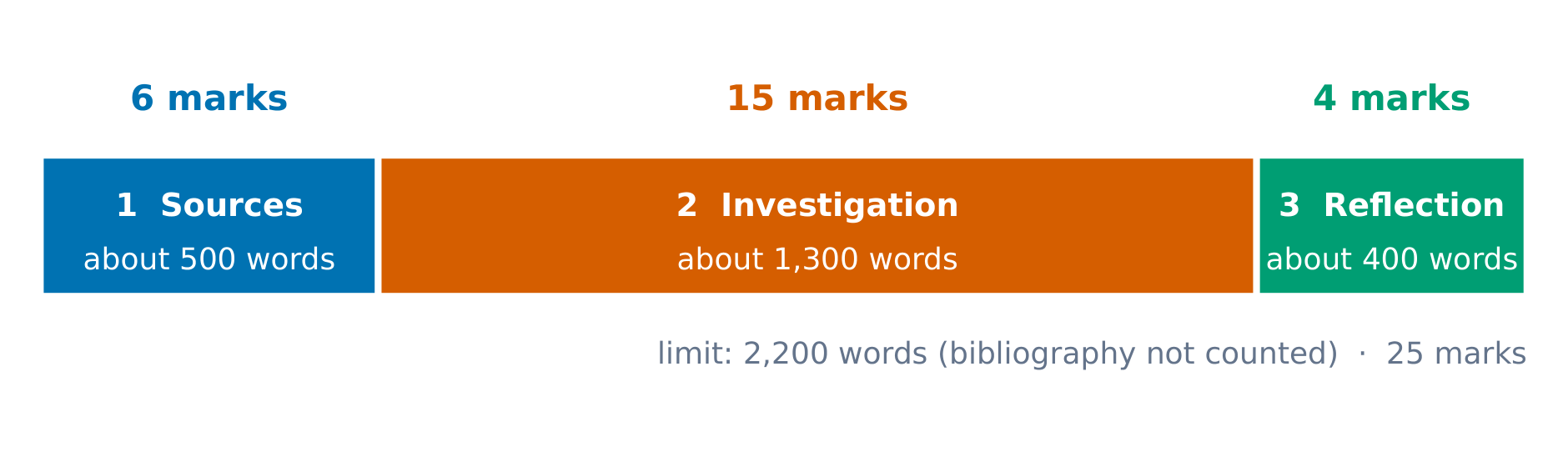
Section Criterion Marks Suggested length What it rewards
1 A: identification and evaluation of sources 6 about 500 words a clear question; two sources explained and analysed for value and limitations
2 B: investigation 15 about 1,300 words an organised, critical argument from a range of evidence, with a reasoned conclusion
3 C: reflection 4 about 400 words what the work showed you about historians' methods and their difficulties
The three sections of the investigation: words follow the marks

Section 2 carries 15 of the 25 marks, so it gets most of the words. A long section 1 takes words from it.

Vocabulary Train
English
historical investigation/hɪˈstɒrɪkl ɪnˌvestɪˈɡeɪʃn/
sanction
3.2

Choosing and planning

The question 问题 makes or breaks the investigation. A good one is:

  • narrow: a person, a decision, an event or a policy, not "a war";
  • answerable: the evidence exists and you can reach it;
  • debatable: historians disagree, or the answer is not simply in the textbook.
A funnel narrowing from the topic of the League of Nations in the 1930s to the Abyssinian crisis of 1935-36 to a focused question on how far the Hoare-Laval Plan was the decisive blow to the League's credibility
Each cut makes the question smaller and the judgement sharper.
Weak question Why it is weak Better question
Why did the League of Nations fail? a whole field; invites a story How far was the Hoare–Laval Plan (December 1935) the decisive blow to the League's credibility?
What was Mao's Great Leap Forward? description only; no debate To what extent were local officials, rather than central policy, responsible for the grain shortfall in Sichuan, 1959–61?
Was the atomic bomb on Hiroshima right? a moral question, not a historical one How far did the wish to end the war before Soviet entry shape the decision to use the bomb in August 1945?

Choose a topic at least ten years in the past, so that historians have had time to write about it. Your research plan 研究计划 is your own working tool, not a marked part: the question, the kinds of sources you will look for, and a first list of books and documents. It will change as you read. Choose a topic with a real historiography 史学辩论, a debate between historians, because section 2 rewards weighing different views. The classic failure is the biography report: a life story retold with no question.

A timeline that works. Most schools give about 20 hours of class time. A typical plan: choose a topic and a first question (weeks 1–2); read widely and narrow the question (weeks 3–5); choose the two section 1 sources and write section 1 (week 6); write section 2 from a theme plan (weeks 7–9); write section 3 and check citations (week 10). Your teacher may comment on one draft only, so make it a complete one.

Vocabulary Train
English
question/ˈkwestʃn/
research plan/rɪˈsɜːtʃ plæn/
historiography/ˌhɪstɔːrɪˈɒɡrəfi/
3.3

Sources, evidence and evaluation

Section 1 states the question, then identifies two sources and explains why each is relevant to it. It then analyses both with OPVL from topic 01: origin, purpose and content as the handles, value and limitations relative to your question. Use one primary source 一手史料 (a document, speech, statistic or memoir from the time) and one secondary source 二手史料 (a historian's book or article) if you can: the contrast gives you more to say.

Source 1: the plan as leaked Source 2: Hoare's memoir
origin text of the British–French proposals, printed in French newspapers, December 1935 Samuel Hoare, Nine Troubled Years (1954)
purpose to offer Italy enough land to end the war; leaked by someone who opposed it to explain and defend his own decisions as foreign secretary
value for the question shows exactly what Britain and France were ready to give an aggressor gives the motives of the man who made the plan, from the inside
limitation for the question a proposal, never carried out; shows intentions, not effects on the League written nearly twenty years later by a man defending his reputation

Weak and strong evaluation. Weak: "The memoir is biased because Hoare wrote it." Strong: "Because Hoare wrote in 1954, after the Second World War had made appeasement a word of shame, he had a reason to stress the danger of pushing Italy towards Germany. This limits the memoir as evidence of his motives in 1935, but it is still valuable for the British government's fear of a war on two fronts."

The rest of your reading feeds section 2. Group the evidence by theme, one group for each part of your argument, and check sources against each other: corroboration 相互印证 (two independent sources agree) and contradiction are both findings. Cite in the text (author, page) and give a full, consistent bibliography.

Vocabulary Train
English
primary source/ˈpraɪməri sɔːs/
secondary source/ˈsekəndəri sɔːs/
corroboration/kəˌrɒbəˈreɪʃn/
3.4

Analysis, conclusion and reflection

Section 2 is analysis 分析, not narrative: each part argues one point with evidence, weighs the other side and leads into the next. Name the historians who disagree and explain why they disagree (different sources, different questions, different times of writing). The conclusion answers the question directly and follows from the argument.

Section 2 plan as three themes leading to a judgement: the pattern since Manchuria in 1931, the leak and withdrawal of the plan in December 1935, and the Rhineland in March 1936, each with its evidence and the counter-view, arrowing to the conclusion
A theme plan for section 2: every theme argues, weighs and leads to the judgement.

A section 2 paragraph, analysed. "The plan's terms mattered less than its leak. Italy had already been named the aggressor in October 1935, and the League's sanctions left out oil (Source A). What changed in December was that the public saw the League's two leading members bargaining with that aggressor in secret. Hoare resigned within a week, which shows how strong the reaction was in Britain. However, some historians argue that the League's credibility was already lost after Japan took Manchuria in 1931, then left the League (1933) and kept its conquest. This view is persuasive for Asia, but in Europe many governments still expected the League to act in 1935, so the plan was the moment that expectation ended." The first sentence argues, the middle uses evidence, the "however" weighs a counter-view, and the last sentence makes a judgement.

Section 3 is reflection 反思 on method. Say what the investigation showed you about how historians work and the problems they meet: choosing sources, missing voices, bias, archives that are closed, or how hindsight changes a question. Always tie the point to your own investigation. "I learned a lot" earns nothing; "I could read only English-language sources, so my answer leans on the British view, and the Ethiopian experience of the war appears only through outsiders" earns marks.

Worked example in brief. Question: "How far was the Hoare–Laval Plan (December 1935) the decisive blow to the League's credibility?" Section 1 evaluates the leaked plan and Hoare's memoir, as in the table above. Section 2 argues in three themes: the pattern since Manchuria (1931); the leak and quick withdrawal of the plan; and the remilitarisation of the Rhineland (March 1936), when no League member acted. The conclusion: the plan mattered less for its terms than for its leak and withdrawal, which showed that the League's leading members would bargain with an aggressor. Section 3 reflects on relying on British sources and on how later historians judged the League by its failure in 1939.

Common mistakes: a question too wide for 2,200 words; section 1 that describes the sources but does not evaluate them for the question; section 2 as a story in time order; historians named but not weighed; a conclusion that sits on the fence; a reflection that is about you, not about historical method; citations missing or inconsistent.

Vocabulary Train
English
analysis/əˈnæləsɪs/
reflection/rɪˈflekʃn/
3.5

Checklist

  • The format: 2,200 words at most, three sections, 25 marks; section 2 carries 15 (all).
  • A narrow, answerable, debatable question, at least ten years in the past (section 1).
  • Two sources identified, their relevance explained, and each analysed with OPVL relative to the question (section 1).
  • Evidence grouped by theme, with corroboration and contradiction both reported, and historians' views weighed (section 2).
  • A conclusion that answers the question and follows from the argument (section 2).
  • Reflection on historians' methods, tied to your own investigation (section 3).
  • Consistent citation and a full bibliography (all).

Boundary notes: this follows the guide first assessed in 2017; the suggested section lengths and the timeline are guidance, the 2,200-word limit is not. The worked example and the model paragraph are original.

Additional notes PDF
Supported preparation: Investigation and historical reflection

Scope and prerequisites

IB history first assessment 2017; 2028 course recorded separately. School selects one of five prescribed subjects (both cases), two of twelve world-history topics; HL selects one region with three sections. No selection is silently implied. Future 2028 focused/thematic studies are a different course.

Mapped preparation outcomes: ib_history_sl.3.1, ib_history_sl.3.2. Read the matching native lesson first. Actual approved choices, evidence and final learner work remain separate.

Source vocabulary

historical inquiry 历史探究; significance 重要性.

Explanation and worked method

Focus a question on an issue, period and setting that surviving sources can address. Build a source inventory, cite exact sources and distinguish evaluation, argument and reflection on historical method.

Original classroom evidence panel for Investigation and historical reflection

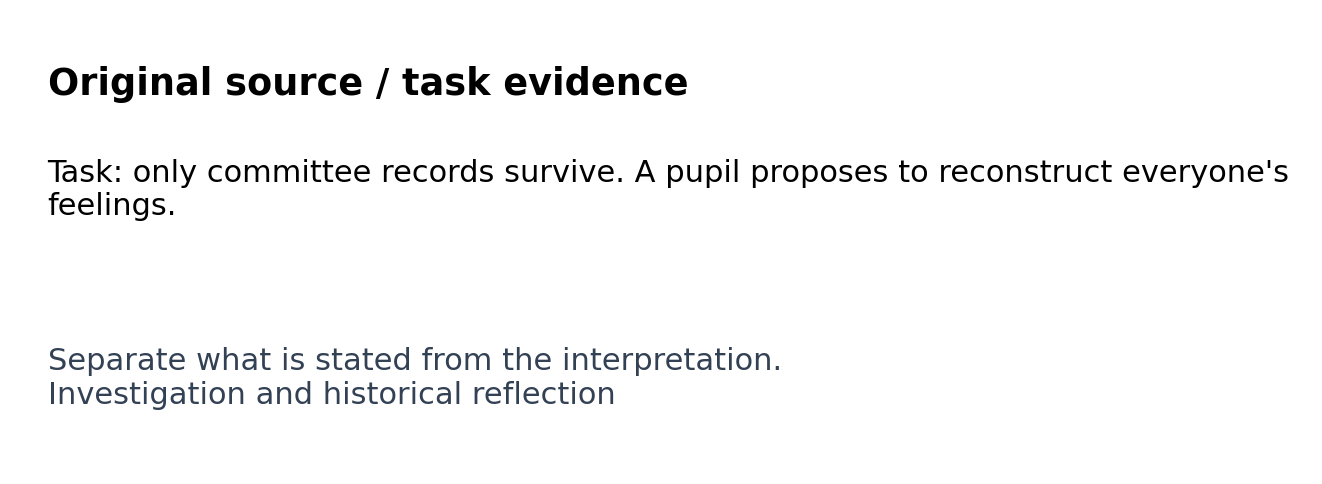
Task: only committee records survive. A pupil proposes to reconstruct everyone's feelings. Revise the question and reflect on the limitation.

Ask how the committee justified a bounded decision during a specified period, while noting that official records may omit dissent and users' experiences. Seek other surviving evidence without inventing testimony. Reflection explains selection and survival of records, not how hard the pupil worked.

Independent transfer

A private letter survives after an official-record-only investigation. Is it automatically more truthful?

Attempt independently before reading the model.

Checked original model

No. It can reveal a different perspective or omitted experience, but purpose, author, context and corroboration still matter. Revise the source range and question if justified; private status alone establishes neither accuracy nor representativeness.

These are authored formative expectations, not official IB descriptors. Accept other justified arguments with evidence and material limits.

Source and task holds

This supplement teaches the method for this part of the course. The full assessment criteria and any texts your school chooses come from your teacher.

Interactive lessons on this topic

Work through it step by step, with instant-check exercises.

More topics in International Baccalaureate · IB Diploma · History · SL

Log in or create account

IGCSE, A-Level & AP