Skip to content

Core · Power, legitimacy and source analysis

International Baccalaureate · IB Diploma · Global Politics · SL · Topic 1

Video lesson for this topic Open the video page
5:19

Power, sovereignty and legitimacy

In 2021 a container ship got stuck across the Suez Canal for six days, and factories in Europe ran short of parts from Asia. No government chose this, and no…

English narration · English + 中文 subtitles burned in

1.1

Power, sovereignty and legitimacy

IB Diploma Programme Global Politics SL (the guide first assessed in 2026). This topic covers the core 核心部分 of the course, understanding power and global politics, which SL and HL students both study. Four key concepts 关键概念 run through the whole course: power, sovereignty, legitimacy and interdependence. Paper 1 (1 hour 15 minutes; 30% at SL, 20% at HL) tests the core through source-based questions 基于材料的问题: you read short sources and use them, with examples you have studied, to explain and evaluate.

In March 2021 a container ship, the Ever Given, got stuck across the Suez Canal for six days. Hundreds of ships waited at each end, and factories in Europe ran short of parts made in Asia. No government chose this, and no army could fix it quickly. One ship showed how closely the world's states and companies depend on each other, and how power in global politics is not only about armies. This topic gives you the concepts to analyse events like this.

Must-know for the core:

Area Key content
power hard, soft and smart power; power as a relationship; three faces of power
sovereignty supreme authority in a territory; challenges from above, below and within
legitimacy Weber's three types; consent and performance; international legitimacy
interdependence mutual dependence; symmetric and asymmetric; cooperation and risk
actors states, intergovernmental organisations, NGOs, companies, movements
Paper 1 sources plus your own examples; concepts applied to cases
Vocabulary Train
English
core/kɔː/
key concept
source-based question
three faces of power
1.2

Power

Power 权力 is the ability to make things happen and to influence what others do. It is a relationship 关系: a state has power over another actor in a particular situation, not in general.

Type How it works Example
hard power 硬实力 forces or pays others: armies, sanctions, money a US-led coalition expelled Iraq's army from Kuwait in 1991
soft power 软实力 attracts others: culture, values, education South Korean films and music have made the country's culture popular across Asia
smart power 巧实力 a planned mix of hard and soft power aid and trade deals offered together with security agreements

The political scientist Joseph Nye introduced the term "soft power" in 1990.

Power can also be hard to see. Political scientists describe three faces of power 权力的三个维度: the power to win a decision, the power to decide which questions are discussed at all, and the power to shape what people want, so that some ideas are never questioned.

The three faces of power: the deeper the face, the harder it is to see and resist
Vocabulary Train
English
power/ˈpaʊə/
relationship/rɪˈleɪʃənʃɪp/
hard power/hɑːd ˈpaʊə/
soft power/sɒft ˈpaʊə/
smart power
1.3

Sovereignty

Sovereignty 主权 is supreme authority over a territory and its people. The idea is often traced to the Peace of Westphalia (1648), which ended long wars in Europe: each ruler controls their own territory, and outsiders should not interfere.

  • Internal sovereignty 对内主权: the state makes and enforces the law inside its borders.
  • External sovereignty 对外主权: other states recognise it as a state.

In practice, sovereignty is challenged from three directions:

Direction What it means Example
from above international organisations and treaties limit what states can do WTO trade rules; EU members share decisions on trade and, for many, a single currency
from below groups inside the state claim authority separatist movements; armed groups controlling territory
from within the state cannot govern its own territory Somalia had no working central government after 1991
Sovereignty challenged from above, from below and from within

States often give up some sovereignty by choice, because cooperation brings benefits: trade, security or a voice in decisions.

Vocabulary Train
English
sovereignty/ˈsɒvərɪnti/
internal sovereignty
external sovereignty
1.4

Legitimacy

Legitimacy 合法性 is the belief that a government or an action has the right to exercise power. Power without legitimacy must rely on force, which is costly. The sociologist Max Weber described three types of authority 权威:

Type Based on Example
traditional custom and history a monarchy that has ruled for centuries
charismatic the personal qualities of a leader a leader of an independence movement
legal-rational laws, elections and offices a president who leaves office at the end of a fixed term

Legitimacy can come from consent 同意 (people accept the government, for example through elections) and from performance 绩效 (the government delivers security, jobs and services). A government that fails for years, through corruption or economic crisis, may lose it.

Internationally, legitimacy often comes from law and institutions. In 1990 the UN Security Council passed Resolution 678, which allowed member states to use force to remove Iraq's army from Kuwait. Because of this resolution, many states saw the 1991 war as legal and legitimate.

Vocabulary Train
English
legitimacy/ləˈdʒɪtɪməsi/
authority/əˈθɒrɪti/
consent/kənˈsent/
performance/pəˈfɔːməns/
1.5

Interdependence

Interdependence 相互依存 means that what happens to one actor affects others. States depend on each other for trade, energy, finance, health and the environment.

  • It is symmetric 对称的 when both sides depend on each other equally, and asymmetric 不对称的 when one side depends more. The less dependent side then has more power, for example the power to threaten sanctions 制裁.
  • It encourages cooperation, because conflict becomes expensive for everyone.
  • It also creates risks: a problem in one place (a blocked canal, a pandemic, a financial crisis) spreads quickly.
Vocabulary Train
English
interdependence/ˌɪntədɪˈpendəns/
symmetric/sɪˈmetrɪk/
asymmetric/ˌeɪsɪˈmetrɪk/
sanction
1.6

Actors in global politics

States 国家 are the main actors, but not the only ones.

Actor Example Source of power
intergovernmental organisation 政府间组织 (IGO) the United Nations (193 member states) membership, law, legitimacy
non-governmental organisation 非政府组织 (NGO) Médecins Sans Frontières (Nobel Peace Prize 1999) expertise, public trust, presence on the ground
multinational company 跨国公司 large technology and energy firms money, technology, jobs
social movement climate strikes led by school students public opinion, media attention
Vocabulary Train
English
state/steɪt/
intergovernmental organisation
non-governmental organisation
multinational company/ˌmʌltɪˈnæʃənl ˈkʌmpəni/
1.7

Reading political sources

For Paper 1, read each source with three questions:

  1. Claim 主张: what does the source say?
  2. Evidence 证据: what does it use to support this (data, examples, expert views)?
  3. Perspective 视角: who is speaking, from what position, and what do they want?

Then connect the source to a concept and to your own example. A sample question from the IB: "Using Source C and one example you have studied, explain the reasons why international cooperation may be problematic for some states."

Worked answer outline.

Source C argues that cooperation can limit a state's sovereignty, because states must follow shared rules even when they disagree. For example, members of the World Trade Organization must accept the rulings of its dispute system, which can order a state to change its trade laws. Cooperation can also be asymmetric: a small state that depends on a large trading partner has less power to shape the agreement. However, states usually accept these limits because the benefits of trade and security are greater than the costs.

The answer uses the source, names a real example, uses two key concepts (sovereignty and interdependence), and gives a counter-view.

Vocabulary Train
English
claim/kleɪm/
evidence/ˈevɪdəns/
perspective/pəˈspektɪv/
1.8

Checklist

  • Paper 1: 1 hour 15 minutes; source-based questions on the core; 30% SL, 20% HL.
  • Power: hard, soft and smart, with examples; power as a relationship; the three faces of power.
  • Sovereignty: internal and external; Westphalia 1648; challenges from above, below and within.
  • Legitimacy: Weber's three types; consent and performance; Resolution 678 as international legitimacy.
  • Interdependence: symmetric and asymmetric; cooperation and risk; the Ever Given example.
  • Actors: states, IGOs, NGOs, companies and movements.
  • Sources: claim, evidence, perspective; concept plus example plus counter-view.
Additional notes PDF
Supported preparation: Power and legitimacy

Scope and prerequisites

IB global politics first assessment 2026. Use the 2026 core/thematic model and HL stimulus paper, not the retired 2017 HL presentation. School approves a safe, non-partisan engagement and bounded case selection.

Mapped preparation outcomes: ib_global_politics_sl.1.1, ib_global_politics_sl.1.2. Read the matching native lesson first. Actual approved choices, evidence and final learner work remain separate.

Source vocabulary

agenda 议程; legitimacy 合法性.

Explanation and worked method

Power concerns capacity to shape action, resources and agendas. Legitimacy concerns accepted justification for authority; it differs from popularity or formal power alone. Evaluate a source for a question through origin, purpose, content and evidence, not an automatic interested= false rule.

Original classroom evidence panel for Power and legitimacy

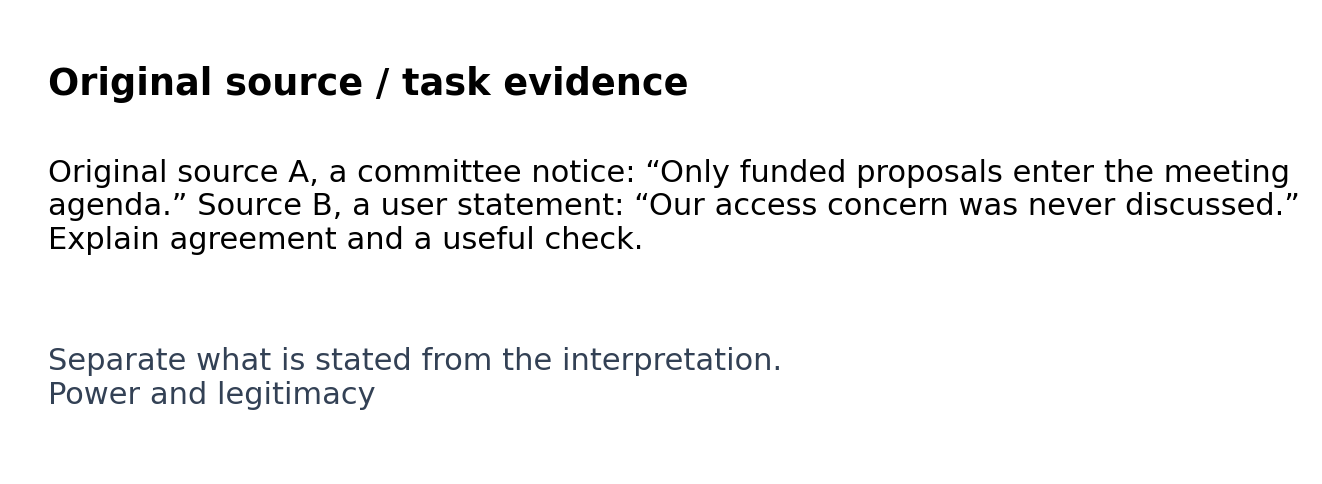
Original source A, a committee notice: “Only funded proposals enter the meeting agenda.” Source B, a user statement: “Our access concern was never discussed.” Explain agreement and a useful check.

Both can support a constraint on agenda access, although B concerns one person's experience. The notice shows the stated rule; neither alone establishes every practical decision. Inspect agendas, funding criteria and excluded stakeholders' accounts.

Independent transfer

Everyone may speak, but one funder sets the agenda. Explain the different forms of influence.

Attempt independently before reading the model.

Checked original model

Formal participation permits speech while agenda control determines which issues reach a decision. Compare actual proposals considered, funding conditions and responses to excluded concerns. Equal formal rights do not establish equal practical influence or accepted legitimacy.

These are authored formative expectations, not official IB descriptors. Accept other justified arguments with evidence and material limits.

Source and task holds

This supplement teaches the method for this part of the course. The full assessment criteria and any texts your school chooses come from your teacher.

Interactive lessons on this topic

Work through it step by step, with instant-check exercises.

More topics in International Baccalaureate · IB Diploma · Global Politics · SL

Log in or create account

IGCSE, A-Level & AP