Skip to content

4 · Global economy and development

International Baccalaureate · IB Diploma · Economics · HL · Topic 6

Video lesson for this topic Open the video page
8:43

The global economy

In 1980 China opened its first special economic zone in Shenzhen, then a small town. Today it is a city of more than seventeen million, and China is the…

English narration · English + 中文 subtitles burned in

6.1

The global economy

IB Diploma Programme Economics HL, Unit 4 The global economy (first assessment 2022). This topic covers sections 4.1 to 4.10: why countries trade, how they protect their industries, trading blocs, exchange rates, the balance of payments, and economic development. The trade examples use one market, with demand $Q_d = 140 - 2P$ and domestic supply $Q_s = 20 + 4P$, at a world price of 12. All numbers are original.

In 1980 China opened its first special economic zone in Shenzhen, then a small town near Hong Kong. Foreign firms could build factories there and export to the world. Today Shenzhen is a city of more than 17 million people, and China is the world's largest exporter of goods. Over the same years, hundreds of millions of Chinese people left extreme poverty. This topic asks how trade causes growth like this, who loses from it, and why some countries still struggle to develop.

Must-know for this topic:

Idea Key relationship
comparative advantage specialise in the good with the LOWER opportunity cost
tariff (worked model) world price 12 → imports 48; tariff of 4 → price 16, imports 24, revenue 96, deadweight loss 48
integration free trade area → customs union → common market → economic and monetary union
exchange rates floating, fixed or managed; demand and supply of a currency
balance of payments current account + capital account + financial account = 0 (with errors and omissions)
Marshall–Lerner (HL) a depreciation helps the current account if PED for exports + PED for imports > 1
terms of trade (HL) $ToT = \dfrac{\text{index of export prices}}{\text{index of import prices}} \times 100$
development sustainable development; HDI; barriers; strategies
6.2

International trade

Why countries trade

International trade gives consumers lower prices and more choice. Firms can sell to bigger markets and gain economies of scale 规模经济. Competition from abroad pushes local firms to be more efficient. Trade also spreads new technology and ideas.

Absolute and comparative advantage

A country has an absolute advantage 绝对优势 in a good if it can make more of it with the same resources. It has a comparative advantage 比较优势 if it can make the good at a lower opportunity cost 机会成本. Trade is based on comparative advantage, not absolute advantage.

Worked example. In one day, one worker makes:

Wheat Cloth Opportunity cost of 1 cloth Opportunity cost of 1 wheat
Country A 4 2 2 wheat 0.5 cloth
Country B 1 1 1 wheat 1 cloth
  1. A has an absolute advantage in BOTH goods: it makes more of each.
  2. But one cloth costs A 2 wheat and costs B only 1 wheat. So B has the comparative advantage in cloth.
  3. One wheat costs A only 0.5 cloth and costs B 1 cloth. So A has the comparative advantage in wheat.
  4. A specialises in wheat and B in cloth. Any trade price between 1 and 2 wheat per cloth helps both: A gets cloth for less than 2 wheat, and B gets more than 1 wheat for each cloth.
Two production possibility curves: Country A from 400 wheat to 200 cloth and Country B from 100 wheat to 100 cloth; each country produces only one good and, after trade, consumes at a point outside its own curve
With 100 workers each and a price of 1.5 wheat per cloth, both countries consume outside their own PPC

Suppose each country has 100 workers and they trade 120 wheat for 80 cloth (1.5 wheat per cloth). A makes 400 wheat and ends with 280 wheat and 80 cloth; working alone, it could have 80 cloth and only 240 wheat. B makes 100 cloth and ends with 20 cloth and 120 wheat; alone, it could have 20 cloth and only 80 wheat. Both gain.

The theory has limits. It assumes no transport costs, constant opportunity costs, and workers who can move easily from one industry to another. In reality, the workers in a closing cloth factory may not find new jobs quickly. And a country may become too dependent on one or two goods.

The World Trade Organization

The World Trade Organization 世界贸易组织 (WTO), set up in 1995 and now with more than 160 members, sets rules for world trade. It runs rounds of talks to lower trade barriers, and it settles trade disputes 贸易争端 between members. Critics say its rules favour rich countries, and its dispute system has been weak since its appeals body stopped working in 2019.

Vocabulary Train
English
economies of scale/ɪˈkɒnəmiz ɒv skeɪl/
absolute advantage/ˈæbsəluːt ədˈvæntɪdʒ/
comparative advantage/kəmˈpærətɪv ədˈvæntɪdʒ/
opportunity cost/ɒpəˈtjuːnɪti kɒst/
World Trade Organization/wɜːld treɪd ˌɔːɡənaɪˈzeɪʃn/
trade disputes
6.3

Trade protection

Trade protection 贸易保护 means government action that limits imports to help domestic producers. Most tools make foreign goods dearer or scarcer.

Types of protection

  • Tariffs 关税: taxes on imports.
  • Quotas 配额: limits on the quantity of a good that can be imported.
  • Production subsidies 生产补贴: payments to domestic producers, which lower their costs.
  • Export subsidies 出口补贴: payments to firms for each unit they export.
  • Administrative barriers 行政壁垒: slow customs checks, strict product standards, or long paperwork that make importing harder.

The effects of a tariff (HL calculation)

Worked example. Domestic demand is $Q_d = 140 - 2P$ and domestic supply is $Q_s = 20 + 4P$. The country can import as much as it wants at the world price of 12.

  1. Free trade. At $P = 12$: $Q_d = 140 - 24 = 116$ and $Q_s = 20 + 48 = 68$. Imports $= 116 - 68 = 48$.
  2. Tariff of 4. The domestic price rises to 16: $Q_d = 108$ and $Q_s = 84$. Imports $= 108 - 84 = 24$.
  3. Government revenue $= 4 \times 24 = 96$.
  4. Deadweight loss. Domestic firms now make 16 extra units that foreign firms made more cheaply: $\tfrac12 \times 4 \times (84 - 68) = 32$. Consumers give up 8 units they valued above the world price: $\tfrac12 \times 4 \times (116 - 108) = 16$. Total: 48.
Domestic demand and supply with a world price of 12 and a tariff-inclusive price of 16; imports fall from 48 to 24, tariff revenue of 96 shaded between 84 and 108, and two deadweight-loss triangles
A tariff of 4 halves imports, raises 96 for the government and wastes 48

Who gains and who loses? Consumers lose: they pay more and buy less. Domestic producers gain: they sell more at a higher price. The government gains revenue. Foreign producers lose sales. Society as a whole loses the deadweight loss of 48.

A quota of 24 units would raise the domestic price to 16 in the same way. But there is no tariff revenue. The extra 4 per unit goes to whoever holds the import licences, often foreign firms. A production subsidy of 4 per unit would raise domestic output to 84 while the price stays at 12, so consumers do not lose. But the government pays $4 \times 84 = 336$.

Arguments for and against protection

For protection Against protection
protect an infant industry 幼稚产业 until it can compete higher prices and less choice for consumers
protect jobs in industries facing cheap imports other countries may retaliate 报复, leading to a trade war
stop dumping 倾销 (selling abroad below cost) protected firms have little reason to become efficient
national security: food, energy, weapons resources stay in industries without a comparative advantage
raise tax revenue (important in some low-income countries) higher costs for firms that use imported inputs
diversification 多元化 away from a few exports it can lead to corruption around licences

Many economists accept some of these arguments in a few cases, such as a real infant industry for a limited time. They reject most others, because the losses to consumers are usually larger than the gains to producers.

Vocabulary Train
English
tariff/ˈtærɪf/
quota/ˈkwəʊtə/
production subsidies
export subsidies
administrative barriers/ədˈmɪnɪstrətɪv ˈbærɪəz/
infant industry/ˈɪnfənt ˈɪndʌstri/
retaliate
dumping/ˈdʌmpɪŋ/
diversification/daɪˌvɜːsɪfɪˈkeɪʃn/
trade protection/treɪd prəˈtekʃn/
6.4

Economic integration

Countries can agree to lower barriers with each other. This is economic integration 经济一体化.

  • A bilateral 双边 agreement is between two countries. A multilateral 多边 agreement is among many (such as the WTO's rules).
  • A preferential trade agreement 优惠贸易协定 lowers barriers on some goods only.

Trading blocs 贸易集团 go further, in stages:

Stage What members do Example
free trade area 自由贸易区 no barriers between members; each keeps its own barriers against others RCEP (China and 14 Asia-Pacific countries), USMCA
customs union 关税同盟 a free trade area plus a common external tariff 共同对外关税 Southern African Customs Union
common market 共同市场 a customs union plus free movement of labour and capital the EU single market
economic and monetary union 经济与货币联盟 a common market plus one currency and one central bank the euro area

Integration brings bigger markets, economies of scale, more competition and more investment. But it can also cause trade diversion 贸易转移: a member buys from a higher-cost partner inside the bloc instead of a lower-cost country outside it. When integration lets a member buy from a lower-cost partner instead of its own higher-cost producers, that is trade creation 贸易创造, which raises efficiency.

A monetary union removes exchange-rate costs and risks, and makes prices easy to compare. But each member loses its own interest rate and exchange rate. In the euro crisis after 2010, countries such as Greece could not devalue or cut interest rates to escape recession.

Vocabulary Train
English
bilateral
multilateral
preferential trade agreement
trading blocs
free trade area
customs union/ˈkʌstəmz ˈjuːnɪən/
common external tariff
common market/ˈkɒmən ˈmɑːkɪt/
economic and monetary union/ˌiːkəˈnɒmɪk ænd ˈmʌnɪtəri ˈjuːnɪən/
trade diversion
trade creation
economic integration/ˌiːkəˈnɒmɪk ˌɪntɪˈɡreɪʃn/
6.5

Exchange rates

What sets the exchange rate

The exchange rate 汇率 is the price of one currency in another currency. Under a floating exchange rate 浮动汇率, demand and supply in the foreign exchange market set it.

  • Demand for yuan comes from foreigners buying Chinese exports, tourists visiting China, and foreign investors buying Chinese assets.
  • Supply of yuan comes from Chinese people and firms buying imports, travelling abroad, and investing abroad.
Market for yuan in US cents per yuan: demand meets supply at 14 cents; more demand for Chinese exports shifts demand right and the yuan appreciates to 15 cents
More demand for Chinese exports raises the demand for yuan, so the yuan appreciates

A rise in a currency's value is an appreciation 升值; a fall is a depreciation 贬值. The exchange rate changes when:

  • foreign demand for a country's exports changes;
  • interest rates change (higher rates attract hot money 热钱, short-term money looking for the best return);
  • inflation differs between countries (high inflation makes exports less competitive);
  • investors speculate 投机 that a currency will rise or fall;
  • the central bank buys or sells its own currency.

Effects of a change

If the yuan appreciates, Chinese exports become dearer abroad and imports become cheaper in China. Exporters may lose sales, but import prices and inflation fall. A depreciation does the opposite: it helps exporters but raises the price of imported fuel and food.

Worked example (HL). One US dollar buys 7.00 yuan. A Chinese phone is priced at 2,100 yuan. In the US it costs $2{,}100 \div 7.00 = 300$ dollars. If the yuan appreciates to 6.00 per dollar, the same phone costs $2{,}100 \div 6.00 = 350$ dollars.

Fixed and managed systems

  • Under a fixed exchange rate 固定汇率, the government or central bank sets the currency's value against another currency and buys or sells to keep it there. The Hong Kong dollar has been fixed to the US dollar since 1983. A deliberate cut in a fixed rate is a devaluation 法定贬值; a deliberate rise is a revaluation 法定升值.
  • A managed exchange rate 有管理的浮动汇率 floats, but the central bank steps in to limit big moves. The People's Bank of China sets a daily central rate and lets the yuan move only within a band around it.

Fixed rates give certainty to traders and investors. But the central bank must hold large foreign currency reserves 外汇储备, and it gives up control of its own interest rate. Floating rates adjust by themselves, but they can swing sharply and make planning hard.

Vocabulary Train
English
exchange rate/eksˈtʃeɪndʒ reɪt/
floating exchange rate/ˈfləʊtɪŋ eksˈtʃeɪndʒ reɪt/
appreciation/əˌpriːʃɪˈeɪʃn/
depreciation/dɪˌpriːʃɪˈeɪʃn/
hot money
speculate/ˈspekjʊleɪt/
fixed exchange rate/fɪkst eksˈtʃeɪndʒ reɪt/
devaluation/diːˌvæljuːˈeɪʃn/
revaluation/rɪˌvæljuːˈeɪʃn/
managed exchange rate/ˈmænɪdʒd eksˈtʃeɪndʒ reɪt/
foreign currency reserves
6.6

The balance of payments

The balance of payments 国际收支 records all of a country's money transactions with the rest of the world in one year.

Account What it records
current account 经常账户 trade in goods and in services; primary income 初次收入 (wages, profits, interest and dividends from abroad); secondary income 二次收入 (transfers such as money workers send home, and foreign aid)
capital account 资本账户 small items such as debt forgiveness and the sale of patents or land
financial account 金融账户 foreign direct investment 外国直接投资 (FDI), portfolio investment 证券投资 (buying shares and bonds), changes in reserve assets

The accounts must add to zero. So a current account deficit is matched by a surplus on the capital and financial accounts: the country pays for extra imports by borrowing or by selling assets to foreigners.

Current account deficits and surpluses

A small deficit can be harmless, for example if it pays for imported machines that raise output later. A large, long-lasting deficit is a problem. The country builds up foreign debt, may need higher interest rates to attract money, and its currency may fall suddenly.

Policies to reduce a deficit:

  • Expenditure-switching policies 支出转换政策 move spending from imports to domestic goods: protection, or a lower exchange rate.
  • Expenditure-reducing policies 支出削减政策 cut total spending, and so imports: contractionary fiscal or monetary policy. These can cause unemployment.
  • Supply-side policies make exports more competitive over the long run.

A persistent surplus can also cause problems: a rising currency, less consumption at home, and trade disputes with deficit countries.

Marshall–Lerner and the J-curve (HL)

A depreciation makes exports cheaper and imports dearer. It improves the current account only if buyers respond enough. The Marshall–Lerner condition 马歇尔-勒纳条件 says this happens when the price elasticity of demand for exports plus the price elasticity of demand for imports is greater than 1.

In the short run, demand is inelastic. Contracts are already signed, and buyers take time to find new suppliers. So right after a depreciation the country pays more for the same imports, and the deficit gets WORSE. Later, volumes adjust and the balance improves. The path looks like a "J".

J-curve: the current account balance dips further into deficit right after a depreciation, then rises into surplus over time
After a depreciation the current account gets worse before it gets better

The terms of trade (HL)

The terms of trade 贸易条件 compare the prices of a country's exports with the prices of its imports:

$$\text{terms of trade} = \frac{\text{index of average export prices}}{\text{index of average import prices}} \times 100$$

Worked example. From the base year, a country's export price index rises to 128.9 and its import price index to 117.1. The terms of trade are $128.9 \div 117.1 \times 100 \approx 110.1$. They have improved by about 10%: each unit of exports now buys about 10% more imports.

Better terms of trade are not always good news. If exports become dearer because of domestic inflation, sales may fall. For many low-income countries that export primary products 初级产品 (food, metals, oil), prices swing a lot. Over the long run their terms of trade have often fallen against manufactured goods, so they must export more just to buy the same imports.

Vocabulary Train
English
balance of payments/ˈbæləns ɒv ˈpeɪmənts/
current account/ˈkʌrənt əˈkaʊnt/
primary income/ˈpraɪməri ˈɪŋkʌm/
secondary income/ˈsekəndəri ˈɪŋkʌm/
capital account/ˈkæpɪtl əˈkaʊnt/
financial account/faɪˈnænʃl əˈkaʊnt/
foreign direct investment/ˈfɒrən daɪˈrekt ɪnˈvestmənt/
portfolio investment
expenditure-switching policies
expenditure-reducing policies
Marshall–Lerner condition/ˈmɑːʃl ˈlɜːnə kənˈdɪʃn/
terms of trade/tɜːmz ɒv treɪd/
primary products
6.7

Economic development

Sustainable development

Economic development 经济发展 is broader than growth. It means better living standards: less poverty, better health and education, more freedom and choice. Sustainable development 可持续发展 meets the needs of people today without harming the ability of future generations to meet their own needs. In 2015 the United Nations agreed 17 Sustainable Development Goals 可持续发展目标 (SDGs) for 2030, including no poverty, zero hunger, quality education, clean water and climate action. Poverty and environmental damage are linked: very poor people may have no choice but to cut forests or overuse land.

Measuring development

Type Measures Limits
single indicators GDP or GNI per capita at PPP; life expectancy; infant mortality; years of schooling each shows only one side of development
composite indicators 综合指标 the Human Development Index 人类发展指数 (HDI): income (GNI per capita at PPP), health (life expectancy) and education (years of schooling), on a scale from 0 to 1 HDI hides inequality and the environment
adjusted indices the Inequality-adjusted HDI 不平等调整后人类发展指数 (IHDI) and the Gender Inequality Index 性别不平等指数 (GII) data can be old or poor in low-income countries

A country whose HDI rank is much higher than its GNI rank turns its income into health and education well. A country whose HDI rank is much lower may have high income from oil but poor public services or great inequality.

Barriers to development

Poverty trap cycle: low income leads to low saving, low investment in capital, low productivity and poor health and education, which keep income low; aid, FDI, microfinance, education and healthcare can break a link
Each link in the poverty trap keeps the next one weak
  • The poverty trap 贫困陷阱: people with low incomes cannot save, so there is little money for investment, so productivity and incomes stay low.
  • Economic barriers: high inequality; poor infrastructure (roads, power, internet); little access to credit and markets; a large informal economy that pays no taxes; capital flight 资本外逃 (rich people moving money abroad); and unsustainable foreign debt.
  • Dependence on primary products: for example, copper makes up most of Zambia's exports, so a fall in the world copper price cuts national income sharply.
  • Geography: being landlocked 内陆的 raises transport costs; tropical disease and climate shocks hurt health and farming.
  • Political and social barriers: weak institutions, corruption, poor legal and property rights, political instability and conflict, and gender inequality 性别不平等 (when girls cannot go to school, half the country's talent is wasted).

Strategies for development

Strategy How it helps Problems
export promotion 出口导向 uses comparative advantage; China, South Korea and Singapore grew this way depends on world demand; may need cheap labour
import substitution 进口替代 protects new domestic industries (Latin America, 1950s–1980s) firms stayed inefficient; high prices for consumers
diversification less risk from one export price needs skills and investment
foreign direct investment (FDI) by multinational corporations 跨国公司 brings capital, jobs, technology and skills profits leave the country; firms may use low wages or weak environmental rules
foreign aid 对外援助 grants and cheap loans for health, schools and emergencies can be tied to the donor's goods; corruption; dependency
multilateral help (World Bank, IMF) long-term loans; help in a crisis loan conditions may force spending cuts
debt relief 债务减免 frees money for schools and hospitals may encourage new borrowing
microfinance 小额信贷 small loans to people banks ignore, often women (the Grameen Bank) high interest rates; loans may pay for consumption, not business
fair trade 公平贸易 guaranteed minimum prices for farmers reaches only a small share of producers
better institutions, education and health raise productivity and attract investment take many years and need good government

Most successful countries have used a mix: market reforms and open trade, together with strong government investment in education, health and infrastructure. Every strategy should be judged by the barrier it removes, and by whether the gains are equal and sustainable.

Vocabulary Train
English
economic development/ˌiːkəˈnɒmɪk dɪˈveləpmənt/
sustainable development/səˈsteɪnəbl dɪˈveləpmənt/
Sustainable Development Goals/səˈsteɪnəbl dɪˈveləpmənt ɡəʊlz/
composite indicators
Human Development Index/ˈhjuːmən dɪˈveləpmənt ˈɪndeks/
Inequality-adjusted HDI
Gender Inequality Index/ˈdʒendə ɪniːˈkwɒlɪti ˈɪndeks/
poverty trap/ˈpɒvəti træp/
capital flight/ˈkæpɪtl flaɪt/
landlocked
gender inequality
export promotion
import substitution
multinational corporations/ˌmʌltɪˈnæʃənl ˌkɔːpəˈreɪʃnz/
foreign aid
debt relief
microfinance/ˌmaɪkrəʊfaɪˈnæns/
fair trade/feə treɪd/
6.8

Checklist

  • The benefits of trade; absolute against comparative advantage; the 4/2 against 1/1 table; trade at 1.5 wheat per cloth puts both countries outside their PPCs; the limits of the theory; the WTO (4.1).
  • Tariffs, quotas, production and export subsidies, administrative barriers; the tariff worked example: imports 48 → 24, revenue 96, deadweight loss 32 + 16 = 48; who gains and who loses; quota and subsidy compared (4.2).
  • The arguments for and against protection, with evaluation (4.3).
  • Bilateral, multilateral and preferential agreements; free trade area, customs union, common market, economic and monetary union with examples; trade creation and trade diversion; the costs of a monetary union (4.4).
  • Floating, fixed and managed exchange rates; what shifts the demand and supply of a currency; appreciation and depreciation and their effects; the phone priced at 2,100 yuan; devaluation and revaluation; reserves (4.5).
  • The current, capital and financial accounts; why they balance; the problems of persistent deficits and surpluses; expenditure-switching, expenditure-reducing and supply-side corrections; HL Marshall–Lerner and the J-curve; HL terms of trade 128.9 / 117.1 → 110.1 and why primary exporters lose (4.6).
  • Development against growth; sustainable development and the 17 SDGs (4.7).
  • Single and composite indicators: GNI per capita at PPP, HDI, IHDI, GII; comparing HDI and GNI ranks (4.8).
  • Barriers: the poverty trap, economic barriers, primary-product dependence, geography, political and social barriers (4.9).
  • Strategies: export promotion, import substitution, diversification, FDI, aid, multilateral help, debt relief, microfinance, fair trade, institutions and human capital, each with its problems (4.10).
Additional notes PDF
Supported preparation: Global economy and policy synthesis

Scope and prerequisites

IB economics first assessment 2022. Three supervised news commentaries cover microeconomics, macroeconomics and the global economy through distinct key concepts. School checks source recency and commentary requirements against the full guide.

Mapped preparation outcomes: ib_economics_hl.6.1, ib_economics_hl.6.2. Read the matching native lesson first. Actual approved choices, evidence and final learner work remain separate.

Source vocabulary

comparative advantage 比较优势; sustainable development 可持续发展.

Explanation and worked method

Trade can increase specialization and choice while redistributing gains and losses. Tariffs, exchange rates and development policies act through different channels. Evaluate a named policy with stakeholders, time and constraints rather than a list of advantages.

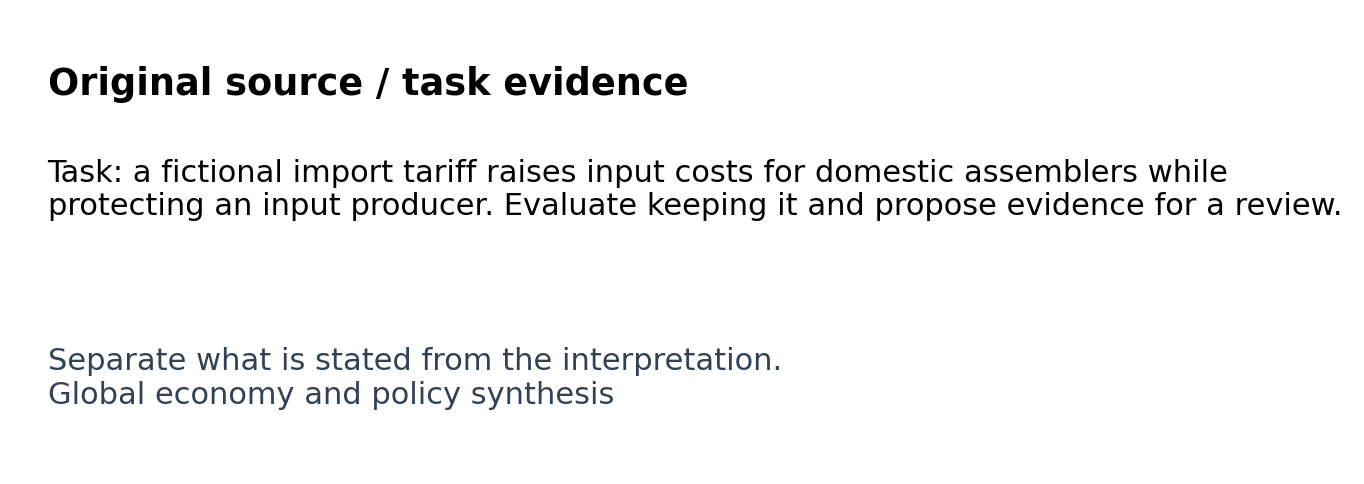
Original classroom evidence panel for Global economy and policy synthesis

Task: a fictional import tariff raises input costs for domestic assemblers while protecting an input producer. Evaluate keeping it and propose evidence for a review.

The protected producer may expand, but assemblers face higher costs, consumers may pay more and exporters may lose competitiveness. Consider supply responsiveness, employment adjustment, revenue, retaliation and feasible alternatives. A temporary training or adjustment policy has its own costs and delivery risks. Review quantities, prices, employment and distribution before judging net benefit.

Independent transfer

Currency depreciation occurs but import spending initially rises. Explain a possible mechanism.

Attempt independently before reading the model.

Checked original model

Foreign-currency imports become more expensive in domestic currency while quantities may adjust slowly because of contracts and limited substitutes. Export and import demand responses and timing determine the later trade-balance effect. Depreciation does not guarantee immediate improvement.

These are authored formative expectations, not official IB descriptors. Accept other justified arguments with evidence and material limits.

Source and task holds

This supplement teaches the method for this part of the course. The full assessment criteria and any texts your school chooses come from your teacher.

Interactive lessons on this topic

Work through it step by step, with instant-check exercises.

More topics in International Baccalaureate · IB Diploma · Economics · HL

Log in or create account

IGCSE, A-Level & AP