Skip to content

3.3–3.7; 4 · Networks, media and automation

International Baccalaureate · IB Diploma · Digital Society · SL · Topic 2

Video lesson for this topic Open the video page
3:37

Networks, media and automation

In March 2011 an earthquake and tsunami damaged the Fukushima nuclear station. Within days a rumour spread across China by text message and social media, that…

English narration · English + 中文 subtitles burned in

2.1

Networks, media and automation

IB Diploma Programme Digital Society SL (first assessed in 2024). This topic covers the other five content areas: computers 计算机 (3.3), networks and the internet 网络与互联网 (3.4), media 媒体 (3.5), artificial intelligence 人工智能 (3.6) and robots and autonomous technologies 机器人与自主技术 (3.7). It also teaches how to work with sources 来源, which you need for Paper 2 (1 hour 15 minutes; 20% at HL, 30% at SL), a paper of questions on sources you have not seen before.

In March 2011 an earthquake and tsunami damaged the Fukushima nuclear power station in Japan. Within days, a rumour spread across China by text message and social media: iodised salt protects you from radiation, and soon the sea would be polluted, so there would be no more salt. People queued outside shops and bought bags and bags of salt; in some cities the shelves were empty. The rumour was false: eating salt does not protect against radiation, and China had large salt reserves. A false claim had travelled faster than the truth through a network of phones. This topic asks how that happens.

Must-know for networks, media and automation:

Area Key content
computers (3.3) hardware and software; more power, less size and cost
networks (3.4) the internet as a network of networks; cables, data centres, platforms
media (3.5) everyone can publish; feeds ranked by engagement; misinformation
AI (3.6) machine learning; narrow and general AI
robots (3.7) machines that sense, decide and act; who is responsible?
sources claim, perspective and origin; Paper 2
Vocabulary Train
English
computer
networks and the internet/ˈnetwɜːks ænd ðɪ ˈɪntənet/
media/ˈmiːdiːə/
artificial intelligence/ˌɑːtɪˈfɪʃl ɪnˈtelɪdʒəns/
robots and autonomous technologies/ˈrəʊbɒts ænd ɔːˈtɒnəməs tekˈnɒlədʒiz/
source/sɔːs/
2.2

Computers and networks

A computer runs software 软件 (instructions) on hardware 硬件 (the physical machine). For decades the number of transistors on a chip roughly doubled every two years, so computers became smaller, cheaper and more powerful. A smartphone today is a powerful computer that most people carry everywhere.

The internet 互联网 is a network of networks. Data travels in small packets through routers, and almost all data between continents travels through cables on the sea floor. At each layer someone has control: the companies that own the cables and data centres 数据中心, the platforms (the apps and websites people use) and the governments that make rules. Whoever controls a layer can set its rules, and that is a question of power.

Four layers of the internet, from undersea cables and data centres up through networks and platforms to users, with who sets the rules at each layer
Each layer has owners, and each owner can set rules for the layers above it.
Vocabulary Train
English
software/ˈsɒftweə/
hardware/ˈhɑːdweə/
internet/ˈɪntənet/
data centre/ˈdeɪtə ˈsentə/
2.3

Media

Digital media changed three things:

  • Creation: anyone with a phone can publish text, photos and video.
  • Distribution: a feed is ranked by an algorithm, usually by engagement 参与度 (likes, shares, comments, time watched), not by date or by accuracy.
  • Participation: users comment, share, remix and join campaigns.

Misinformation 错误信息 is false information shared by people who believe it, like the salt rumour. Disinformation 虚假信息 is false information spread on purpose to deceive. A 2018 study in the journal Science looked at about 126,000 stories shared on Twitter: false stories spread further and faster than true ones, and true stories took about six times as long to reach 1,500 people. False news is often new and surprising, so people share it.

Three versions of one school event ranked by engagement bars, with accuracy shown as dots
The feed ranks by engagement, so the least accurate version rises to the top.
Vocabulary Train
English
engagement/enˈɡeɪdʒmənt/
misinformation
disinformation
2.4

Artificial intelligence

Artificial intelligence is computer systems doing tasks that usually need human intelligence, such as recognising faces, translating or writing. Most modern AI uses machine learning 机器学习: instead of following rules written by a programmer, the system finds patterns in large amounts of data.

Type What it can do Example
narrow AI 弱人工智能 one task, or one kind of task face unlock on a phone; a translation app; AlphaGo, which beat the Go champion Lee Sedol 4–1 in 2016
generative AI 生成式人工智能 produces new text, images or sound from patterns in its data ChatGPT (2022), image generators
general AI 通用人工智能 any task a human can do, at human level does not yet exist

AI raises questions in every context: who owns the data it learned from (economic), whether its answers are true (human knowledge), and whether it treats groups fairly (social).

Vocabulary Train
English
machine learning/məˈʃiːn ˈlɜːnɪŋ/
narrow AI/ˈnærəʊ ˌeɪ ˈaɪ/
generative AI/ˈdʒenərətɪv ˌeɪ ˈaɪ/
general AI/ˈdʒenərəl ˌeɪ ˈaɪ/
2.5

Robots and autonomous technologies

A robot 机器人 is a machine that senses its surroundings, makes decisions and acts in the physical world. An autonomous 自主的 technology acts without a human controlling each step: a warehouse robot, a delivery drone, a self-driving car. Since 2022 Baidu's Apollo Go robotaxis have carried passengers with no safety driver in parts of Wuhan and other Chinese cities.

When an autonomous machine makes a mistake, who is responsible? In March 2018 a self-driving test car run by Uber hit and killed a woman crossing a road in Tempe, Arizona. The car's sensors detected her seconds before the crash but the system did not brake, and the safety driver in the car was looking at a phone. Was the fault the driver's, the company's, the programmers', or the car's? Autonomy moves decisions away from people, but responsibility still has to land somewhere.

Vocabulary Train
English
robot/ˈrəʊbɒt/
autonomous
2.6

Working with sources

Paper 2 gives you sources: texts, images, charts and data. Read each one for three things:

Ask Question Salt rumour example
claim 观点 what does the source say? a message says iodised salt protects against radiation
perspective 视角 who made it, and what are their interests? an anonymous forwarded text; a government health notice; a scientist
origin and purpose 来源与目的 where, when and why was it made? made in panic, to warn friends, with no evidence

Then compare: where do the sources agree or disagree, and which is more reliable? Diverse sources means really different perspectives (users, companies, governments, researchers), not several sources that all say the same.

Paper 2 questions usually move from finding information in one source, to explaining and comparing sources, to a longer answer that uses the sources together with your own knowledge and real-world examples.

Worked plan. Using the sources and your own knowledge, discuss whether social media makes false information more dangerous.

  • Sources: the 2018 Science study (researchers: false news spreads faster); a platform statement about labelling false posts (company: the problem is under control).
  • Own example: the 2011 salt panic, which spread by text message as well as social media, so the problem is older than today's apps.
  • Judgement: social media makes false information faster and wider, but ranking by engagement is the main cause, and it can be changed.
Vocabulary Train
English
claim/kleɪm/
perspective/pəˈspektɪv/
origin and purpose
2.7

Checklist

  • Computers: hardware, software, growing power.
  • Networks: a network of networks; cables, data centres, platforms; who controls each layer.
  • Media: creation, distribution, participation; misinformation and disinformation; the 2018 Science study.
  • AI: machine learning; narrow, generative and general AI.
  • Robots: sense, decide, act; autonomy and responsibility (Tempe 2018).
  • Sources: claim, perspective, origin and purpose; the Paper 2 plan.
Additional notes PDF
Supported preparation: Infrastructure and material consequences

Scope and prerequisites

IB digital society first assessment 2024. Integrate concepts, content and contexts. Inquiry uses a process document, recorded multimedia presentation and references; HL adds global well-being, governance/human rights and sustainable development interventions.

Mapped preparation outcomes: ib_digital_society_sl.2.1, ib_digital_society_sl.2.2. Read the matching native lesson first. Actual approved choices, evidence and final learner work remain separate.

Source vocabulary

network 网络; automation 自动化.

Explanation and worked method

Network access depends on devices, power, connectivity and service providers. AI-based recommendations use patterns in training data; an autonomous system may also act. Evaluate a service through completed outcomes and failure conditions, including energy and maintenance.

Original classroom evidence panel for Infrastructure and material consequences

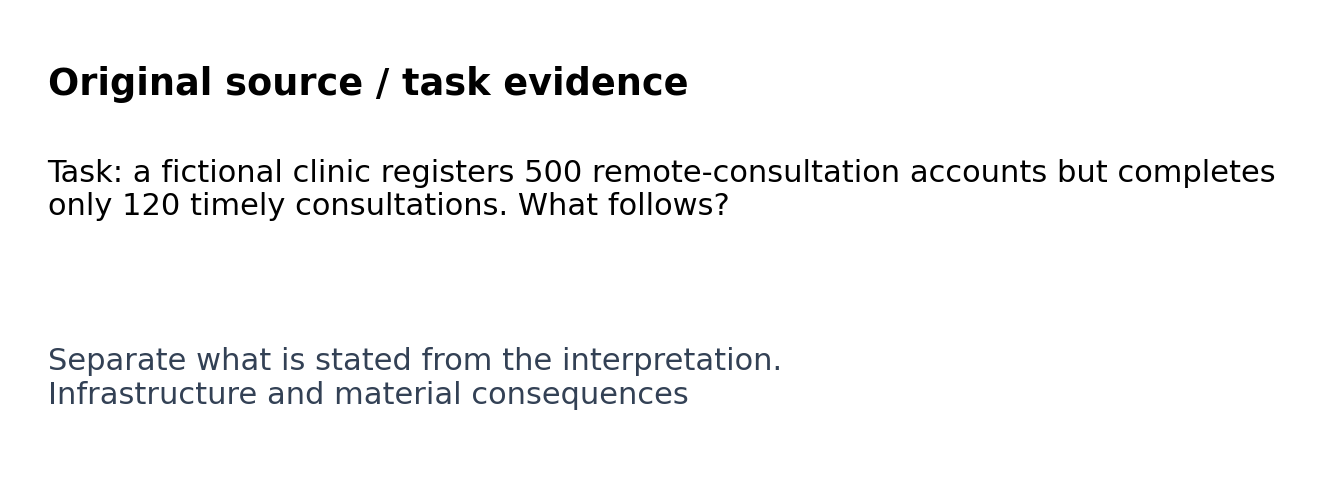
Task: a fictional clinic registers 500 remote-consultation accounts but completes only 120 timely consultations. What follows?

Registration shows uptake at one stage, not effective healthcare access. Inspect failed connections, device sharing, staff availability, patient groups and existing alternatives. Compare completed timely consultations and relevant access barriers before and after implementation, with a suitable comparator where possible. Include privacy, power reliability and environmental costs.

Independent transfer

Timely consultations rise mainly among people already well served. Has equitable access improved?

Attempt independently before reading the model.

Checked original model

The overall count can rise without reducing exclusion. Compare completion and barriers for previously underserved users, using compatible definitions and periods. Evaluate alternatives, costs and unmet need before claiming equitable improvement.

These are authored formative expectations, not official IB descriptors. Accept other justified arguments with evidence and material limits.

Source and task holds

This supplement teaches the method for this part of the course. The full assessment criteria and any texts your school chooses come from your teacher.

Interactive lessons on this topic

Work through it step by step, with instant-check exercises.

Log in or create account

IGCSE, A-Level & AP