Scope and prerequisites
IB classical languages first assessment 2024; Latin focus. This supplemental reference covers only the listed preparation outcomes. School selections, full-guide procedures and required live or recorded performance are separate.
- Write purposeful Latin prose informed by classical models
- Explain linguistic choices and revise for morphology, syntax 句法 and intended effect 预期效果
Prerequisites: Present-tense forms and cases from sheet 1; stated audience and intention.
Explain and choose the method
Define audience and intention, then choose constructions you can justify grammatically.
The rationale 理由说明 links selected choices to intentions and researched classical models; it is not a translation 翻译 of the composition.
For a short original encouragement to a friend, choose simple Latin whose forms you can explain. Vocabulary: amicus = friend; amice = friend (direct address); laboramus = we work; speramus = we hope; hodie = today; cras = tomorrow; semper = always. Model: “Amice, hodie laboramus; cras speramus. Semper laboramus, semper speramus.” Meaning: “Friend, today we work; tomorrow we hope. We always work, we always hope.” Rationale : direct address identifies the audience; first-person plural shares the task; balanced time words and repeated semper connect present effort with continuing hope. This is a short grammar-and-style rehearsal 排练, not an assessed-length composition or a borrowed ancient passage.
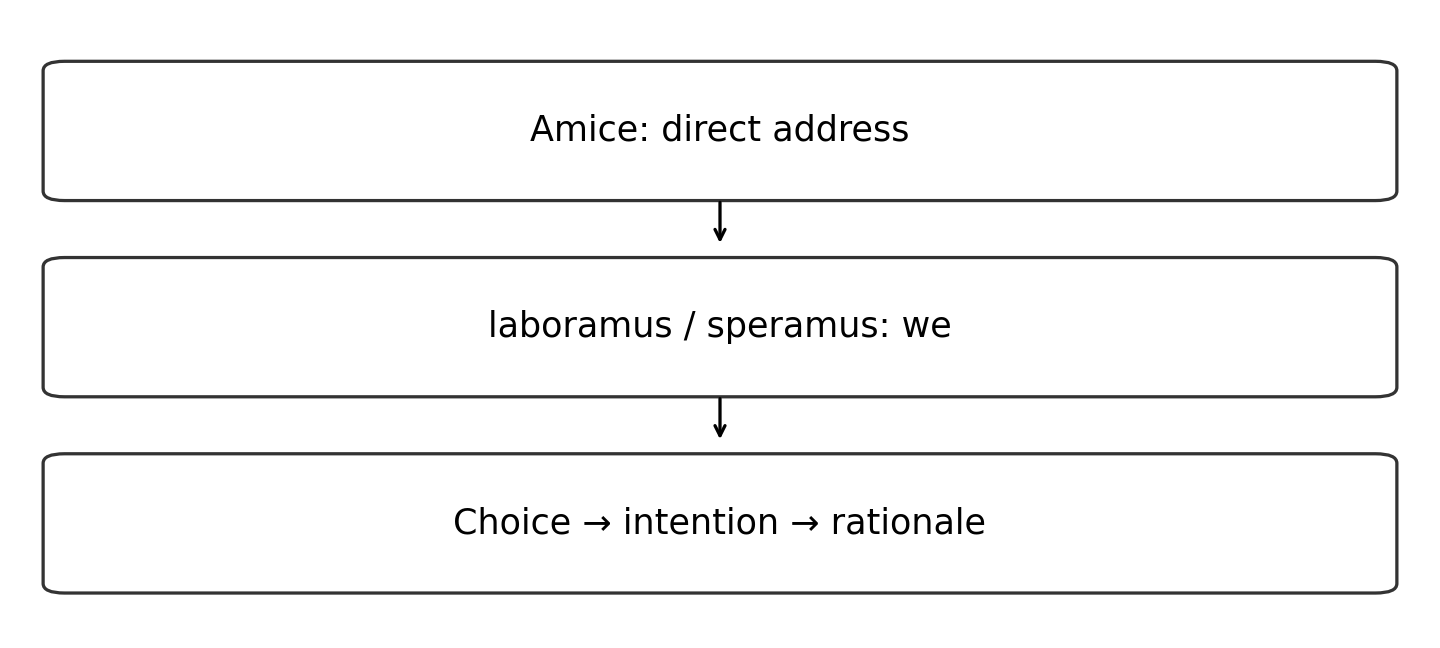
Existing worked example: Begin with simple clauses whose subjects and verbs agree. Check cases, tense sequence and idiom against trustworthy reference material. Use a model's technique, such as balanced clauses, while creating an original context and wording.
Complete original context
Every transfer question states all data it needs.
Independent practice and checked reasoning
Transfer 1
Write a short original Latin message using the supplied vocabulary to share work and hope with a friend. Explain two purposeful choices and translate the whole message.
Reasoning: One possible response: “Amice, hodie laboramus et speramus. Cras laboramus et speramus.” Meaning: “Friend, today we work and hope. Tomorrow we work and hope.” Amice directly addresses the friend; the plural verbs include writer and friend; the paired clauses connect both actions across two times. Alternative accurate arrangements are acceptable. No ancient provenance is claimed.
Transfer 2
Revise “Amicus, hodie laboramus; cras sperat” to address the friend directly and keep a shared we throughout. Explain both changes.
Reasoning: “Amice, hodie laboramus; cras speramus.” Amice is the supplied vocative for direct address; speramus is first-person plural matching the intended we, rather than third-person singular sperat. A different person is possible in another message but changes this intention.
Transfer 3
What remains necessary before this rehearsal could support assessed HL composition? Distinguish model influence from copying.
Reasoning: Teacher-approved classical models, accurate source references, full-guide task requirements and original sustained composition with a rationale. A model may inform a technique such as parallel clauses, but copying its wording is not original authorship. The short original exercise demonstrates choices and revision only.
Limits and next use
HL composition is assessed separately from unseen translation. Teacher verifies source use and authorship; do not count copied prose as original composition or invent a Greek-language equivalent for this Latin course.
All tasks here are public original practice with authored guidance. They are not official questions or fresh diagnostics. Existing protected tests and mocks remain separate.