Skip to content

Core · Experience planning and reflection

International Baccalaureate · IB Diploma · Creativity, Activity, Service · Topic 1

Video lesson for this topic Open the video page
3:01

Creativity, activity, service

CAS is part of the Diploma core. It is not graded, but you must complete it. For at least eighteen months you take part in experiences in three strands…

English narration · English + 中文 subtitles burned in

1.1

Creativity, activity, service

IB Diploma Programme Creativity, Activity, Service (CAS; 2016 guide). CAS is part of the core of the Diploma: every student does it, and it is not graded, but you must complete it to receive the Diploma. For at least 18 months you take part in experiences 经历 in three strands, with a reasonable balance between them. You complete at least one CAS project CAS项目 that lasts at least a month, keep a portfolio 学习档案 of evidence, and have three formal interviews with your school's CAS coordinator.

A student joins a team that runs a monthly repair café in the community centre: neighbours bring broken lamps, radios and bicycles, and volunteers fix them for free. At the first event the team expected twenty visitors and six came. They could have written "it was a good experience" and moved on. Instead they asked why, found that all their posters were inside the school, and moved them to the community centre and the local market. Thirty people came the next month. That question ("why, and what will we change?") is what turns an activity into CAS.

Must-know for CAS:

Area Key content
strands creativity, activity, service
learning outcomes seven; each shown at least once in the portfolio
CAS project collaborative, planned by students, at least one month
reflection during, after and later; decisions and what you learned
portfolio and interviews evidence of each outcome; three interviews with the coordinator
Vocabulary Train
English
experience/ekˈspɪərɪəns/
portfolio/pɔːtˈfəʊlɪəʊ/
CAS project/ˌsiː eɪ ˈes ˈprɒdʒekt/
1.2

The three strands

Strand What it means Examples
creativity 创造 exploring ideas that lead to an original product or performance designing the lighting for the school play; writing songs; coding a game
activity 活动 physical effort for a healthy lifestyle a weekly swim club; learning tai chi; training for a 10 km run
service 服务 unpaid work with a community that meets a real need a reading scheme for younger students; teaching older people to use phones

Service must respond to a real need 需求 that you have investigated with the community, not one you imagine for them.

Vocabulary Train
English
creativity/kriːˌeɪˈtɪvɪti/
activity/ækˈtɪvɪti/
service/ˈsɜːvɪs/
need
1.3

The seven learning outcomes

Your portfolio must show each of these learning outcomes 学习成果 at least once:

  1. Identify your own strengths and areas for growth.
  2. Show that you have taken on challenges and developed new skills.
  3. Show how you start and plan a CAS experience.
  4. Show commitment 投入 and perseverance 坚持.
  5. Show the skills and benefits of working with others.
  6. Show engagement with issues of global significance 全球意义.
  7. Recognise and think about the ethics 伦理 of your choices and actions.
A grid of the term's experiences and project against the seven learning outcomes: lighting design evidences strengths and new skills, the swim club perseverance, the reading scheme planning and commitment, the repair-cafe project collaboration and ethics; global issues is still empty
Check your portfolio against all seven outcomes: here, global significance still needs evidence.
Vocabulary Train
English
commitment/kəˈmɪtmənt/
perseverance/ˌpɜːsɪˈvɪərəns/
global significance
ethics/ˈeθɪks/
learning outcome
1.4

The CAS project and the portfolio

The CAS project is collaborative 协作的: you work with others, you plan it yourselves, and it lasts at least one month. The repair café is a project in two strands at once (service and creativity).

Your portfolio holds the evidence: plans, photos, records and reflections. Evidence is better than claims: show the attendance list and the moved posters, not just "I learned to work in a team".

Vocabulary Train
English
collaborative/kəˈlæbrətɪv/
1.5

Reflection

Reflection 反思 is thinking about what you did and what you learned. Do it during an experience, straight after it, and later, when you can see how it changed you.

A four-box loop for the repair cafe: planned 20 visitors, got 6, traced the cause to posters only inside school, decided to move posters to the community centre, feeding the next event
A reflection that changes the next decision.

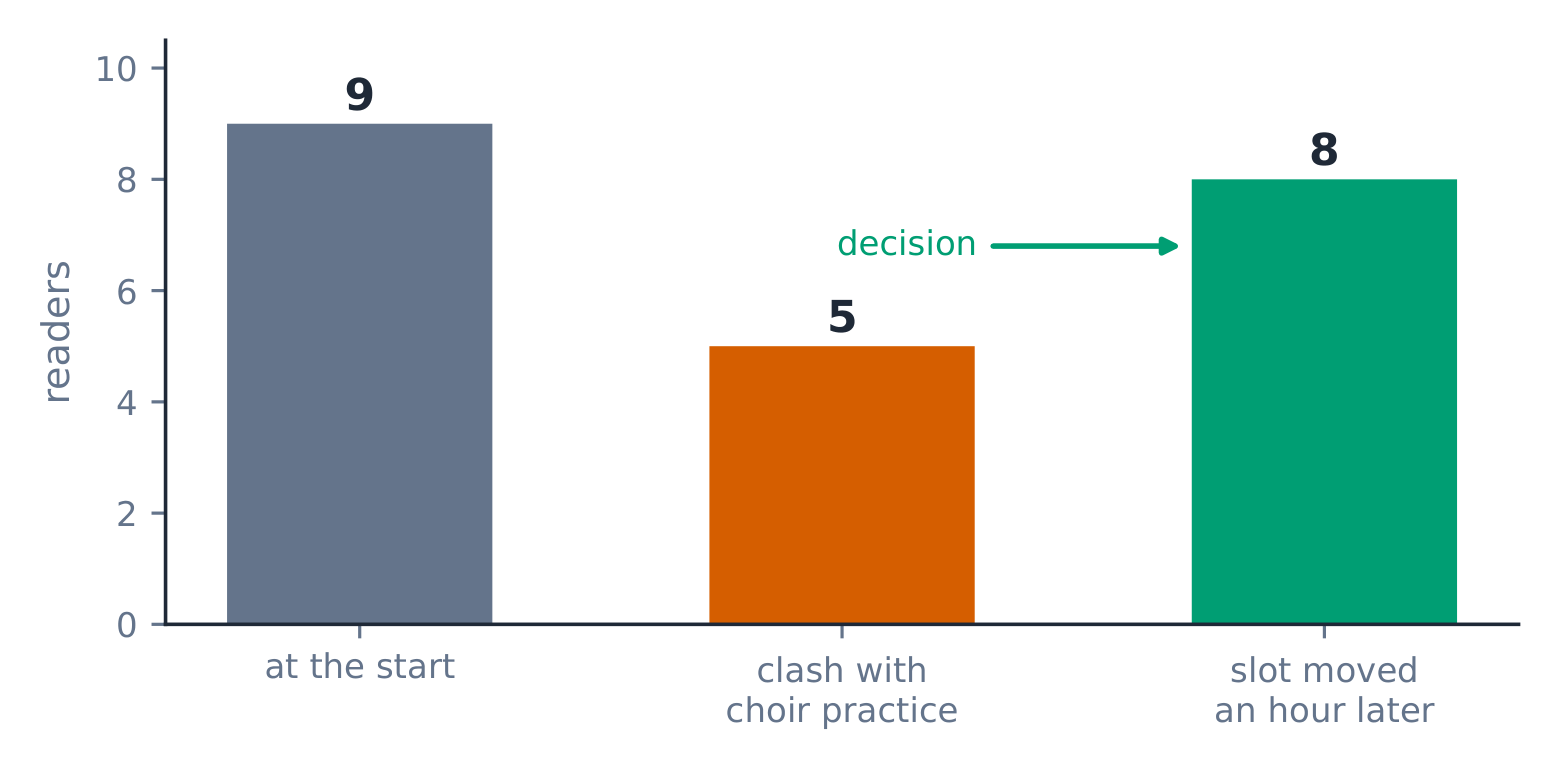
A second example. A student runs a weekly reading scheme for younger students. Attendance falls from nine readers to five. The student finds that the sessions clash with choir practice, moves them an hour later, and attendance returns to eight. The portfolio shows the problem, the decision and the result, which is evidence of commitment and of thinking about the readers' needs.

Bar chart of reading-scheme attendance: 9 readers at the start, 5 during the clash with choir practice, 8 after the slot moved an hour later
The attendance counts are the evidence.

Weak reflections: a diary of what happened with no learning; one line of "I grew a lot" under a photo; writing all the reflections at the end of the course.

Vocabulary Train
English
reflection/rɪˈflekʃn/
1.6

Checklist

  • At least 18 months; three strands in balance; not graded but required.
  • The seven learning outcomes, each shown at least once.
  • One collaborative project, planned by students, at least a month.
  • Reflection during, after and later; decisions and what changed.
  • A portfolio of evidence; three interviews with the coordinator.

Interactive lessons on this topic

Work through it step by step, with instant-check exercises.

Log in or create account

IGCSE, A-Level & AP