Say it aloud: stories, comparisons and reasons
HSK 3 · Topic 8
 2:53
HSK 3 Say it aloud 8: stories, comparisons and reasons
This is the speaking floor for everything the grammar built. Tell a short story in time order on the rail xian, ranhou, zuihou. Compare with bi, which says…
English explanations + Mandarin examples · captions follow the spoken text
8.1
Tell a story someone can follow
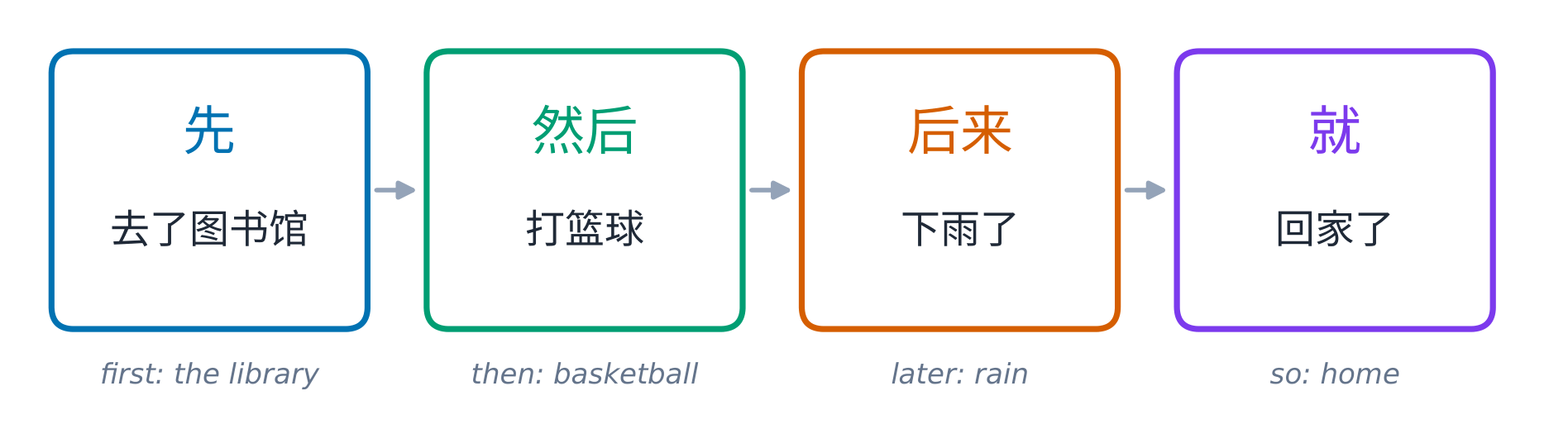
A classmate asks what happened on Saturday. Give a short answer with a beginning, an event and an outcome. Time words help organise it, but a story does not need a surprise or a fixed number of verbs.
星期六我先去了图书馆,然后和朋友打篮球。后来下雨了,我们就回家了。
Xīngqīliù wǒ xiān qù le túshūguǎn, ránhòu hé péngyou dǎ lánqiú. Hòulái xià yǔ le, wǒmen jiù huí jiā le.
On Saturday I first went to the library, then played basketball with friends. Later it rained, so we went home.
先 and 然后 order activities; 后来 moves a past story forward. The rain explains going home. The listener does not need every detail of the day. Retell this with a different activity and an outcome that still follows from the facts.
| English |
|---|
| first ... then ... finally ... |
| much colder today than yesterday |
| I am not as tall as him |
8.2
Compare the same feature
地铁比公交车快。 The metro is faster than the bus.
公交车没有地铁快。 The bus is not as fast as the metro.
The standard follows 比 or 没有. To make the difference large, say 地铁比公交车快多了; to make it small, say 快一点儿. In this simple comparison use a bare adjective, rather than 比公交车很快. A speed comparison does not establish which option is cheaper or more comfortable.
8.3
Give a reason without inventing it
因为下雨了,所以我们回家了。 Because it rained, we went home.
因为 and 所以 may appear together, but either can be omitted when the relation is clear. Both are not compulsory in every answer. Compare 下雨了,我们就回家了: the order and 就 also connect the events. State a reason supported by the story.
8.4
Work through a follow-up
A partner asks 为什么不坐公交车? Why not take the bus?
今天时间不多。地铁比公交车快,所以我想坐地铁。 There is little time today. The metro is faster than the bus, so I want to take the metro.
This answers the actual question. It does not need a story if the comparison and reason are enough. If the partner asks 多少钱?, give a price or say you do not know; do not repeat the speed comparison as if it supplied a fare.
8.5
Practise interaction
Prepare key words rather than a full script. Speak for about half a minute, let a partner ask one follow-up, and answer it. This is a classroom practice duration, not an official test limit. If alone, record an answer, pause, and give yourself a different question.
Check whether the events are in order, the compared feature is clear, and the reason fits the outcome. Ask a listener to comment on clarity and pronunciation. Different sentences can achieve the same task.
8.6
Practice
- Put the story in order with 先, 然后, 后来: 我们回家了 / 我去了商店 / 下雨了 / 我和朋友喝了咖啡.
- Fill the gap: 这个苹果__那个苹果大。
- Make the difference large: 今天比昨天冷。
- Rewrite with 没有, keeping the meaning: 我的房间比你的房间小。(Start: 我的房间……)
- Find the mistake: 地铁比公交车很快。
- A partner asks 你为什么没去打篮球? Give a reason in one sentence.
8.7
A fresh situation
R1. Interpret and repair. A learner says both 因为 and 所以 must appear in every spoken explanation. Correct the rule.
R2. Use it yourself. Tell a three-event weekend story, then answer why one event changed. Use a comparison only if it helps.
Write your responses before opening the key. Compare meaning as well as form; a different valid answer need not copy the model.
8.8
Answers and explanations
Check after your attempt. For open tasks, compare the message and the stated criteria, then revise one detail.
Practice answers
- 我先去了商店,然后和朋友喝了咖啡。后来下雨了,我们就回家了。 The rain explains going home, so it comes before it.
- 比: 这个苹果比那个苹果大。
- 今天比昨天冷多了。 (or 冷得多)
- 我的房间没有你的房间大。 With 没有, use the adjective of the bigger side.
- Remove 很: 地铁比公交车快。 Use 快多了 or 快一点儿 to show how much.
- For example: 因为下雨了,所以我没去打篮球。 or 下雨了,我就没去。
Fresh-situation answers
R1. They can appear together, but either may be omitted when the relationship is clear. 因为下雨了,我们回家了 and 下雨了,所以我们回家了 both work.
R2. One possible response. 我先去了公园,然后看见天快黑了,就回家了。因为天快黑了,我想早点回家。The reason answers the follow-up; a forced comparison would add nothing here.
Recall later. Tomorrow, retell with one changed event and answer an unprepared follow-up.
Interactive lessons on this topic
Work through it step by step, with instant-check exercises.