Epidemiology and clinical evidence
Scope and prerequisites
Supported GRE topic 26 (EP.1). Use the overview measurement lesson VI when interpreting research evidence. Existing official questions are traced in bank_review_form.yaml; original tasks below are not ETS items.
Concepts and method
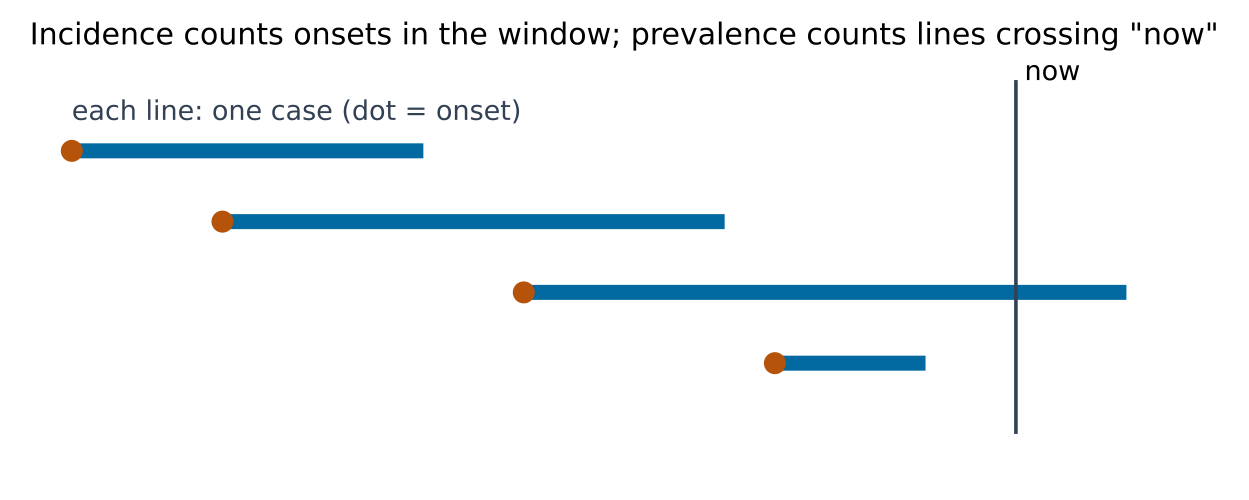
incidence 发病率(新发病例): The number or rate of NEW cases arising in a period. prevalence 患病率: The proportion of a population with the condition at a given time.
Incidence counts NEW cases in a period (number of new diagnoses in a year); prevalence counts ALL existing cases at a time. Chronic conditions can have low incidence and high prevalence; short acute outbreaks show the reverse. A count of new cases in the United States in the past year is an incidence figure.
Rates need denominators: incidence rate is new cases divided by person-time at risk; prevalence is existing cases divided by the population. Comparing raw counts across populations of different sizes misleads; compare rates.
Case reports, case-control studies, cohorts, randomized trials and meta-analyses answer different questions. Random allocation can reduce baseline confounding under appropriate implementation; observational designs need explicit confounder analysis. Quality, bias, relevance and uncertainty must be evaluated within each design. A meta-analysis cannot automatically repair weak constituent studies.
Screening and risk run on base rates: with low prevalence, even an accurate test yields mostly false positives among positives. Number needed to treat and relative versus absolute risk are read against the baseline, not from the treatment label alone.
A cumulative incidence proportion uses new cases among people initially at risk over a specified period. An incidence rate uses person-time, while point prevalence counts existing cases at a specified time. Do not interchange their denominators or units. Design labels are guides, not an automatic quality ladder: a biased trial or weak meta-analysis can mislead. Relative risk reduction needs its baseline; absolute change and follow-up duration are necessary for interpretation.
Worked reasoning
Counting this year's new schizophrenia diagnoses measures incidence; counting everyone currently diagnosed measures prevalence. A 50% relative risk reduction from 2% to 1% is 1 point absolute. A rare-condition screen with many false positives follows directly from the low base rate.
In a fictional closed cohort, 12 of 600 initially unaffected people develop a condition over one year, with complete follow-up. Compute cumulative incidence. If 30 of 750 people have it at a census, compute prevalence.
Cumulative incidence=new cases/initially at-risk population=12/600=.02, or 2% over one year. Point prevalence=existing cases/population at that time=30/750=.04, or 4%. The first is not a person-time incidence rate; the second includes old and new existing cases at the census.
Independent transfer
A fictional trial's risks over the same period are 4% in control and 3% in treatment. Compute relative and absolute reduction and NNT, then qualify.
Attempt independently, then use the matching skill sheet solution.
Review and source limits
Avoid this error: Reporting a new-case count as prevalence, or quoting relative risk without the absolute baseline. Teaching scope comes from teaching.yaml and the source/key/crop review in bank_review_form.yaml. Detailed current diagnostic criteria require an authenticated manual; neither historical ETS practice nor this educational reference certifies them.