Groups, relationships and intergroup processes
Scope and prerequisites
Supported GRE topic 21 (SO.2). Use the overview measurement lesson VI when interpreting research evidence. Existing official questions are traced in bank_review_form.yaml; original tasks below are not ETS items.
Concepts and method
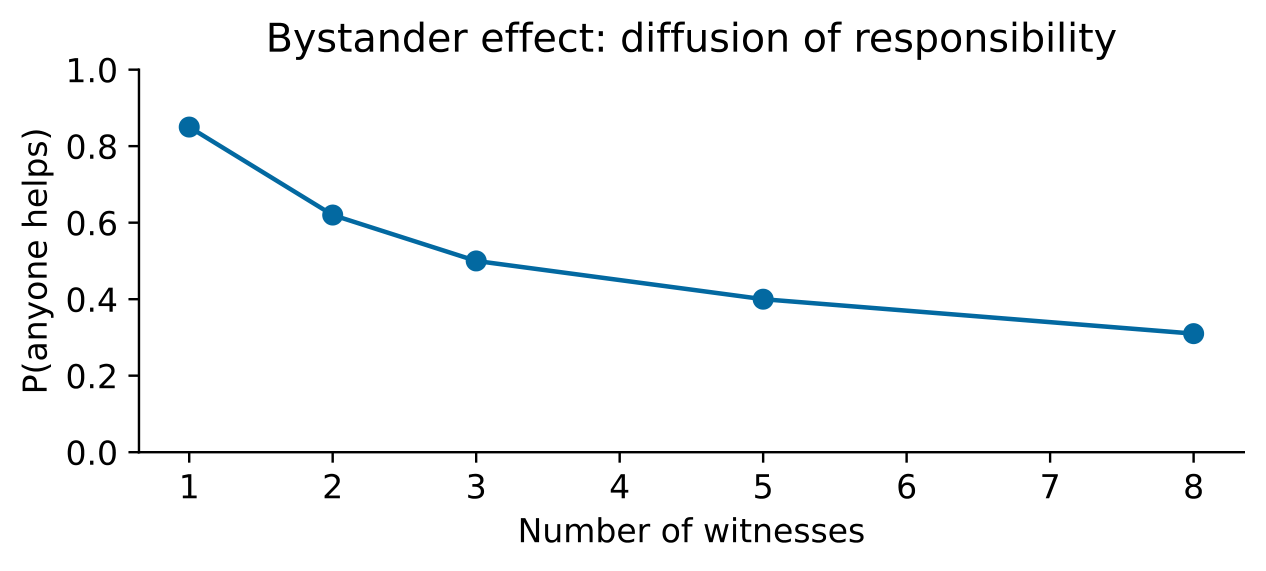
social loafing 社会惰化: Reduced individual effort when contributions are pooled and unidentifiable. bystander effect 旁观者效应: Help becomes less likely as the number of witnesses grows, via diffusion of responsibility.
Groups change performance. Social facilitation: the presence of others strengthens dominant responses, helping well-learned tasks and hurting novel ones. Social loafing: effort falls when individual contributions are unidentifiable. Groupthink: cohesive groups under pressure suppress dissent and reach poor decisions; deindividuation: anonymity in a crowd lowers self-restraint.
Attraction is predicted first by propinquity — physical or functional proximity, as in making friends on the same dorm floor — then similarity and reciprocal liking; mere exposure breeds familiarity-based liking. Social exchange theory reads relationships as outcomes minus costs against a comparison level; interdependence analyses use each partner's payoff structure.
Separate the intergroup trio: stereotypes are beliefs about groups, prejudice is evaluative affect, discrimination is behaviour. The minimal-group paradigm shows in-group favouritism from arbitrary assignment alone; realistic conflict theory ties hostility to competition over resources; the contact hypothesis reduces prejudice under equal status, common goals and cooperative contact, not mere exposure.
The bystander effect: help falls as witnesses increase, through diffusion of responsibility and pluralistic ignorance (each reads others' calm as no emergency). Aggression research links frustration to aggression and shows how residual arousal (excitation transfer) can escalate conflict; altruism is helped by clear identification of a single victim.
Diffusion of responsibility can reduce an individual's felt obligation when others could act. Pluralistic ignorance can make people interpret others' inaction as evidence that help is unnecessary. Cohesion can support cooperation but does not always improve judgement. Group polarization concerns a shift toward an initially favoured direction; groupthink concerns decision processes that suppress critical evaluation. Intergroup explanations must examine structures, norms and contact conditions, not assume every member shares one attitude.
Worked reasoning
Friends cluster on the same dorm floor — propinquity. A tug-of-war team slacks when pulls are pooled — social loafing under unidentifiable contributions. Arbitrary badge colours producing in-group preference is the minimal-group effect. Nobody calling for help in a crowded plaza is diffusion of responsibility.
Several witnesses wait because each thinks another will call for help. Name the mechanism and distinguish it from believing no help is needed.
Expecting someone else to act fits diffusion of responsibility. Interpreting everyone else's calm as evidence there is no emergency fits pluralistic ignorance. The case needs their accounts or an appropriate manipulation to distinguish mechanisms; mere group size does not establish either.
Independent transfer
A group makes a more extreme decision after discussion. Give evidence needed to identify polarization and one alternative process.
Attempt independently, then use the matching skill sheet solution.
Review and source limits
Avoid this error: Writing stereotype, prejudice and discrimination as synonyms, or promising that any contact fixes prejudice; contact works under conditions, not by default. Teaching scope comes from teaching.yaml and the source/key/crop review in bank_review_form.yaml. Detailed current diagnostic criteria require an authenticated manual; neither historical ETS practice nor this educational reference certifies them.