Pure Mathematics 1: the toolkit every later unit uses
Pure Mathematics 1 (P1) is the first compulsory unit of both International AS and International A Level Mathematics, and of International A Level Pure Mathematics. This reference covers every P1 topic in the Edexcel IAL specification (Issue 3, April 2019): algebra and functions, coordinate geometry, trigonometry, differentiation and integration.
- The P1 paper (WMA11/01) lasts 1 hour 30 minutes with 75 marks, and you must answer all questions. Recent papers have ten questions from 5 to 11 marks each.
- A calculator 计算器 may be used, but not one with symbolic algebra, symbolic differentiation or integration, or retrievable stored formulae.
- The yellow booklet Mathematical Formulae and Statistical Tables is provided. The formulae in the "you must know" table below do not appear in that booklet, so memorise them.
- Give inexact answers to 3 significant figures unless told otherwise. When a question says "you must show all stages of your working", a calculator answer alone scores nothing.
Formulae you must know for P1 (from the specification's assessment information):
| Formula | Use |
|---|---|
| $x = \dfrac{-b \pm \sqrt{b^2 - 4ac}}{2a}$ | roots of $ax^2 + bx + c = 0$ |
| $\dfrac{a}{\sin A} = \dfrac{b}{\sin B} = \dfrac{c}{\sin C}$ | sine rule 正弦定理 |
| $a^2 = b^2 + c^2 - 2bc\cos A$ | cosine rule 余弦定理 |
| area $= \tfrac{1}{2}ab\sin C$ | area of a triangle |
| arc length $s = r\theta$, sector area $= \tfrac{1}{2}r^2\theta$ | $\theta$ in radians 弧度 |
| $\dfrac{d}{dx}x^n = nx^{n-1}$ | power rule for differentiation |
| $\displaystyle\int x^n\,dx = \dfrac{x^{n+1}}{n+1} + c \quad (n \neq -1)$ | power rule for integration |
Algebra and functions
Indices and surds
The laws of indices 指数运算法则 hold for all rational exponents:
Fractional powers are roots: $a^{m/n} = \sqrt[n]{a^m}$, so $a^{1/2} = \sqrt{a}$ and $a^{1/3} = \sqrt[3]{a}$. A negative power means reciprocal: $a^{-1} = 1/a$. Questions usually ask you to write an answer in the form $kx^n$ with $k$ and $n$ fully simplified constants.
Worked example — three index manipulations (adapted from Edexcel IAL WMA11 June 2025 Q1). Given $p = \dfrac{x^4}{16}$ and $q = \dfrac{40}{3x}$, write each expression in the form $kx^n$.
(a) $p^{\frac{1}{2}}$.
- Known: $p = x^4/16$, and a power $\tfrac12$ means square root.
$$p^{\frac{1}{2}} = \sqrt{\frac{x^4}{16}} = \frac{\sqrt{x^4}}{\sqrt{16}} = \frac{x^2}{4}$$
- Check: squaring the answer, $(x^2/4)^2 = x^4/16 = p$.
(b) $(pq)^{-1}$.
- Known: multiply before inverting, using $x^4 \cdot x^{-1} = x^3$.
$$pq = \frac{x^4}{16}\times\frac{40}{3x} = \frac{40x^3}{48} = \frac{5x^3}{6}$$$$(pq)^{-1} = \left(\frac{5x^3}{6}\right)^{-1} = \frac{6}{5}x^{-3}$$
- Check: $(pq)\times(pq)^{-1} = \frac{5x^3}{6}\times\frac{6}{5x^3} = 1$.
(c) $(pq)^2$.
- Check: $5^2 = 25$, $6^2 = 36$, $(x^3)^2 = x^6$, and the constants are already fully simplified.
A surd 根式 is an exact root such as $\sqrt{2}$. Keep answers exact unless asked for decimals; examiners penalise rounded decimals where a surd is expected. To rationalise the denominator 分母有理化, multiply numerator and denominator by a term that removes the root:
Worked example — rationalising. Write $\dfrac{12}{1+\sqrt{2}}$ with a rational denominator.
- Known: $(1+\sqrt2)(\sqrt2-1) = \sqrt2 - 1 + 2 - \sqrt2 = 1$, so multiply by $\dfrac{\sqrt2-1}{\sqrt2-1}$.
$$\frac{12}{1+\sqrt2}\times\frac{\sqrt2-1}{\sqrt2-1} = \frac{12(\sqrt2-1)}{(1+\sqrt2)(\sqrt2-1)} = 12(\sqrt2 - 1) = 12\sqrt2 - 12$$
- Check by calculator: $12/(1+1.4142\ldots) = 4.9706\ldots$ and $12\sqrt2 - 12 = 4.9706\ldots$ ✓
Quadratics: discriminant and completing the square
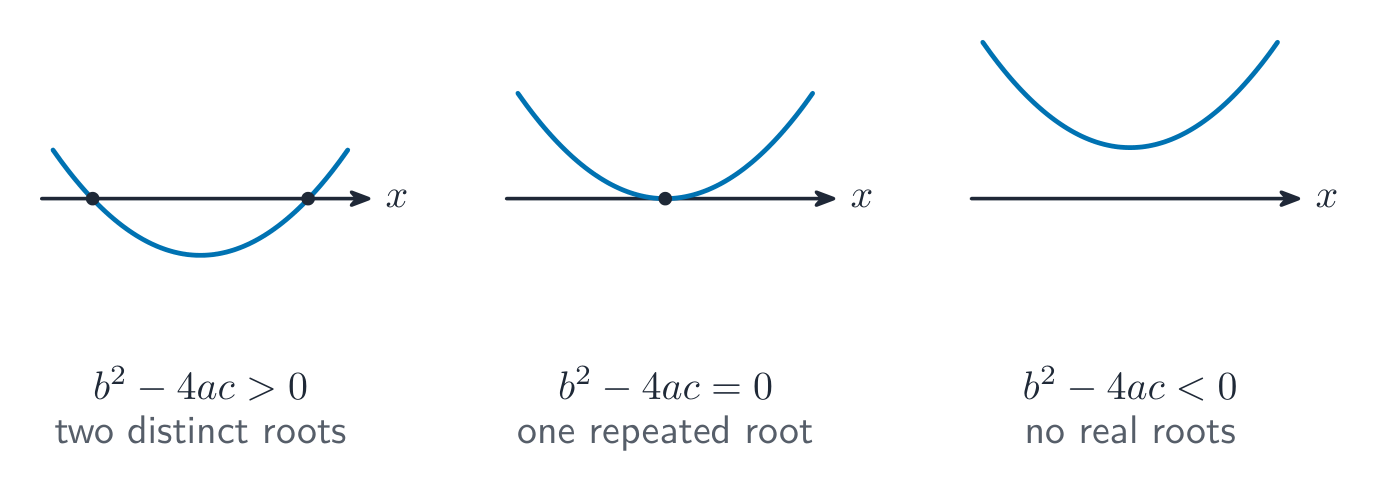
A quadratic function 二次函数 has the form $y = ax^2 + bx + c$; its graph is a parabola opening up ($a>0$) or down ($a<0$). The discriminant 判别式 $\Delta = b^2 - 4ac$ counts the roots:
- $\Delta > 0$: two distinct real roots — the curve cuts the $x$-axis twice;
- $\Delta = 0$: one repeated root — the curve touches the $x$-axis;
- $\Delta < 0$: no real roots — the curve never meets the $x$-axis.
Completing the square 配方 rewrites $ax^2+bx+c$ as $a\left(x+\dfrac{b}{2a}\right)^2 + \left(c - \dfrac{b^2}{4a}\right)$, which gives the turning point $\left(-\dfrac{b}{2a},\, c - \dfrac{b^2}{4a}\right)$ directly. Solve quadratics by factorisation, the formula, completing the square, or a calculator — but "show all stages" questions reject calculator-only working.
Worked example — a hidden quadratic (adapted from Edexcel IAL WMA11 June 2025 Q10). The equation $(k-1)x^6 + 4x^3 + (k-4) = 0$, where $k$ is a constant.
(a) For $k = 4.5$, find the exact solutions.
- Known: with $k = 4.5$ the equation is $3.5x^6 + 4x^3 + 0.5 = 0$; multiply by 2 to clear decimals:
$$7x^6 + 8x^3 + 1 = 0$$
- Why substitute: $x^6 = (x^3)^2$, so this is a quadratic in $x^3$. Substitute $z = x^3$:
$$7z^2 + 8z + 1 = 0 \implies (7z+1)(z+1) = 0 \implies z = -\tfrac{1}{7} \ \text{ or } z = -1$$
- Return to $x$: $x^3 = -\tfrac17$ or $x^3 = -1$, so
$$x = -\sqrt[3]{\tfrac{1}{7}} = -\frac{\sqrt[3]{7}}{7} \qquad \text{or} \qquad x = -1$$
- Check: $z=-1$ gives $7-8+1 = 0$ ✓; $z=-\tfrac17$ gives $7\cdot\tfrac{1}{49} - \tfrac87 + 1 = \tfrac17 - \tfrac87 + 1 = 0$ ✓
(b) Find the set of values of $k$ for which the equation has no real roots.
- Known: treat the equation as a quadratic in $x^3$ with $a = k-1$, $b = 4$, $c = k-4$. No real
roots needs a negative discriminant:
$$b^2 - 4ac = 16 - 4(k-1)(k-4) = 16 - 4(k^2 - 5k + 4) = -4k^2 + 20k = 4k(5-k)$$$$4k(5-k) < 0 \implies k < 0 \ \text{or}\ k > 5$$
- Check: at $k = -1$: $4(-1)(6) = -24 < 0$ ✓; at $k = 6$: $4(6)(-1) = -24 < 0$ ✓; at $k = 3$: $4(3)(2) = 24 > 0$ ✓ (two real roots there).
Simultaneous equations and inequalities
Solve simultaneous equations 联立方程 analytically by substitution 代入法: rearrange the linear equation, substitute into the other, solve, then substitute back. A line meeting a curve gives a quadratic whose roots are the intersection $x$-coordinates — this is the "geometrical interpretation of algebraic solutions" the specification asks for.
Worked example — line meets cubic-squared curve (adapted from Edexcel IAL WMA11 June 2025 Q7). $C_1$: $y = 0.2x^2(x-4)$ and $C_2$: $y = 1.2x(8-x)$ intersect where
- Expand both sides: $0.2x^3 - 0.8x^2 = 9.6x - 1.2x^2$.
- Collect terms: $0.2x^3 + 0.4x^2 - 9.6x = 0$, then divide by $0.2$: $x^3 + 2x^2 - 48x = 0$.
- Factorise: $x(x^2 + 2x - 48) = x(x+8)(x-6) = 0$, so $x = 0, -8, 6$.
- Substitute back into $C_2$: $(0, 0)$, $(-8, -153.6)$, $(6, 14.4)$.
- Check with $C_1$: $0.2(-8)^2(-12) = 0.2\cdot64\cdot(-12) = -153.6$ ✓ and $0.2(36)(2) = 14.4$ ✓
Inequalities 不等式 follow the same algebra, but the answer is a range:
- Solve $ax + b > cx + d$ by collecting $x$ (the inequality sign survives adding/subtracting, and survives dividing by a positive number; dividing by a negative flips the sign).
- Solve $px^2 + qx + r \le 0$ by sketching: the solution is where the parabola is on or below the axis, between the roots.
- "Curve below line" inequalities such as $px^2+qx+r < ax+b$ mean: where is the curve's height less than the line's height? Find intersections first.
- When sketching the solution region, use a dotted line for strict $<$ or $>$ boundaries and a solid line for $\le$ or $\ge$.
Worked example. Solve $x^2 < 3x + 10$.
- Rearrange: $x^2 - 3x - 10 < 0$, and factorise: $(x-5)(x+2) < 0$.
- The parabola $y = (x-5)(x+2)$ opens upward, so it is below zero between its roots:
$$-2 < x < 5$$
- Check: $x = 0$ gives $0 < 10$ ✓; $x = 6$ gives $36 < 28$ ✗ (correctly excluded).
Polynomials: expanding and factorising
Expand brackets and collect like terms; factorise by taking out common factors and by grouping. Cubics factorise fully once one root is spotted: $x^3 + 4x^2 + 3x = x(x^2+4x+3) = x(x+1)(x+3)$. The notation $f(x)$ names the function, so $f(2)$ means "substitute $x = 2$".
Sketching graphs and transformations
Sketch (do not plot) these families: quadratics and simple cubics 三次函数 such as $y = x^3 - 4x$; reciprocal functions 反比例函数 $y = \dfrac{k}{x}$ and $y = \dfrac{k}{x^2}$ ($x \ne 0$), which have an asymptote 渐近线 — a line the curve approaches but never touches; and the trigonometric graphs below. Mark intercepts and turning points.
Intersections answer equations: the curves $y = f(x)$ and $y = g(x)$ meet where $f(x) = g(x)$.
One transformation 变换 at a time, applied to $y = f(x)$:
| New equation | What it does to the graph |
|---|---|
| $y = a f(x)$ | stretch parallel to the $y$-axis, scale factor $a$ |
| $y = f(x) + a$ | translation by $\begin{pmatrix} 0 \\ a \end{pmatrix}$ (moves up by $a$) |
| $y = f(x + a)$ | translation by $\begin{pmatrix} -a \\ 0 \end{pmatrix}$ (moves left by $a$) |
| $y = f(ax)$ | stretch parallel to the $x$-axis, scale factor $\dfrac{1}{a}$ |
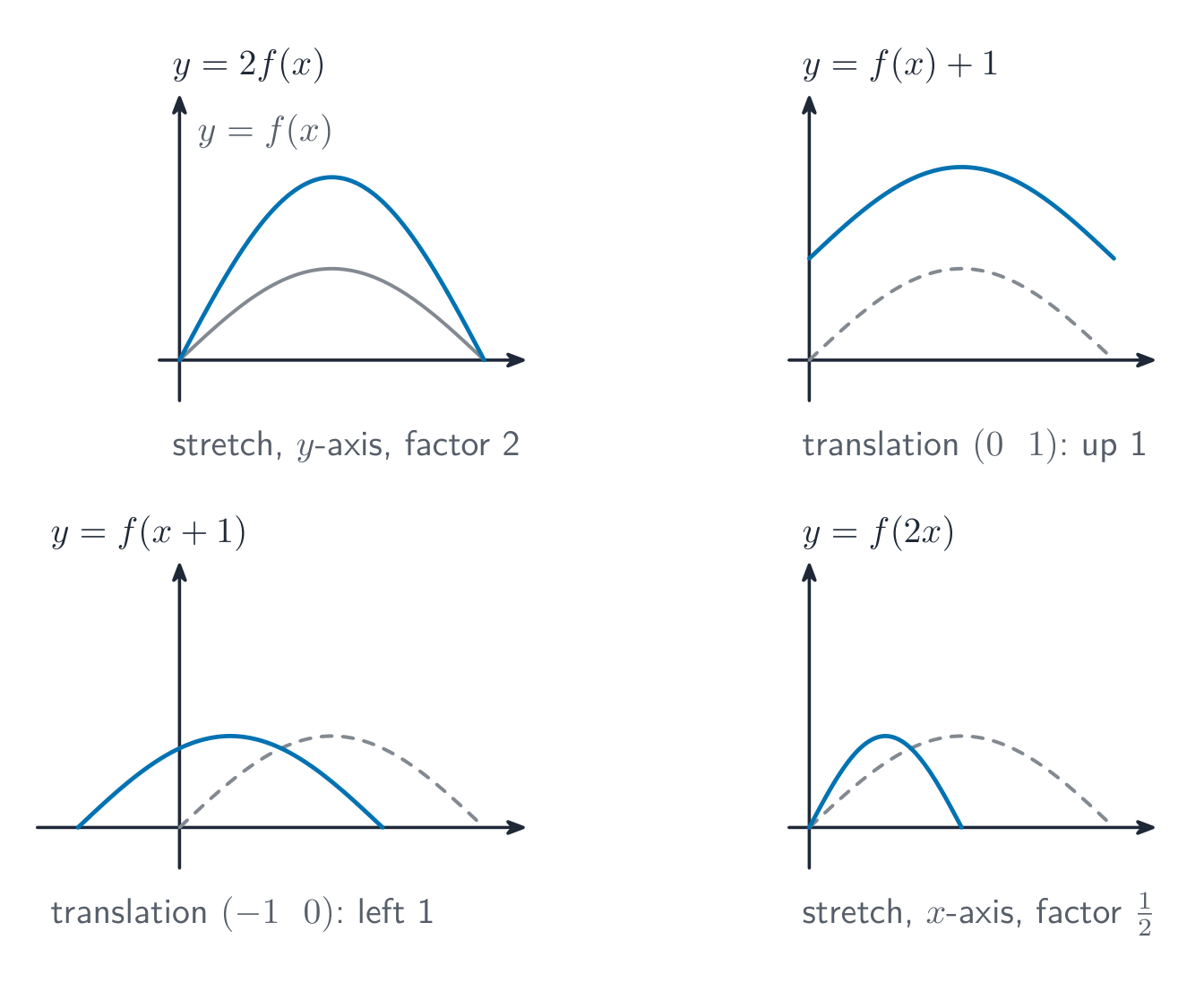
Worked example — describe two transformations (adapted from Edexcel IAL WMA11 June 2025 Q9).
- $y = \sqrt{2x}$ from $y = \sqrt{x}\,$: write $\sqrt{2x} = f(2x)$, so this is a stretch parallel to the $x$-axis with scale factor $\tfrac12$.
- $y = 12 - \sqrt{x}$ from $y = -\sqrt{x}\,$: write $12 - \sqrt x = -\sqrt x + 12$, a translation by $\begin{pmatrix} 0 \\ 12 \end{pmatrix}$ (up by 12).
- Check with a point: $y=\sqrt x$ passes $(4, 2)$; after the first transformation the curve passes $(2, 2)$ (halved $x$), and $y = \sqrt{2\times2} = 2$ ✓. After the second, $y = -\sqrt{4} + 12 = 10$, so $(4, 10)$ lies on it ✓.
Coordinate geometry in the (x, y) plane
A line through $(x_1, y_1)$ with gradient $m$ has equation $y - y_1 = m(x - x_1)$; the form $ax + by + c = 0$ hides the gradient in $-\dfrac{a}{b}$. Two points give the gradient: $m = \dfrac{y_2 - y_1}{x_2 - x_1}$.
- Parallel 平行 lines share their gradient: $m_1 = m_2$.
- Perpendicular 垂直 lines have gradients multiplying to $-1$: $m_1 m_2 = -1$.
Worked example — perpendicular through the origin (adapted from Edexcel IAL WMA11 June 2025 Q5). The line $l_1$ has equation $x - 2y + 25 = 0$; $l_2$ passes through the origin and is perpendicular to $l_1$.
(a) Equation of $l_2$.
- Known: rearrange $l_1$: $2y = x + 25$, so $y = \tfrac12 x + \tfrac{25}{2}$ and $m_1 = \tfrac12$.
- Why: perpendicular gradients multiply to $-1$, so $m_2 = -1 \div \tfrac12 = -2$.
$$y - 0 = -2(x - 0) \implies y = -2x$$
(b) $l_1$ and $l_2$ intersect at $P$.
- Substitute $y = -2x$ into $x - 2y + 25 = 0$:
$$x - 2(-2x) + 25 = 0 \implies 5x + 25 = 0 \implies x = -5, \quad y = -2(-5) = 10$$
- $P = (-5, 10)$. Check in $l_1$: $-5 - 20 + 25 = 0$ ✓
(c) Shortest distance from $l_1$ to the origin, as a simplified surd.
- The shortest distance is $|OP|$ along the perpendicular:
$$|OP| = \sqrt{(-5-0)^2 + (10-0)^2} = \sqrt{25 + 100} = \sqrt{125} = 5\sqrt{5}$$
- Check: $\sqrt{125} = \sqrt{25\times5} = 5\sqrt5 \approx 11.18$ ✓
Trigonometry
The sine rule, cosine rule and area of a triangle
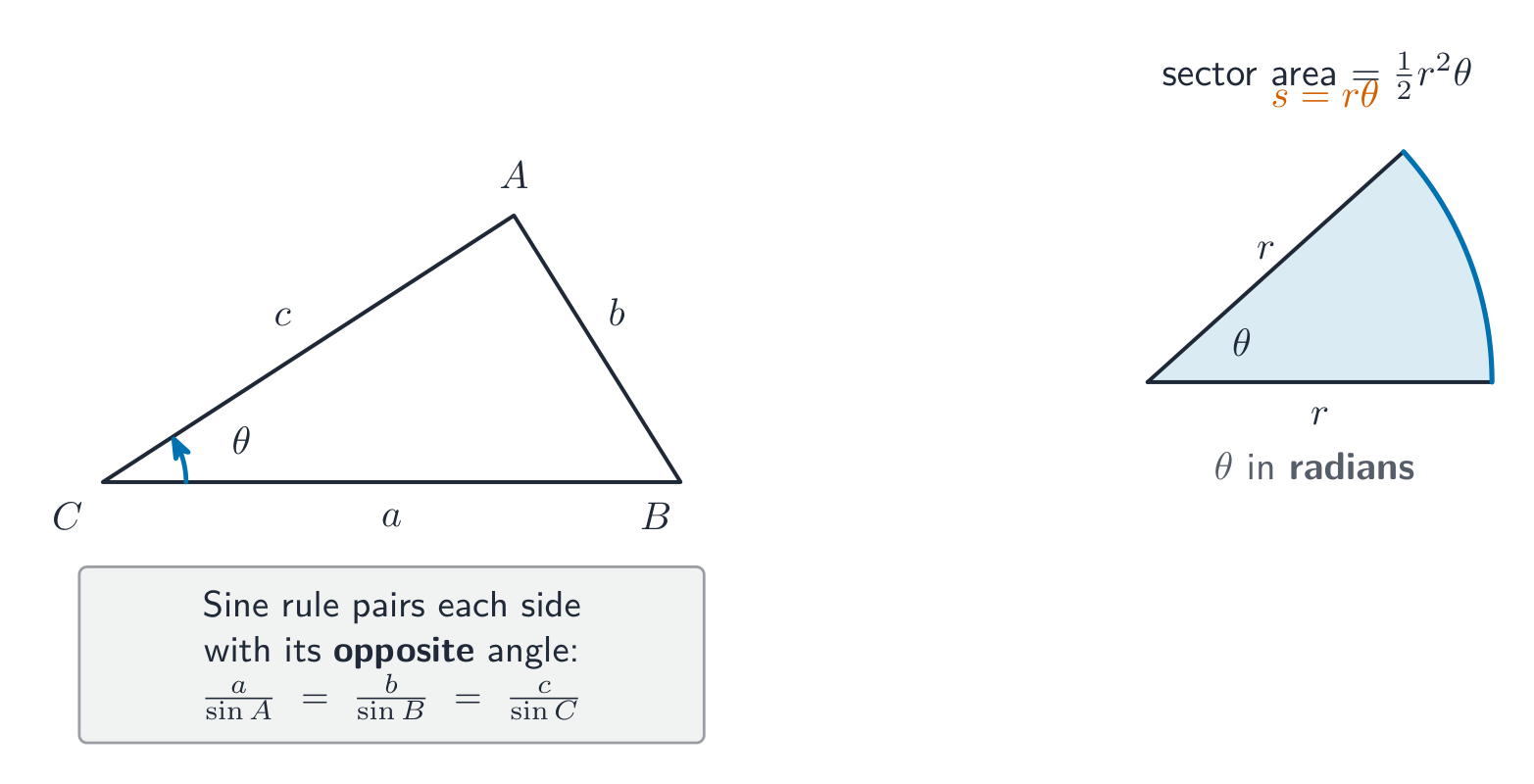
In triangle $ABC$ with sides $a, b, c$ opposite angles $A, B, C$:
Use the sine rule for pairs (side, opposite angle); the cosine rule when no pair is opposite. The sine rule has an ambiguous case 二义情形: $\sin\theta = \sin(180° - \theta)$, so an angle and its supplement can both fit — check which the diagram allows.
Radian measure, arc length and sector area
One radian is the angle subtended by an arc equal in length to the radius; $180° = \pi$ radians. With $\theta$ in radians:
The arc length 弧长 is $s = r\theta$ and the sector area 扇形面积 is $\tfrac{1}{2}r^2\theta$.
A major sector is the larger share of the circle: angle $2\pi - \theta$ when the minor angle is $\theta$.
Worked example — a helipad from a major sector and a triangle (adapted from Edexcel IAL WMA11 June 2025 Q6). A landing pad is the major sector $AOB$ of a circle centre $O$ joined to triangle $AOC$: $AO = OB = 15$ m, $BC = 2$ m, $CBO$ is a straight line, and angle $ACO = 0.6$ radians.
(a) Show angle $COA = 1.847$ radians to 3 decimal places.
- Known: $OC = OB + BC = 15 + 2 = 17$ m; in triangle $AOC$, side $AO = 15$ is opposite the given angle $0.6$, and side $OC = 17$ is opposite angle $CAO$.
- Sine rule (quote it first):
$$\frac{\sin CAO}{17} = \frac{\sin 0.6}{15} \implies \sin CAO = \frac{17\sin 0.6}{15} = 0.6399\ldots \implies CAO = 0.6944\ldots$$$$COA = \pi - 0.6 - 0.6944\ldots = 1.8471\ldots = 1.847 \ (3\,\mathrm{d.p.})$$
- Check: angles sum to $\pi$: $0.6 + 0.6944 + 1.8471 \approx 3.1416$ ✓
(b) Total area of the pad.
- Major sector angle: $2\pi - 1.847 = 4.436$ radians.
$$\text{sector} = \tfrac12 r^2\theta = \tfrac12 \times 15^2 \times 4.436 = 499.1\ \text{m}^2 \ (\text{awrt } 499)$$$$\text{triangle} = \tfrac12 ab\sin C = \tfrac12 \times 15 \times 17 \times \sin 1.847 = 122.7\ \text{m}^2$$$$\text{total} = 499.1 + 122.7 = 622\ \text{m}^2 \ (3\ \text{s.f.})$$
- Check: $\sin 1.847 = \sin(\pi - 1.847) = \sin 1.2946 = 0.962$ ✓
(c) Perimeter of the pad.
- The boundary is the major arc $AB$ plus sides $AC$ and $BC$.
$$\text{arc} = r\theta = 15 \times 4.436 = 66.5\ \text{m}$$
- Cosine rule for $AC$ (quote it first):
$$AC^2 = 15^2 + 17^2 - 2(15)(17)\cos 1.847 = 225 + 289 + 139.9 = 653.9 \implies AC = 25.6\ \text{m}$$$$\text{perimeter} = 66.5 + 25.6 + 2 = 94.1\ \text{m} \ (3\ \text{s.f.})$$
- Check: $\cos 1.847 < 0$ (the angle is obtuse), so the $-2bc\cos A$ term adds ✓
Sine, cosine and tangent graphs
$y = \sin x$ and $y = \cos x$ repeat every $2\pi$ ($360°$); $y = \tan x$ repeats every $\pi$ ($180°$) with asymptotes at $x = 90° + 180°n$. Know the symmetries: $\cos$ is even, $\sin(180° - x) = \sin x$, and $\tan x = \sin x / \cos x$. Curves such as $y = 3\sin x$, $y = \sin 2x$ and $y = \sin\left(x + \frac{\pi}{6}\right)$ follow from the transformation rules above. Solve equations graphically by counting intersections in a given interval.
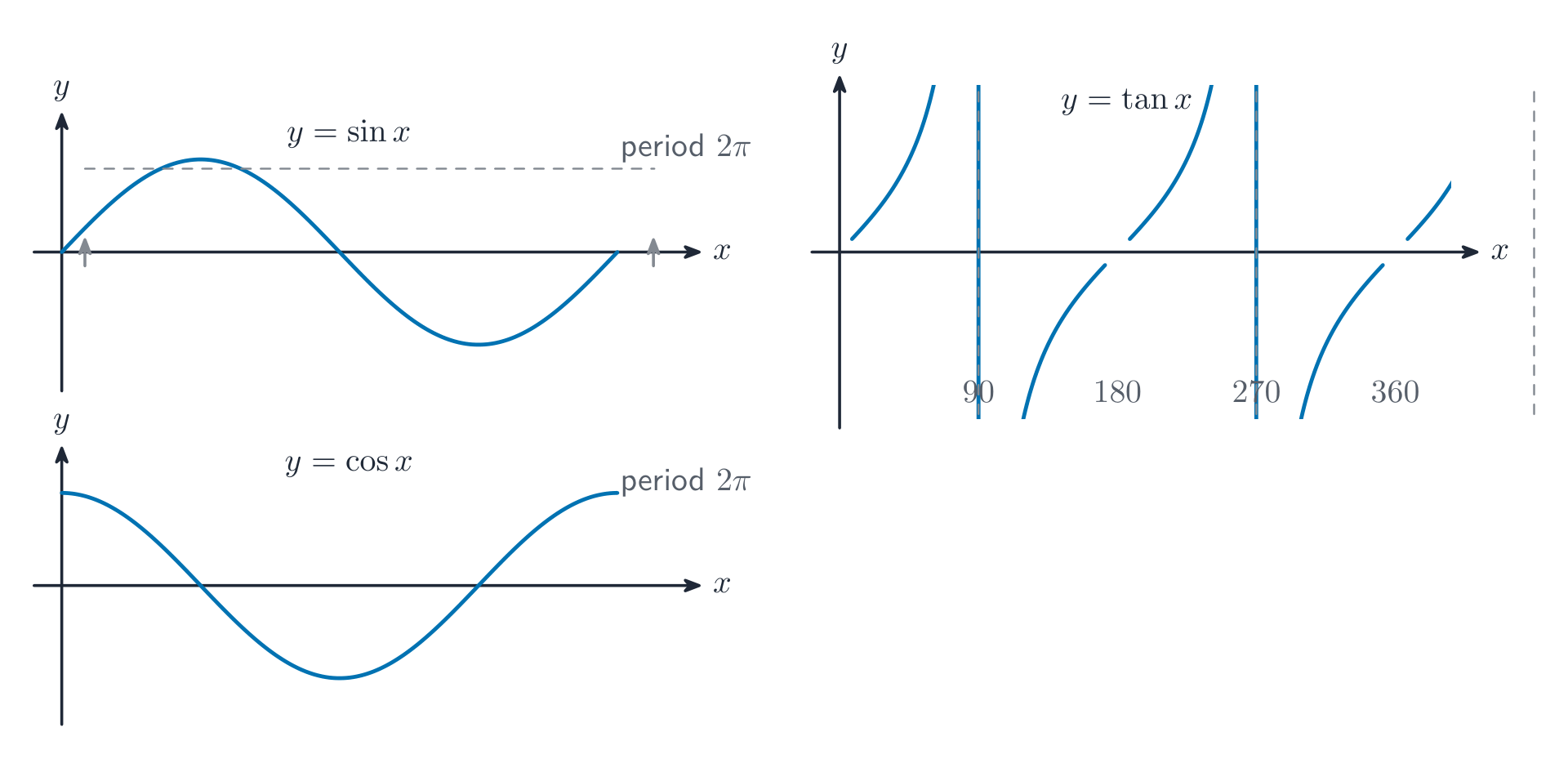
Worked example — counting solutions (adapted from Edexcel IAL WMA11 June 2025 Q4). For $y = 4\cos x$ with $x$ in degrees: how many solutions does $5 + 4\cos x = 1$ have for $-720° < x \le 720°$?
- Rearrange: $4\cos x = -4$, so $\cos x = -1$, giving $x = 180° + 360°n$.
- In $-720° < x \le 720°$: $x = -540°, -180°, 180°, 540°$ — 4 solutions.
- Check: $\cos(\pm180°) = -1$ ✓, and $5 + 4(-1) = 1$ ✓. The interval is half-open, so $x = -720°$ (where $\cos = 1$) is excluded correctly.
Differentiation
The derivative 导数 $f'(x) = \dfrac{dy}{dx}$ is the gradient of the tangent 切线斜率 to $y = f(x)$ at a point — the limit of the chord gradients as the two points merge. It is the rate of change 变化率 of $y$ with respect to $x$. The second derivative 二阶导数 $f''(x)$ differentiates again. (The chain rule is not required in P1.)
Differentiate term by term with the power rule, expanding products and splitting fractions first:
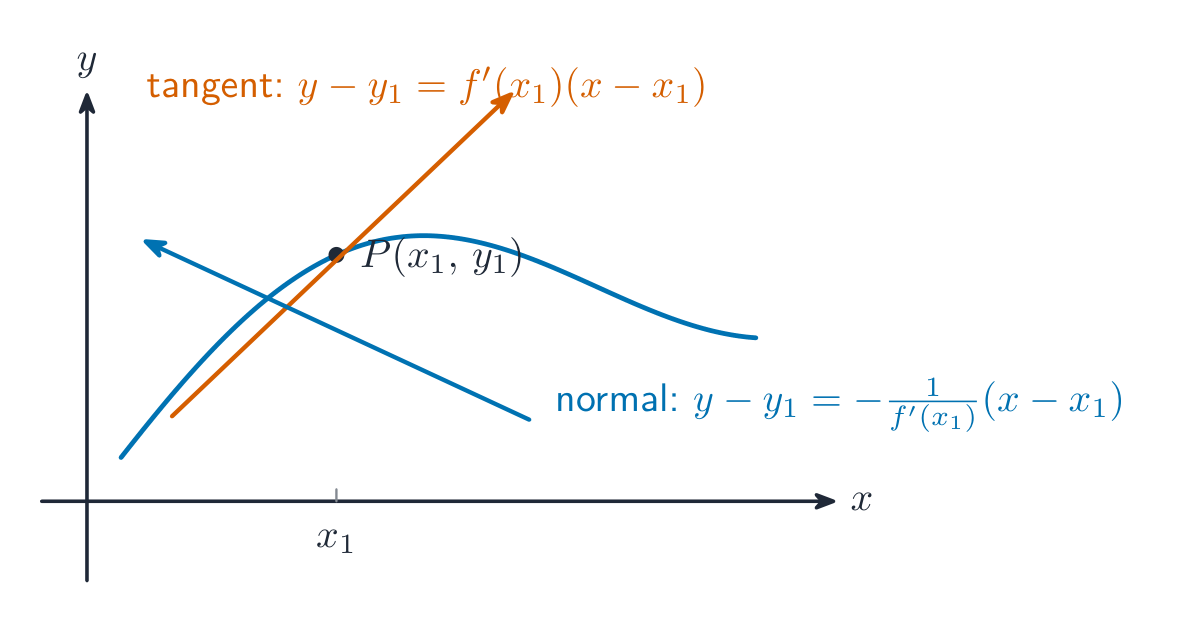
Worked example — gradient condition on a curve (adapted from Edexcel IAL WMA11 June 2025 Q2). $C$: $y = 2x^{5/2} - 4x + 3$; the point $P$ on $C$ has $x$-coordinate $2^k$ and the gradient at $P$ is 16. Find $k$.
- Differentiate (powers drop by one): $\dfrac{dy}{dx} = 2\cdot\tfrac52 x^{3/2} - 4 = 5x^{3/2} - 4$.
- Set the gradient to 16 at $x = 2^k$:
$$5(2^k)^{3/2} - 4 = 16 \implies (2^k)^{3/2} = 4 = 2^2 \implies 2^{3k/2} = 2^2 \implies \tfrac{3k}{2} = 2 \implies k = \tfrac{4}{3}$$
- Check: $2^{4/3} = 2.5198\ldots$ and $5(2.5198)^{3/2} - 4 = 5(4.0) - 4 = 16$ ✓
Worked example — tangent, normal work and second derivative (adapted from Edexcel IAL WMA11 June 2025 Q8). A curve has $f'(x) = 3\sqrt{x} + kx^2$ and passes through $P(4, 12)$; the tangent at $P$ is $y = 10x + c$.
(a) Show $k = \tfrac14$ and find $c$.
- Known: the tangent's gradient equals $f'(4)$:
$$f'(4) = 3\sqrt{4} + 16k = 6 + 16k = 10 \implies k = \tfrac14$$
- The tangent passes through $(4, 12)$: $12 = 10(4) + c \implies c = -28$.
- Check: $f'(4) = 6 + 16\cdot\tfrac14 = 10$ ✓ and $10(4) - 28 = 12$ ✓
(b) $f''(x)$ at $P$.
- Check: $\tfrac{3}{2\sqrt4} = \tfrac34$ ✓
Integration
Integration 积分 reverses differentiation: if $\dfrac{dy}{dx} = x^n$ ($n \neq -1$), then
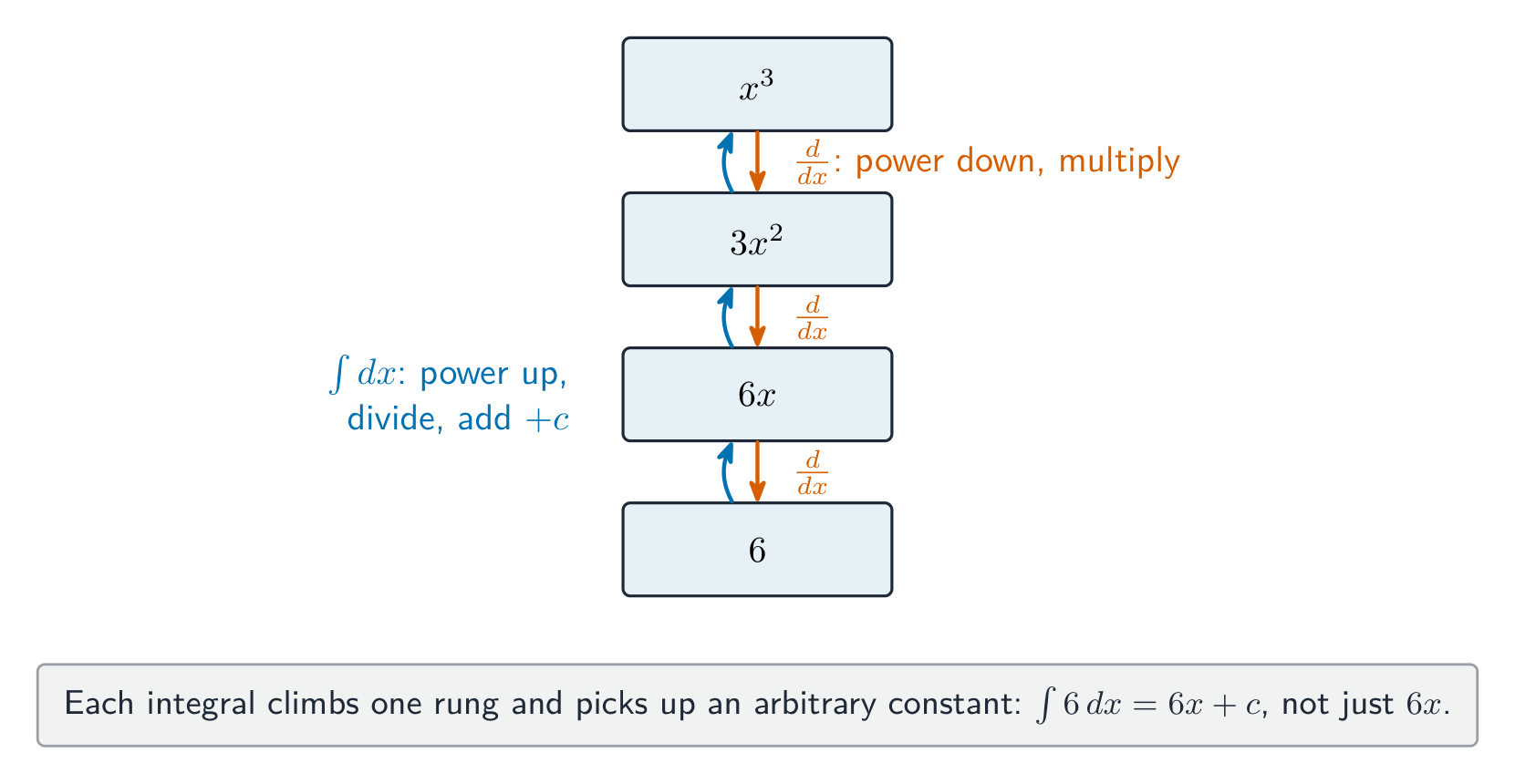
Worked example — expand before integrating (adapted from Edexcel IAL WMA11 June 2025 Q3). Find $\displaystyle\int \frac{(x+3)^2}{3\sqrt{x}}\,dx$.
- Expand the numerator: $(x+3)^2 = x^2 + 6x + 9$; the denominator is $3x^{1/2}$.
- Divide term by term (powers of $x$ subtract):
$$\frac{x^2}{3x^{1/2}} = \tfrac13 x^{3/2} \qquad \frac{6x}{3x^{1/2}} = 2x^{1/2} \qquad \frac{9}{3x^{1/2}} = 3x^{-1/2}$$
- Integrate each term (power up one, divide by the new power):
$$\int \left(\tfrac13 x^{3/2} + 2x^{1/2} + 3x^{-1/2}\right) dx = \tfrac13\cdot\tfrac{2}{5}x^{5/2} + 2\cdot\tfrac23 x^{3/2} + 3\cdot 2x^{1/2} + c$$$$= \frac{2}{15}x^{5/2} + \frac{4}{3}x^{3/2} + 6\sqrt{x} + c$$
- Check by differentiating: $\tfrac{2}{15}\cdot\tfrac52 x^{3/2} = \tfrac13 x^{3/2}$ ✓, $\tfrac43\cdot\tfrac32 = 2$ ✓, $6\cdot\tfrac12 = 3$ ✓ — the integrand returns exactly.
Worked example — recover $f(x)$ from $f'(x)$ and a point (adapted from Edexcel IAL WMA11 June 2025 Q8, continued). With $k = \tfrac14$, so $f'(x) = 3x^{1/2} + \tfrac14 x^2$, and $P(4, 12)$ on the curve:
- Substitute $P$: $2(4)^{3/2} + \tfrac{64}{12} + d = 12$, and $4^{3/2} = 8$:
$$16 + \tfrac{16}{3} + d = 12 \implies d = -\tfrac{28}{3} \implies f(x) = 2x^{3/2} + \frac{x^3}{12} - \frac{28}{3}$$
- Check: $f(4) = 16 + \tfrac{16}{3} - \tfrac{28}{3} = 16 - 4 = 12$ ✓, and differentiating the answer gives $f'(x) = 3x^{1/2} + \tfrac{x^2}{4}$, so $f'(4) = 6 + 4 = 10$ ✓ (the tangent gradient from before).
Checklist before you call this unit done
- Manipulate $a^{m/n}$, negative powers and surds exactly, and rationalise denominators.
- Read $b^2-4ac$ three ways, complete the square, and solve hidden quadratics by substitution.
- Solve linear–quadratic simultaneous equations by substitution and interpret them as intersections.
- Solve and sketch linear and quadratic inequalities with correct dotted/solid boundaries.
- Sketch cubics, reciprocals (with asymptotes) and transformed curves, naming direction, type and scale factor of each single transformation.
- Write line equations in both forms; use $m_1m_2 = -1$ for perpendiculars.
- Quote sine rule, cosine rule and $\tfrac12 ab\sin C$; handle the ambiguous case and major sectors in radians.
- Count trigonometric-graph solutions over an interval before listing them.
- Differentiate and integrate $x^n$ term by term, after expanding; always add $+c$.
- Turn $f'(x)$ plus one point into $f(x)$, and check by substituting the point back.