
Mechanics 3: elastic strings, SHM, circles and centres of mass
Mechanics 3 (M3, paper WME03/01, 1 hour 30 minutes, 75 marks, first assessment June 2020) is the final mechanics unit: P1–P4, M1 and M2 are assumed. The whole paper works symbolically — answers stay in $m$, $g$, $a$, $L$, $r$, and exact algebra is the marks. This reference covers acceleration as a function of $x$, elastic strings and springs, variable forces and simple harmonic motion, horizontal and vertical circular motion, and centres of mass by integration.
Must-know for M3 (not in the booklet):
| Family | Formulae |
|---|---|
| Hooke's law | tension $T = \dfrac{\lambda e}{L}$ ($\lambda$ modulus, $e$ extension, $L$ natural length) |
| elastic energy | $E = \dfrac{\lambda e^2}{2L}$ |
| SHM | $\ddot x = -\omega^2 x$, period 周期 $\tfrac{2\pi}\omega$, $v^2 = \omega^2(a^2 - x^2)$ |
| circles | $a = r\omega^2 = \tfrac{v^2}r$ towards the centre; $v = r\omega$ |
| COM | $\bar x = \dfrac{\int x\,y^2\,dx}{\int y^2\,dx}$ for a solid of revolution about $x$ |
| kinematics | $a = v\dfrac{dv}{dx}$ when $a = f(x)$ |
Kinematics with acceleration as a function of x
When acceleration depends on displacement, replace $\tfrac{dv}{dt}$ with $v\dfrac{dv}{dx}$ and integrate against $x$; when it depends on time, separate $\tfrac{dx}{dt}$. The initial condition closes each constant — state it before substituting.
Worked example (WME03 June 2025 Q3). With $a = 4x - 2$ and at $t = 1$, $x = 0$, $v = 1$: (a) $v\tfrac{dv}{dx} = 4x - 2$ gives $\tfrac12v^2 = 2x^2 - 2x + \tfrac12$, so $v^2 = (2x-1)^2$ and (positive direction) $v = 1 - 2x$. (b) Substituting $v = 1 - 2x$ into $a = \tfrac{dv}{dt}$ gives $\tfrac{dv}{dt} = -2v$ (or separate $\tfrac{dx}{dt} = 1 - 2x$): $\ln v = -2t + C$ with $v(1) = 1$ gives $v = e^{2-2t}$.
Elastic strings and springs
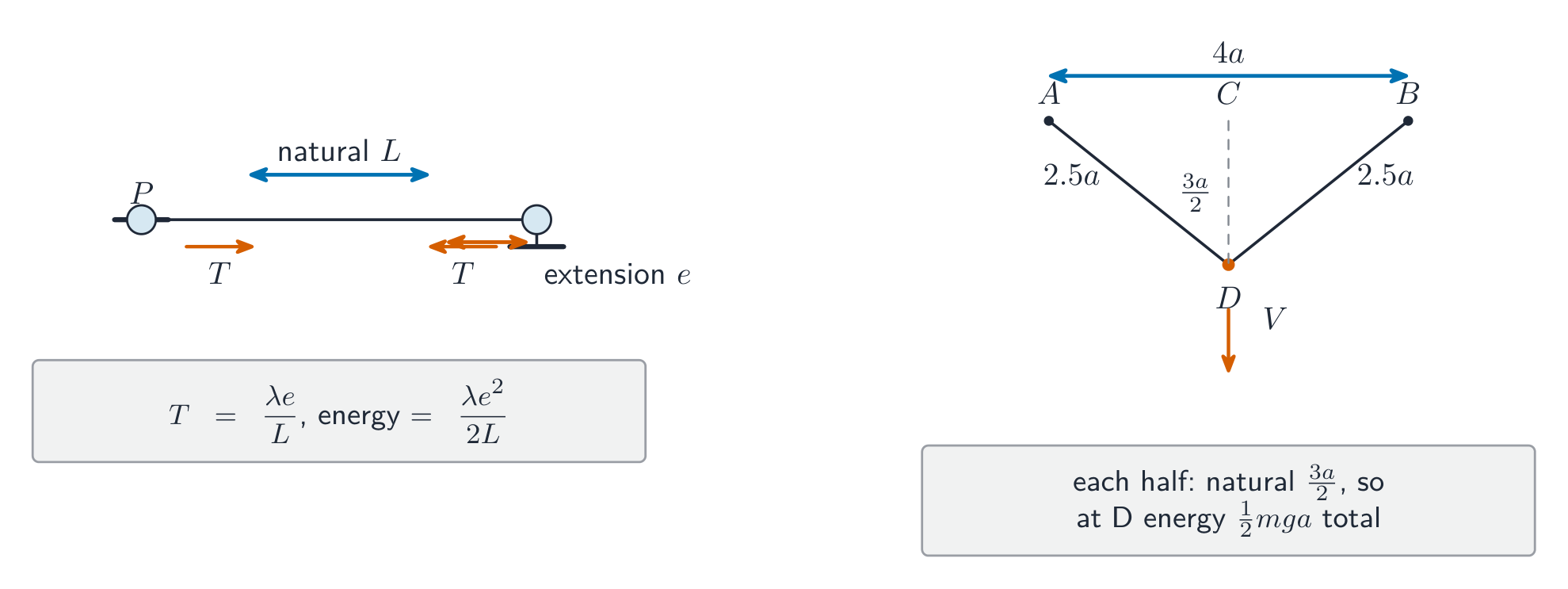
Hooke's law 胡克定律: a light elastic string (or spring) of natural length 原长 $L$ and modulus of elasticity 弹性模量 $\lambda$ stretched by $e$ exerts the tension $T = \tfrac{\lambda e}{L}$ — tension pulling inwards at both ends. The elastic energy 弹性势能 stored is $\tfrac{\lambda e^2}{2L}$. Work–energy principle 功能原理 problems now carry three energy stores: kinetic, gravitational and elastic, plus any work done against resistance.
Worked example — a midpoint on a two-part string (WME03 June 2025 Q4). A string with $\lambda = mg$, natural length $3a$, fixed between A and B ($AB = 4a$ horizontal); P hangs from the midpoint, projected downward from C (the midpoint of AB) at $\sqrt{3ag/2}$, and reaches D with $CD = \tfrac32a$. Each half of the string has natural length $\tfrac{3a}2$: at C the half-length is $2a$ (extension $\tfrac a2$); at D it is $\sqrt{(2a)^2 + (\tfrac32a)^2} = \tfrac{5a}2$ (extension $a$). Elastic energy gain per half: $\dfrac{mg}{2\cdot\frac{3a}2}\big(a^2 - \tfrac{a^2}4\big) = \dfrac{mg}{3a}\cdot\tfrac{3a^2}4 = \tfrac{mga}4$; both halves: $\tfrac12mga$ ✓. Then with resistance $\tfrac15mg$ over $\tfrac{3a}2$ and the loss of gravitational energy $mg\cdot\tfrac{3a}2$:
so $V = \sqrt{29ag/10}$.
Worked example — a hinged rod (WME03 June 2025 Q1). A uniform rod AB (mass $m$, length $2a$) hinged at A; an elastic string ($\lambda = 2mg$, natural length $L$) runs vertically from B to C, where AC is horizontal and BC $= 1.2a$ — the geometry puts B at $1.6a$ horizontally from A and $1.2a$ below it (a 3–4–5 triangle), so the rod's midpoint is $0.8a$ from the vertical through A. Moments about A: $T\cdot 1.6a = mg\cdot 0.8a$, so $T = \tfrac12mg$; then Hooke's law gives $\tfrac12mg = \tfrac{2mg}{L}(1.2a - L)$, i.e. $L = 0.96a = \tfrac{24}{25}a$.
Variable forces and simple harmonic motion
With variable force $F(x)$ in one dimension: $m\dfrac{dv}{dt} = F$ becomes $mv\dfrac{dv}{dx} = F(x)$; inverse-square gravitation appears as $F = \dfrac{k}{x^2}$. Simple harmonic motion 简谐运动 (SHM) means $\ddot x = -\omega^2x$ — the sign is the proof. Standard results (quotable): period $\tfrac{2\pi}{\omega}$, $v^2 = \omega^2(a^2 - x^2)$, $x = a\cos\omega t$ from an end, $a\sin\omega t$ from the centre. A particle between two elastic strings oscillates with SHM whenever the net force is proportional to displacement from the equilibrium point.
Worked example — SHM between two strings (WME03 June 2025 Q7). Strings from P to A ($\lambda = mg$, natural $3L$) and to B ($\lambda = 2mg$, natural $2L$), $AB = 7L$; equilibrium at E with $AE = 4.5L$ (each tension $= \tfrac{mg}2$ — the check that E is genuine). At displacement $x$ from E towards B, the B-string shortens and the A-string lengthens:
so P moves with SHM, $\omega^2 = \tfrac{4g}{3L}$ and the period is $\tfrac{2\pi}{\omega} = \pi\sqrt{\tfrac{3L}g}$. Released from C with $AC = 5L$ with amplitude 振幅 $\tfrac L2$: $v_{max} = \tfrac L2\omega = \sqrt{\tfrac{gL}3}$. The time with $|v| \le \sqrt{\tfrac{gL}{12}} = \tfrac{v_{max}}2$: with $x = \tfrac L2\cos\omega t$ from the end, $v \propto \sin\omega t$ and $|\sin\omega t| \le \tfrac12$ holds for a third of every oscillation, so the slow time is $\tfrac13 \times \pi\sqrt{\tfrac{3L}g} = \pi\sqrt{\tfrac{L}{3g}}$.
Motion in a horizontal circle
Angular speed 角速度 $\omega$ (rad s⁻¹) with $v = r\omega$; the centripetal acceleration 向心加速度 is $r\omega^2 = \tfrac{v^2}r$, directed towards the centre. Resolve towards the centre for the force equation and vertically for equilibrium — the conical pendulum 圆锥摆, a particle on a table tethered by a string, and banked surfaces are the three standard contexts.
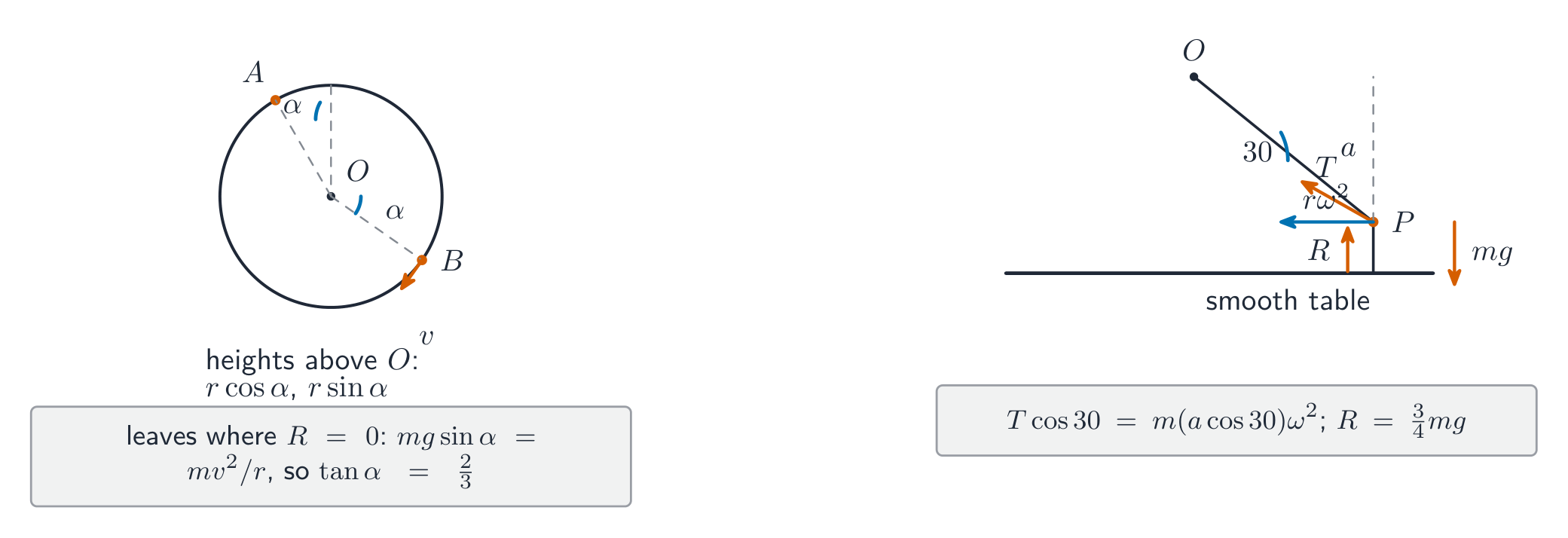
Worked example — a circle on a table (WME03 June 2025 Q2). P (mass $m$) on a smooth table, attached to O above by a string of length $a$ making 30° with the table, moving in a circle with $\omega = \sqrt{\tfrac{g}{2a}}$. The circle's radius is $a\cos30°$. Towards the centre: $T\cos30° = m(a\cos30°)\omega^2 = ma\cos30°\cdot\tfrac{g}{2a}$, so $T = \tfrac{mg}2$. Vertically: $R = mg - T\sin30° = mg - \tfrac{mg}4 = \tfrac{3mg}4$.
Motion in a vertical circle
A vertical circle 竖直圆周 pairs energy with Newton's law towards the centre. The change in kinetic energy equals the loss of gravitational and elastic potential energy when there are no other energy transfers. This energy equation combines with Newton's law towards the centre; the leaving condition on a surface is $R = 0$, on a string $T = 0$. After leaving, the particle is a projectile: the horizontal component of velocity is conserved.
Worked example — leaving a sphere (WME03 June 2025 Q5). P released at A on a smooth sphere (radius $r$), OA at $\alpha$ above the vertical; it leaves at B, OB at $\alpha$ above the horizontal. (a) Energy A→B: the height of A above O is $r\cos\alpha$ and the height of B above O is $r\sin\alpha$, so P falls $r(\cos\alpha - \sin\alpha)$: $\tfrac12mv^2 = mgr(\cos\alpha - \sin\alpha)$, giving $v^2 = 2gr(\cos\alpha - \sin\alpha)$. (b) At B with $R = 0$: $mg\sin\alpha = \tfrac{mv^2}r$ (the component of weight towards O); eliminating $v^2$: $\sin\alpha = 2(\cos\alpha - \sin\alpha)$, so $\tan\alpha = \tfrac23$. (c) Afterwards the horizontal component $v\sin\alpha$ is conserved; at the horizontal through O the speed satisfies $\tfrac12mW^2 = mgr\cos\alpha$, and $\cos^2\theta = \dfrac{v^2\sin^2\alpha}{W^2} = \dfrac{8}{78} = \dfrac4{39}$ — so $\cos\theta = \tfrac2{\sqrt{39}}$.
Centres of mass 质心 by integration
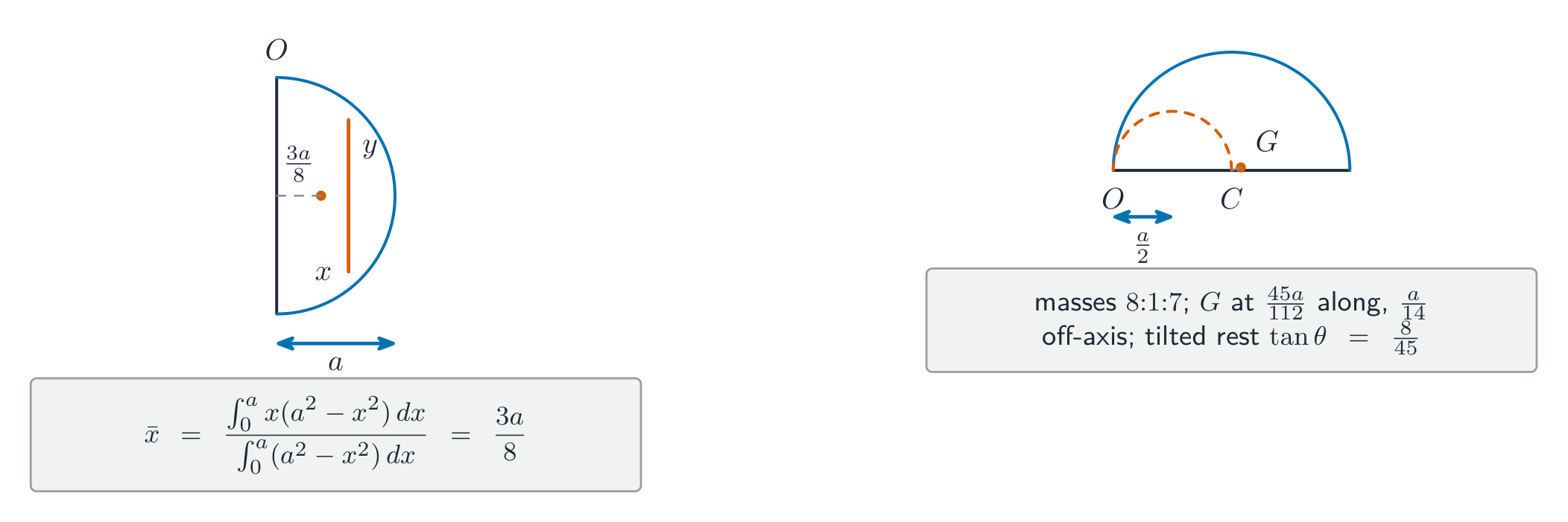
For a uniform solid of revolution 旋转体, $\bar x = \dfrac{\int_0^a xy^2\,dx}{\int_0^a y^2\,dx}$ (weight thin discs by $\pi y^2\,dx$). The hemisphere 半球 result must be derivable, not just quoted: with $y^2 = a^2 - x^2$, $\int_0^a x(a^2 - x^2)dx = \tfrac{a^4}4$ and $\int_0^a (a^2 - x^2)dx = \tfrac{2a^3}3$, giving $\bar x = \tfrac{3a}8$ from the plane face. Composite bodies 组合体: weight the parts by mass (radius-cubed for similar solids) and take moments; removed parts carry negative mass. Equilibrium 平衡 of the tilted body: the COM sits vertically above the contact point.
Worked example — a carved hemisphere (WME03 June 2025 Q6). S is a solid hemisphere (radius $a$) with a radius-$\tfrac a2$ hemisphere removed, plane faces coplanar, centres $O$ (big) and $C$ with $OC = \tfrac a2$. Masses $8 : 1 : 7$ (radii cubed); along the axis $8\cdot\tfrac{3a}8 - 1\cdot\tfrac{3a}{16} = 7\bar y$, so the COM of S is $\tfrac{45a}{112}$ from the OC-line through O. Perpendicular to OC (moments about the in-plane axis through O): $8\cdot 0 - 1\cdot\tfrac a2 = 7\bar x$, so $\bar x = \tfrac{a}{14}$. Resting tilted on its curved surface, $\tan\theta = \dfrac{a/14}{45a/112} = \tfrac8{45}$.
Checklist before you call this unit done
- Convert $a = f(x)$ via $v\,dv/dx$ and close constants from a stated instant; finish the second integration by separation or by eliminating $x$.
- Use $T = \lambda e/L$ and elastic energy $\lambda e^2/2L$; for midpoint strings treat each half separately; run three-store work-energy with resistance over distance.
- Combine moments with Hooke's law for hinged rods in equilibrium (geometry first: horizontal/vertical offsets of the attachment points).
- Prove SHM by deriving $\ddot x = -\omega^2 x$ (equilibrium tensions first), then quote period, $v_{max} = a\omega$ and the sinusoidal time fractions.
- Resolve towards the centre ($r\omega^2$) and vertically for horizontal circles — table reactions, conical pendulums, banked surfaces.
- For vertical circles: energy between levels, $R = 0$ (or $T = 0$) at the leaving point, projectile continuation conserving the horizontal component.
- Derive the hemisphere COM by the disc integral; build composites with signed masses; close tilted equilibrium with the COM-above-contact condition.