| Enduring Understanding | Learning Objective | Essential Knowledge |
|---|---|---|
CSN-1 | CSN-1.A |
|
CSN-1.B |
| |
CSN-1.C |
| |
CSN-1.D |
|
Computer Systems and Networks
AP Computer Science Principles · Topic 4
 7:47
Computer Systems and Networks
People call it the cloud. It is not a cloud. This box sits in somebody's home: a router, taking data from your phone and passing it on. This plug is the other…
English narration · English + 中文 subtitles burned in
4.1
The Internet

Syllabus
Source: College Board AP Course and Exam Description
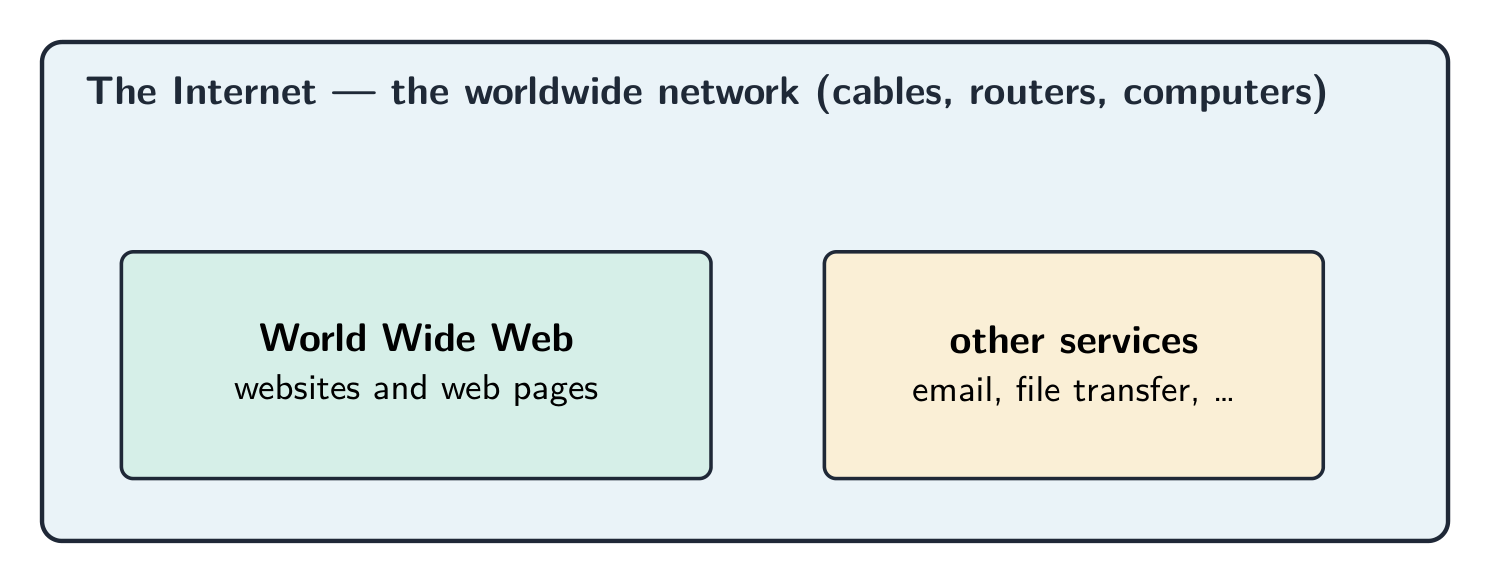
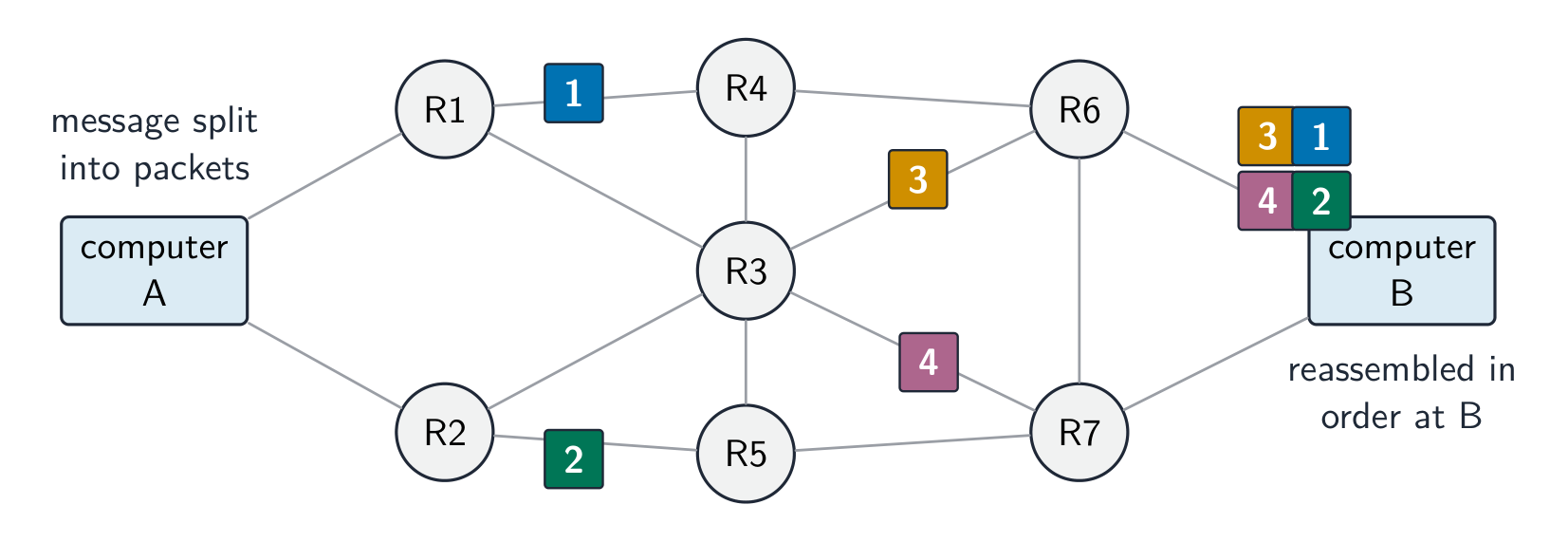
The Internet 互联网 is a global network 网络 of networks. Data travels as packets 数据包 – small chunks that are sent separately and reassembled at the destination 目的地. Two ideas make it work at scale:
- Protocols 协议 are agreed rules for communication. IP (Internet Protocol) addresses and routes 路由 packets; TCP reassembles them in order and re-requests lost ones; HTTP carries web pages; DNS translates a name like
example.cominto an IP address IP地址. - Redundancy 冗余 and routing: there are many possible paths between two points, so if one path fails, packets take another. This makes the Internet fault-tolerant 容错.
The Internet is designed to be open 开放的 and scalable 可扩展的 – built on standards 标准 anyone can use, so it keeps working as billions of devices 设备 join. Bandwidth 带宽 is the amount of data a connection can carry per second.
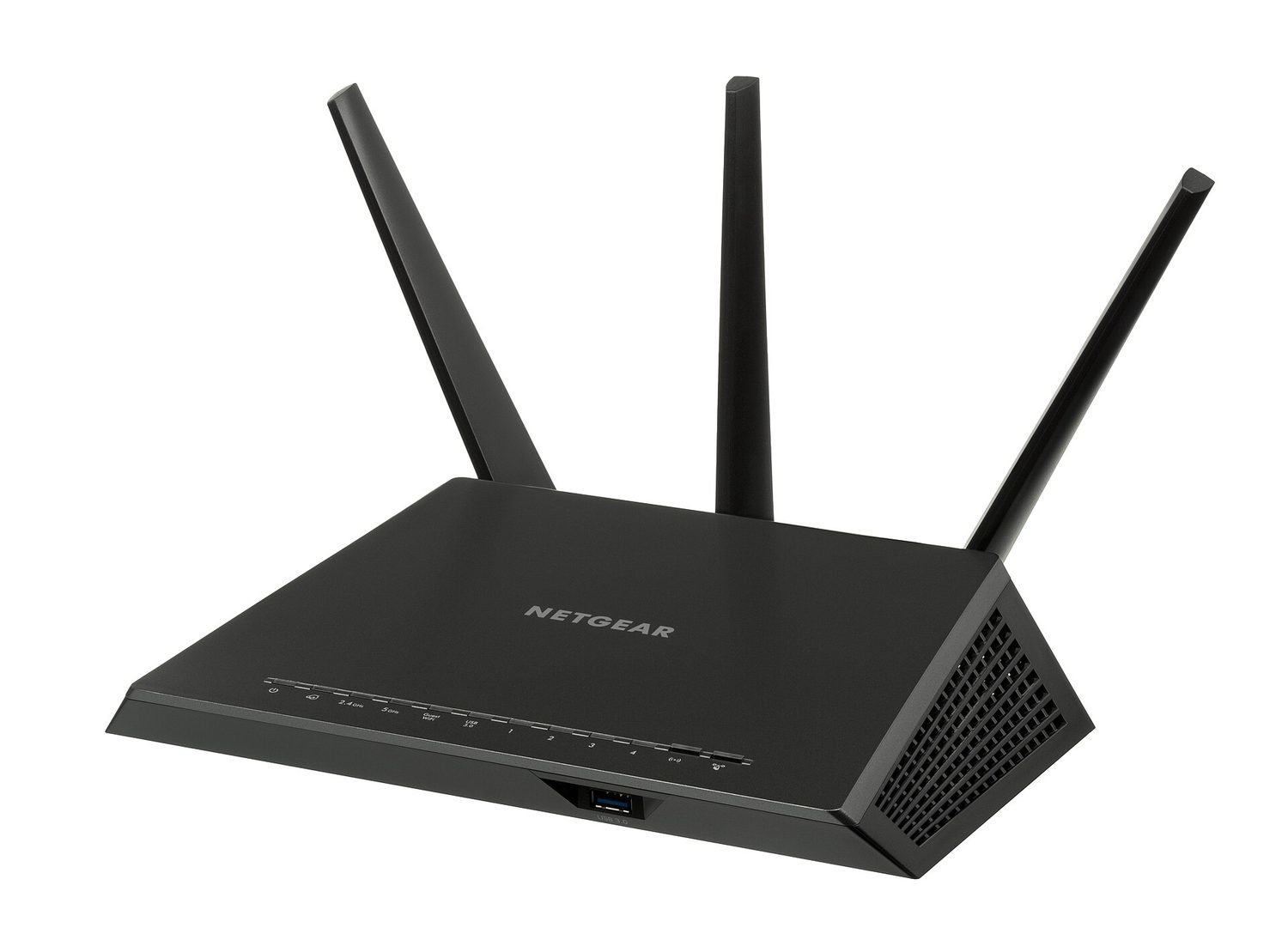
How packets travel. A router 路由器 reads each packet's destination IP address and forwards it toward that address. Routing is dynamic: each packet takes whatever path is best at that moment, so packets of one message can take different paths and arrive out of order. TCP puts them back in order using their sequence numbers.
- TCP aims to provide reliable 可靠的, ordered byte-stream delivery by detecting missing data and retransmitting it. A connection can still fail, so delivery is not guaranteed under every network failure.
- UDP sends datagrams without built-in delivery acknowledgements, ordering or retransmission. It can avoid waiting for retransmission, but it is not always faster. An application may add its own reliability; time-sensitive video and games may prefer a missing update to a late one.
- Protocols are layered 分层的: for example, HTTP/1.1 uses TCP over IP. Other HTTP versions can use a different transport. Each layer has a role.
- Bandwidth is how much data a connection can carry per second; latency 延迟 is the delay for one packet to arrive.
Worked example: how many addresses? An IP address is a binary number of fixed length, so $n$ bits give $2^{n}$ different addresses.
- IPv4 uses 32 bits 位: $2^{32} \approx 4.3$ billion addresses — too few for every device on Earth.
- IPv6 uses 128 bits: $2^{128}$ addresses.
- IPv6 has $\dfrac{2^{128}}{2^{32}} = 2^{96}$ times as many addresses as IPv4.
- Each extra bit doubles the number of addresses: going from 32 to 33 bits gives $2 \times 2^{32}$ addresses, not $2^{32} + 1$.
Explore
How data crosses the Internet in packets
The Internet breaks a message into numbered packets, each addressed and routed independently (often by different paths), then reassembled at the destination. That design makes it fault-tolerant — if one route fails, packets take another.
Vocabulary
Train
| English |
|---|
| Internet/ˈɪntənet/ |
| network/ˈnetwɜːk/ |
| packets/ˈpækɪts/ |
| destination |
| Protocols/ˈprəʊtəkɒlz/ |
| routes |
| IP address/ˌaɪ ˈpiː əˈdres/ |
| Redundancy/rɪˈdʌndənsi/ |
| fault-tolerant/fɒlt ˈtɒlərənt/ |
| open |
| scalable |
| standards |
| devices |
| Bandwidth/ˈbændwɪdθ/ |
| router/ˈruːtə/ |
| reliable/rɪˈlaɪəbl/ |
| layered |
| latency/ˈleɪtənsi/ |
| bits/bɪts/ |
4.2
Fault Tolerance
Syllabus
| Enduring Understanding | Learning Objective | Essential Knowledge |
|---|---|---|
CSN-1 | CSN-1.E |
|
Source: College Board AP Course and Exam Description
A system is fault-tolerant if it keeps working even when part of it fails. The Internet achieves this through redundant connections: because packets can be routed along multiple paths, the failure of one router or cable does not stop communication – traffic simply reroutes. Fault tolerance costs extra resources (the redundant paths) but greatly improves reliability 可靠性. A single path with no backup is not fault-tolerant.
Worked example: which failures break the network? In the network below, the lines are connections between computers.

- Can A still reach F if one connection fails? Yes. Every connection on one route has a backup route 备用路由: if A–B fails, A–C–E–F still works.
- Smallest number of failures that cut A off from F? Two: for example A–B and A–C, because those are A's only two connections.
- Is G fault-tolerant? No. G has one connection, F–G. If it fails, G cannot reach anyone, so F–G is a single point of failure 单点故障.
Exam skill: to find whether a failure disconnects two computers, cross out the failed connections and look for any remaining path between them.
Vocabulary
Train
| English |
|---|
| reliability/rɪˌlaɪəˈbɪlɪti/ |
| backup route |
| single point of failure/ˈsɪŋɡl pɔɪnt ɒv ˈfeɪlɪə/ |
4.3
Parallel and Distributed Computing

Syllabus
| Enduring Understanding | Learning Objective | Essential Knowledge |
|---|---|---|
CSN-2 | CSN-2.A |
|
CSN-2.B |
|
Source: College Board AP Course and Exam Description
- Sequential computing 顺序计算 runs one operation at a time.
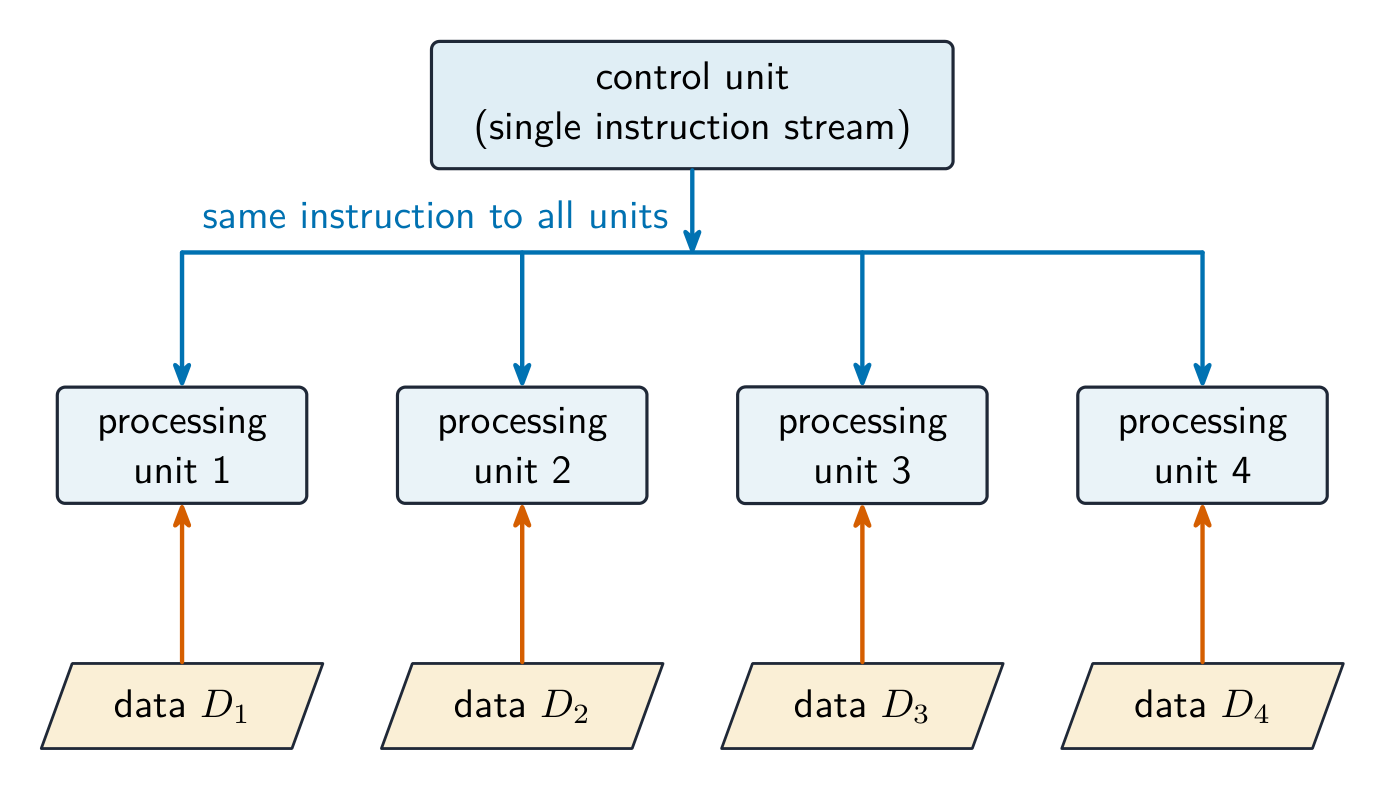
- Parallel computing 并行计算 splits a task into parts that run at the same time on multiple processors 处理器, finishing faster.
- Distributed computing 分布式计算 uses many computers connected by a network to work on one problem – essential for problems too big for a single machine.
A parallel solution's speedup 加速比 is the sequential time divided by the parallel time. Speedup is limited: parts that must run in sequence cannot be sped up by adding processors, so doubling the processors rarely doubles the speed.
Worked example. A task has a part that must run sequentially, taking $40$ seconds, plus a parallelizable part that takes $60$ seconds on one processor – so on a single processor the whole task takes $40+60=100$ seconds. Spread the parallel part across $3$ processors and it takes $\tfrac{60}{3}=20$ seconds, so the total parallel time is $40+20=60$ seconds and the speedup is $\tfrac{100}{60}\approx1.67$. The $40$-second sequential part is a floor: even with infinitely many processors the task can never finish in under $40$ seconds.
Worked example: two processors, three independent processes. Processes P, Q and R take $50$, $40$ and $30$ seconds and do not depend on each other. Each processor runs one process at a time.
- Sequentially (one processor): $50 + 40 + 30 = 120$ seconds.
- With two processors, try each split and take the longer processor's time: $\{50\}, \{40, 30\} \to 70$; $\{50, 30\}, \{40\} \to 80$; $\{50, 40\}, \{30\} \to 90$.
- The best split finishes in 70 seconds: one processor runs P while the other runs Q then R.
- Speedup $= \dfrac{120}{70} \approx 1.71$.
Exam skill: given the times for the sequential and parallel portions of a task, be able to calculate the total parallel time and the speedup.
Vocabulary
Train
| English |
|---|
| Sequential computing/siːˈkwenʃl kəmˈpjuːtɪŋ/ |
| Parallel computing/ˈpærəlel kəmˈpjuːtɪŋ/ |
| processors/ˈprəʊsesəz/ |
| Distributed computing/ˈdɪstrɪbjuːtɪd kəmˈpjuːtɪŋ/ |
| speedup/ˈspiːdʌp/ |
4.3
Exam tips
- Describe how data travels in packets over a redundant, fault-tolerant network of independent routers.
- Know that protocols (IP, TCP, HTTP) are agreed rules, and that open standards let different systems interoperate 互操作.
- Explain scalability 可扩展性 and how the Internet grows without central control 集中控制.
- Contrast bandwidth (rate) with latency (delay), and describe the DNS name-to-address lookup.
- Discuss the digital divide 数字鸿沟 and security basics (encryption 加密, authentication 身份验证) in plain terms.
Vocabulary
Train
| English |
|---|
| interoperate |
| scalability/ˌskeɪləˈbɪlɪti/ |
| central control |
| digital divide/ˈdɪdʒɪtl dɪˈvaɪd/ |
| encryption/enˈkrɪpʃn/ |
| authentication/ɔːˌθentɪˈkeɪʃn/ |
Interactive lessons on this topic
Work through it step by step, with instant-check exercises.