| Learning Objective | Essential Knowledge |
|---|---|
2.1.A |
|
Selection and Iteration
AP Computer Science A · Topic 2
 7:58
Selection and Iteration
Here are three loops. The first two differ by one character — a less-than instead of a less-than-or-equal. The first runs ten times. The second runs eleven.…
English narration · English + 中文 subtitles burned in
2.1
Selection and Repetition in Algorithms

Syllabus
Source: College Board AP Course and Exam Description
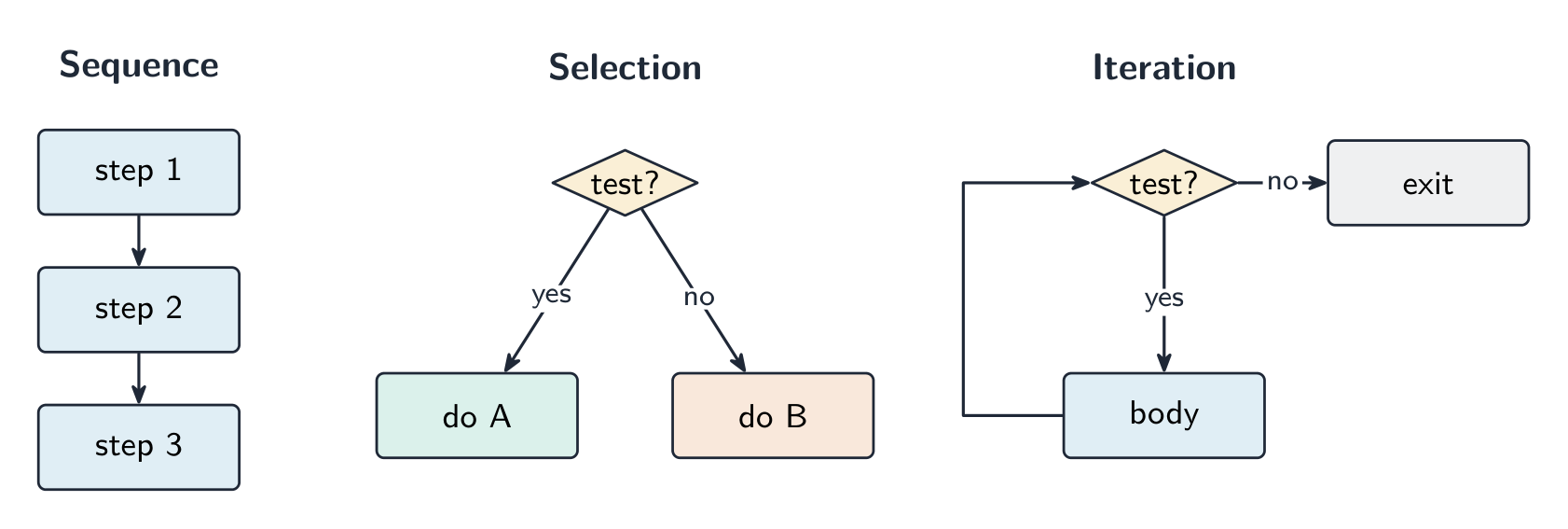
Algorithms 算法 are built from three control structures 控制结构: sequence 顺序 (steps in order), selection 选择 (choosing a path), and iteration 迭代 (repeating steps). This topic covers selection and iteration – the tools that let a program make decisions and loop.
Vocabulary
Train
| English |
|---|
| Algorithms/ˈælɡərɪθəmz/ |
| control structures/kənˈtrəʊl ˈstrʌktʃəz/ |
| sequence/ˈsiːkwəns/ |
| selection/sɪˈlekʃn/ |
| iteration/ˌɪtəˈreɪʃn/ |
2.2
Boolean Expressions

Syllabus
| Learning Objective | Essential Knowledge |
|---|---|
2.2.A |
|
Source: College Board AP Course and Exam Description
A boolean expression 布尔表达式 evaluates to true or false, using relational operators 关系运算符: == (equal), != (not equal), <, >, <=, >=. Note == compares primitive values 基本类型值 but object references 对象引用 for objects, so use .equals for Strings.
Worked example. With int a = 7, b = 3; and String s = "cat";:
| Expression | Value | Why |
|---|---|---|
a % b == 1 |
true |
7 % 3 is 1 |
a / b >= 2.5 |
false |
7 / 3 is the int 2 |
a != b * 2 |
true |
b * 2 is 6; arithmetic runs before comparing |
s.equals("cat") |
true |
same characters |
s.length() > b |
false |
3 > 3 is false |
A common mistake is = for ==: if (a = 7) does not compile, because = assigns and gives an int, not a boolean.
Explore
Explore the AND truth table
A Boolean expression evaluates to true or false. AND is true only when both operands are true; toggle the inputs to see all four cases.
Vocabulary
Train
| English |
|---|
| boolean expression/ˈbuːlɪən ekˈspreʃn/ |
| relational operators/rɪˈleɪʃənl ˈɒpəreɪtəz/ |
| primitive values |
| object references |
2.3
The if Statement
Syllabus
| Learning Objective | Essential Knowledge |
|---|---|
2.3.A |
|
Source: College Board AP Course and Exam Description
An if statement 条件语句 runs a block 代码块 only when its condition 条件 is true; an optional else gives an alternative:
if (score >= 60) {
    System.out.println("Pass");
} else {
    System.out.println("Fail");
}
Common mistakes.
- A semicolon after the condition ends the
if: inif (x > 0); { count++; }the block runs every time. - Without braces only one statement belongs to the
if. Below,"Done"prints whatevertis, despite the indentation:
if (t > 30)
    System.out.println("Hot");
    System.out.println("Done");
Explore
See which branch an if chooses
An if statement runs its body only when the condition is true, otherwise it skips to else. Slide the score across the boundaries and watch the grade change.
Vocabulary
Train
| English |
|---|
| if statement/ɪf ˈsteɪtmənt/ |
| block/blɒk/ |
| condition/kənˈdɪʃn/ |
2.4
Nested if Statements
Syllabus
| Learning Objective | Essential Knowledge |
|---|---|
2.4.A |
|
Source: College Board AP Course and Exam Description
Placing an if inside another, or chaining with else if, tests several cases in order. Only the first matching branch 分支 runs:
if (g >= 90) grade = 'A';
else if (g >= 80) grade = 'B';
else grade = 'C';
Worked example. The order of the tests matters. This version never gives an 'A':
if (g >= 80) grade = 'B';
else if (g >= 90) grade = 'A';   // never reached for g >= 90
else grade = 'C';
For g = 95 the first test is already true, so 'B' is chosen and the rest is skipped. With ranges, test the narrowest case first (highest mark first), as in the correct version above. If the chain used separate if statements without else, every true test would run and the last one would win.
Vocabulary
Train
| English |
|---|
| branch/bræntʃ/ |
2.5
Compound Boolean Expressions
Syllabus
| Learning Objective | Essential Knowledge |
|---|---|
2.5.A |
|
Source: College Board AP Course and Exam Description
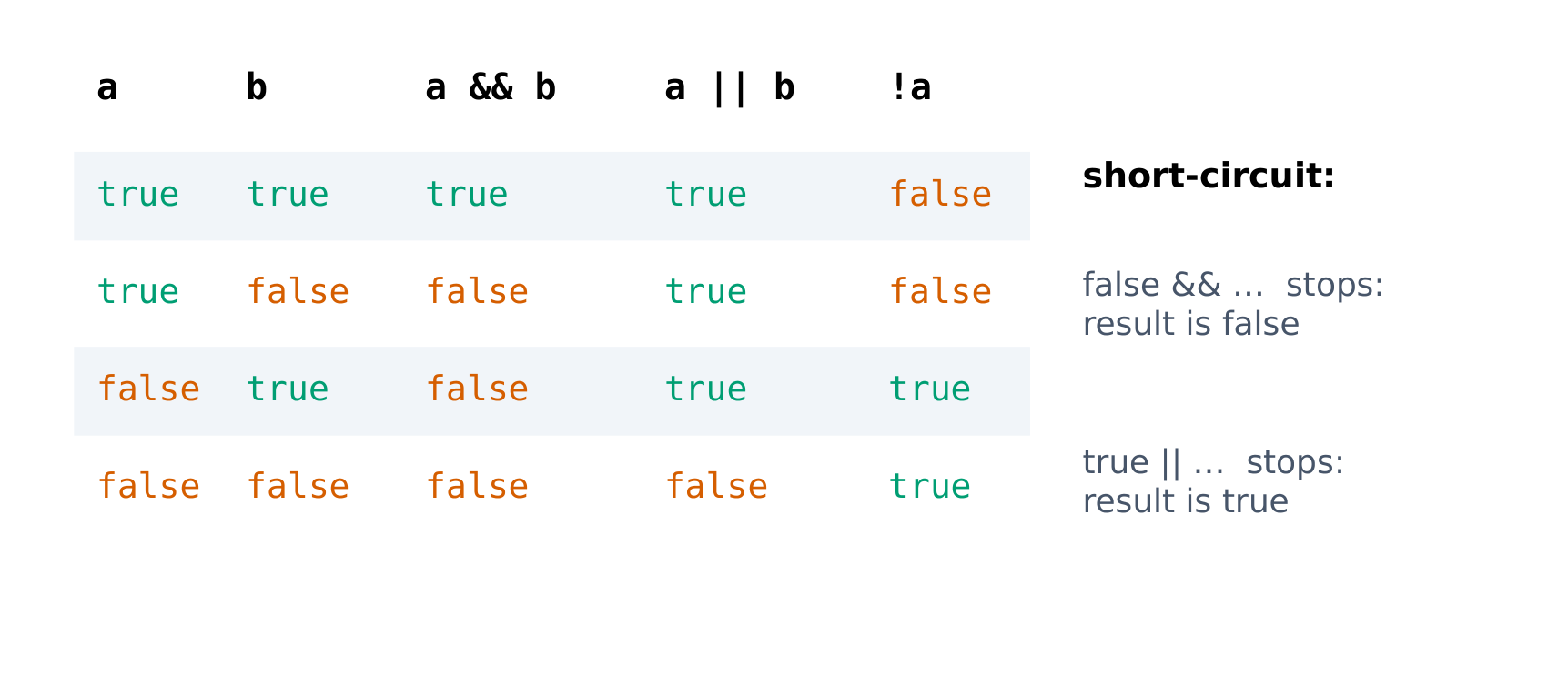
Logical operators 逻辑运算符 combine conditions: && (and – both true), || (or – at least one true), ! (not – reverse). Java uses short-circuit evaluation 短路求值: && stops if the left side is false, and || stops if the left side is true – useful to guard against 防止 errors, e.g. if (n != 0 && total / n > 5).
Worked example. Evaluate !(x > y) || x < 5 && y == 6 for x = 4, y = 6. The order is !, then &&, then ||:
x > yis4 > 6, false, so!(x > y)is true.x < 5 && y == 6istrue && true, true.true || trueis true. In fact, step 2 is never run:||already hastrueon its left and short-circuits.
Short-circuiting changes what runs. In if (s != null && s.length() > 0) the null check must come first; the other order throws a NullPointerException when s is null.
Vocabulary
Train
| English |
|---|
| Logical operators/ˈlɒdʒɪkl ˈɒpəreɪtəz/ |
| short-circuit evaluation/ʃɔːt ˈsɜːkɪt ɪˌvæljuːˈeɪʃn/ |
| guard against |
2.6
Comparing Boolean Expressions
Syllabus
| Learning Objective | Essential Knowledge |
|---|---|
2.6.A |
|
2.6.B |
|
Source: College Board AP Course and Exam Description
De Morgan's laws 德摩根定律 rewrite negations: !(a && b) equals !a || !b, and !(a || b) equals !a && !b. Two boolean expressions are equivalent 等价 if they give the same result for every input – a truth table 真值表 proves it. Simplifying conditions this way is a common exam task.
Worked example. Write !(age >= 13 && age <= 19) without the !.
- De Morgan:
!(age >= 13) || !(age <= 19)(the&&becomes||). - Negate each comparison:
!(age >= 13)isage < 13;!(age <= 19)isage > 19. - Result:
age < 13 || age > 19, every age outside the teens.
Check one value of each kind: age = 15 gives false in both; age = 25 gives true in both. A common error is to negate >= as <=: the opposite of >= is <.
a |
b |
!(a && b) |
!a || !b |
|---|---|---|---|
| T | T | F | F |
| T | F | T | T |
| F | T | T | T |
| F | F | T | T |
Explore
One matching row is not enough
Compare the original, De Morgan rewrite and unflipped candidate for every pair of pure Boolean inputs. A mismatch is a counterexample.
Vocabulary
Train
| English |
|---|
| De Morgan's laws/də ˈmɔːɡənz lɔːz/ |
| equivalent/ɪˈkwɪvələnt/ |
| truth table/truːθ ˈteɪbl/ |
2.7
while Loops
Syllabus
| Learning Objective | Essential Knowledge |
|---|---|
2.7.A |
|
2.7.B |
|
Source: College Board AP Course and Exam Description
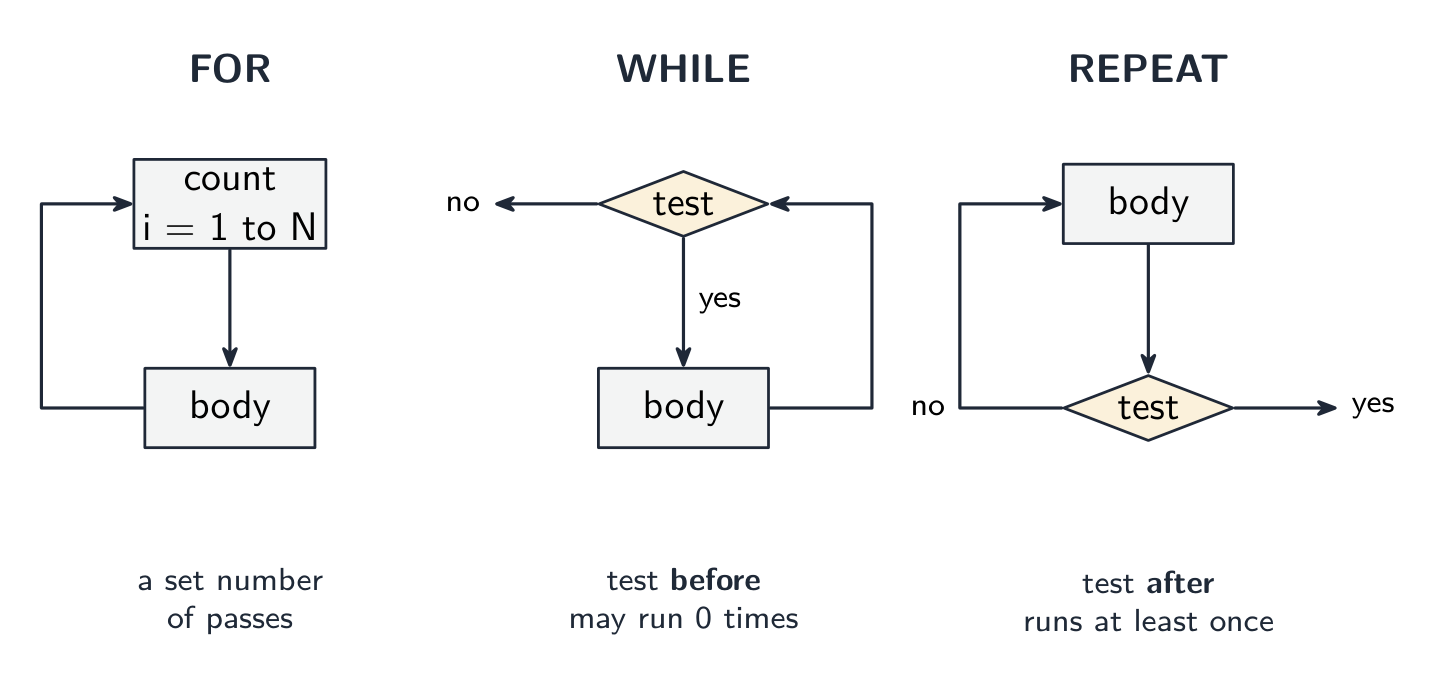
A while loop 当型循环 repeats while its condition stays true, testing before each pass. You must change something inside so the loop eventually stops, or it becomes an infinite loop 无限循环:
int i = 0;
while (i < 5) {
    System.out.println(i);
    i++;
}
Worked example. Trace a loop that adds the digits of n = 472:
int n = 472, sum = 0;
while (n > 0) {
    sum += n % 10;   // last digit
    n /= 10;         // drop it
}
| Pass | n % 10 |
sum |
n after |
|---|---|---|---|
| 1 | 2 | 2 | 47 |
| 2 | 7 | 9 | 4 |
| 3 | 4 | 13 | 0 |
After pass 3 the test n > 0 is false, so the loop stops with sum = 13. If n started at 0, the body would run zero times: a while loop tests before the first pass.
Explore
Trace a while loop
A while loop repeats as long as its condition stays true, updating its variables each pass. Step through to see the sum of squares build up.
Vocabulary
Train
| English |
|---|
| while loop/waɪl luːp/ |
| infinite loop/ˈɪnfɪnət luːp/ |
2.8
for Loops

Syllabus
| Learning Objective | Essential Knowledge |
|---|---|
2.8.A |
|
Source: College Board AP Course and Exam Description
A for loop packs initialization 初始化, condition, and update 更新 into one line – best when you know the count:
for (int i = 0; i < n; i++) {
    // runs n times, i = 0..n-1
}
A for and an equivalent while do the same work; be able to convert between them.
Worked example. How many times does this run, and what does it print?
for (int k = 10; k > 0; k -= 3)
    System.out.print(k + " ");
k takes the values 10, 7, 4, 1; the next value, $-2$, fails k > 0. So it runs 4 times and prints 10 7 4 1. The equivalent while moves the three parts apart:
int k = 10;
while (k > 0) {
    System.out.print(k + " ");
    k -= 3;
}
A loop for (int i = a; i < b; i++) runs $b - a$ times; with <= it runs $b - a + 1$ times. A variable declared in the for header, such as k, cannot be used after the loop.

Explore
Trace a for loop
A for loop runs a fixed number of times, its counter stepping through a range. Watch the counter and running total advance one pass at a time.
Vocabulary
Train
| English |
|---|
| initialization |
| update/ˈʌpdeɪt/ |
2.9
Building Complete Selection and Iteration Algorithms
Syllabus
| Learning Objective | Essential Knowledge |
|---|---|
2.9.A |
|
Source: College Board AP Course and Exam Description
Combine loops and conditions to solve real problems – count, sum, find a maximum, or test a property:
int max = arr[0];
for (int k = 1; k < arr.length; k++) {
    if (arr[k] > max) max = arr[k];
}
Two integer patterns the exam tests directly use % and /. For a nonnegative integer 整数 n, read its digits 数字位 one at a time by taking n % 10 (the last digit) and then n = n / 10 (drop it). For nonzero d, n % d == 0 tests divisibility 整除性: n is evenly divisible by d. Combine them with a counter 计数器 to find the frequency 频率 with which some criterion 条件标准 is met.
Worked example. Count the numbers from 1 to 20 that are divisible by 3 but not by 2.
int count = 0;
for (int i = 1; i <= 20; i++) {
    if (i % 3 == 0 && i % 2 != 0) {
        count++;
    }
}
The multiples of 3 are 3, 6, 9, 12, 15, 18; the odd ones are 3, 9, 15, so count is 3. The counter starts at 0 before the loop; resetting it inside the loop is a common error.
Standard patterns like a running total 累加和, a counter, or a flag 标志 (a boolean that records whether something happened) recur throughout the course.
Vocabulary
Train
| English |
|---|
| digits |
| integer/ˈɪntɪdʒə/ |
| divisibility |
| counter/ˈkaʊntə/ |
| frequency/ˈfriːkwənsi/ |
| criterion/kraɪˈtɪərɪən/ |
| running total |
| flag/flæɡ/ |
2.10
String Algorithms
Syllabus
| Learning Objective | Essential Knowledge |
|---|---|
2.10.A |
|
Source: College Board AP Course and Exam Description
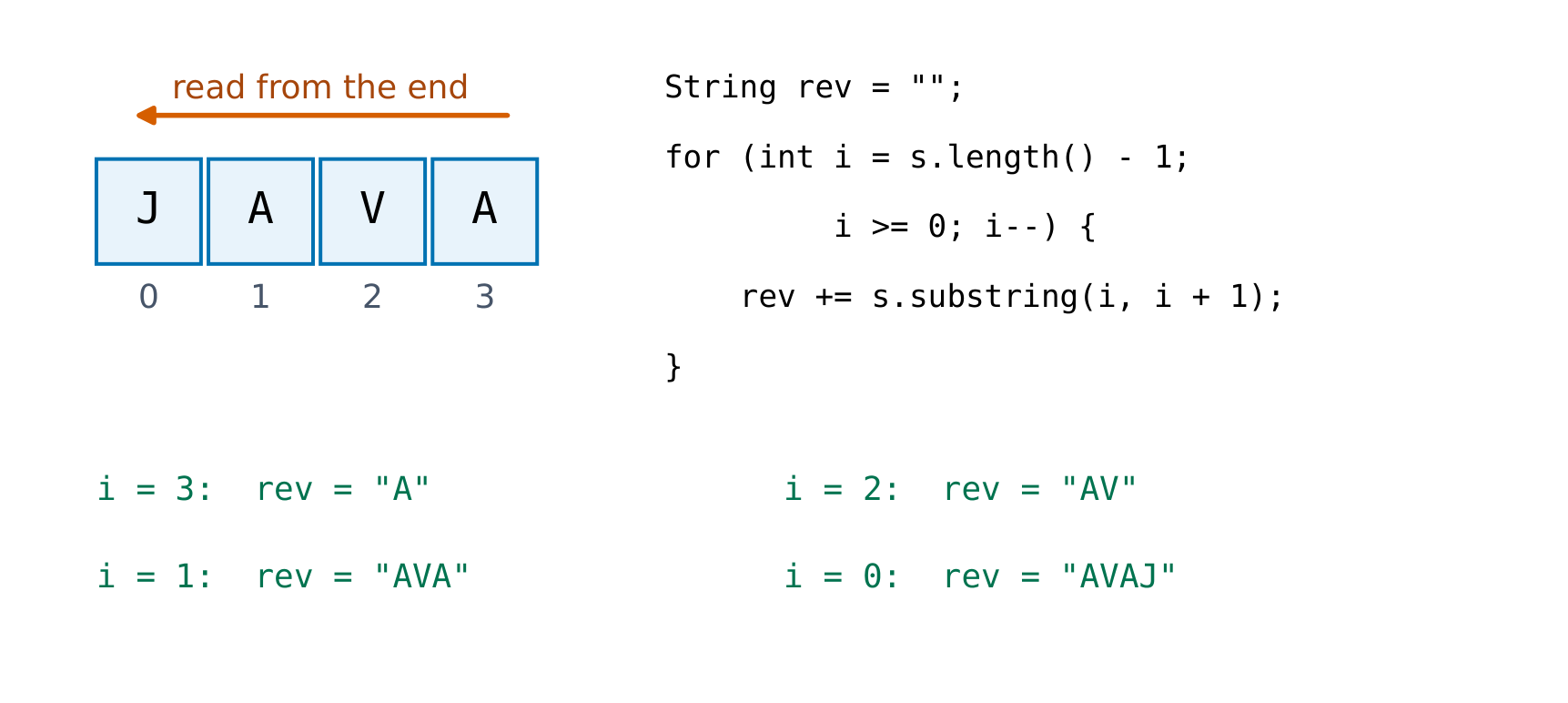
Loop through a string by index 索引 to process each character 字符:
for (int i = 0; i < s.length(); i++) {
    char c = s.charAt(i);
    // count vowels, reverse, check for a substring, ...
}
Typical tasks: count occurrences 出现次数, build a reversed or filtered copy, or test whether one string contains another.
Worked example. Count how many times "ana" occurs in "banana", overlaps included.
String s = "banana", t = "ana";
int count = 0;
for (int i = 0; i <= s.length() - t.length(); i++) {
    if (s.substring(i, i + t.length()).equals(t)) {
        count++;
    }
}
i runs from 0 to $6 - 3 = 3$, checking "ban", "ana", "nan", "ana": count is 2. With i < s.length() instead, substring(4, 7) is past the end and throws a StringIndexOutOfBoundsException.
Vocabulary
Train
| English |
|---|
| index/ˈɪndeks/ |
| character/ˈkærɪktə/ |
| occurrences |
2.11
Nested Iteration

Syllabus
| Learning Objective | Essential Knowledge |
|---|---|
2.11.A |
|
Source: College Board AP Course and Exam Description
A nested loop 嵌套循环 puts one loop inside another; the inner loop 内层循环 completes fully for each pass of the outer loop 外层循环. If the outer runs $n$ times and the inner $m$ times, the body runs $n\times m$ times – the basis for processing grids 网格 and comparing all pairs.
Worked example. What does this print?
for (int r = 1; r <= 3; r++) {
    for (int c = 1; c <= r; c++) {
        System.out.print(c);
    }
    System.out.println();
}
r |
c takes |
Line printed |
|---|---|---|
| 1 | 1 | 1 |
| 2 | 1, 2 | 12 |
| 3 | 1, 2, 3 | 123 |
The println is inside the outer loop but outside the inner one, so it ends each row.
Vocabulary
Train
| English |
|---|
| nested loop/ˈnestɪd luːp/ |
| inner loop/ˈɪnə luːp/ |
| outer loop/ˈaʊtə luːp/ |
| grids |
2.12
Informal Run-Time Analysis

Syllabus
| Learning Objective | Essential Knowledge |
|---|---|
2.12.A |
|
Source: College Board AP Course and Exam Description
Run-time analysis 运行时间分析 counts how many basic steps an algorithm takes as the input size $n$ grows. Count the executions of the innermost statement: with constant work per iteration, visiting each of $n$ items once is linear 线性 ($n$ steps); two full nested loops of $n$ iterations each are quadratic 平方级 ($n^2$). This informal counting lets you compare two algorithms' efficiency 效率.
Exam skill: for a nested loop, be able to state how many times the inner statement runs in terms of the loop bounds – a frequent multiple-choice question.
Worked example. How many stars does this print?
for (int i = 0; i < 4; i++)
    for (int j = 0; j < i; j++)
        System.out.print("*");
The inner loop runs i times for each outer i: 0 + 1 + 2 + 3 = 6 stars. When the inner bound is the outer variable, the total is the triangular sum $0+1+\dots+(n-1)=\dfrac{n(n-1)}{2}$ – here $\dfrac{4\times3}{2}=6$ – not the full $n^2=16$ of a rectangular nested loop.
Explore
Compare how algorithms scale
Run-time describes how the number of steps grows with the input size $n$. Increase $n$ and watch a linear $O(n)$ pull far ahead of a quadratic $O(n^2)$.
Vocabulary
Train
| English |
|---|
| Run-time analysis/rʌn taɪm əˈnæləsɪs/ |
| linear/ˈlɪnɪə/ |
| quadratic/kwɒˈdrætɪk/ |
| efficiency/ɪˈfɪʃənsi/ |
2.12
Exam tips
- Get boundary conditions 边界条件 right: use
<vs<=deliberately, and watch the first and last iteration of every loop (off-by-one 差一错误 is the classic bug 缺陷). - Build compound conditions with
&&,||,!and remember short-circuit evaluation (put the null check first). - Trace nested loops by counting how many times the inner body runs in total.
- Choose the right structure —
if/else iffor ranges, a loop for repetition — and avoid an infinite loop by updating the loop variable 循环变量. - Apply De Morgan's laws when you simplify or negate a boolean condition.
Vocabulary
Train
| English |
|---|
| boundary conditions |
| off-by-one |
| bug/bʌɡ/ |
| loop variable |
Interactive lessons on this topic
Work through it step by step, with instant-check exercises.