コンテンツへスキップ
科目
  • 1 be動詞
    1.1

    am / is / are

    be verbs: am / is / are change with the subject

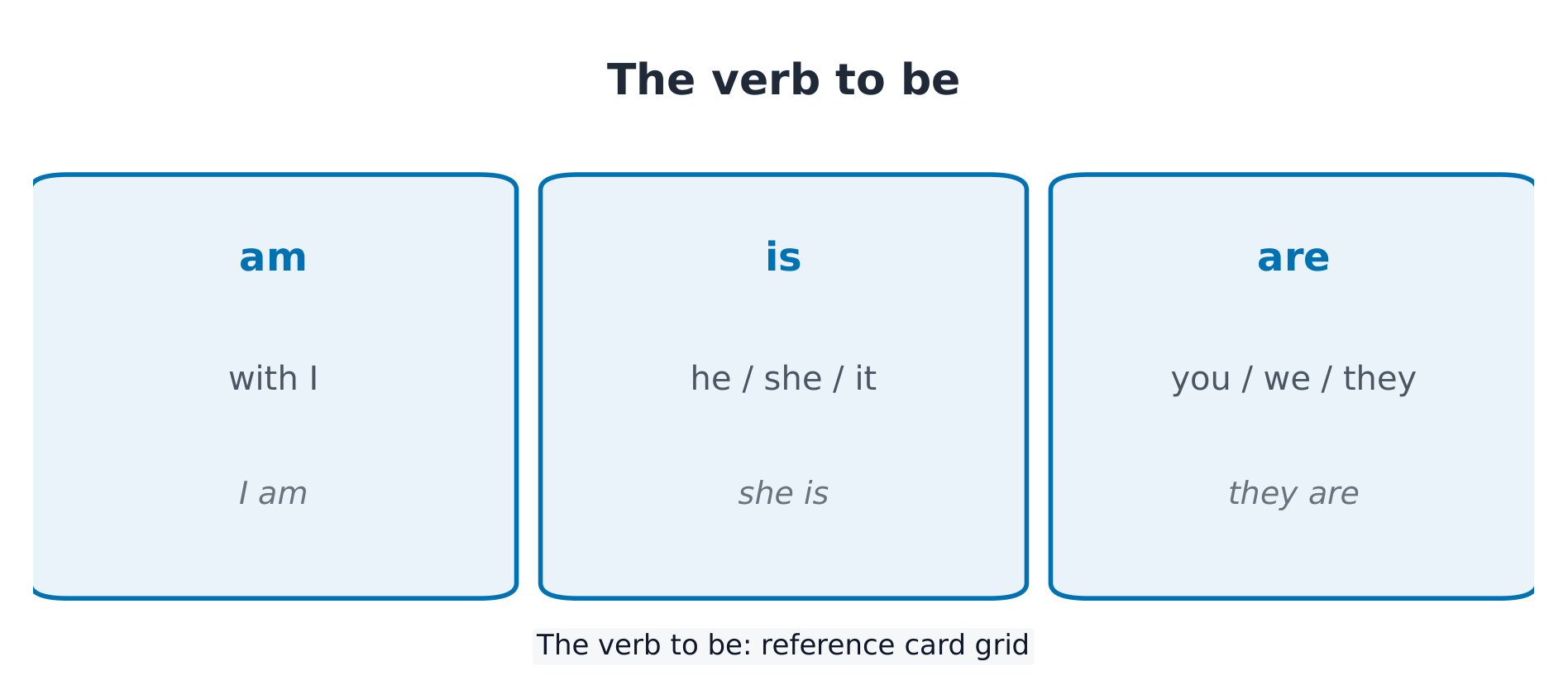
    The verb "to be" means "is / am / are." It changes according to the subject and has three forms:

    • I → am
    • he / she / it → is
    • you / we / they → are

    我I 是am 一名a 学生student.

    I am a student.

    她She 是is 开心happy.

    She is happy.

    他们They (是)are 来自from 中国China.

    They are from China.

    Note: Common spoken contractions: I'm, you're, he's, she's, it's, we're, they're.

    1.2

    Negation and Interrogative

    Negation: Add not after the be verb (often contracted).

    他He 不是is not 一名a 老师teacher.

    He is not a teacher. (= He isn't a teacher.)

    Interrogative: Place the be verb before the subject.

    (是吗)Are 你you 准备好ready?

    Are you ready?

    Short answers: Yes, I am. / No, I'm not.

    Note: Negative contractions: is not → isn't, are not → aren't; but am not is only contracted to I'm not (there is no ~~amn't~~).

    Common Errors

    • ❌ ~~He busy.~~ → ✓ He is busy. — In Chinese, "He is very busy" can exist without a verb, but an English sentence must have a verb. Use be to link when the predicative is an adjective or noun and there are no other verbs in the sentence (He is busy); do not add be if the sentence already contains an ordinary verb (I go to school).
    • ❌ ~~I am go to school.~~ → ✓ I go to school. — Do not use be and ordinary verbs together; "go" alone suffices for "to go."
    • ❌ ~~They is my friends.~~ → ✓ They are my friends. — Plural subjects (you / we / they) take are.
    • ❌ ~~I am agree.~~ → ✓ I agree. — agree is itself a verb; do not add am before it.
    • ❌ ~~Are you ready? — Yes, I'm.~~ → ✓ Yes, I am. — Contractions cannot be used at the end of affirmative short answers (say Yes, I am); however, negative short answers typically end with a negative contraction (No, he isn't / No, I can't; first person is No, I'm not, as there is no amn't).
  • 2 主格代名詞
    2.1

    I, you, he, she, it, we, they

    主格代名詞と所有代名詞

    主格代名詞 (subject pronouns) は主語を表すために用いられ、動詞の前に置きます:

    • I(私)、you(あなた/あなたたち)、he(彼)、she(彼女)
    • it(それ)、we(私たち)、they(彼ら/それら)

    他He 是is 我的my 哥哥brother.

    私たちは音楽が好きです。

    我们We 喜欢like 音乐music.

    使用上のポイント:

    使用上のポイント:

    • I は文末でも文中でも必ず大文字で書きます。
    • 物や動物には主に it を使います:This is my bag. It is new.(これは私の鞄です。それは新しいです。)
    • 複数の人や物はすべて they を使います:The books are here. They are mine.(本はこちらにあります。それらは私のものです。)

    注意 主格代名詞の後に動詞が続きます。後で学ぶ目的格代名詞(me、him、her…)と混同しないでください。

    よくある間違い

    • ❌ ~~My mother is a doctor. He is very kind.~~ → ✓ She is very kind. — 中国語の口語では「彼/彼女」は同じ音ですが、英語では he と she を明確に区別する必要があります。
    • ❌ ~~Me am a student.~~ → ✓ I am a student. — 主語にする場合は I を使い、me を使いません。
    • ❌ ~~My friend he is tall.~~ → ✓ My friend is tall. — 主語は一度述べるだけで十分です。「名詞+代名詞」の重複は避けます(中国語の「私の友達は彼は…」という習慣を英語に持ち込まないでください)。
    • ❌ ~~Is raining.~~ → ✓ It is raining. — 英語の文には必ず主语が必要です;天気、時間、日付は it で始めます。
  • 3 所有形容詞
    3.1

    my, your, his, her, our, their

    所有限定詞:my / your / his / her

    所有限定詞 (possessive adjectives) は「誰のものか」を表し、名詞の前に置きます:

    • I → my(私の)、you → your(あなたの)、he → his(彼の)
    • she → her(彼女の)、it → its(その)、we → our(私たちの)、they → their(彼らの)

    这This 是is 我的my 包bag.

    彼女の名字はルシーです。

    她的Her 名字name 是is 露西Lucy.

    これは私の携帯電話です。(近い場所)

    使用上のポイント:

    • 所有限定詞の後に必ず名詞が続きます:my book, their house。
    • 名詞の単复数に変化しません:my book, my books(my は変わりません)。

    注意 its(その、無印记)と it's(= it is)を慎重に区別してください。例:The dog wags its tail.(犬は尾を振っています。)

    よくある間違い

    • ❌ ~~This is she book.~~ → ✓ This is her book. — 名詞の前には所有形を使う必要があります:he → his, she → her。
    • ❌ ~~He is me friend.~~ → ✓ He is my friend. — I の所有形は my です。
    • ❌ ~~The dog wags it's tail.~~ → ✓ …wags its tail. — it's = it is;「そのもの」は its で、印记はありません。
    • ❌ ~~Their is a park near here.~~ → ✓ There is a park near here. — their(彼らの)と there(そこにある/あちら)は発音が同じですが、書き間違いに注意してください。
  • 4 this, that, these, those
    4.1

    this と that

    近・遠 × 単数・複数:this / that / these / those

    指示代名詞 (demonstratives) は「どれか」を指し示します。単数には this と that を使います:

    • this(これ):話し手から近い位置。
    • that(あれ):話し手から遠い位置。

    这This 是is 我的my 手机phone.

    あなただけの車ですね。(遠い場所)

    那That 是is 你的your 车car.

    これらは私の本です。

    4.2

    these と those

    複数には these と those を使います:

    • these(これら):近い。those(あれら):遠い。

    这些These 是are 我的my 书books.

    あれらは彼女的朋友です。

    那些Those 是are 她的her 朋友friends.

    対比記憶:

    私はペンを持っています。

    • 近い → this(単数)/ these(複数)。
    • 遠い → that(単数)/ those(複数)。

    注意 these や those の後には複数名詞が続きます:these books, ~~these book~~ ではありません。

    よくある間違い

    • ❌ ~~these book~~ → ✓ these books — these や those の後には必ず複数名詞が続きます。
    • ❌ ~~This books are mine.~~ → ✓ These books are mine. — 名詞が複数の場合、指示代名詞も複数形にする必要があります。
    • ❌ 電話で名前を告げる際、~~I am Tom.~~ → ✓ This is Tom. — 英語では電話での自己紹介には this is を使います。
    • 組み合わせを覚えてください:近い場所の this / these は here とセットで使うことが多く、遠い場所の that / those は there とセットで使うことが多いです。
  • 5 不定冠詞 a, an と複数形
    5.1

    a と an

    a / an:発音を見る(子音 vs 母音)

    a と an は「一つ」を表し、単数可数名詞の前に置きます。選び方は発音を見てください:

    • a + 子音音:a book, a dog, a cat。
    • an + 母音音:an apple, an egg, an orange。

    我I 有have 一个a 笔pen.

    彼女はリンゴを食べます。

    她She 吃eats 一个an 苹果apple.

    彼女はリンゴを食べます。

    注意 文字ではなく音を確認してください:an hour(h は発音しない)、a university("yu-"と読む)。

    5.2

    名詞の複数形

    「複数」を表す場合、名詞は複数形にし、通常 -s を付けます。

    • 一般的に -s を加える:book → books, car → cars。
    • -s / -sh / -ch / -x で終わる場合は -es を加える:bus → buses, box → boxes。
    • 子音+y で終わる場合は y を i に変えて -es を加える:baby → babies, city → cities。

    我I 有have 两two 猫cats.

    不規則複数形(暗記必須):

    不規則な複数形(暗記が必要):

    • man → men, woman → women, child → children。
    • foot → feet, tooth → teeth, person → people。

    注意 複数名詞の前には a / an を使いません:~~a books~~ ✗ → books / two books ✓。

    よくある間違い

    • ❌ ~~I have dog.~~ → ✓ I have a dog. — 中国語では「犬を持っています」と言えますが、英語では単数可数名詞の前に必ず a / an (または my、the など) が必要です。
    • ❌ ~~an university~~ → ✓ a university;❌ ~~a hour~~ → ✓ an hour — 文字ではなく発音を確認してください:university は子音 /j/ で始まり、hour の h は発音しません。
    • ❌ ~~two book~~ → ✓ two books — 中国語の名詞には複数変化がありませんが、英語の数字の名詞には -s を加える必要があります。これが最も忘れやすいポイントです。
    • ❌ ~~three childs~~ → ✓ three children — 不規則な複数は個別に暗記する必要があります:men、women、children、feet、teeth、people。
    • ❌ ~~a people~~ → ✓ a person(一人の人) / people(多くの人) — people そのものが複数です。
  • 6 there is と there are
    6.1

    単数形と複数形

    There is(単数)/ There are(複数)

    there is / there are は「ある/いる(某所に存在する)」を表します。

    • There is + 単数 / 不可算名詞: There is a book.
    • There are + 複数名詞: There are two books.

    (有)There 有is 一只a 猫cat 在on (冠词)the 沙发上sofa.

    ソファーに猫がいます。

    (有)There 有are 三three 书books 在on (冠词)the 桌上desk.

    牛乳がありません。

    注意 口語では there is がよく there's と省略されます: There's a problem.

    6.2

    否定文と疑問文

    否定: there is not / there are not (省略形: there isn't / there aren't)。

    (有)There 没有isn't 任何any 牛奶milk.

    この近くに銀行はありますか?

    疑問文: is / are を there の前に置きます。

    (有吗)Is (有)there 一家a 银行bank 附近near 这里here?

    彼女は青い瞳を持っています。

    短縮回答: Yes, there is. / No, there isn't.

    注意 否定文・疑問文では any をよく使います: Is there any water?(水はありますか?)

    よくある間違い

    • ❌ ~~Here has many people.~~ → ✓ There are many people here. — 中国語の「这里有很多人」の「有」は存在を表すため、英語では there is / there are を使い、have で直訳してはいけません。
    • ❌ ~~There have a book on the desk.~~ → ✓ There is a book on the desk. — there の後には is / are を使い、there have という表現はありません。
    • ❌ ~~There is two cats.~~ → ✓ There are two cats. — 後の名詞が複数的なら are を使います。
    • ❌ ~~There are a milk.~~ → ✓ There is some milk. — milk は不可算名詞なので、there is + some を使い、a は使えません。
  • 7 have got
    7.1

    have got / has got

    have got / has got

    have got は「所有する (= have)」を表し、イギリス英語で一般的です。

    • I / you / we / they → have got
    • he / she / it → has got

    我I 有have got 一个a 兄弟brother.

    私は兄弟がいる。(= I have a brother.)

    她She 有has got 蓝色blue 眼睛eyes.

    彼は車を持っていません。

    注意 口語では I've got、she's got、they've got と省略されることが多いです。意味は have / has と同じです。

    7.2

    否定文と疑問文

    否定: haven't got / hasn't got。

    他He 没有hasn't got 一辆a 车car.

    ペンは持っていますか?

    疑問文: Have / Has を主語の前に置きます。

    (有吗)Have 你you 有got 一支a 笔pen?

    あなたはペンを持っていますか?

    短縮回答: Yes, I have. / No, I haven't.

    注意 have got は「所有している」という現在の状態を表すのに多く使われます。過去や習慣については、通常の have / had を使います。

    よくある間違い

    • ❌ ~~She have got long hair.~~ → ✓ She has got long hair. — he / she / it には has got を使います。
    • ❌ ~~I have got not a car.~~ → ✓ I haven't got a car. — not は have / has の後に置き、その後省略します。
    • ❌ ~~Do you have got a pen?~~ → ✓ Have you got a pen? / Do you have a pen? — 両方の表現が正しいですが、混在させてはいけません。
    • ❌ ~~Yes, I have got.~~ → ✓ Yes, I have. — 短縮回答は have / has までで、got は含みません。
  • 8 現在単純法
    8.1

    習慣と三人称 -s

    一般現在時:反復する習慣

    現在完了時 (present simple) は習慣や事実を述べます。基本形は動詞の原形です。

    我I 喜欢like 茶tea.

    彼はサッカーをします。

    主語が he / she / it の場合、動詞に -s をつけます:

    他He 踢plays 足球football.

    綴り:

    私はコーヒーが好きではありません。

    • 一般的に -s を加える: like → likes。
    • -s / -sh / -ch / -x / -o で終わる場合は -es を加える: go → goes, watch → watches。
    • 子音 + y で終わる場合は、y を i に変えて -es を加える: study → studies。

    注意 -s をつけるのは he / she / it のみで、I / you / we / they は原形を使います: They like tea。

    8.2

    否定文と疑問文

    日常の習慣: I have breakfast every morning.

    否定文と疑問文では補助動詞 do / does を使います(he / she / it には does)。

    否定: 主語 + don't / doesn't + 動詞の原形。

    我I 不don't 喜欢like 咖啡coffee.

    ここに住んでいますか?

    疑問文: Do / Does + 主語 + 動詞の原形 ?

    (助动词)Does 她she 住live 这里here?

    彼女はここに住んでいますか?

    注意 do / does を使った場合、動詞は原形に戻ります(-s を付けません): ~~Does she lives~~ ✗ → Does she live ✓。

    よくある間違い

    • ❌ ~~He go to school by bus.~~ → ✓ He goes to school by bus. — 三人称単数で -s を忘れるのが最も頻繁なミスですので、作成後は必ず確認してください。
    • ❌ ~~She doesn't likes coffee.~~ → ✓ She doesn't like coffee. — does / doesn't を使った場合、動詞は原形に戻ります。
    • ❌ ~~I very like English.~~ → ✓ I like English very much. — 中国語の「很喜欢」を直訳できません。very は動詞を直接修飾することはできません。
    • ❌ ~~You like tea?~~ → ✓ Do you like tea? — 疑問文は do / does で始め、声調だけで完結させてはいけません。
  • 9 can
    9.1

    能力と依頼

    can: 能力、否定、疑問文

    can は能力(「できる/上手だ」)を表したり、依頼に使われたりします。その後には動詞の原形を置き、人称によらず同じ形です。

    我I 会can 游泳swim.

    少し手伝ってもらえますか?

    能Can 你you 帮help 我me?

    彼女は運転できません。

    注意 can の後には原形を使います: ~~can to swim~~ ✗、~~can swims~~ ✗ → can swim ✓。

    9.2

    否定文と疑問文

    否定: cannot (省略形 can't) + 動詞の原形。

    她She 不会can't 开车drive.

    彼は料理ができますか?

    疑問文: Can を主語の前に置きます。

    能Can 他he 做饭cook?

    彼は料理ができますか?

    短縮回答: Yes, I can. / No, I can't.

    注意 can には -s も do / does もありません。疑問文はそのまま Can he…? とし、~~Does he can…?~~ とはしません。

    よくある間違い

    • ❌ ~~She cans drive.~~ → ✓ She can drive. — can には三人称単数の -s がなく、すべての人称で同じ形です。
    • ❌ ~~I don't can swim.~~ → ✓ I can't swim. — can の否定は直接 not を付けて can't とし、don't は使いません。
    • ❌ ~~He can sings very good.~~ → ✓ He can sing very well. — can の後は動詞の原形を使います。動詞を修飾するには副詞の well を使い、good は使いません。
    • ❌ ~~You can help me?~~ → ✓ Can you help me? — 他人に依頼する際は、can を主語の前に置きます。
  • 10 命令法
    10.1

    命令と指示

    祈使文:命令、否定、依頼

    命令文 (imperatives) は命令、指示、または依頼に使います。動詞の原形で始め、主語は書きません。

    打开Open (冠词)the 门door 请, please.

    座ってください。

    坐Sit 下down.

    遅刻しないでください。

    否定: 前に Don't を置きます。

    不要Don't (是)be 迟到late.

    遅刻しないでください。

    使用上のポイント:

    • please を加えるとより丁寧です: Please come in.(お入りください。)
    • また、ルート案内や手順説明にも使います: Turn left.(左へ折れ。) Mix the eggs.(卵を混ぜる。)

    注意 命令文では主語を書きません: ~~You open the door~~(命令の場合) → Open the door。

    よくある間違い

    • ❌ ~~Please open door.~~ → ✓ Please open the door. — 命令文でも冠詞は必須です。
    • ❌ ~~Don't to touch it.~~ → ✓ Don't touch it. — don't の後は directly 動詞の原形を置き、to は加えません。
    • ❌ ~~No talk in class!~~ → ✓ Don't talk in class! / No talking! — 禁止する際は don't + 原形を使います。no の後には -ing 形や名詞を使います。
    • ❌ ~~You sit down!~~ → ✓ Sit down, please. — you を加えた命令は怒っているように聞こえます。丁寧にしたい場合は please を加えるか、Can you…? と問い changing してください。
  • 11 疑問詞
    11.1

    what, where, who

    疑問詞:物/場所/人/時間への質問

    疑問詞 (question words) は問文の冒頭に置き、具体的な情報を尋ねます。

    • what(何)、where(どこ)、who(誰)

    什么What 是is 你的your 名字name?

    あなたはどこに住んでいますか?

    哪里Where (助动词)do 你you 住live?

    あの男性は誰ですか?

    谁Who 是is 那个that 男人man?

    パーティーはいつですか?

    注意 疑問詞の後にbe動詞または助動詞do/doesが来ることが多いです:Where do you work?(あなたはどこで働いていますか?)

    11.2

    when, why, how

    • when(いつ)、why(なぜ)、how(どうやって/どのように)

    什么时候When 是is (冠词)the 派对party?

    なぜ悲しいのですか?

    为什么Why (是)are 你you 难过sad?

    この言葉はどう書きますか?

    怎么How (助动词)do 你you 拼写spell 它it?

    鍵はかばんの中にあります。

    注意 how は形容詞と組み合わせて程度を問うこともできます:How old are you?(何歳ですか?)How much is it?(いくらですか?)

    よくある間違い

    • ❌ ~~Where you live?~~ → ✓ Where do you live? — 疑問詞の後に主語を直接置かず、do/doesまたはbeが必要です。
    • ❌ ~~What means this word?~~ → ✓ What does this word mean? — meanは普通動詞です:疑問詞 + does + 主語 + 原形。
    • ❌ ~~Why you are late?~~ → ✓ Why are you late? — 文中にbe動詞がある場合、beを主語の前に持ってきます。
    • ❌ ~~How to spell it?~~ → ✓ How do you spell it? — 中国語の「どう書きますか」を直訳すると主語と助動詞が欠けるため、補完する必要があります。
  • 12 場所の前置詞
    12.1

    in, on, under

    場所の前置詞:in / on / under

    場所の前置詞(prepositions of place)は、物がどこにあるかを示します。

    • in(…の中に)、on(…の上/表面)、under(…の下)

    (冠词)The 钥匙keys 在are 在...里in (冠词)the 包里bag.

    本は机の上にあります。

    (冠词)The 书book 在is 在...上on (冠词)the 桌上table.

    猫は椅子の下にいます。

    (冠词)The 猫cat 在is 在...下under (冠词)the 椅子下chair.

    店は銀行の隣にあります。

    12.2

    next to, between, behind

    • next to(…の隣)、between(…の間)、behind(…の後ろ)、in front of(…の前)

    (冠词)The 商店shop 在is 旁边next to (冠词)the 银行bank.

    彼女はトムとサムの中ほどに座っています。

    她She 坐sits 之间between 汤姆Tom 和and 萨姆Sam.

    彼女はトムとサムの間で座っています。

    注意 between は「両者の間」を意味し、その後に A and B がよく使われます:between the door and the window(扉と窓の間)。

    よくある間違い

    • ❌ ~~The picture is in the wall.~~ → ✓ The picture is on the wall. — 壁に「掛けられている」のは表面接触なので、onを使います。
    • ❌ ~~I read it on the book.~~ → ✓ …in the book. — 本「の中」の内容にはinを使用し、写真の中の人々も in the photo と表します。
    • ❌ ~~The shop is next the bank.~~ → ✓ next to the bank — next to は二つの語であり、to を省略してはいけません。
    • ❌ ~~between the door with the window~~ → ✓ between the door and the window — betweenは固定表現 A and B を使います。

ログインまたはアカウント作成

IGCSE, A-Level & AP