Skip to content · ⁨コンテンツへスキップ⁩

Selection and evolution · ⁨自然選択と進化⁩

A-Level Biology · ⁨A-Level 生物⁩ · Topic 17 · ⁨トピック 17⁩

View Slides · ⁨查看幻灯片⁩ Train · ⁨練習する⁩
Video lesson for this topic · ⁨このトピックのビデオレッスン⁩ Open the video page · ⁨動画ページを開く⁩
8:23

Variation and Evolution

In the early eighteen hundreds, almost every peppered moth in England was pale and speckled, which hid it beautifully on lichen-covered bark. Then the…

English narration · English + 中文 subtitles burned in · ⁨英語ナレーション・英語+中文字幕 burning-in⁩

17.1

Variation · ⁨変異⁩

Syllabus · ⁨シラバス⁩
English
  1. explain, with examples, that phenotypic variation is due to genetic factors or environmental factors or a combination of genetic and environmental factors
  2. explain what is meant by discontinuous variation and continuous variation
  3. explain the genetic basis of discontinuous variation and continuous variation
  4. use the t-test to compare the means of two different samples (the formula for the t-test will be provided, as shown in the Mathematical requirements)
日本語
  1. 例を挙げて、表現型の変異が遺伝的要因または環境的要因、あるいはその両方の組み合わせによるものであることを説明する
  2. 不連続変異および連続変異の意味を説明する
  3. 不連続変異および連続変異の遺伝的基盤を説明する
  4. 2つの異なるサンプルの平均値を比較するためにt検定を使用する(t検定の数式は数学的要項に示されている通り提供される)

Source: Cambridge International syllabus · ⁨出典: Cambridge International シラバス⁩

English

Variation 变异 means the differences between individuals. It has three possible causes:

  • genetic factors only — set by the alleles 等位基因 you inherit (for example human blood group).
  • environmental factors 环境因素 only — set by your surroundings (for example a scar, or the language you speak).
  • a combination of both — most features, such as height and body mass, depend on genes and on diet and lifestyle.

There are two patterns of variation:

  • discontinuous variation 不连续变异 — clear, separate groups with nothing in between (for example blood group A, B, AB or O). It is usually controlled by one or a few genes 基因, with little effect from the environment.
  • continuous variation 连续变异 — a smooth range from one extreme to the other (for example height). It is controlled by many genes together, plus the environment.

To compare the means of two samples (for example the heights of plants in sun and in shade), you use the t-test, which tells you whether the difference is large enough to be real, or just due to chance.

日本語

変異とは個体間の違いを意味し、3つの原因があり得る:

  • 遺伝的要因のみ—— inherited するアルレルによって決定される(例:人間の血液型)。
  • 環境的要因のみ——周囲の環境によって決定される(例:傷跡や話す言語)。
  • 両者の組み合わせ——身長や体重など、ほとんどの形質は遺伝子および栄養やライフスタイルに依存する。
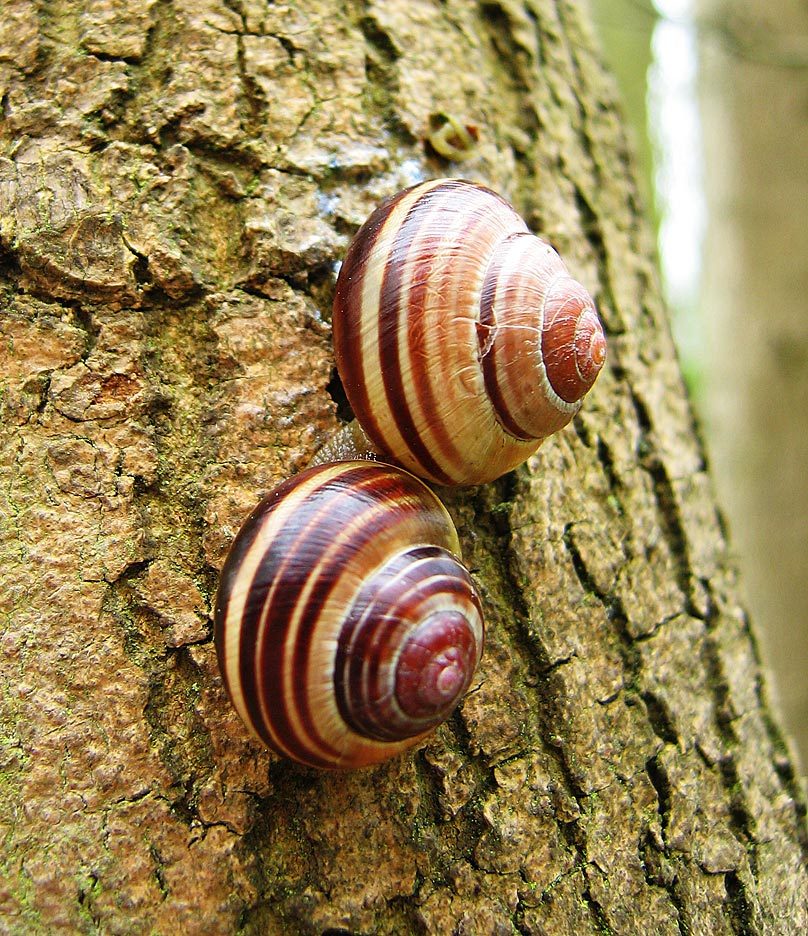
異なる色と縞模様を持つ2匹の巻貝
巻貝 (Cepaea nemoralis) は殻の色と縞模様に目立つ変異を示す

変異には2つのパターンがある:

  • 不連続変異——間に什么都没有く明確に区別されるグループ(例:血液型A, B, AB, O)。通常は1つまたは少数の遺伝子によって制御され、環境の影響は小さい。
  • 連続変異——一方の極端から他方へ滑らかな範囲(例:身長)。多くの遺伝子が共同して作用し、さらに環境の影響を受ける。
2つのグラフ:血液型の棒グラフ(不連続、個別の棒)、身長の滑らかな鐘型曲線(連続)
不連続変異は別々のグループに分かれ、連続変異は滑らかな範囲である

2つのサンプルの平均を比較する場合(例:日陰と日向での植物の身長)、t検定を使用する。これは差が実際に大きいのか、それとも偶然によるものかを知るために用いる。

Explore · ⁨探索⁩

The t-distribution behind the t-test · ⁨t検定におけるt分布⁩

The t-test compares two sample means against a critical value you look up in a t-table. This is that table made live: the value depends on the degrees of freedom (here $n_1+n_2-2$). Drag df and watch the critical value change — small samples have heavier tails, so they need a larger difference to count as real. · ⁨t検定は、2つのサンプル平均を有意水準の閾値と比較します。この閾値はt表で探します。このインタラクティブな表では、閾値は自由度(ここでは$n_1+n_2-2$)によって決まります。dfをドラッグすると閾値が変わるのを観察してください。小標本は裾が厚いため、真の差として認められるにはより大きい差が必要です。⁩

Explore · ⁨探索⁩

Variation type lab · ⁨変異型別実験⁩

Classify examples by the source and pattern of variation. · ⁨変異の起源とパターンに基づいて例を分類せよ。⁩

Vocabulary · ⁨語彙⁩ Train · ⁨練習する⁩
English 日本語
variation/ˌveərɪˈeɪʃn/ 変異
allele/əˈliːl/ アルレル
environmental factor/enˌvaɪrənˈmentl ˈfæktə/ 環境要因
discontinuous variation/dɪskənˈtɪnjuːəs ˌveərɪˈeɪʃn/ 不連続変異
gene/dʒiːn/ 遺伝子
continuous variation/kənˈtɪnjuːəs ˌveərɪˈeɪʃn/ 連続変異
population/ˌpɒpjʊˈleɪʃn/ 人口
offspring/ˈɒfsprɪŋ/ 子孫
compete/kəmˈpiːt/ 競争する
adapted/əˈdæptɪd/ 適応
reproduce/rɪprəˈdjuːs/ 繁殖する
17.2

Natural selection · ⁨自然選択⁩

Syllabus · ⁨シラバス⁩
English
  1. explain that natural selection occurs because populations have the capacity to produce many offspring that compete for resources; in the ‘struggle for existence’, individuals that are best adapted are most likely to survive to reproduce and pass on their alleles to the next generation
  2. explain how environmental factors can act as stabilising, disruptive and directional forces of natural selection
  3. explain how selection, the founder effect and genetic drift, including the bottleneck effect, may affect allele frequencies in populations
  4. outline how bacteria become resistant to antibiotics as an example of natural selection
  5. use the Hardy–Weinberg principle to calculate allele and genotype frequencies in populations and state the conditions when this principle can be applied (the two equations for the Hardy–Weinberg principle will be provided, as shown in the Mathematical requirements)
  6. describe the principles of selective breeding (artificial selection)
  7. outline the following examples of selective breeding: • the introduction of disease resistance to varieties of wheat and rice • inbreeding and hybridisation to produce vigorous, uniform varieties of maize • improving the milk yield of dairy cattle
日本語
  1. 自然選択が、資源を巡って競争する多数の子供を生み出す能力を持つ集団において生じることを説明する。「生存競争」において最も適応した個体が繁殖して次世代にアレルを伝える可能性が高いことを説明する
  2. 環境要因が自然選択の安定化、乱立、定向の力として機能する方法を説明する
  3. 選択、創始者効果、遺伝的浮動(ボトルネック効果を含む)が集団内のアレル頻度に与える影響を説明する
  4. 細菌が抗生物質に耐性を獲得する過程を、自然選択の一例として概要を述べる
  5. 集団内のアレル頻度および遺伝子型頻度を計算するためにハ rdイ-ワインバーグの原理を使用し、この原理を適用できる条件を述べる(ハ rdイ-ワインバーグの原理の2つの方程式は数学的要項に示されている通り提供される)
  6. **選抜育種(人工選択)**の原則を説明する
  7. 選抜育種の以下の事例を概要で述べる:• 小麦および米の品種への病害抵抗性の導入 • 強健で均質なトウモロコシ品種を生産するための近親交配および交雑 • 乳牛の乳量向上

Source: Cambridge International syllabus · ⁨出典: Cambridge International シラバス⁩

English
Natural selection: the peppered moth

A population 种群 produces far more offspring 后代 than can survive, so the offspring must compete 竞争 for resources such as food and space. This is the "struggle for existence". The individuals that are best adapted 适应 are most likely to survive, reproduce 繁殖, and pass on their alleles to the next generation. Over many generations, the helpful alleles become more common in the population. This is natural selection 自然选择.

Environmental conditions can push selection in three ways:

  • stabilising selection 稳定选择 favours the average and removes the extremes (the population stays the same).
  • directional selection 定向选择 favours one extreme, so the mean shifts that way.
  • disruptive selection 分裂选择 favours both extremes and removes the average.

Allele frequencies can also change in other ways:

  • the founder effect 奠基者效应 — a few individuals start a new population, so they carry only some of the alleles of the original group.
  • genetic drift 遗传漂变 — in a small population, allele frequencies change by chance from generation to generation.
  • the bottleneck effect 瓶颈效应 — a sudden fall in population size leaves few survivors, reducing the variety of alleles.

Antibiotic resistance as natural selection

A chance mutation 突变 makes a few bacteria resistant to an antibiotic 抗生素. When the antibiotic is used, the non-resistant bacteria die, but the resistant ones survive and reproduce. Over time the resistance 耐药性 spreads through the population. This is natural selection in action.

日本語
自然選択:ハダカガの蛾

個体群は、生存できる数を遥かに超える子孫を生み出すため、子供たちは食料や空間などの資源を巡って競争せねばならない。これを「生存のための闘争」という。適応した最も有利な個体が生き残り、繁殖して次世代にアルレールを引き継ぐ可能性が高い。何世代もかけて、有益なアルレールは個体群内でより普遍的になる。これが自然選択である。

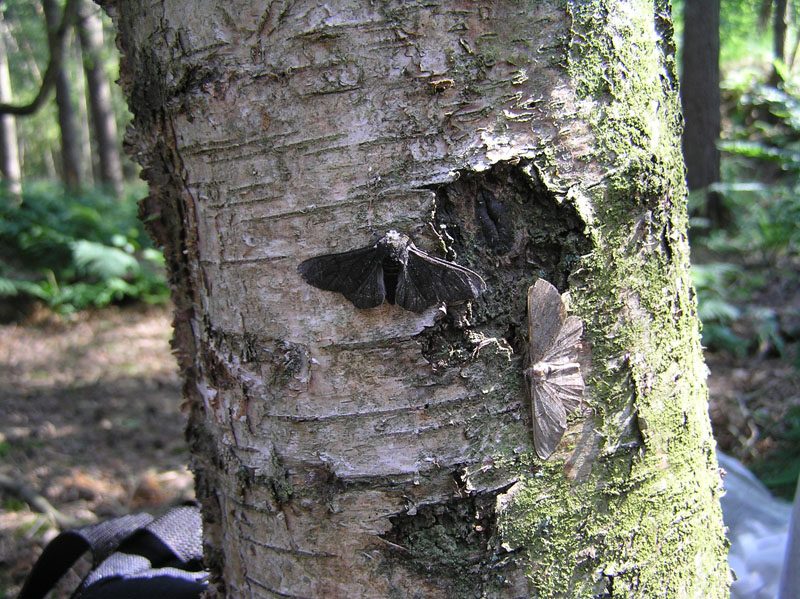
樹幹に止まっている2匹のモス:左側には浅い地衣に覆われた樹皮の上にほぼ黒いモスが、右側には暗い樹皮の上に淡い斑点模様のモスが止まっている
このカモスジガは自然選択を示す:黒色形は暗く煤けた樹皮に擬態し、淡い斑点形は淡い地衣に擬態する — 鳥は目立つ方を食べる

環境条件は次の3つの方法で選択を推進する:

  • 安定化選択は平均的な形質を好むため極端な形質が除去され(個体群はそのまま)、
  • 方向性選択は片側の極端な形質を好むため平均値がその方向へシフトし、
  • 分裂選択は両方の極端な形質を好むため平均的な形質が除去される。
選択前後の形質分布を比較する3つのグラフ:安定化選択は分布を狭くし、方向性選択は片側にシフトさせ、分裂選択は2つの山に分ける
安定化選択は範囲を狭くし、方向性選択は平均値をシフトさせ、分裂選択は2つに分ける

アルレール頻度は他の方法でも変化することがある:

  • 創始者効果 — 少数の個体が新しい個体群を形成するため、元の集団のアルレールの一部しか持たない。
  • 遺伝的浮動 — 小規模な個体群では、偶然によって世代を超えてアルレール頻度が変化する。
  • ボトルネック効果 — 個体数の急激な減少により少数の生存者しか残らず、アルレールの多様性が低下する。
多様な色を持つ大規模な集団が災害を経験し、少数のみが生き残るため、再生した集団にはわずかな色のみの変異しか残っていない様子を描写
ボトルネック:少数だけが災害を生き延びるため、回復した個体群は遺伝的多様性が低くなる

抗生物質耐性における自然選択

偶然の突然変異により少数の細菌がある抗生物質に対して耐性を持つようになる。抗生物質が使用されると耐性のない細菌は死滅するが、耐性菌は生き残り繁殖する。時間とともに耐性は個体群全体に広まる。これが実際に機能している自然選択である。

Explore · ⁨探索⁩

Natural selection · ⁨自然選択⁩

Step through Darwin's idea: variation + a selection pressure means the best-adapted survive and pass on their alleles. · ⁨ダーウィンの考えを段階的に確認せよ:変異+選択圧により、最も適応した個体が生存し、アルルを後世に伝える。⁩

Vocabulary · ⁨語彙⁩ Train · ⁨練習する⁩
English 日本語
natural selection/ˈnætʃərəl sɪˈlekʃn/ 自然選択
stabilising selection/ˈsteɪbəlaɪzɪŋ sɪˈlekʃn/ 安定化選択
directional selection/daɪˈrekʃənl sɪˈlekʃn/ 方向性選択
disruptive selection/dɪsˈrʌptɪv sɪˈlekʃn/ 分断的選択
founder effect/ˈfaʊndə ɪˈfekt/ 創始者効果
genetic drift/dʒɪˈnetɪk drɪft/ 遺伝的浮動
bottleneck effect/ˈbɒtəlnek ɪˈfekt/ ボトルネック効果
mutation/mjuːˈteɪʃn/ 突然変異
antibiotic/ˌæntɪbaɪˈɒtɪk/ 抗生物質
resistance/rɪˈzɪstəns/ 反対意见
Hardy–Weinberg principle/ˈhɑːdi ˈwaɪnbɜːɡ ˈprɪnsɪpl/ ハーディ=ワインバーグの法則
allele frequency/əˈliːl ˈfriːkwənsi/ アレル頻度
genotype/ˈdʒenətaɪp/ 遺伝子型
Watch lesson · ⁨レッスンを視聴⁩
17.2

The Hardy–Weinberg principle · ⁨ハーディ=ヴァインベルグの法則⁩

English

The Hardy–Weinberg principle 哈迪-温伯格原理 lets you calculate the allele frequencies 等位基因频率 and genotype 基因型 frequencies in a population. It only holds true when there is a large population, mating is random, and there is no mutation, no migration and no natural selection.

Call the frequency of the dominant allele $p$ and the frequency of the recessive allele $q$. There are only two alleles, so:

$$p + q = 1.$$

The genotype frequencies then add up to 1, where $p^2$ is homozygous dominant, $2pq$ is heterozygous (the carriers), and $q^2$ is homozygous recessive:

$$p^2 + 2pq + q^2 = 1.$$

Worked example. A recessive condition affects $1$ in every $100$ people. Find the frequency of carriers.

Only the homozygous recessive genotype ($q^2$) shows the condition, so $q^2 = \tfrac{1}{100} = 0.01$, giving $q = \sqrt{0.01} = 0.1$. Then $p = 1 - q = 0.9$. The carriers are the heterozygotes:

$$2pq = 2 \times 0.9 \times 0.1 = 0.18.$$

So about $18\%$ of the population are carriers — far more than the $1\%$ who show the condition.

日本語

ハーディ=ヴァインベルグの法則を用いると、個体群内のアルレール頻度と遺伝子型頻度を計算できる。これは個体群が大きく、交配がランダムであり、かつ突然変異、移入・移出、自然選択がない場合にのみ成立する。

優性アルレールの頻度を $p$、劣性アルレールの頻度を $q$ とする。アルレールは2種類しかないので:

$$p + q = 1.$$

遺伝子型頻度の和は1となり、ここで $p^2$ はホモ接合優性、$2pq$ はヘテロ接合(キャリア)、$q^2$ はホモ接合劣性を表す:

$$p^2 + 2pq + q^2 = 1.$$

計算例。 遺伝的欠陥が$1$人に$100$人ずつ発症する場合、キャリア(保因者)の頻度を求めよ。

ホモ接合劣性の遺伝子型($q^2$)のみがその形質を示すため、$q^2 = \tfrac{1}{100} = 0.01$ となり、$q = \sqrt{0.01} = 0.1$ が得られる。したがって $p = 1 - q = 0.9$ となる。キャリアはヘテロ接合体である:

$$2pq = 2 \times 0.9 \times 0.1 = 0.18.$$

つまり個体群の約 $18\%$ がキャリアであり、形質を示す $1\%$ よりも遥かに多い。

ハーディ=ヴァインベルグ:アルレール頻度 p と q が、遺伝子型頻度 p², 2pq, q² を生む
17.2

Selective breeding (artificial selection) · ⁨選抜育種(人工選択)⁩

English

In selective breeding 选择育种, also called artificial selection 人工选择, humans (not nature) choose which organisms breed, so that useful features are passed on. Examples:

  • breeding disease resistance 抗病性 into varieties of wheat and rice.
  • using inbreeding 近交 and hybridisation 杂交 (crossing different lines) to make vigorous, uniform maize.
  • breeding dairy cattle to improve their milk yield 产量.
日本語

選抜育種、または人工選択において、人間(自然界ではなく)がどの生物を繁殖させるかを選び、有用な特徴が引き継がれるようにする。例:

  • 小麦や米の品種に病害抵抗性を導入するための育種。
  • 近親交配および雑交(異なる系統の交配)を用いて、旺盛で均一なトウモロコシを作る。
  • 乳牛の育種による乳産出量の向上。
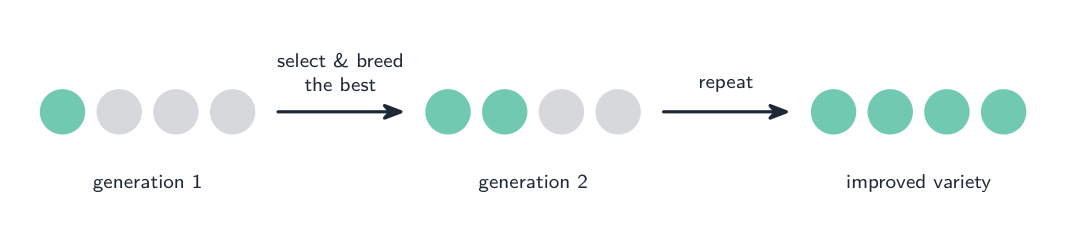
3世代の個体:毎回望む特徴(緑色)を持つものだけを選抜して繁殖するため、緑色の割合が上昇し、最終的に全品种がその特徴を持つようになる
選抜育種:各世代で最良のものだけを選んで繁殖させることで、目的の特徴が次第に普遍的になる
Explore · ⁨探索⁩

Selective breeding · ⁨品種改良⁩

Step through it. Humans take the role of the environment — choosing the breeders, generation after generation. · ⁨手順を追って確認せよ。人間が環境の役割を果たし、世代を超えて親の個体を選択する。⁩

Vocabulary · ⁨語彙⁩ Train · ⁨練習する⁩
English 日本語
selective breeding/sɪˈlektɪv ˈbriːdɪŋ/ 選抜育種
artificial selection/ˌɑːtɪˈfɪʃl sɪˈlekʃn/ 人工選択
disease resistance/dɪˈziːz rɪˈzɪstəns/ 病気抵抗力
inbreeding/ˈɪnbriːdɪŋ/ 近親交配
hybridisation/ˌhaɪbrɪdaɪˈzeɪʃn/ 雑種交配
yield/jiːld/ yield
evolution/ɪvəˈluːʃn/ 進化
species/ˈspiːsiːz/ 種
gene pool/dʒiːn puːl/ 遺伝子プール
sequence/ˈsiːkwəns/ 順序 (シーケンス)
17.3

Evolution · ⁨進化⁩

Syllabus · ⁨シラバス⁩
English
  1. outline the theory of evolution as a process leading to the formation of new species from pre-existing species over time, as a result of changes to gene pools from generation to generation
  2. discuss how DNA sequence data can show evolutionary relationships between species
  3. explain how speciation may occur as a result of genetic isolation by: • geographical separation (allopatric speciation) • ecological and behavioural separation (sympatric speciation)
日本語
  1. 世代ごとのゲノムポールの変化により、既存の種から新しい種が形成されるプロセスとしての進化理論を概要で述べる
  2. DNA塩基配列データが種間の進化的関係を示す方法を議論する
  3. 遺伝的隔離による種分化の起こり方を説明する:• 地理的分離(異所種分化) • 生態学的・行動的分離(同所種分化)

Source: Cambridge International syllabus · ⁨出典: Cambridge International シラバス⁩

English

Evolution 进化 is the slow formation of new species 物种 from earlier ones, as the gene pool 基因库 (all the alleles in a population) changes from generation to generation.

DNA sequence 序列 data can show how closely related two species are: the more similar their DNA sequences, the more recently they shared a common ancestor.

Speciation 物种形成 happens when two populations become genetically separated, so they can no longer breed together. This genetic isolation 隔离 can come about in two ways:

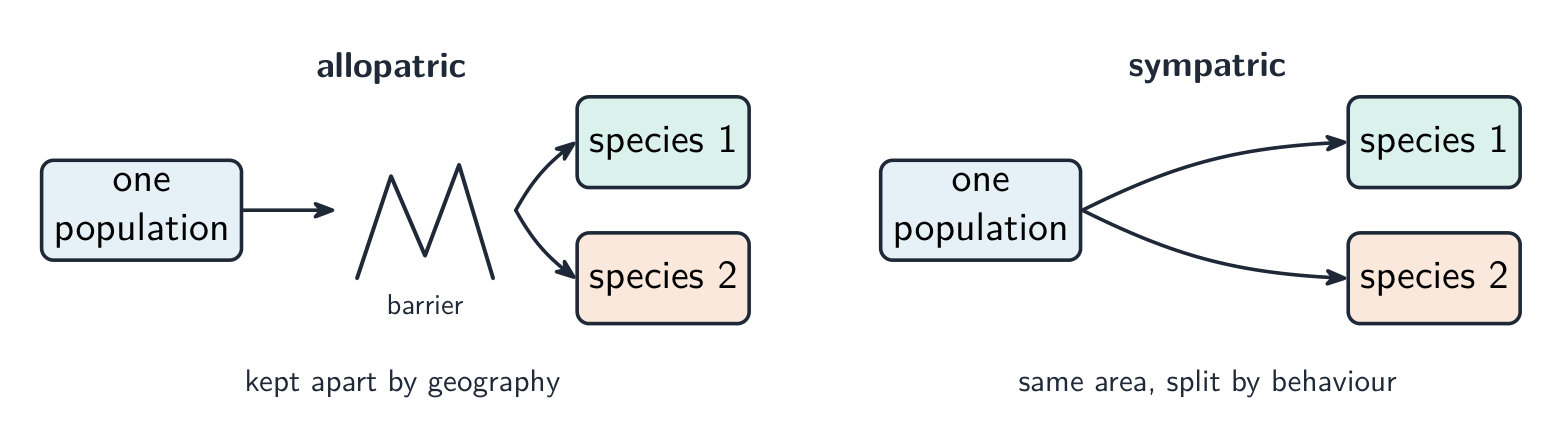
  • allopatric speciation 异域物种形成 — the populations are kept apart by a geographical separation 地理隔离, such as a sea or a mountain range.
  • sympatric speciation 同域物种形成 — the populations live in the same area but are separated by differences in behaviour or way of life.
日本語

進化とは、遺伝子プール(個体群に含まれるすべてのアルレール)が世代を超えて変化することで、古い種から新しい種がゆっくりと形成されることである。

DNA配列データは2つの種の系統的近傍性を示すことができる:DNA配列が類似しているほど、共通祖先を共有した時期は最近的である。

種分化は、2つの個体群が遺伝的に隔離され、互いに交尾できなくなることで起こる。この遺伝的隔離は次の2つの方法で生じることがある:

  • 地理的種分化 — 個体群が地理的分断(海や山脈など)によって離隔されている。
  • 同域種分化 — 個体群は同じ地域に住むが、行動や生活様式の違いによって隔離されている。
新種への2つの経路:物理的障壁によって個体群が分かれる地理的種分化と、同じ地域内の個体群が行動によって分かれる同域種分化
地理的種分化には物理的障壁が必要;同域種分化は同じ地域内で起こる
Explore · ⁨探索⁩

Allopatric speciation · ⁨地理的分種⁩

Step through it. A barrier splits one population; the two halves diverge until they can no longer interbreed. · ⁨手順を確認しよう。障壁によって一つの集団が二つに分かれ、両者は互いに交尾できなくなるまで分化していく。⁩

Vocabulary · ⁨語彙⁩ Train · ⁨練習する⁩
English 日本語
speciation/ˌspiːʃɪˈeɪʃn/ 新種の形成
isolation/ˌaɪsəˈleɪʃn/ 孤立
allopatric speciation/ˌæləˈpætrɪk ˌspiːʃɪˈeɪʃn/ 異地種形成
geographical separation/ˌdʒɪəˈɡræfɪkl ˌsepəˈreɪʃn/ 地理的分離
sympatric speciation/ˈsɪmpətrɪk ˌspiːʃɪˈeɪʃn/ 同地種形成
Watch lesson · ⁨レッスンを視聴⁩
17.3

Exam tips · ⁨試験対策⁩

English
  • Explain natural selection as a sequence: variation → selection pressure → the better-adapted survive and reproduce → allele frequency changes.
  • Use the Hardy–Weinberg equations ($p+q=1$, $p^2+2pq+q^2=1$); $q^2$ is the recessive-phenotype frequency — a common calculation.
  • Distinguish stabilising, directional and disruptive selection with an example of each.
  • Distinguish allopatric vs sympatric speciation (geographic vs reproductive isolation).
日本語
  • 自然選択を、変異 → 選択圧 → 適応度の高い個体の生存と繁殖 → アルレール頻度の変化という流れとして説明すること。
  • ハーディ=ヴァインベルグの式($p+q=1$, $p^2+2pq+q^2=1$)を使用すること。$q^2$ は劣性形質の頻度であり、よく出題される計算である。
  • 安定化選択、定向選択、分裂選択の違いを、それぞれ具体例を挙げて説明せよ。
  • 異所的 vs 同所的種形成(地理的隔離と生殖的隔離の区別)。

Interactive lessons on this topic · ⁨このトピックのインタラクティブ授業⁩

Work through it step by step, with instant-check exercises. · ⁨一歩ずつ進め、即時チェック付きの問題で学習します。⁩

Past Papers · ⁨過去問⁩

More topics in A-Level Biology · ⁨A-Level 生物⁩ · ⁨A-Level Biology · ⁨A-Level 生物⁩ の他のトピック⁩

Log in or create account · ⁨ログインまたはアカウント作成⁩

IGCSE, A-Level & AP