Skip to content · ⁨Lompat ke konten⁩

Short Fiction I · ⁨Fiksi Pendek I⁩

AP English Literature and Composition · ⁨AP Sastra Inggris dan Komposisi⁩ · Topic 1 · ⁨Topik 1⁩

Video lesson for this topic · ⁨Pelajaran video untuk topik ini⁩ Open the video page · ⁨Buka halaman video⁩
6:43

Unit 1: Short Fiction I

AP English Literature membaca teks dalam tiga genre melintasi sembilan unit — fiksi pendek, puisi, dan fiksi panjang atau drama — masing-masing dikunjungi tiga kali pada…

English narration · English + 中文 subtitles burned in · ⁨Narasi bahasa Inggris · Subtitle bahasa Inggris + 中文 disematkan langsung⁩

1.1

What Textual Details Reveal About a Character · ⁨Apa Rincian Teks Ungkapkan Tentang Seorang Karakter⁩

Syllabus · ⁨Silabus⁩
English

Enduring Understanding (CHR-1): Characters in literature allow readers to study and explore a range of values, beliefs, assumptions, biases, and cultural norms represented by those characters.

Learning Objective 1.A: Identify and describe what specific textual details reveal about a character, that character’s perspective, and that character’s motives.

  • CHR-1.A Description, dialogue, and behavior reveal characters to readers.
  • CHR-1.B Descriptions of characters may come from a speaker, narrator, other characters, or the characters themselves.
  • CHR-1.C Perspective is how narrators, characters, or speakers understand their circumstances, and is informed by background, personality traits, biases, and relationships.
  • CHR-1.D A character’s perspective is both shaped and revealed by relationships with other characters, the environment, the events of the plot, and the ideas expressed in the text.
Bahasa Indonesia

Pemahaman Abadi (CHR-1): Karakter dalam sastra memungkinkan pembaca mempelajari dan mengeksplorasi berbagai nilai, keyakinan, asumsi, bias, dan norma budaya yang diwakili oleh karakter-karakter tersebut.

Tujuan Pembelajaran 1.A: Identifikasi dan deskripsikan detail teks spesifik apa yang mengungkapkan tentang sebuah karakter, perspektif karakter tersebut, dan motif karakter tersebut.

  • CHR-1.A Deskripsi, dialog, dan perilaku mengungkapkan karakter kepada pembaca.
  • CHR-1.B Deskripsi tentang karakter dapat berasal dari pembicara, narator, karakter lain, atau karakter itu sendiri.
  • CHR-1.C Perspektif adalah cara narator, karakter, atau pembicara memahami situasi mereka, dan dipengaruhi oleh latar belakang, sifat kepribadian, bias, dan hubungan.
  • CHR-1.D Perspektif karakter dibentuk dan diungkapkan baik oleh hubungan dengan karakter lain, lingkungan, peristiwa plot, maupun ide-ide yang diungkapkan dalam teks.

Source: College Board AP Course and Exam Description · ⁨Sumber: Deskripsi Kursus dan Ujian College Board AP⁩

English

AP English Literature reads texts in three genres across nine units - short fiction, poetry, and longer fiction or drama, each visited three times at increasing difficulty. Unit 1 installs the tools for all of them.

Character 人物 is revealed by three things, and the CED names them exactly:

  • Description, dialogue, and behaviour 描写、对话与行为 reveal characters to readers.
  • Descriptions may come from a speaker, narrator, other characters, or the characters themselves - so who is describing is part of the evidence.
  • Perspective 视角 is how narrators, characters, or speakers understand their circumstances, informed by background, experience, and values.
  • A character's perspective is both shaped and revealed by relationships with other characters, the environment, and events.

That last point is the one that turns character notes into analysis. A character is not a list of adjectives; a character is a way of seeing, which becomes visible in what they notice, what they misread, and how they respond.

Bahasa Indonesia

AP Sastra Inggris membaca teks dalam tiga genre di sembilan unit - fiksi pendek, puisi, dan fiksi panjang atau drama, masing-masing dikunjungi tiga kali dengan tingkat kesulitan yang meningkat. Unit 1 menyediakan alat untuk semuanya.

Karakter 人物 diungkapkan oleh tiga hal, dan CED menyebutnya secara tepat:

  • Deskripsi, dialog, dan perilaku 描写、对话与行为 mengungkapkan karakter kepada pembaca.
  • Deskripsi dapat berasal dari pembicara, narator, karakter lain, atau karakter itu sendiri - sehingga siapa yang mendeskripsikan merupakan bagian dari bukti.
  • Perspektif 视角 adalah bagaimana narator, karakter, atau pembicara memahami situasi mereka, dipengaruhi oleh latar belakang, pengalaman, dan nilai-nilai.
  • Perspektif seorang karakter dibentuk sekaligus diungkap oleh hubungan dengan karakter lain, lingkungan, dan peristiwa.

Poin terakhir inilah yang mengubah catatan karakter menjadi analisis. Seorang karakter bukan sekadar daftar kata sifat; seorang karakter adalah cara melihat, yang terlihat dari apa yang mereka perhatikan, apa yang mereka salah tafsirkan, dan bagaimana mereka bereaksi.

Ungkapkan apa yang ditetapkan oleh rincian tersebut, dan hentikan di mana bukti berakhir
Explore · ⁨Jelajahi⁩

Take a detail exactly as far as it goes · ⁨Ambil detail sedalam-dalamnya hingga batasnya⁩

Over-reading loses as many marks as under-reading: say what the detail establishes, and stop where the evidence stops. · ⁨Membaca terlalu dalam kehilangan poin sama banyaknya dengan membaca terlalu dangkal: katakan apa yang ditetapkan oleh detail tersebut, dan hentikan di mana bukti berhenti.⁩

1.2

Textual Details That Convey Setting · ⁨Rincian Teks yang Menyampaikan Latar⁩

Syllabus · ⁨Silabus⁩
English

Enduring Understanding (SET-1): Setting and the details associated with it not only depict a time and place, but also convey values associated with that setting.

Learning Objective 2.A: Identify and describe specific textual details that convey or reveal a setting.

  • SET-1.A Setting includes the time and place during which the events of the text occur.
Bahasa Indonesia

Pemahaman Abadi (SET-1): Latar dan detail yang terkait dengannya tidak hanya menggambarkan waktu dan tempat, tetapi juga menyampaikan nilai-nilai yang terkait dengan latar tersebut.

Tujuan Pembelajaran 2.A: Identifikasi dan deskripsikan detail teks spesifik yang menyampaikan atau mengungkapkan latar.

  • SET-1.A Latar mencakup waktu dan tempat di mana peristiwa teks terjadi.

Source: College Board AP Course and Exam Description · ⁨Sumber: Deskripsi Kursus dan Ujian College Board AP⁩

English

Setting 背景 includes the time and place during which the events of the text occur.

The CED's definition is deliberately minimal, and that is the trap. Setting earns marks not when it is described but when it is shown doing something - constraining a character, explaining a value, or contrasting with an interior state. A paragraph that establishes where a story happens has not yet made a claim.

Bahasa Indonesia

Latar 背景 mencakup waktu dan tempat di mana peristiwa-peristiwa dalam teks terjadi.

Definisi CED sengaja dibuat minimal, dan itu adalah jebakan. Latar mendapatkan nilai bukan saat dideskripsikan, tetapi saat ditunjukkan melakukan sesuatu - membatasi karakter, menjelaskan nilai, atau berkontras dengan keadaan batin. Paragraf yang menetapkan di mana cerita terjadi belum tentu membuat klaim.

1.3

How Plot Orders Events · ⁨Bagaimana Plot Mengurutkan Peristiwa⁩

Syllabus · ⁨Silabus⁩
English

Enduring Understanding (STR-1): The arrangement of the parts and sections of a text, the relationship of the parts to each other, and the sequence in which the text reveals information are all structural choices made by a writer that contribute to the reader’s interpretation of a text.

Learning Objective 3.A: Identify and describe how plot orders events in a narrative.

  • STR-1.A Plot is the sequence of events in a narrative; events throughout a narrative are connected, with each event building on the others, often with a cause-and-effect relationship.
  • STR-1.B The dramatic situation of a narrative includes the setting and action of the plot and how that narrative develops to place characters in conflict(s), and often involves the rising or falling fortunes of a main character or set of characters.
Bahasa Indonesia

Pemahaman Abadi (STR-1): Pengaturan bagian-bagian dan segmen-segmen teks, hubungan bagian-bagian satu sama lain, dan urutan di mana teks mengungkapkan informasi adalah semua pilihan struktural yang dibuat penulis yang berkontribusi pada interpretasi pembaca terhadap teks.

Tujuan Pembelajaran 3.A: Identifikasi dan deskripsikan bagaimana plot mengurutkan peristiwa dalam naratif.

  • STR-1.A Plot adalah urutan peristiwa dalam naratif; peristiwa sepanjang naratif saling terhubung, dengan setiap peristiwa membangun di atas yang lain, sering kali dengan hubungan sebab-akibat.
  • STR-1.B Situasi dramatis dari sebuah naratif mencakup latar dan aksi plot serta bagaimana naratif tersebut berkembang untuk menempatkan karakter dalam konflik, dan sering melibatkan naik atau turunnya nasib tokoh utama atau sekumpulan karakter.

Source: College Board AP Course and Exam Description · ⁨Sumber: Deskripsi Kursus dan Ujian College Board AP⁩

English
  • Plot 情节 is the sequence of events in a narrative; events are connected, each building on those before it.
  • The dramatic situation 戏剧情境 includes the setting and action of the plot and how the narrative develops to place characters in conflict.

The word sequence is doing work. Plot is not the events but their order - and an author who reveals something late that happened early has made a choice you can analyse.

Bahasa Indonesia
  • Plot 情节 adalah urutan peristiwa dalam narasi; peristiwa-peristiwa saling terhubung, masing-masing membangun di atas yang sebelumnya.
  • Situasi dramatis 戏剧情境 mencakup latar dan aksi plot serta bagaimana narasi berkembang untuk menempatkan karakter dalam konflik.

Kata urutan memiliki makna. Plot bukan sekadar peristiwa tetapi urutan-nya - dan penulis yang mengungkapkan sesuatu yang terjadi belakangan padahal terjadi duluan telah membuat pilihan yang bisa Anda analisis.

Urutan peristiwa sebenarnya berbanding urutan yang Anda dengar - perbedaannya adalah sebuah pilihan
Vocabulary · ⁨Kosa kata⁩ Train · ⁨Latih⁩
English Bahasa Indonesia
Character/ˈkærɪktə/ Karakter
Description, dialogue, and behaviour/dɪˈskrɪpʃn ˈdaɪəlɒɡ ænd bɪˈheɪvjə/ Deskripsi, dialog, dan perilaku
Perspective/pəˈspektɪv/ Sudut Pandang
Setting/ˈsetɪŋ/ Latar
Plot/plɒt/ Plot
dramatic situation/drəˈmætɪk ˌsɪtʃuːˈeɪʃn/ situasi dramatis
1.4

The Function of a Sequence of Events · ⁨Fungsi Urutan Peristiwa⁩

Syllabus · ⁨Silabus⁩
English

Enduring Understanding (STR-1): The arrangement of the parts and sections of a text, the relationship of the parts to each other, and the sequence in which the text reveals information are all structural choices made by a writer that contribute to the reader’s interpretation of a text.

Learning Objective 3.B: Explain the function of a particular sequence of events in a plot.

  • STR-1.C Plot and the exposition that accompanies it focus readers’ attention on the parts of the narrative that matter most to its development, including characters, their relationships, and their roles in the narrative, as well as setting and the relationship between characters and setting.
Bahasa Indonesia

Pemahaman Abadi (STR-1): Pengaturan bagian-bagian dan segmen-segmen teks, hubungan bagian-bagian satu sama lain, dan urutan di mana teks mengungkapkan informasi adalah semua pilihan struktural yang dibuat penulis yang berkontribusi pada interpretasi pembaca terhadap teks.

Tujuan Pembelajaran 3.B: Jelaskan fungsi urutan peristiwa tertentu dalam plot.

  • STR-1.C Plot dan pengantar yang menyertainya fokus perhatian pembaca pada bagian-bagian naratif yang paling penting bagi perkembangannya, termasuk karakter, hubungan mereka, dan peran mereka dalam naratif, serta latar dan hubungan antara karakter dan latar.

Source: College Board AP Course and Exam Description · ⁨Sumber: Deskripsi Kursus dan Ujian College Board AP⁩

English

Plot and the exposition that accompanies it focus readers' attention on the parts of the narrative that matter most to the text's meaning.

That sentence is the whole method for prose analysis: proportion is evidence. What the text lingers over, and what it passes in a clause, is the author telling you where to look.

Bahasa Indonesia

Plot dan eksposisi yang menyertainya memfokuskan perhatian pembaca pada bagian-bagian narasi yang paling penting bagi makna teks.

Kalimat itu adalah seluruh metode untuk analisis prosa: proporsi adalah bukti. Apa yang teks lamati, dan apa yang dilewatkan dalam satu klausa, adalah penulis memberi tahu Anda di mana harus melihat.

1.5

Identifying the Narrator or Speaker · ⁨Mengidentifikasi Narator atau Pembicara⁩

Syllabus · ⁨Silabus⁩
English

Enduring Understanding (NAR-1): A narrator’s or speaker’s perspective controls the details and emphases that affect how readers experience and interpret a text.

Learning Objective 4.A: Identify and describe the narrator or speaker of a text.

  • NAR-1.A Narrators or speakers relate accounts to readers and establish a relationship between the text and the reader.
  • NAR-1.B Perspective refers to how narrators, characters, or speakers see their circumstances, while point of view refers to the position from which a narrator or speaker relates the events of a narrative.
  • NAR-1.C A speaker or narrator is not necessarily the author.
Bahasa Indonesia

Pemahaman Abadi (NAR-1): Perspektif narator atau pembicara mengendalikan detail dan penekanan yang mempengaruhi bagaimana pembaca mengalami dan menginterpretasikan teks.

Tujuan Pembelajaran 4.A: Identifikasi dan deskripsikan narator atau pembicara dari sebuah teks.

  • NAR-1.A Narator atau pembicara menceritakan kisah kepada pembaca dan menetapkan hubungan antara teks dan pembaca.
  • NAR-1.B Perspektif merujuk pada bagaimana narator, tokoh, atau pembicara melihat situasi mereka, sedangkan sudut pandang merujuk pada posisi dari mana seorang narator atau pembicara mengisahkan peristiwa dalam sebuah narasi.
  • NAR-1.C Seorang pembicara atau narator tidak haruslah merupakan penulisnya.

Source: College Board AP Course and Exam Description · ⁨Sumber: Deskripsi Kursus dan Ujian College Board AP⁩

English
  • Narrators or speakers relate accounts and establish a relationship between the text and the reader.
  • Perspective refers to how narrators, characters, or speakers see their circumstances; point of view 叙述视点 refers to the position from which they relate the account.
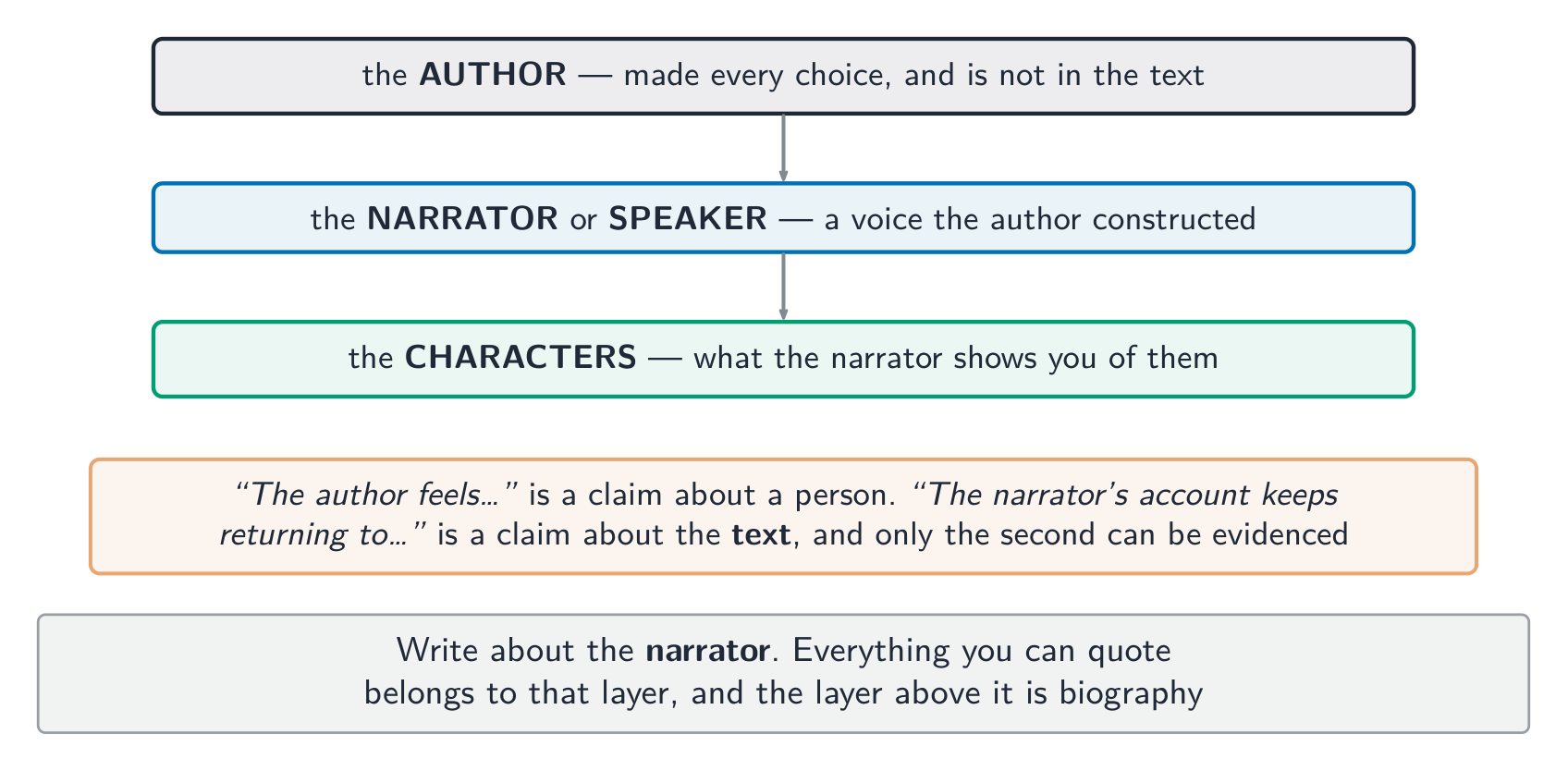
  • A speaker or narrator is not necessarily the author. Never write "the author feels" about a first-person narrator.
Bahasa Indonesia
Apa yang setiap sudut pandang dapat dan tidak dapat berikan kepada Anda - dan batasan itulah analisisnya
Perspektif adalah bagaimana mereka melihat; sudut pandang adalah di mana mereka berdiri. CED memisahkannya, dan begitu juga Anda.
  • Nerator atau pembicara menyampaikan laporan dan membangun hubungan antara teks dan pembaca.
  • Perspektif merujuk pada bagaimana narator, karakter, atau pembicara melihat situasi mereka; sudut pandang 叙述视点 merujuk pada posisi dari mana mereka menyampaikan laporan.
  • Seorang pembicara atau narator tidak selalu penulis. Jangan pernah menulis "penulis merasa" tentang narator orang pertama.
Tulislah tentang narator: semua yang bisa Anda kutip milik lapisan itu
Explore · ⁨Jelajahi⁩

Sort each statement by the layer it belongs to · ⁨Urutkan setiap pernyataan berdasarkan lapisan yang dimilikinya⁩

Everything you can quote belongs to the narrator's layer. The layer above it is biography. · ⁨Semua yang bisa dikutip milik lapisan narator. Lapisan di atasnya adalah biografi.⁩

Vocabulary · ⁨Kosa kata⁩ Train · ⁨Latih⁩
English Bahasa Indonesia
point of view/pɔɪnt ɒv vjuː/ sudut pandang
observational to all-knowing/ɒbzəˈveɪʃənl tʊ ɔːl ˈnəʊɪŋ/ observasional hingga serba tahu
1.6

The Function of Point of View · ⁨Fungsi Sudut Pandang⁩

Syllabus · ⁨Silabus⁩
English

Enduring Understanding (NAR-1): A narrator’s or speaker’s perspective controls the details and emphases that affect how readers experience and interpret a text.

Learning Objective 4.B: Identify and explain the function of point of view in a narrative.

  • NAR-1.D The point of view contributes to what narrators, characters, or speakers can and cannot provide in a text based on their level of involvement and intimacy with the details, events, or characters.
  • NAR-1.E Narrators may also be characters, and their role as characters may influence their perspective.
  • NAR-1.F First-person narrators are involved in the narrative; their relationship to the events of the plot and the other characters shapes their perspective.
  • NAR-1.G Third-person narrators are outside observers.
  • NAR-1.H Third-person narrators’ knowledge about events and characters may range from observational to all-knowing, which shapes their perspective.
  • NAR-1.I The outside perspective of third-person narrators may not be affected by the events of the narrative.
Bahasa Indonesia

Pemahaman Abadi (NAR-1): Perspektif narator atau pembicara mengendalikan detail dan penekanan yang mempengaruhi bagaimana pembaca mengalami dan menginterpretasikan teks.

Tujuan Pembelajaran 4.B: Mengidentifikasi dan menjelaskan fungsi sudut pandang dalam sebuah narasi.

  • NAR-1.D Sudut pandang berkontribusi terhadap apa yang dapat dan tidak dapat disediakan oleh narator, tokoh, atau pembicara dalam sebuah teks berdasarkan tingkat keterlibatan dan kedekatan mereka dengan detail, peristiwa, atau karakter.
  • NAR-1.E Narator juga bisa menjadi tokoh, dan peran mereka sebagai tokoh dapat memengaruhi perspektif mereka.
  • NAR-1.F Narator orang pertama terlibat dalam narasi; hubungan mereka dengan peristiwa plot dan tokoh lain membentuk perspektif mereka.
  • NAR-1.G Narator orang ketiga adalah pengamat dari luar.
  • NAR-1.H Pengetahuan narator orang ketiga tentang peristiwa dan tokoh dapat berkisar dari observasional hingga semua tahu, yang membentuk perspektif mereka.
  • NAR-1.I Perspektif luar dari narator orang ketiga mungkin tidak terpengaruh oleh peristiwa dalam narasi tersebut.

Source: College Board AP Course and Exam Description · ⁨Sumber: Deskripsi Kursus dan Ujian College Board AP⁩

English
  • Point of view contributes to what narrators can and cannot provide in a text, based on their position.
  • Narrators may also be characters, and that role may influence their perspective.
  • First-person narrators are involved in the narrative; their relationship to events and to other characters shapes what they can tell you.
  • Third-person narrators are outside observers, and their knowledge may range from observational to all-knowing 全知.
  • The outside perspective of a third-person narrator may not be affected by the events of the narrative.

The analytical payoff is the cannot. A first-person narrator cannot report what they did not witness or will not admit, and every gap is meaningful. A limited third-person narrator confines you to one consciousness, which is a choice about whose experience counts.

Bahasa Indonesia
  • Sudut pandang berkontribusi pada apa yang dapat dan tidak dapat diberikan narator dalam sebuah teks, berdasarkan posisinya.
  • Nerator juga bisa berupa karakter, dan peran itu dapat mempengaruhi perspektif mereka.
  • Nerator orang pertama terlibat dalam narasi; hubungan mereka dengan peristiwa dan karakter lain membentuk apa yang bisa mereka sampaikan kepada Anda.
  • Nerator orang ketiga adalah pengamat luar, dan pengetahuan mereka bisa berkisar dari observasional hingga serba tahu 全知.
  • Perspektif luar dari narator orang ketiga mungkin tidak terpengaruh oleh peristiwa dalam narasi.

Hasil analisisnya terletak pada kata tidak dapat. Nerator orang pertama tidak dapat melaporkan apa yang tidak mereka saksikan atau tidak mau akui, dan setiap kekosongan bermakna. Nerator orang ketiga terbatas membatasi Anda pada satu kesadaran, yang merupakan pilihan mengenai pengalaman siapa yang dihitung.

1.7

Developing a Paragraph with Claim and Evidence · ⁨Mengembangkan Paragraf dengan Klaim dan Bukti⁩

Syllabus · ⁨Silabus⁩
English

Enduring Understanding (LAN-1): Readers establish and communicate their interpretations of literature through arguments supported by textual evidence.

Learning Objective 7.A: Develop a paragraph that includes 1) a claim that requires defense with evidence from the text and 2) the evidence itself.

  • LAN-1.A In literary analysis, writers read a text closely to identify details that, in combination, enable them to make and defend a claim about an aspect of the text.
  • LAN-1.B A claim is a statement that requires defense with evidence from the text.
  • LAN-1.C In literary analysis, the initial components of a paragraph are the claim and textual evidence that defends the claim.
Bahasa Indonesia

Pemahaman Berkelanjutan (LAN-1): Pembaca membangun dan menyampaikan interpretasi mereka terhadap karya sastra melalui argumen yang didukung oleh bukti tekstual.

Tujuan Pembelajaran 7.A: Mengembangkan paragraf yang mencakup 1) klaim yang memerlukan pembelaan dengan bukti dari teks dan 2) bukti itu sendiri.

  • LAN-1.A Dalam analisis sastra, penulis membaca teks secara mendalam untuk mengidentifikasi detail-detail yang, jika digabungkan, memungkinkan mereka membuat dan membela klaim mengenai aspek tertentu dari teks.
  • LAN-1.B Klaim adalah pernyataan yang memerlukan pembelaan dengan bukti dari teks.
  • LAN-1.C Dalam analisis sastra, komponen awal dari sebuah paragraf adalah klaim dan bukti tekstual yang membela klaim tersebut.

Source: College Board AP Course and Exam Description · ⁨Sumber: Deskripsi Kursus dan Ujian College Board AP⁩

English
  • In literary analysis, writers read a text closely to identify details that, in combination, enable them to make and defend a claim.
  • A claim is a statement that requires defence with evidence from the text.
  • The initial components of a paragraph are the claim and the textual evidence that defends it.

Note in combination. A single detail rarely supports an interpretive claim; two or three details that point the same way do.

Worked example (a real AP exam task). The AP Literature free-response section has three questions - poetry analysis, prose fiction analysis, and a literary argument on a work you choose - all marked on a six-point rubric: thesis 1, evidence and commentary 4, sophistication 1. For a prose fiction prompt asking how the author uses narrative techniques to reveal a character's attitude, a weak answer writes "the narrator is first-person, which makes it personal." A scoring answer uses the cannot: "Because the narrator is a participant recounting events years later, the account gives us his present judgement of his younger self and withholds what the other characters thought - so the reader receives his self-criticism as the only available evidence, and must decide whether the harshness of it is accuracy or performance." Point of view, its limit, and the effect on the reader.

Bahasa Indonesia
  • Dalam analisis sastra, penulis membaca teks secara saksama untuk mengidentifikasi rincian yang, jika dikombinasikan, memungkinkan mereka membuat dan membela sebuah klaim.
  • Sebuah klaim adalah pernyataan yang memerlukan pembelaan dengan bukti dari teks.
  • Komponen awal paragraf adalah klaim dan bukti tekstual yang membela klaim tersebut.

Perhatikan frasa jika dikombinasikan. Satu rincian jarang mendukung klaim interpretatif; dua atau tiga rincian yang mengarah ke arah yang sama bisa.

Contoh terpecahkan (tugas ujian AP asli). Bagian respons bebas Ujian Sastra AP terdiri dari tiga pertanyaan—analisis puisi, analisis fiksi prosa, dan argumen sastra pada karya yang Anda pilih—semuanya dinilai menggunakan rubrik enam poin: tesis 1, bukti dan komentar 4, kedalaman analitis 1. Untuk instruksi fiksi prosa yang menanyakan bagaimana penulis menggunakan teknik naratif untuk mengungkapkan sikap tokoh, jawaban lemah menulis "narator menggunakan sudut pandang orang pertama, yang membuatnya terasa personal." Jawaban bernilai tinggi menggunakan kata tidak dapat: "Karena narator adalah partisipan yang menceritakan peristiwa beberapa tahun kemudian, narasi memberikan kita penilaian masa kini atas dirinya sendiri saat muda dan menyembunyikan apa yang dipikirkan karakter lain—sehingga pembaca menerima kritik dirinya sebagai satu-satunya bukti yang tersedia, dan harus memutuskan apakah kekerasan kritiknya adalah ketepatan atau pertunjukan." Sudut pandang, batasannya, dan efeknya pada pembaca.

1.7

Exam tips · ⁨Tips ujian⁩

English
  • Character is a way of seeing, not a list of adjectives. Analyse what they notice and misread.
  • Setting must do something. Describing where a story happens is not yet a claim.
  • Plot is the order of events. A late revelation of an early event is an authorial choice worth analysing.
  • Proportion is evidence. What the text lingers over is where the meaning is.
  • The narrator is not the author. Never write "the author feels" about a first-person narrator.
  • The analytical gold in point of view is what the narrator cannot provide.
Bahasa Indonesia
  • Tokoh adalah cara melihat, bukan daftar kata sifat. Analisislah apa yang mereka perhatikan dan salah tafsirkan.
  • Latar tempat harus melakukan sesuatu. Mendeskripsikan di mana cerita terjadi belum merupakan sebuah klaim.
  • Plot adalah urutan peristiwa. Pengungkapan terlambat atas suatu peristiwa awal adalah pilihan penulis yang layak dianalisis.
  • Proporsi adalah bukti. Apa yang ditonjolkan teks adalah di mana maknanya berada.
  • Narator bukan penulis. Jangan pernah menulis "penulis merasa" mengenai narator orang pertama.
  • Emas analitis dalam sudut pandang adalah apa yang tidak dapat diberikan oleh narator.

Interactive lessons on this topic · ⁨Pelajaran interaktif untuk topik ini⁩

Work through it step by step, with instant-check exercises. · ⁨Kerjakan langkah demi langkah, dengan latihan pengecekan instan.⁩

Past Papers · ⁨Soal-Soil Masa Lalu⁩

More topics in AP English Literature and Composition · ⁨AP Sastra Inggris dan Komposisi⁩ · ⁨Topik lain dalam AP English Literature and Composition · ⁨AP Sastra Inggris dan Komposisi⁩⁩

Log in or create account · ⁨Masuk atau buat akun⁩

IGCSE, A-Level & AP