English
Two simple measures help managers judge how the workforce is doing.
Labour turnover 员工流失率 shows the percentage of staff who leave in a year:
$$\text{labour turnover} = \frac{\text{number of staff leaving}}{\text{average number employed}} \times 100\%$$
High labour turnover can mean low pay, poor motivation or weak management. It raises the cost of recruiting and training.
Worked example. A firm employs $200$ people on average, and $30$ leave during the year. Find its labour turnover.
$$\text{labour turnover} = \frac{30}{200} \times 100\% = 15\%.$$
Labour productivity 劳动生产率 shows the output made by each worker:
$$\text{labour productivity} = \frac{\text{total output}}{\text{number of employees}}$$
Higher labour productivity lowers the cost of each unit, so the firm can compete better.
Worked example. A team of $8$ workers makes $2400$ units in a week. Find the labour productivity.
$$\text{labour productivity} = \frac{2400}{8} = 300 \text{ units per worker per week}.$$
Bahasa Indonesia
Dua ukuran sederhana membantu manajer menilai kinerja tenaga kerja.
Rotasi tenaga kerja menunjukkan persentase staf yang keluar dalam satu tahun:
$$\text{labour turnover} = \frac{\text{number of staff leaving}}{\text{average number employed}} \times 100\%$$
Rotasi tenaga kerja yang tinggi bisa berarti gaji rendah, motivasi buruk, atau manajemen lemah. Hal ini meningkatkan biaya perekrutan dan pelatihan.
Contoh terpecahkan. Sebuah perusahaan employs $200$ orang rata-rata, dan $30$ keluar selama tahun tersebut. Temukan rotasi tenagakerjanya.
$$\text{labour turnover} = \frac{30}{200} \times 100\% = 15\%.$$
Produktivitas tenaga kerja menunjukkan output yang dihasilkan oleh setiap pekerja:
$$\text{labour productivity} = \frac{\text{total output}}{\text{number of employees}}$$
Produktivitas tenaga kerja yang lebih tinggi menurunkan biaya per unit, sehingga perusahaan dapat bersaing lebih baik.
Contoh terpecahkan. Sebuah tim $8$ pekerja membuat $2400$ unit dalam seminggu. Temukan produktivitas tenaga kerjanya.
$$\text{labour productivity} = \frac{2400}{8} = 300 \text{ units per worker per week}.$$





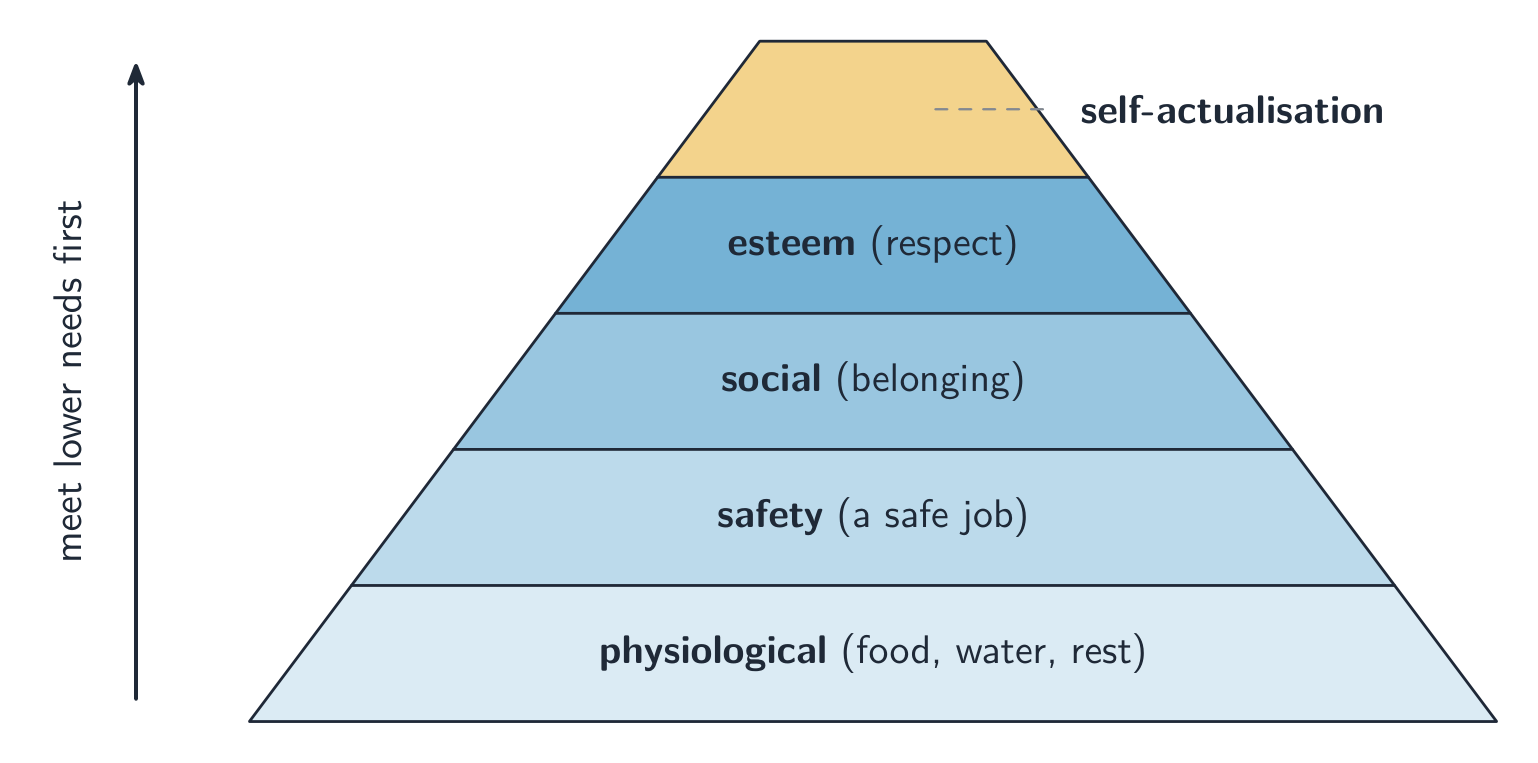
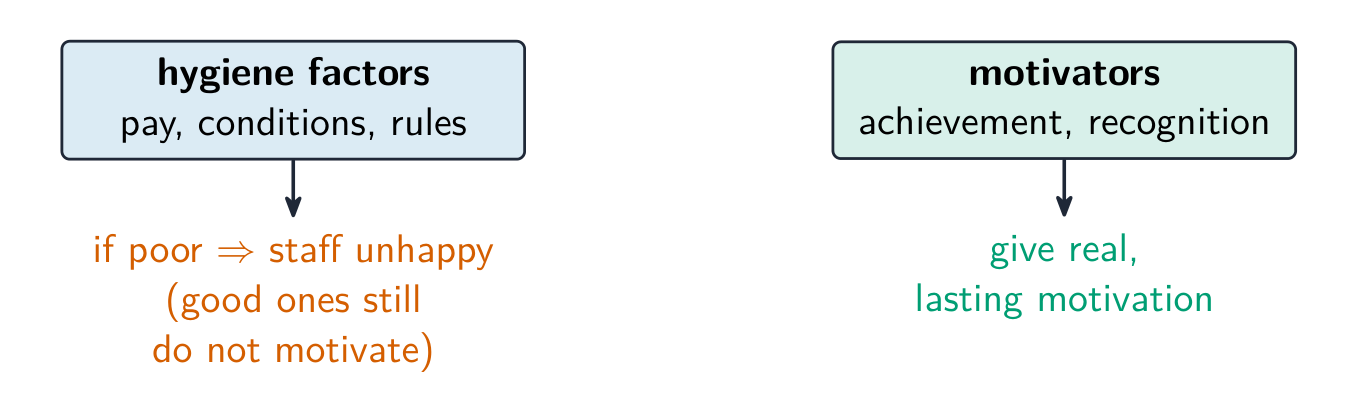 *Faktor higienis mencegah ketidakpuasan; hanya pendorong yang memberikan motivasi yang nyata dan tahan lama

