עץ ענק אדום מעלה מים לגובה של יותר ממאה מטרים למעלה, כל יום בלי שבת – ואין לו לב, שרירים או משאבה מסוג כלשהו. אז מה עושה ה…
English narration · English + 中文 subtitles burned in · קריאת קול באנגלית · תרגום אנגלי + סינית שרוף בתוך הסרטון
7.1
The two transport tissues · רקמות ההובלה השתיים
Syllabus · סיילבוס
English
draw plan diagrams of transverse sections of stems, roots and leaves of herbaceous dicotyledonous plants from microscope slides and photomicrographs
describe the distribution of xylem and phloem in transverse sections of stems, roots and leaves of herbaceous dicotyledonous plants
draw and label xylem vessel elements, phloem sieve tube elements and companion cells from microscope slides, photomicrographs and electron micrographs
relate the structure of xylem vessel elements, phloem sieve tube elements and companion cells to their functions
עברית
לשרטט דיאגרמות מפתח של חתכים רוחביים של גבעולים, שורשים ועלים של צמחים דו-עליים עשירים מזרמי מיקרוסקופ ותמונות מיקרוסקופיות
לתאר את חלוקת העץ ו-האגב בחתכים רוחביים של גבעולים, שורשים ועלים של צמחים דו-עליים עשירים
לשרטט ולסמן אלמנטים של כלי עץ, אלמנטים של צינורות מסננת אגב ו-תאים伴隨 מזרמי מיקרוסקופ, תמונות מיקרוסקופיות ומיקרוסקופי אלקטרונים
לקשר את מבנה אלמנטים של כלי עץ, אלמנטים של צינורות מסננת אגב ותאים伴隨 לתפקדיהם
Source: Cambridge International syllabus · מקור: הסיילבוס הבינלאומי של קמבריד'ג'
English
Plants move substances through two transport tissues 组织:
xylem 木质部 carries water and dissolved mineral ions 矿物离子 up from the roots.
phloem 韧皮部 carries dissolved foods (called assimilates 同化物, mainly sugars) to wherever they are needed.
In a transverse section 横切面 (a cut straight across) of a dicotyledonous plant 双子叶植物:
in the stem, xylem and phloem sit together in bundles near the outside, with xylem on the inside of each bundle.
in the root, the xylem is in the centre, often in a star shape, with phloem between the arms.
in the leaf, both are found in the veins.
When you draw a plan diagram, you draw only the outlines of the tissues, not the single cells.
Xylem vessels
Xylem water-carrying tubes are called vessels 导管. They are made of dead, empty cells joined end to end, with the end walls gone, so they form one long open pipe. Their walls are thickened and waterproofed with lignin 木质素. So the structure suits the job: the hollow, open tube with no contents lets water flow fast, and the lignin gives strength and support.
Phloem sieve tubes and companion cells
Phloem food-carrying tubes are called sieve tubes 筛管. They are living cells joined end to end, but their end walls are not gone — they become sieve plates 筛板 with many holes that sap flows through. To leave room for flow, a sieve tube cell loses most of its contents and has no nucleus.
Beside each sieve tube is a companion cell 伴胞. It keeps its nucleus 细胞核 and has many mitochondria 线粒体. It does the living work for the sieve tube and loads sugars into it.
This is what a real vascular bundle 维管束 looks like under the microscope, in a stained section of a young sunflower stem:
עברית
צמחים מובילים חומרים דרך שתי רקמות הובלה:
אקסלם מוביל מים ויוני מינרלים מומסים למעלה מהשורשים.
פלואם מוביל מזון מומס (הנקרא אסימילטים, בעיקר סוכרים) לכל מקום שבו הם נדרשים.
בחציצה רוחבית (חתך ישר) של צמח דו-עלי:
בגבעול, האקלמה והפלוהם ממוקמים יחד באשכולות בקרבת החוץ, כאשר האקלמה נמצאת בתוך כל אשכול.
בשורש, האקלמה נמצאת במרכז, לעיתים בצורת כוכב, עם הפלוהם בין הזרועות.
בעלה, שניהם נמצאים בעורקים.
כאשר אתה מאייר תרשים תוכנית, אתה מצייר רק את הקווים החיצוניים של הרקמות, לא תאי יחידים.
מיקום הרקמות: אשכולות הגבעול יוצרים טבעת בקרבת השוליים (אקלמה בפנים); בשורש האקלמה יוצרת כוכב מרכזיהעץ בגזע העץ הוא אקלמה; כל טבעה היא שנת צמיחה אחת
מיכלי אקלמה
צינורות הובלת המים באקלמה נקראים מיכלים. הם עשויים מתאים מתים וחלולים המחוברים קצה לקצה, כאשר קירות הסיום נעלמו, כך שהם יוצרים צינור פתוח וארוך. קירותיהם מעובים ומטופלים בליגנין כדי להיות עמידים למים. לכן המבנה מתאים למשימה: הצינור החלול והפתוח ללא תכולה מאפשר זרימת מים מהירה, והליגנין מספק חוזק ותמיכה.
צינורות מסנן פלוהם ותאי ליווי
צינורות הובלת המזון בפלוהם נקראים צינורות מסנן. הם תאים חיים המחוברים קצה לקצה, אך קירות הסיום שלהם אינם נעלמים — הם הופכים לצלחות מסנן עם许多 חורים דרכיהם זורם ה sap. כדי להשאיר מקום לזרימה, תא צינור מסנן מאבד את רוב תוכנו ואינו מכיל גרעין.
לצד כל צינור מסנן יש תא ליווי. הוא שומר על הגרעין שלו ויש לו מיטוכונדריות רבות. הוא מבצע את העבודה התאית עבור צינור המסנן ומטעין אותו בסוכרים.
האקלמה היא צינור מת ופתוח; הפלוהם הוא צינורות מסנן חיים עם צלחות מסנן ותאי ליווי
זהו המראה של אשכול וסקולרי אמיתי תחת מיקרוסקופ, בחציצה צבועה של גבעול סביבני צעיר:
אשכול וסקולרי אמיתי בחציצה: התאים האדומים הגדולים הם מיכלי אקלמה (קירות ליגניניים עבים); התאים הקטנים מעליהם הם פלוהם
Explore · חקור
Xylem and phloem side by side · קסלם ופלואם זה לצד זה
Tap each part. Xylem is a dead, hollow pipe for water; phloem is a living tube for sugars, helped by its companion cell. · לחץ בכל חלק. קסלם הוא צינור מת, חלול למים; פלואם הוא צינור חי לסוכרים, בעזרת תא השכן שלו.
Water from the soil to the xylem · מים מהקרקע אל האקלמה
Syllabus · סיילבוס
English
state that some mineral ions and organic compounds can be transported within plants dissolved in water
describe the transport of water from the soil to the xylem through the: • apoplast pathway, including reference to lignin and cellulose • symplast pathway, including reference to the endodermis, Casparian strip and suberin
explain that transpiration involves the evaporation of water from the internal surfaces of leaves followed by diffusion of water vapour to the atmosphere
explain how hydrogen bonding of water molecules is involved with movement of water in the xylem by cohesion-tension in transpiration pull and by adhesion to cellulose in cell walls
make annotated drawings of transverse sections of leaves from xerophytic plants to explain how they are adapted to reduce water loss by transpiration
state that assimilates dissolved in water, such as sucrose and amino acids, move from sources to sinks in phloem sieve tubes
explain how companion cells transfer assimilates to phloem sieve tubes, with reference to proton pumps and cotransporter proteins
explain mass flow in phloem sieve tubes down a hydrostatic pressure gradient from source to sink
עברית
ציין כי חלק מיונים מינרליים ותרכובות אורגניות יכולים להיות מובילים בתוך הצמחים, מומסים במים.
תאר את הובלת המים מהקרקע לשיפון דרך: • שביל האפופלסט, כולל הפניה לליגנין ולצלולוז • שביל הסימפלסט, כולל הפניה לאנדודרמיס, רצועת קזפרית ולסוברין.
הסבר כי התאדות מעורבת בהתאדות מים מפני השטח הפנימיים של העלים, שאחריה מתרחשת התפשטות של קיטור מים לאטמוספירה.
הסבר כיצד קשרי מימן של מולקולות מים מעורבים בתנועת מים בשיפון על ידי קוהזיה-מתח במשיכת התאדות ועל ידי הדבקה לצלולוז בדפנות התאים.
עשה איורים מוסברים של חתכים רוחביים בעלים מצמחי יבשה כדי להסביר כיצד הם מותאמים להפחתת איבוד מים באמצעות התאדות.
ציין כיאסימילטים המומסים במים, כמו סוכרוז וחומצות אמינו, זזים ממקורות ליעדים בצינורות מסננת פלואם.
הסבר כיצד תאי ליווי מעבירים אסימילטים לצינורות מסננת פלואם, בהפניה למשאבות פרוטונים ולחלבוני קוטרנספורטר.
הסבר אתהזרימה המונית בצינורות מסננת פלואם לאורך גרדינט לחץ הידרוסטטי ממקור ליעד.
Source: Cambridge International syllabus · מקור: הסיילבוס הבינלאומי של קמבריד'ג'
English
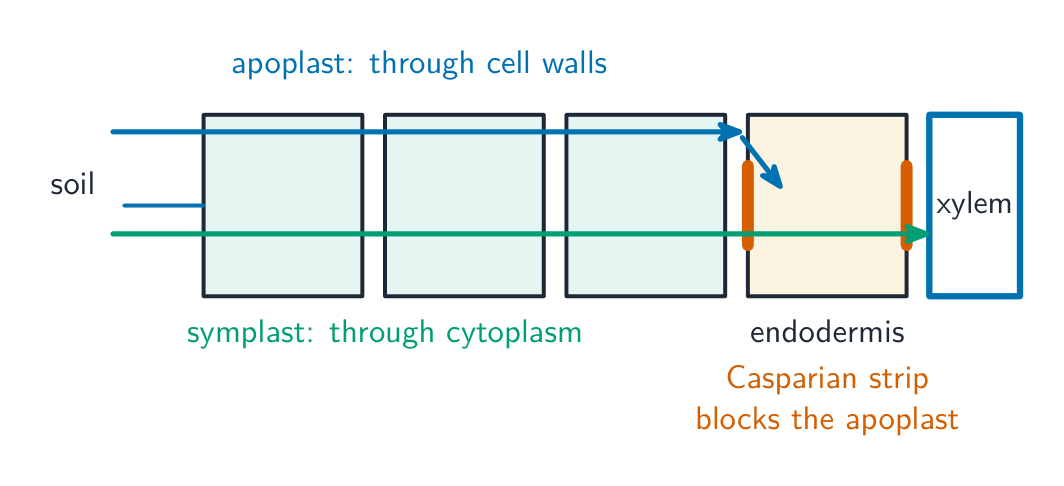
Water enters a root hair cell 根毛细胞 by osmosis 渗透, because the root hair has a lower water potential than the soil water. Water then crosses the root to the xylem by two pathways:
the apoplast pathway 质外体途径 — water moves through the cell walls 细胞壁 (made of cellulose 纤维素) and the spaces between cells, without entering the cytoplasm. This is fast.
the symplast pathway 共质体途径 — water moves through the cytoplasm of cells, passing from cell to cell through the plasmodesmata 胞间连丝.
At a ring of cells called the endodermis 内皮层, the apoplast pathway is blocked by the Casparian strip 凯氏带, a waterproof band of suberin 木栓质. This forces all the water through the cell membranes, which lets the plant control what enters the xylem.
עברית
מים נכנסים לתוך תא שיער השורש באמצעות אוסמוזה, מכיוון שפוטנציאל המים בשורש נמוך מאשר במי הקרקע. לאחר מכן, המים חוצים את השורש ללובידה דרך שני מסלולים:
מסלול האפופלט — המים עוברים דרך קירות התאים (העשויים צלולוז) והרווחים בין התאים, מבלי להיכנס לקיטופלזמה. תהליך זה מהיר.
מסלול הסיפלסט — המים עוברים דרך הקיטופלזמה של התאים, ועוברים מתא אחד לאחר על ידי פלזמודוסמותא.
במעגל תאים הנקרא אנדודרמיס, מסלול האפופלט חסום על ידי רצועת קספרי, רצועה עמידה למים העשויה סוברין. זאת מחייבת את כל המים לעבור דרך ממברנות התאים, מה שמאפשר לצמח לשלוט במה שנכנס ללובידה.
האפופלט עובר דרך הקירות, הסיפלסט דרך הקיטופלזמה; רצועת קספרי חוסמת את האפופלט באנדודרמיס
Explore · חקור
Water from soil to xylem · מים מהקרקע לערישה
Follow water in from the soil. It crosses the root two ways, is forced through a membrane at the endodermis, then enters the xylem. · עוקב אחר כניסת המים מקרקע. הוא חוצה את השורש בשתי דרכים, נדחק דרך ממברנה באנדודרמיס, ולאחר מכן נכנס לערישה.
7.2
Transpiration and the movement of water up the xylem · אידוי-דילול ותנועת המים כלפי מעלה בלובידה
English
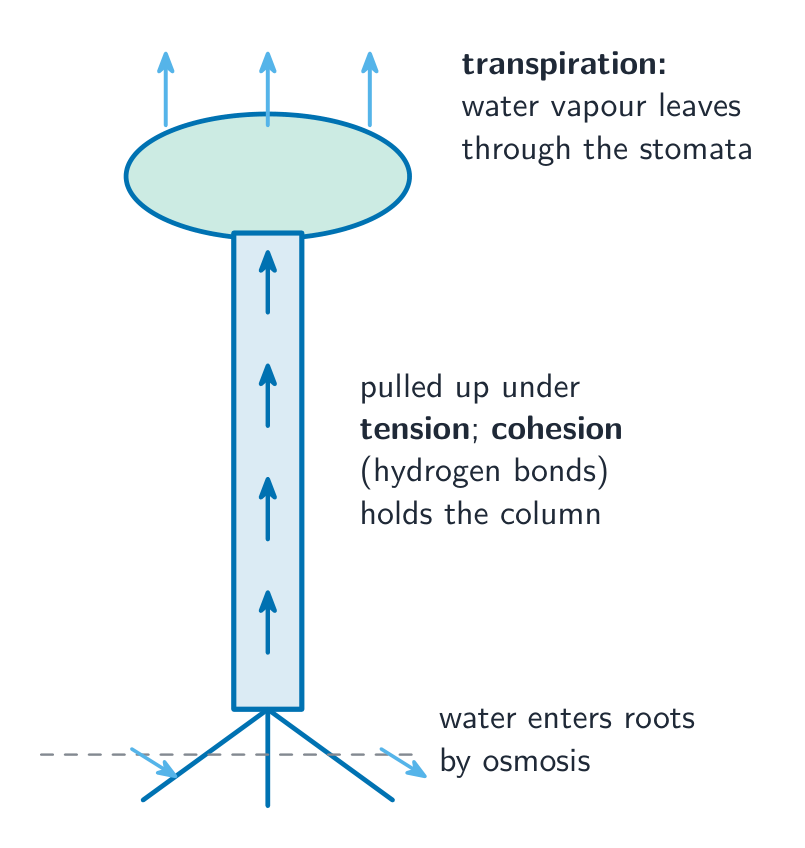
Transpiration 蒸腾作用 is the loss of water vapour from a plant. Water evaporates (turns to vapour) from the wet cell surfaces inside the leaf — this is evaporation 蒸发. The water vapour 水蒸气 then diffuses 扩散 out through the stomata 气孔 into the atmosphere 大气.
This loss at the top pulls water up the xylem in a continuous column. It works because of hydrogen bonding between water molecules:
water molecules attract each other through hydrogen bonds 氢键, so they stick together. This sticking is cohesion 内聚力, and it lets the whole column be pulled up under tension 张力 (the cohesion–tension idea).
water molecules also stick to the cellulose of the cell walls. This is adhesion 附着力, which helps hold the column in place.
Worked example. A plant cell with a water potential of $-800\ \text{kPa}$ is placed in a solution of water potential $-400\ \text{kPa}$. Which way does water move, and what happens to the cell? Water always moves down a water potential gradient - from the less negative (higher) value to the more negative (lower) one. The solution at $-400$ is higher than the cell at $-800$, so water moves into the cell. The cell swells, the protoplast presses on the cell wall, the pressure potential rises, and the cell becomes turgid. Two traps: $-400$ is greater than $-800$, which is the sign error that reverses half of all answers; and pure water is the maximum at 0, so every solution is negative and a water potential can never rise above zero.
עברית
אידוי-דילול הוא איבוד קרבי מים מצמח. מים מתאדים (ופונים לקרבי) משטחים רטיבים בתאי העלה — זהו אידוי. קרבי המים随后מתפשטים החוצה דרך הנקביות אל האטמוספרה.
איבוד זה בחלק העליון מושך מים כלפי מעלה בלובידה בעמודה רציפה. התהליך פועל בזכות קשרי מימן בין מולקולות המים:
מולקולות מים נמשכות זו לזו דרך קשרי מימן, ולכן הן נדבקות אחת לשנייה. הדבקה זו היא קוהזיה, והיא מאפשרת למשיכת העמודה כולה כלפי מעלה תחת מתח (עיקרון הקוהזיה-מתח).
מולקולות מים נדבקות גם לצלולוז שבקירות התאים. זהו אדהזיה, שתורם להחזקת העמודה במקומה.
אידוי-דילול בעלה מושך את כל עמודת המים כלפי מעלה בלובידה; קוהזיה (קשרי מימן) שומרת עליה together
דוגמה מוצגת. תא צמחי עם פוטנציאל מים של $-800\ \text{kPa}$ מונח בתמיסה בעלת פוטנציאל מים של $-400\ \text{kPa}$. לאילו כיוון זורמים המים, ומה קורה לתא? מים זורמים תמיד כלפי מטה לאורך גרדינט פוטנציאל מים - מערך פחות שלילי (גבוה יותר) ל-יותר שלילי (נמוך יותר). התמיסה ב$-400$ היא גבוהה מאשר התא ב$-800$, ולכן המים זורמים לתוך התא. התא מתנפח, הפרוטופלאסט לוחץ על קיר התא, פוטנציאל הלחץ עולה, והתא הופך ל-תתוח. שתי תחבשות: $-400$ הוא גדול מ$-800$, שהיא טעות סימן הפוכה לחצי מהתשובות; ומים טהורים הם המקסימום ב-0, לכל תמיסה יש ערך שלילי ופוטנציאל מים לעולם לא יכול לעלות מעל אפס.
Explore · חקור
The transpiration stream · זרם האיידור
Step through how water is pulled up a tree — evaporation at the top creates a tension that drags the whole cohesive column upward. · הסבר כיצד מים מושכים כלפי מעלה בעץ — איידור בחלק העליון יוצר מתח שמשיך את עמודת ההיצמדמות כולה כלפי מעלה.
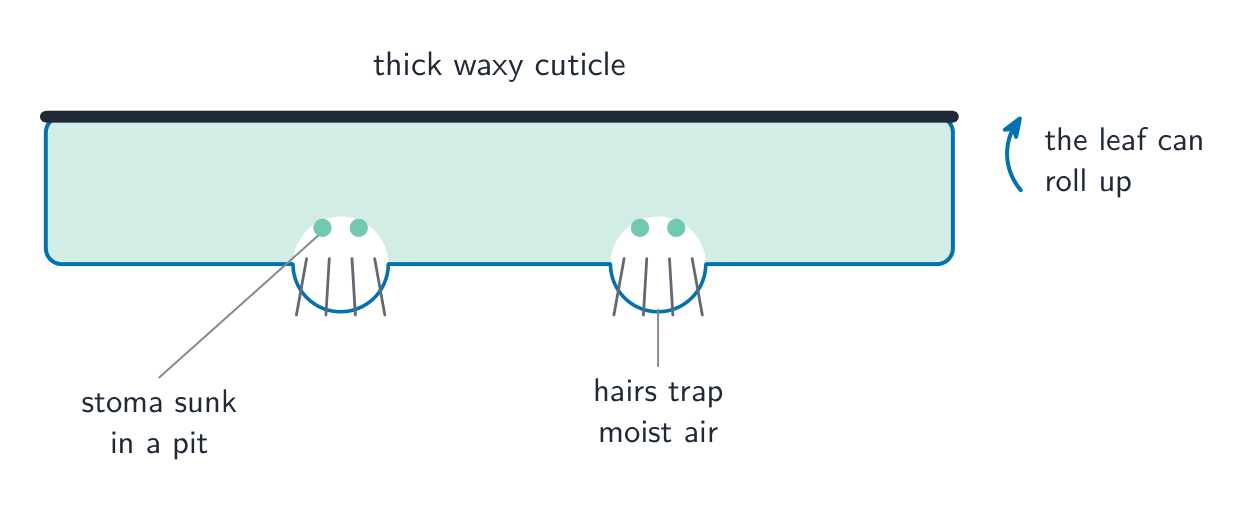
A xerophyte 旱生植物 is a plant adapted 适应 to live where water is scarce. Its leaves reduce water loss by transpiration in several ways: a thick waxy cuticle 角质层, stomata sunk in pits, hairs that trap moist air, and leaves that can roll up. You should be able to draw a labelled leaf section showing these features.
עברית
צמח יבשתי הוא צמח מותאם לחיים במקום בו מים נדירים. עלותיו מפחיתות איבוד מים באמצעות אידוי-דילול בדרכים שונות: קטינה שעווית עבה, נקביות שקועות בחריצים, שיער שואג אוויר לח, ועלים שיכולים להתגלגל. עליך להיות מסוגל לצייר חתך אורך בעלה עם תווית המראה תכונות אלו.
עלי צמחי יבשתי מקטרים איבוד מים: קטינה עבה, נקביות שקועות, אוויר לח שואג והתגלגלות
Translocation: moving assimilates in the phloem · הובלה: העברת תוצרי תעלול בפתוליה
English
Assimilates such as sucrose 蔗糖 and amino acids 氨基酸 are carried in the phloem from a source 源 to a sink 库.
a source is where the assimilate is made or released (for example a photosynthesising leaf).
a sink is where it is used or stored (for example a growing root).
Loading at the source
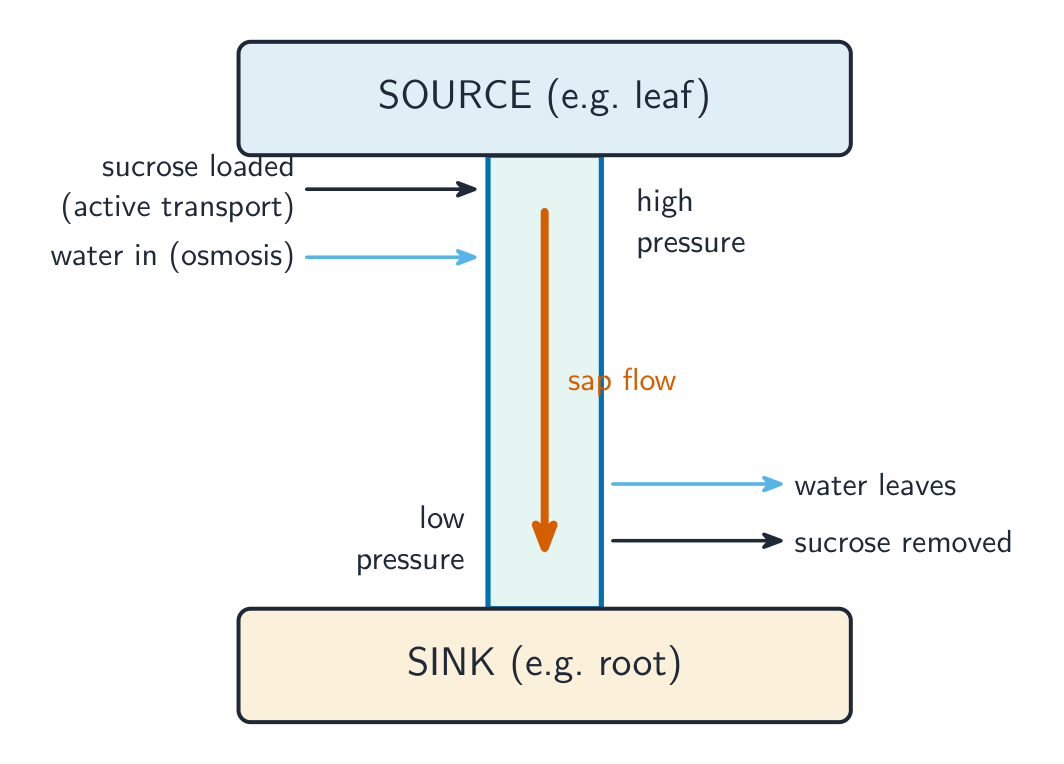
Companion cells load sucrose into the sieve tubes against its concentration gradient. They use proton pumps 质子泵 to pump hydrogen ions out, then cotransporter proteins 协同运输蛋白 bring sucrose back in together with those ions. This is a form of active transport 主动运输.
Loading sucrose lowers the water potential 水势 inside the sieve tube, so water follows by osmosis. This raises the hydrostatic pressure 静水压 there.
Mass flow
At the sink, sucrose is removed, so the water potential rises, water leaves, and the pressure falls. The result is a pressure difference between source (high) and sink (low). Sap flows from high to low pressure down this gradient. This pressure-driven flow is called mass flow 集流.
עברית
תוצרי תעלול כמו סוכרוז וחומצות אמינו מובילים בפתוליה ממקור לקצה.
מקור הוא המקום שבו התוצר המטבולי מיוצר או משוחרר (למשל, עלה מבצע פוטוסינתזה).
שקע הוא המקום שבו הוא משמש או מאוחסן (למשל, שורש גדל).
טעינה במקור
תאי ליווי מטענים סוכרוז לתוך הצינורות המכחליים נגד ריכוזו. הם משתמשים במשאבות פרוטונים כדי לשאוב יוני מימן החוצה, ולאחר מכן חלבונים קוטרנספורטיביים מביאים את הסוכרוז חזרה פנימה יחד עם היונים הללו. זהו סוג של הובלה פעילה.
הטענת סוכרוז מפחיתה את הפוטנציאל המים בתוך הצינור המכחלי, ולכן מים נכנסים אליו באמצעות אוסמוזה. הדבר מעלה את הלחץ ההידרוסטטי שם.
זרימת מסה
בשקע, הסוכרוז מוסר, ולכן הפוטנציאל המים עולה, מים יוצאים והלחץ יורד. התוצאה היא הפרש לחץ בין המקור (גבוה) לשקע (נמוך). הקוואר זורם מגבוה לנמוך לאורך גרדינט זה. זרימה זו המופעלת על ידי לחץ נקראת זרימת מסה.
הטענת סוכרוז במקור מעלה את הלחץ; לאחר מכן הקוואר זורם בזרימת מסה לשקע
Explore · חקור
Translocation by mass flow · הובלה על ידי זרימת מסה
Step through how sugar moves. Loading at the source pulls water in and raises the pressure, pushing sap to the sink. · התהליך של תנועת הסוכר: טעינה במוצר גוררת כניסת מים ומעלה את הלחץ, ודוחפת את השרף אל המקור.
State the tissue for each direction: xylem carries water up (dead, lignified), phloem carries assimilates both ways (living sieve tubes + companion cells).
Explain water movement by cohesion-tension: transpiration pulls a continuous water column held by cohesion (H-bonds) and adhesion.
List the factors affecting transpiration rate (light, temperature, humidity, air movement) and how a potometer measures uptake.
For xerophytes, link each adaptation (thick cuticle, sunken stomata, rolled leaves, hairs) to reduced water loss.
עברית
ציין את הרקמה לכל כיוון: עץ מוביל מים כלפי מעלה (מת, ליגניפיציה), פלואם מוביל תוצרים מטבוליים בשני הכיוונים (צינורות מכחליים חיים + תאי ליווי).
הסבר את תנועת המים באמצעות קוהזיה-מתח: הנשימה מושכת עמודת מים רציפה המוחזקת על ידי קוהזיה (קשרי H) ואדוזיה.
ספר את הגורמים המשפיעים על קצב הנשימה (אור, טמפרטורה, לחות, תנועת אוויר) וכיצד פוטומטר מדוד ספיגה.
עבור צמחים צמחי-מדבר, קשר כל הסתגלות (קוטיקה עבה, אובדנים שקועים, עליים גלולים, שערות) להפחתת איבוד מים.
Interactive lessons on this topic · שיעורים אינטראקטיביים בנושא זה
Work through it step by step, with instant-check exercises. · לעבור על הדברים צעד אחר צעד, עם תרגילים לבדיקה מיידית.
Pick one and the site follows you — notes, papers, videos and practice all open on it. · בחרו נושא אחד והאתר יעקוב אחריו — הערות, מסמכים, וידאו ותרגולים פתוחים בו.
Type to search notes, lessons, code, vocabulary and past-paper questions across every subject. · הקלד כדי לחפש הערות, שיעורים, קוד, אוצר מילים ושאלות מבחנים בכל הנושאים.