Profit Maximization · Maximisation du profit
| English | Français |
|---|---|
| total revenue/ˈtəʊtl ˈrevənjuː/ | revenu total |
| average revenue/ˈævrɪdʒ ˈrevənjuː/ | revenu moyen |
| marginal revenue/ˈmɑːdʒɪnl ˈrevənjuː/ | revenu marginal |
| profit-maximizing rule/ˈprɒfɪt ˈmæksɪmaɪzɪŋ ruːl/ | règle de maximisation du profit |
The one rule every firm follows
- Make too little and you leave easy money on the table.
- Make too much and the last units cost more than they earn.
- Somewhere in between sits the quantity with the biggest profit.
- One simple rule finds it every time.
La seule règle que suit toute entreprise
- Produire trop peu et vous laissez de l'argent facile sur la table.
- Produire trop et la dernière unité coûte plus qu'elle ne rapporte.
- Quelque part entre les deux se trouve la quantité avec le plus grand profit.
- Une règle simple la trouve à chaque fois.
Three revenue ideas
- Total revenue 总收入 (TR) is all the money from sales: $TR = P \times Q$.
- Average revenue 平均收入 (AR) is revenue per unit: $AR = \tfrac{TR}{Q}$ — this always equals the price.
- Marginal revenue 边际收入 (MR) is the extra revenue from one more unit: $MR = \tfrac{\Delta TR}{\Delta Q}$.
Trois idées sur le revenu
- Le revenu total 总收入 (TR) est tout l'argent des ventes : $TR = P \times Q$.
- Le revenu moyen 平均收入 (AR) est le revenu par unité : $AR = \tfrac{TR}{Q}$ — cela équivaut toujours au prix.
- Le revenu marginal 边际收入 (MR) est le revenu supplémentaire d'une unité de plus : $MR = \tfrac{\Delta TR}{\Delta Q}$.
Marginal revenue is: · Le revenu marginal est :
MR = ΔTR/ΔQ — the change in total revenue from one more unit sold. · MR = ΔTR/ΔQ — le changement dans le revenu total dû à la vente d'une unité de plus.
Average revenue always equals the price of the good. · Le revenu moyen est toujours égal au prix du bien.
AR = TR/Q = (P × Q)/Q = P. · RM = TR/Q = (P × Q)/Q = P.
Produce where MR = MC
- The profit-maximizing rule 利润最大化法则: make the quantity where marginal revenue equals marginal cost.
- If $MR > MC$, the next unit earns more than it costs — keep going.
- If $MR < MC$, the next unit costs more than it earns — make less.
- Only at $MR = MC$ can profit no longer improve.
Produire là où MR = MC
- La règle de maximisation du profit 利润最大化法则 : fabriquer la quantité où le revenu marginal égale le coût marginal.
- Si $MR > MC$, la prochaine unité rapporte plus qu'elle ne coûte — continuez.
- Si $MR < MC$, la prochaine unité coûte plus qu'elle ne rapporte — réduisez la production.
- Seulement à $MR = MC$ le profit ne peut plus s'améliorer.
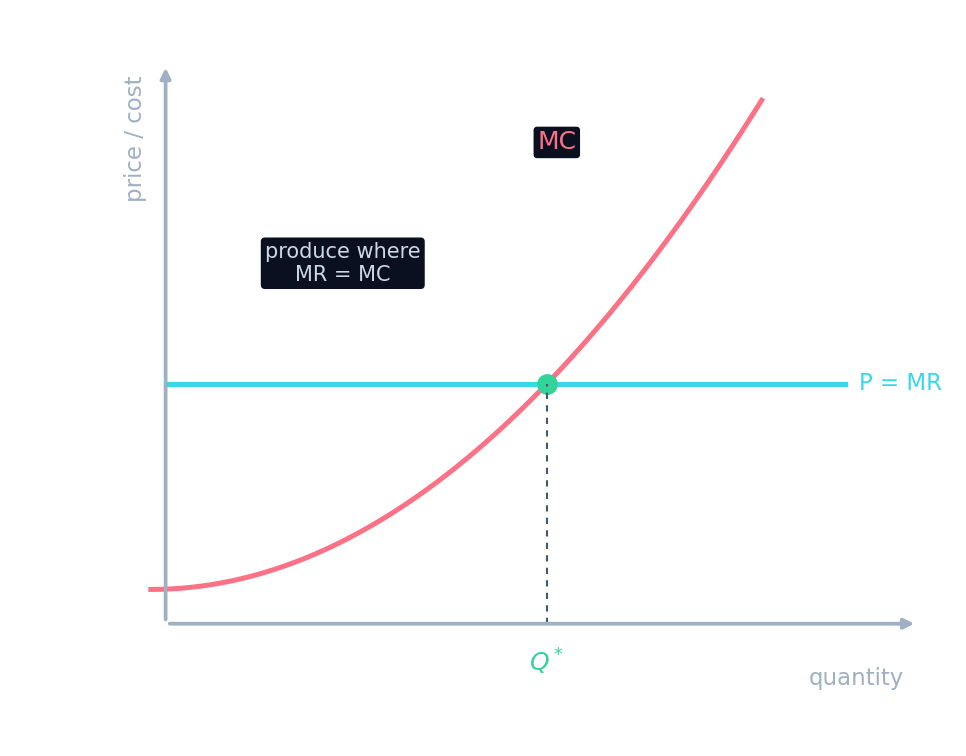
Cost curves and the best quantity · Courbes de coûts et quantité optimale
A firm maximises profit where marginal revenue meets marginal cost. Explore how the marginal-cost curve sets that best quantity. · Une entreprise maximise son profit là où le revenu marginal rencontre le coût marginal. Explorez comment la courbe de coût marginal définit cette quantité optimale.
A firm maximises profit by producing the quantity where: · Une entreprise maximise son profit en produisant la quantité où :
At MR = MC profit can no longer improve — the profit-maximizing rule. · À MR = CM, le profit ne peut plus s'améliorer — c'est la règle de maximisation du profit.
At the current output, MR is greater than MC. The firm should: · Au niveau de production actuel, le Rm est supérieur au Cm. L'entreprise doit :
MR > MC means the next unit adds to profit, so keep producing until MR = MC. · Rm > Cm signifie que l'unité suivante ajoute au profit, donc continuez à produire jusqu'à ce que Rm = Cm.
Measure the profit
- Once you know the best quantity, measure profit with price and average total cost:
- Economic profit $= (P - ATC) \times Q$.
- If $P > ATC$ there is a profit; if $P = ATC$ the firm breaks even; if $P < ATC$ it makes a loss.
- $MR = MC$ finds the best quantity whether the firm is making a profit or the smallest possible loss.
Mesurer le profit
- Une fois que vous connaissez la meilleure quantité, mesurez le profit avec le prix et le coût total moyen :
- Profit économique $= (P - ATC) \times Q$.
- Si $P > ATC$ il y a un profit ; si $P = ATC$ l'entreprise fait zéro profit ; si $P < ATC$ elle subit une perte.
- $MR = MC$ détermine la meilleure quantité que l'entreprise doit produire, qu'elle fasse un profit ou la plus petite perte possible.
At its best quantity a firm makes Q = 50 units, with price P = 12 and average total cost ATC = 9. What is its economic profit? · À sa quantité optimale, une entreprise produit Q = 50 unités, avec un prix P = 12 et un coût total moyen CTM = 9. Quel est son profit économique ?
Economic profit = (P − ATC) × Q = (12 − 9) × 50 = 150. · Profit économique = (P − CAT) × Q = (12 − 9) × 50 = 150.
Economic profit at the best quantity equals (P − ______) × Q. · Le profit économique à la quantité optimale est égal à (P − ______) × Q.
Per-unit profit is P − ATC; multiply by Q for total economic profit. · Le profit par unité est P − CAT ; multipliez par Q pour obtenir le profit économique total.
Revenue: TR = P × Q, AR = P, and MR is the extra from one more unit. The profit-maximizing rule is MR = MC. Then measure profit as (P − ATC) × Q — positive if P > ATC, break-even if equal, a loss if below.
Revenu : TR = P × Q, AR = P, et MR est le supplément généré par une unité supplémentaire. La règle de maximisation du profit est MR = MC. Ensuite, mesurez le profit comme (P − ATC) × Q — positif si P > ATC, nul s'il est égal, négatif (perte) s'il est inférieur.