Logarithms, trigonometry and numerical methods (Pure 3) · Logarithmes, trigonométrie et méthodes numériques (Pure 3)
| English | Français |
|---|---|
| logarithm/ˈlɒɡərɪθəm/ | logarithme |
| exponential equation/ˌekspəˈnenʃl ɪˈkweɪʒn/ | équation exponentielle |
| decay/dɪˈkeɪ/ | décomposition |
| linearise/ˈlɪnɪəraɪz/ | linéariser |
| convergence/kənˈvɜːdʒəns/ | convergence |
Building on what you know
- Pure 3 doesn't introduce entirely new ideas — it deepens and extends the skills from Pure 2.
- Logarithms 对数, trigonometry, and numerical methods return with harder problems and richer applications.
S'appuyer sur ce que vous connaissez
- Pure 3 n'introduit pas entièrement de nouvelles idées — il approfondit et étend les compétences de Pure 2.
- Les logarithmes 对数, la trigonométrie et les méthodes numériques reviennent avec des problèmes plus difficiles et des applications plus riches.
Logarithms revisited
- The log laws with $e^x$ and $\ln x$ return in harder contexts: solving exponential equations 指数方程, modelling growth and decay 衰减, and linearising 线性化 data.
- Key skill: when the unknown is in the power, take logs of both sides.
Worked example. Solve $5e^{2x} = 30$. Divide: $e^{2x} = 6$. Take $\ln$: $2x = \ln 6$, so $x = \dfrac{\ln 6}{2} \approx 0.896$.
A line r = a + t b: start at a, then slide by t lots of the direction b
Logarithmes revisités
- Les lois des logarithmes avec $e^x$ et $\ln x$ reviennent dans des contextes plus difficiles : résoudre des équations exponentielles 指数方程, modéliser la croissance et la décroissance 衰减, et linéariser 线性化 les données.
- Compétence clé : quand l'inconnue est dans la puissance, prenez le log des deux côtés.
Exemple résolu. Résolvez $5e^{2x} = 30$. Divisez : $e^{2x} = 6$. Prenez $\ln$ : $2x = \ln 6$, donc $x = \dfrac{\ln 6}{2} \approx 0.896$.
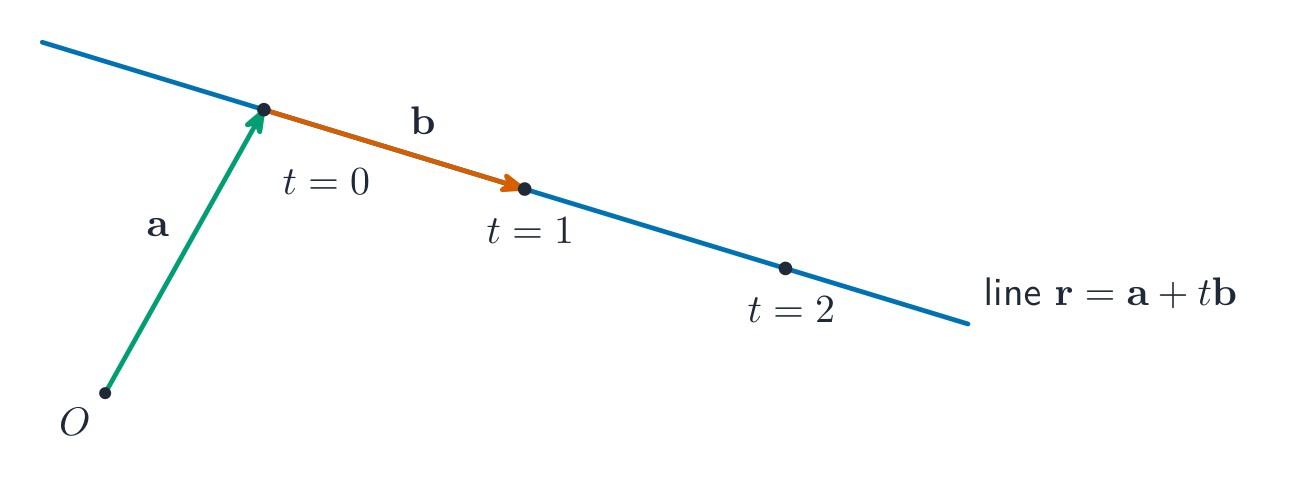
Une droite r = a + tb : commencez à a, puis glissez de t fois le vecteur direction b
What is ln(e³)? · Quelle est la valeur de ln(e³) ?
ln and e are inverses, so ln(e³) = 3. · ln et e sont des fonctions réciproques, donc ln(e³) = 3.
Solve 5e^(2x) = 30 for x (2 dp). · Résolvez 5e^(2x) = 30 pour x (arrondi à 2 décimales).
e^(2x) = 6, so 2x = ln 6, x = (ln 6)/2 ≈ 0.896 ≈ 0.90. · e^(2x) = 6, donc 2x = ln 6, x = (ln 6)/2 ≈ 0.896 ≈ 0.90.
Trigonometry revisited
- $\sec^2\theta \equiv 1 + \tan^2\theta$, $\csc^2\theta \equiv 1 + \cot^2\theta$.
- The compound- and double-angle formulae, and the $R$-form of $a\sin\theta + b\cos\theta$.
- These identities are essential for integration and solving trig equations.
Don't mix up the identities. $\sec^2\theta \equiv 1 + \tan^2\theta$ (plus sign), not $1 - \tan^2\theta$. The sign comes from dividing $\sin^2\theta + \cos^2\theta \equiv 1$ by $\cos^2\theta$.
Trigonométrie revisitée
- $\sec^2\theta \equiv 1 + \tan^2\theta$, $\csc^2\theta \equiv 1 + \cot^2\theta$.
- Les formules d'angles composés et doubles, et la forme $R$ de $a\sin\theta + b\cos\theta$.
- Ces identités sont essentielles pour l'intégration et la résolution d'équations trigonométriques.
Ne mélangez pas les identités. $\sec^2\theta \equiv 1 + \tan^2\theta$ (signe plus), pas $1 - \tan^2\theta$. Le signe vient de la division de $\sin^2\theta + \cos^2\theta \equiv 1$ par $\cos^2\theta$.
The unit circle · Le cercle unité
(cos θ, sin θ)
The · Le R-formula rewrites a sin θ + b cos θ as one wave — and it all lives on this circle. · La formule R réécrit a sin θ + b cos θ sous la forme d'une onde unique — et tout cela repose sur ce cercle.
Using sec²θ ≡ 1 + tan²θ, if tan θ = 3, what is sec²θ? · En utilisant sec²θ ≡ 1 + tan²θ, si tan θ = 3, quelle est la valeur de sec²θ ?
sec²θ = 1 + 3² = 1 + 9 = 10.
sec²θ ≡ 1 − tan²θ.
The correct identity is sec²θ ≡ 1 + tan²θ (plus, not minus). · L'identité correcte est sec²θ ≡ 1 + tan²θ (plus, et non moins).
Numerical methods revisited
- A sign change to trap a root, then an iterative formula $x_{n+1} = F(x_n)$.
- Convergence 收敛 requires $|F'(x)| < 1$ near the root.
allow_no_figure: Review lesson consolidating Pure 2 skills (logarithms, trigonometry, numerical methods) — no new visual concepts introduced.
Méthodes numériques revisitées
- Un changement de signe pour piéger une racine, puis une formule itérative $x_{n+1} = F(x_n)$.
- La convergence 收敛 nécessite $|F'(x)| < 1$ près de la racine.
allow_no_figure: Leçon de révision consolidant les compétences de Pure 2 (logarithmes, trigonométrie, méthodes numériques) — aucun nouveau concept visuel introduit.
A numerical root is found by a sign change, then repeatedly applying: · Une racine numérique est trouvée par un changement de signe, puis en appliquant répétitivement :
Iteration applies x_{n+1} = F(x_n) until the values converge to the root. · L'itération applique x_{n+1} = F(x_n) jusqu'à ce que les valeurs convergent vers la racine.
Worked example — R-formula application
- Express $3\sin\theta + 4\cos\theta$ in the form $R\sin(\theta + \alpha)$.
- $R = \sqrt{3^2 + 4^2} = 5$. $\tan\alpha = \dfrac{4}{3} \Rightarrow \alpha \approx 53.1^{\circ}$.
- So $3\sin\theta + 4\cos\theta = 5\sin(\theta + 53.1^{\circ})$.
- Maximum value is $5$ (when $\sin(\theta + 53.1^{\circ}) = 1$).
- Plotting $\ln y$ against $x$ gives a line whose gradient and intercept find the constants (using indices and inverse functions); know the reciprocal trig functions secant, cosecant, cotangent; and iteration $x_{n+1}=F(x_n)$ shows convergence to a root.
Exemple résolu — application de la formule R
- Exprimez $3\sin\theta + 4\cos\theta$ sous la forme $R\sin(\theta + \alpha)$.
- $R = \sqrt{3^2 + 4^2} = 5$. $\tan\alpha = \dfrac{4}{3} \Rightarrow \alpha \approx 53.1^{\circ}$.
- Donc $3\sin\theta + 4\cos\theta = 5\sin(\theta + 53.1^{\circ})$.
- La valeur maximale est $5$ (quand $\sin(\theta + 53.1^{\circ}) = 1$).
- Tracer $\ln y$ contre $x$ donne une droite dont la pente et l'ordonnée à l'origine trouvent les constantes (en utilisant les indices et les fonctions réciproques) ; connaissez les fonctions trigonométriques réciproques sécante, cosécante, cotangente ; et l'itération $x_{n+1}=F(x_n)$ montre la convergence vers une racine.
For 3 sin θ + 4 cos θ = R sin(θ + α), what is R? · Pour 3 sin θ + 4 cos θ = R sin(θ + α), quelle est la valeur de R ?
R = √(3² + 4²) = √25 = 5.
You've got it
- 3.2 logs, 3.3 trig identities/angle formulae, 3.6 numerical methods = the Pure 2 skills
- use $\sec^2\theta \equiv 1 + \tan^2\theta$ and the R-formula as before
- find roots by a sign change then iteration $x_{n+1} = F(x_n)$
Vous avez compris
- 3.2 logs, 3.3 identités/trig/fonctions d'angle, 3.6 méthodes numériques = les compétences de Pure 2
- utilisez $\sec^2\theta \equiv 1 + \tan^2\theta$ et la formule R comme auparavant
- trouvez des racines par un changement de signe puis itération $x_{n+1} = F(x_n)$