Passer au contenu
Sujets
  • 1 Le verbe to be
    1.1

    am / is / are

    verbe to be : am / is / are varient selon le sujet

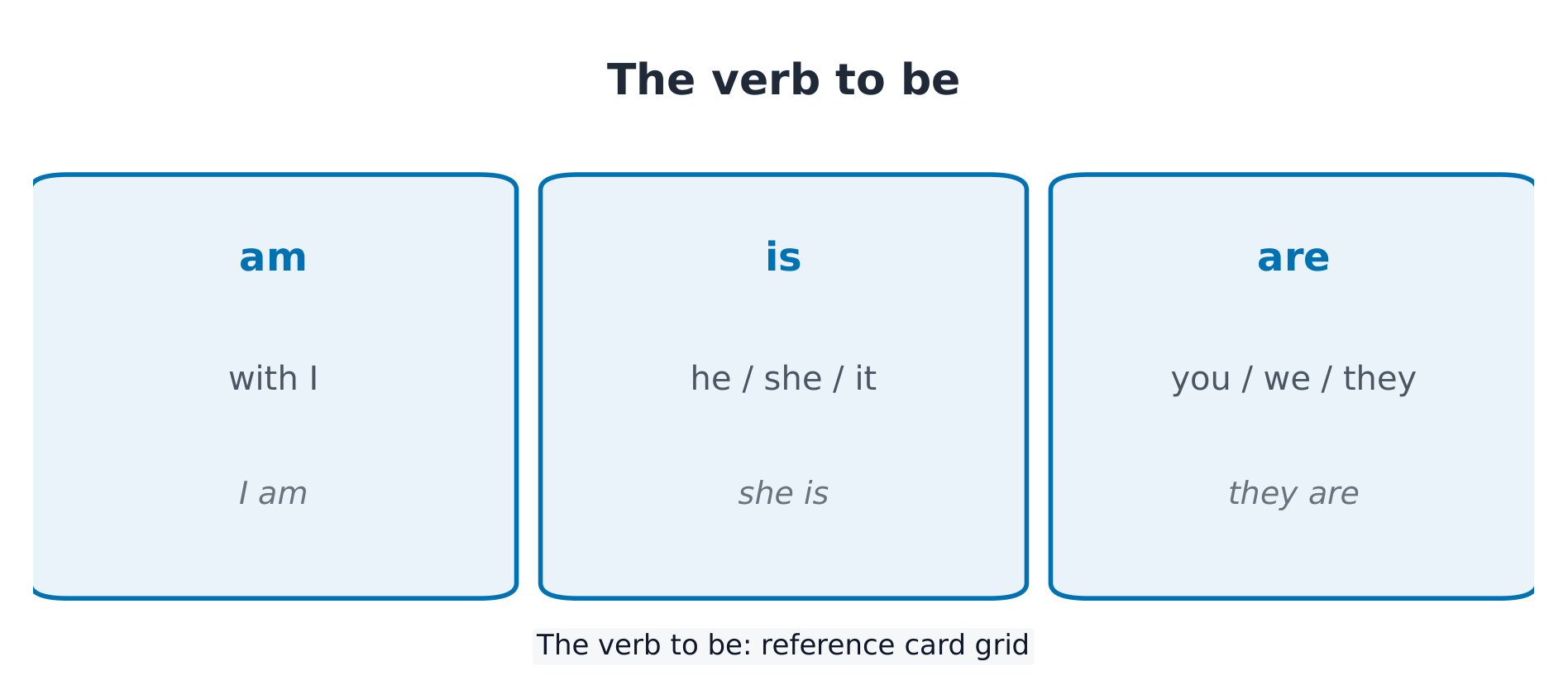
    Le verbe to be (le verbe être) signifie "être / se trouver". Il varie selon le sujet et possède trois formes :

    • I → am
    • he / she / it → is
    • you / we / they → are

    我I 是am 一名a 学生student.

    我是一名学生。

    她She 是is 开心happy.

    她很开心。

    他们They (是)are 来自from 中国China.

    他们来自中国。

    Remarque Les contractions courantes à l'oral sont : I'm, you're, he's, she's, it's, we're, they're.

    1.2

    否定与疑问

    Négation : ajoutez not après le verbe to be (souvent abrégé).

    他He 不是is not 一名a 老师teacher.

    Il n'est pas professeur. (= He isn't a teacher.)

    Question : placez le verbe to be avant le sujet.

    (是吗)Are 你you 准备好ready?

    你准备好了吗?

    Réponses courtes :Yes, I am. / No, I'm not.

    Remarque Contractions négatives : is not → isn't, are not → aren't ; mais am not ne s'abrège qu'en I'm not (pas ~~amn't~~).

    常见错误

    • ❌ ~~He busy.~~ → ✓ He is busy. — En chinois, "il est très occupé" peut exister sans verbe, mais une phrase anglaise doit en avoir un. On utilise to be pour relier un attribut adjectival ou nominal quand il n'y a pas d'autre verbe (He is busy) ; si la phrase contient déjà un verbe ordinaire, on n'ajoute pas to be (I go to school).
    • ❌ ~~I am go to school.~~ → ✓ I go to school. — to be et un verbe ordinaire ne peuvent pas s'empiler ; "aller" se dit simplement go.
    • ❌ ~~They is my friends.~~ → ✓ They are my friends. — Les sujets pluriels (you / we / they) prennent are.
    • ❌ ~~I am agree.~~ → ✓ I agree. — agree (s'accorder) est déjà un verbe, on n'ajoute pas am devant.
    • ❌ ~~Are you ready? — Yes, I'm.~~ → ✓ Yes, I am. — La fin d'une réponse courte affirmative ne prend pas de contraction (on dit Yes, I am) ; mais la fin d'une réponse courte négative prend généralement une contraction négative (No, he isn't / No, I can't ; pour la première personne, c'est No, I'm not, car il n'existe pas de amn't).
  • 2 Pronoms sujets
    2.1

    I, you, he, she, it, we, they

    主语代词与物主词

    Les pronoms sujets (subject pronouns) remplacent le sujet et se placent devant le verbe :

    • I(je), you(tu / vous), he(il), she(elle)
    • it(il/elle pour animaux/choses), we(nous), they(ils/elles)

    他He 是is 我的my 哥哥brother.

    他是我哥哥。

    我们We 喜欢like 音乐music.

    我们喜欢音乐。

    用法要点:

    • I 永远大写,不管在句子哪里。
    • Pour les objets et les animaux, on utilise souvent it :This is my bag. It is new.(C'est mon sac. C'est neuf.)*
    • Pour les personnes ou objets pluriels, on utilise toujours they:The books are here. They are mine.(Les livres sont ici. Ce sont les miens.)*

    Remarque Le pronom sujet est suivi d'un verbe ; ne pas le confondre avec le pronom objet (me, him, her...) que vous apprendrez plus tard.

    常见错误

    • ❌ ~~My mother is a doctor. He is very kind.~~ → ✓ She is very kind. — À l'oral chinois, "il/elle" se prononce de la même manière, mais en anglais, il faut distinguer clairement he et she.
    • ❌ ~~Me am a student.~~ → ✓ I am a student. — Pour faire office de sujet, utilisez I, pas me.
    • ❌ ~~My friend he is tall.~~ → ✓ My friend is tall. — Le sujet ne se dit qu'une fois ; évitez la répétition "nom + pronom" (l'habitude chinoise de dire "mon ami il..." ne se traduit pas en anglais).
    • ❌ ~~Is raining.~~ → ✓ It is raining. — Une phrase anglaise doit avoir un sujet ; pour le temps, l'heure ou la date, commencez par it.
  • 3 Adjectifs possessifs
    3.1

    my, your, his, her, our, their

    adjectifs possessifs : my / your / his / her

    Les adjectifs possessifs (possessive adjectives) signifient "à qui" et se placent devant le nom :

    • I → my(mon/ma), you → your(ton/ta/votre), he → his(son/sa)
    • she → her(sa), it → its(son/sa), we → our(notre/nos), they → their(leur/leurs)

    这This 是is 我的my 包bag.

    这是我的包。

    她的Her 名字name 是is 露西Lucy.

    她的名字叫露西。

    用法要点:

    • Un adjectif possessif est toujours suivi d'un nom : my book, their house.
    • Il ne change pas selon le nombre du nom : my book, my books (my reste inchangé).

    Remarque Faites attention à bien distinguer its(son/sa, sans apostrophe) et it's(= it is). Exemple :The dog wags its tail.(Le chien remue sa queue.)*

    常见错误

    • ❌ ~~This is she book.~~ → ✓ This is her book. — Devant un nom, utilisez la forme possessive : he → his, she → her.
    • ❌ ~~He is me friend.~~ → ✓ He is my friend. — La forme possessive de I est my.
    • ❌ ~~The dog wags it's tail.~~ → ✓ …wags its tail. — it's = it is ; "sa/son" s'écrit its, sans apostrophe.
    • ❌ ~~Their is a park near here.~~ → ✓ There is a park near here. — their (leur/leurs) et there (il y a / là-bas) ont la même prononciation, ne les mélangez pas à l'écrit.
  • 4 this, that, these, those
    4.1

    this et that

    proximité/éloignement × singulier/pluriel : this / that / these / those

    Les démonstratifs (demonstratives) indiquent "lequel". Au singulier, on utilise this et that :

    • this(ceci/cette-ci) : proche de celui qui parle.
    • that(cela/celle-là) : éloigné de celui qui parle.

    这This 是is 我的my 手机phone.

    这是我的手机。(近)

    那That 是is 你的your 车car.

    那是你的车。(远)

    4.2

    these et those

    Au pluriel, on utilise these et those :

    • these(ceux-ci/celles-ci) : proche. those(ceux-là/celles-là) : éloigné.

    这些These 是are 我的my 书books.

    这些是我的书。

    那些Those 是are 她的her 朋友friends.

    那些是她的朋友。

    对照记忆:

    • Proche → this (sing.) / these (pl.).
    • Loin → that (sing.) / those (pl.).

    Remarque these / those sont suivis d'un nom pluriel : these books, pas ~~these book~~.

    常见错误

    • ~~these book~~ → ✓ these books — after these / those, on doit toujours mettre un nom au pluriel.
    • ❌ ~~This books are mine.~~ → ✓ These books are mine. — Si le nom est pluriel, le démonstratif doit aussi être au pluriel.
    • ❌ Quand on se présente au téléphone, on ne dit pas ~~I am Tom.~~ → ✓ This is Tom. — En anglais, on se présente au téléphone avec this is.
    • Retenez les paires : this / these (proche) s'utilisent souvent avec here, et that / those (loin) s'utilisent souvent avec there.
  • 5 a, an et pluriels
    5.1

    a et an

    a / an : selon la prononciation (consonne vs voyelle)

    a et an signifient "un/une" et précèdent un nom comptable singulier. Pour choisir, regardez la prononciation :

    • a + son initial consonne : a book, a dog, a cat.
    • an + son initial voyelle : an apple, an egg, an orange.

    我I 有have 一个a 笔pen.

    我有一支笔。

    她She 吃eats 一个an 苹果apple.

    她吃一个苹果。

    Remarque Regardez le son, pas la lettre : an hour (h muet), a university (se prononce "yu-").

    5.2

    名词复数

    表示"不止一个"时,名词用复数,通常加 -s:

    • Pluriel régulier avec -s : book → books, car → cars.
    • Se terminant par -s / -sh / -ch / -x / -o, on ajoute -es : bus → buses, box → boxes.
    • Consonne + y final, le y devient i puis on ajoute -es : baby → babies, city → cities.

    我I 有have 两two 猫cats.

    我有两只猫。

    不规则复数(要背):

    • man → men, woman → women, child → children.
    • foot → feet, tooth → teeth, person → people.

    Remarque Ne mettez jamais a / an devant un nom pluriel : ~~a books~~ ✗ → books / two books ✓.

    常见错误

    • ❌ ~~I have dog.~~ → ✓ I have a dog. — En chinois, on peut dire "j'ai un chien", mais en anglais, avant un nom comptable singulier, il faut impérativement a / an (ou my, the, etc.).
    • ❌ ~~an university~~ → ✓ a university ; ❌ ~~a hour~~ → ✓ an hour — Regardez la prononciation, pas l'orthographe : university commence par une consonne /j/, h est muet dans hour.
    • ❌ ~~two book~~ → ✓ two books — Les noms chinois ne changent pas au pluriel, mais en anglais, les noms après un chiffre doivent prendre -s, c'est l'oubli le plus fréquent.
    • ❌ ~~three childs~~ → ✓ three children — Les pluriels irréguliers doivent être appris par cœur : men, women, children, feet, teeth, people.
    • ❌ ~~a people~~ → ✓ a person(une personne) / people(pluriel : des personnes) — people est déjà un pluriel.
  • 6 there is and there are
    6.1

    单数与复数

    There is (singulier) / There are (pluriel)

    there is / there are signifie "il y a" (existence de quelque part).

    • There is + nom singulier / non comptable : There is a book.
    • There are + nom pluriel : There are two books.

    (有)There 有is 一只a 猫cat 在on (冠词)the 沙发上sofa.

    沙发上有一只猫。

    (有)There 有are 三three 书books 在on (冠词)the 桌上desk.

    桌上有三本书。

    Remarque À l'oral, there is est souvent abrégé en there's : There's a problem.

    6.2

    否定与疑问

    Négation : there is not / there are not (abréviations : there isn't / there aren't).

    (有)There 没有isn't 任何any 牛奶milk.

    没有牛奶了。

    Question : placez is / are devant there.

    (有吗)Is (有)there 一家a 银行bank 附近near 这里here?

    这附近有银行吗?

    Réponses courtes :Yes, there is. / No, there isn't.

    Remarque Dans les phrases négatives et interrogatives, on utilise souvent any : Is there any water?(Y a-t-il de l'eau ?)

    常见错误

    • ❌ ~~Here has many people.~~ → ✓ There are many people here. — Le "y a" chinois indique l'existence, en anglais on utilise there is / there are, pas de traduction littérale avec have.
    • ❌ ~~There have a book on the desk.~~ → ✓ There is a book on the desk. — Après there, on utilise is / are, il n'existe pas de construction "there have".
    • ❌ ~~There is two cats.~~ → ✓ There are two cats. — Si le nom qui suit est pluriel, utilisez are.
    • ❌ ~~There are a milk.~~ → ✓ There is some milk. — milk est non comptable : utilisez there is + some, jamais a.
  • 7 have got
    7.1

    have got / has got

    have got / has got

    have got signifie "avoir" (= have), très courant dans l'anglais britannique.

    • I / you / we / they → have got
    • he / she / it → has got

    我I 有have got 一个a 兄弟brother.

    J'ai un frère. (= I have a brother.)

    她She 有has got 蓝色blue 眼睛eyes.

    她有一双蓝眼睛。

    Remarque À l'oral, on abrège souvent : I've got, she's got, they've got. Sens identique à have / has.

    7.2

    否定与疑问

    Négation : haven't got / hasn't got.

    他He 没有hasn't got 一辆a 车car.

    他没有车。

    Question : placez Have / Has devant le sujet.

    (有吗)Have 你you 有got 一支a 笔pen?

    你有笔吗?

    Réponses courtes :Yes, I have. / No, I haven't.

    Remarque have got sert surtout pour l'état actuel de possession ; pour parler du passé ou d'une habitude, utilisez plutôt have / had.

    常见错误

    • ❌ ~~She have got long hair.~~ → ✓ She has got long hair. — he / she / it prend has got.
    • ❌ ~~I have got not a car.~~ → ✓ I haven't got a car. — not se place après have / has, puis on abrège.
    • ❌ ~~Do you have got a pen?~~ → ✓ Have you got a pen ? / Do you have a pen ? — Les deux tournures sont correctes, mais on ne peut pas les mélanger.
    • ❌ ~~Yes, I have got.~~ → ✓ Yes, I have. — La réponse courte s'arrête à have / has, sans rajouter got.
  • 8 Présent simple
    8.1

    习惯与第三人称 -s

    一般现在时:反复的习惯

    Le présent simple (present simple) exprime des habitudes et des faits. La forme de base est le verbe à l'infinitif.

    我I 喜欢like 茶tea.

    我喜欢茶。

    Quand le sujet est he / she / it, on ajoute -s au verbe :

    他He 踢plays 足球football.

    他踢足球。

    拼写:

    • Pluruel régulier avec -s : like → likes.
    • Se terminant par -s / -sh / -ch / -x / -o, on ajoute -es : go → goes, watch → watches.
    • Consonne + y final, le y devient i puis on ajoute -es : study → studies.

    Remarque Seul he / she / it prend -s ; I / you / we / they gardent la forme de base : They like tea.

    8.2

    否定与疑问

    Habitudes quotidiennes : I have breakfast every morning.

    Pour la négation et les questions, utilisez l'auxiliaire do / does (il / elle / cela utilise does).

    Négation : Sujet + don't / doesn't + verbe à l'infinitif.

    我I 不don't 喜欢like 咖啡coffee.

    我不喜欢咖啡。

    Question : Do / Does + sujet + verbe à l'infinitif ?

    (助动词)Does 她she 住live 这里here?

    她住在这里吗?

    Attention : avec do / does, le verbe revient à sa forme originale(sans -s) : ~~Does she lives~~ ✗ → Does she live ✓.

    常见错误

    • ❌ ~~He go to school by bus.~~ → ✓ Il va à l'école en bus. — 忘加 -s 是最高频的错误,写完回头检查一遍。
    • ❌ ~~She doesn't likes coffee.~~ → ✓ Elle ne aime pas le café. — 用了 does / doesn't,动词就回到原形。
    • ❌ ~~I very like English.~~ → ✓ J'aime beaucoup l'anglais. — 中文"很喜欢"不能直译;very 不能直接修饰动词。
    • ❌ ~~You like tea?~~ → ✓ Aimes-tu du thé ? — 疑问句要用 do / does 开头,不能只靠语调上扬。
  • 9 can
    9.1

    能力与请求

    can:能力、否定、疑问

    can 表示能力("会 / 能")或用来请求。它后面跟动词原形,所有人称都一样。

    我I 会can 游泳swim.

    我会游泳。

    能Can 你you 帮help 我me?

    你能帮我一下吗?

    注意 can 后面用原形:~~can to swim~~ ✗、~~can swims~~ ✗ → can swim ✓。

    9.2

    否定与疑问

    Négation : cannot(缩写 can't) + verbe à l'infinitif。

    她She 不会can't 开车drive.

    她不会开车。

    Question : Placez Can devant le sujet。

    能Can 他he 做饭cook?

    他会做饭吗?

    Réponse courte : Yes, I can. / No, I can't.

    注意 can 没有 -s、没有 do / does:疑问直接用 Can he…?,不是 ~~Does he can…?~~

    常见错误

    • ❌ ~~She cans drive.~~ → ✓ Elle peut conduire. — can 没有第三人称 -s,所有人称同形。
    • ❌ ~~I don't can swim.~~ → ✓ Je ne peux pas nager. — can 的否定直接加 not(can't),不用 don't。
    • ❌ ~~He can sings very good.~~ → ✓ Il peut chanter très bien. — can 后用动词原形;修饰动词用副词 well,不用 good。
    • ❌ ~~You can help me?~~ → ✓ Peux-tu m'aider ? — 请求别人时,把 can 提到主语前面。
  • 10 Impératifs
    10.1

    命令与指示

    祈使句:命令、否定、请求

    祈使句 (imperatives) 用来下命令、给指示或提请求。直接用动词原形开头,不要主语。

    打开Open (冠词)the 门door 请, please.

    请把门打开。

    坐Sit 下down.

    坐下。

    Négation : 前面加 Don't。

    不要Don't (是)be 迟到late.

    别迟到。

    用法要点:

    • 加 please 更礼貌:Please come in.(请进。)
    • 也用于路线、说明:Turn left.(向左转。)Mix the eggs.(把鸡蛋打匀。)

    注意 祈使句不写主语:~~You open the door~~(命令时)→ Open the door。

    常见错误

    • ❌ ~~Please open door.~~ → ✓ Please open la porte. — 祈使句里冠词照样不能丢。
    • ❌ ~~Don't to touch it.~~ → ✓ Ne touchez pas ça. — don't 后面直接跟动词原形,不加 to。
    • ❌ ~~No talk in class!~~ → ✓ Ne parlez pas en classe ! / No parlant ! — 禁止做某事用 don't + 原形;no 后面要用 -ing 或名词。
    • ❌ ~~You sit down!~~ → ✓ Asseyez-vous, s'il vous plaît. — 加了 you 的命令听起来很生气;想礼貌就加 please,或改问 Can you…?
  • 11 Mots interrogatifs
    11.1

    what, where, who

    疑问词:问事物/地点/人/时间

    疑问词 (question words) 放在问句开头,用来问具体信息。

    • what(什么)、where(哪里)、who(谁)

    什么What 是is 你的your 名字name?

    你叫什么名字?

    哪里Where (助动词)do 你you 住live?

    你住在哪里?

    谁Who 是is 那个that 男人man?

    那个男人是谁?

    注意 疑问词后面常跟 be 动词或助动词 do / does:Where do you work?

    11.2

    when, why, how

    • when(什么时候)、why(为什么)、how(怎样 / 如何)

    什么时候When 是is (冠词)the 派对party?

    派对什么时候?

    为什么Why (是)are 你you 难过sad?

    你为什么难过?

    怎么How (助动词)do 你you 拼写spell 它it?

    这个怎么拼?

    注意 how 还能和形容词搭配问程度:How old are you?(你多大?)How much is it?(多少钱?)

    常见错误

    • ❌ ~~Where you live?~~ → ✓ Où vives-tu ? — 疑问词后面还需要 do / does 或 be,不能直接跟主语。
    • ❌ ~~What means this word?~~ → ✓ Que signifie ce mot ? — mean 是普通动词:疑问词 + does + 主语 + 原形。
    • ❌ ~~Why you are late?~~ → ✓ Pourquoi es-tu en retard ? — 句子里有 be 动词时,把 be 提到主语前面。
    • ❌ ~~How to spell it?~~ → ✓ Comment épicés-tu ça ? — 中文"怎么拼?"直译会丢掉主语和助动词,要补全。
  • 12 Prépositions de lieu
    12.1

    in, on, under

    地点介词:in / on / under

    地点介词 (prepositions of place) 说明东西在哪里。

    • in(在……里面)、on(在……上面 / 表面)、under(在……下面)

    (冠词)The 钥匙keys 在are 在...里in (冠词)the 包里bag.

    钥匙在包里。

    (冠词)The 书book 在is 在...上on (冠词)the 桌上table.

    书在桌上。

    (冠词)The 猫cat 在is 在...下under (冠词)the 椅子下chair.

    猫在椅子下面。

    12.2

    next to, between, behind

    • next to(在……旁边)、between(在……之间)、behind(在……后面)、in front of(在……前面)

    (冠词)The 商店shop 在is 旁边next to (冠词)the 银行bank.

    商店在银行旁边。

    她She 坐sits 之间between 汤姆Tom 和and 萨姆Sam.

    她坐在汤姆和萨姆之间。

    注意 between 表示"两者之间",后面常用 A and B:between the door and the window。

    常见错误

    • ❌ ~~The picture is in the wall.~~ → ✓ Le tableau est sur le mur. — 挂在墙"上"是表面接触,用 on。
    • ❌ ~~I read it on the book.~~ → ✓ …dans le livre. — 书"里"的内容用 in;照片里的人也用 in the photo。
    • ❌ ~~The shop is next the bank.~~ → ✓ à côté de la banque — next to 是两个词,to 不能丢。
    • ❌ ~~between the door with the window~~ → ✓ entre la porte et la fenêtre — between 固定搭配 A and B。

Se connecter ou créer un compte

IGCSE, A-Level & AP