Thin-layer chromatography · Cromatografía en capa fina
| English | Español |
|---|---|
| chromatography/krəʊməˈtɒɡrəfi/ | cromatografía |
| stationary phase/ˈsteɪʃənəri feɪz/ | fase estacionaria |
| mobile phase/ˈməʊbaɪl feɪz/ | fase móvil |
| baseline/ˈbeɪslaɪn/ | línea base (baseline) |
| solvent front/ˈsɒlvənt frʌnt/ | frente de disolvente |
Separating on a plate
- Chromatography 色谱 separates a mixture using two phases — one still, one moving.
- In thin-layer chromatography (TLC) the spots travel up a plate.
- Each substance has its own $R_{\text{f}}$ value.
Separación en una placa
- Cromatografía 色谱 separa una mezcla utilizando dos fases —una estática y otra móvil.
- En la cromatografía en capa delgada (CCD) los puntos viajan hacia arriba por una placa.
- Cada sustancia tiene su propio $R_{\text{f}}$ valor.
TLC route · Ruta de TLC
Follow a spot up a plate and use Rf to identify substances. · Seguir una mancha hacia arriba en la placa y usar Rf para identificar sustancias.
In thin-layer chromatography, the ratio of distances moved by a spot and the solvent is the ______ value. · En cromatografía en capa fina, la razón de las distancias recorridas por una mancha y el solvente es el valor ______.
Always between 0 and 1. · Siempre entre 0 y 1.
A more soluble component travels further up a TLC plate. · Un componente más soluble viaja más lejos hacia arriba en una placa de TLC.
It spends more time in the moving solvent. · Pasa más tiempo en el solvente en movimiento.
The set-up
- the stationary phase 固定相 stays still (e.g. aluminium oxide on a plate).
- the mobile phase 流动相 moves (a solvent travelling up the plate).
- the baseline 基线 is where the spots start; the solvent front 溶剂前沿 is the highest the solvent reaches.
Thin-layer chromatography and the Rf value
El montaje
- La fase estacionaria 固定相 permanece quieta (p. ej., óxido de aluminio en una placa).
- La fase móvil 流动相 se mueve (un disolvente que asciende por la placa).
- La línea base 基线 es donde comienzan los puntos; el frente de disolvente 溶剂前沿 es la altura máxima que alcanza el disolvente.
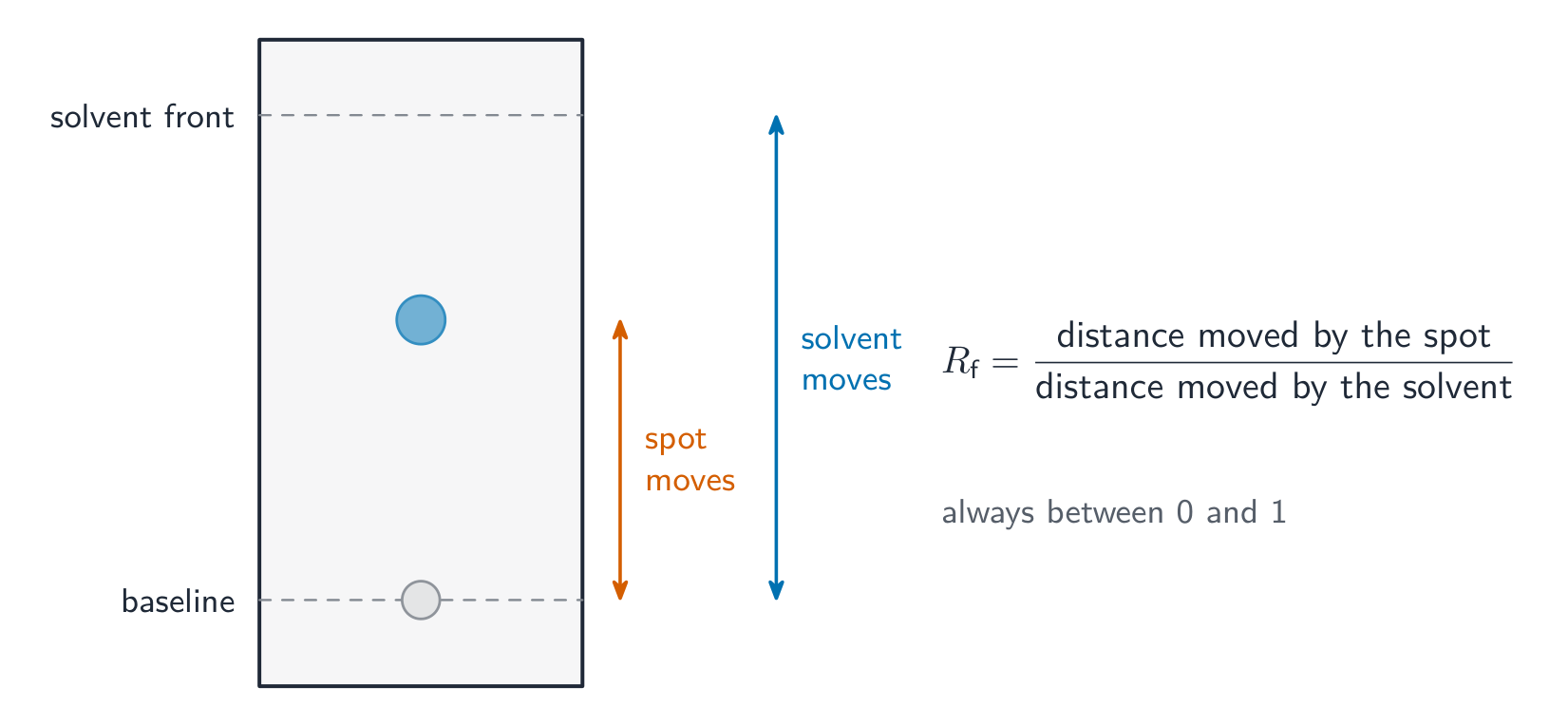
Cromatografía en capa delgada y el valor Rf
In TLC, the stationary and mobile phases are: · En TLC, las fases estacionaria y móvil son:
The plate coating stays still; the solvent (mobile phase) travels up, carrying the spots. · El recubrimiento de la placa permanece inmóvil; el solvente (fase móvil) viaja hacia arriba, transportando las manchas.
The $R_{\text{f}}$ value
- It is always between 0 and 1.
- A substance that sticks more to the stationary phase moves less → a smaller $R_{\text{f}}$.
A developed TLC plate under UV light: each spot is a separated component.
El $R_{\text{f}}$ valor
- Siempre está entre 0 y 1.
- Una sustancia que se adhiere más a la fase estacionaria recorre menos distancia → un menor $R_{\text{f}}$ valor.
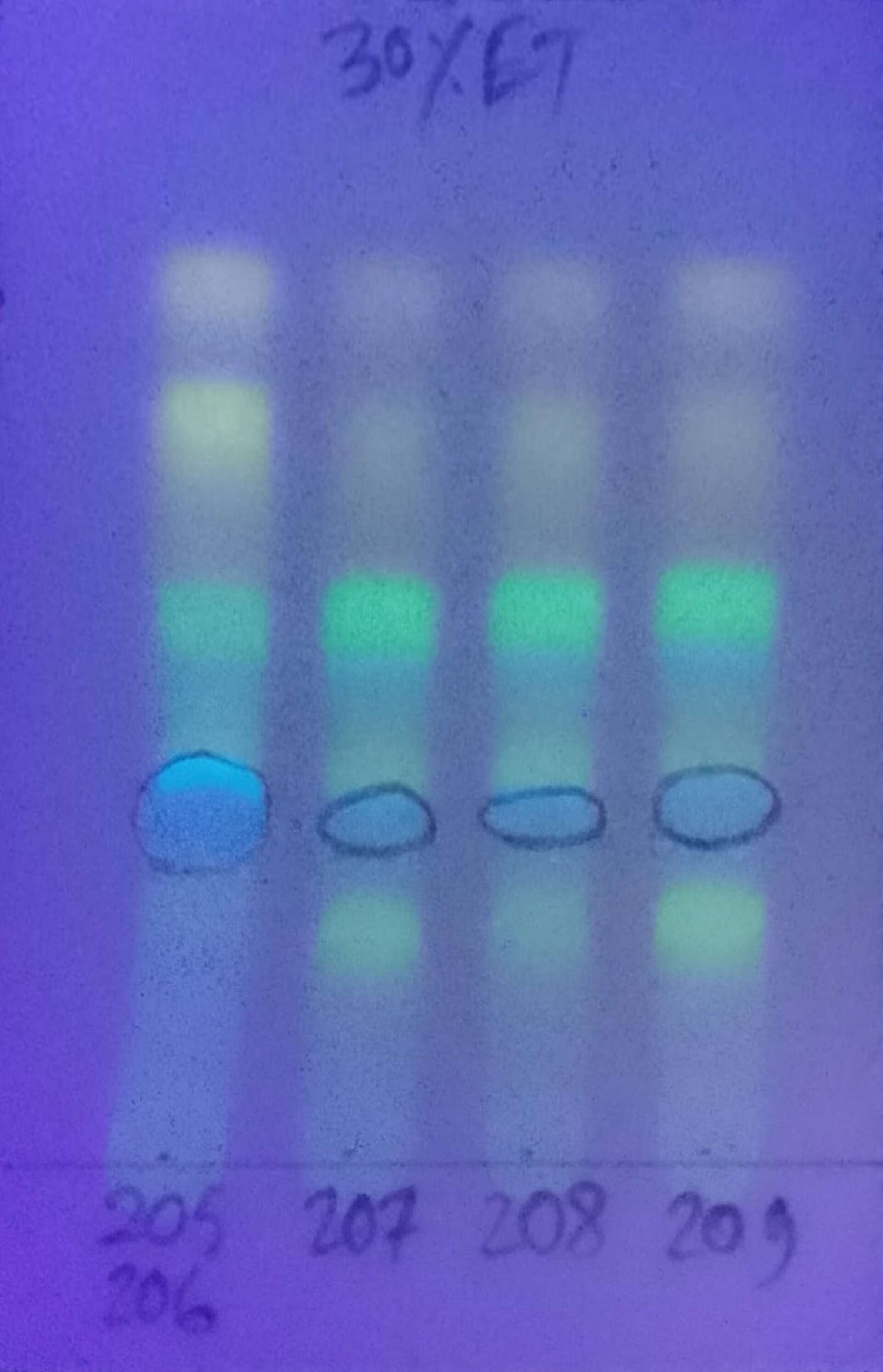
Una placa de CCD revelada bajo luz UV: cada punto es un componente separado.
The Rf value is: · El valor Rf es:
Rf = spot distance / solvent-front distance; it lies between 0 and 1. · Rf = distancia de la mancha / distancia del frente del solvente; se encuentra entre 0 y 1.
A substance that sticks strongly to the stationary phase has: · Una sustancia que se adhiere fuertemente a la fase estacionaria tiene:
Strong adsorption means it travels a shorter distance, giving a smaller Rf. · La fuerte adsorción significa que recorre una distancia más corta, dando un Rf menor.
Using an Rf value
Worked example. A spot moves 3.0 cm while the solvent front moves 7.5 cm. Rf = 3.0 ÷ 7.5 = 0.40 — compared with knowns to identify the compound.
Uso de un valor Rf
Ejemplo resuelto. Una mancha se desplaza 3.0 cm mientras que el frente del disolvente avanza 7.5 cm. Rf = 3.0 ÷ 7.5 = 0.40 — en comparación con valores conocidos para identificar el compuesto.
You've got it
- TLC: a stationary phase (plate) and a mobile phase (solvent moving up)
- $R_{\text{f}} = \dfrac{\text{spot distance}}{\text{solvent-front distance}}$, always between 0 and 1
- sticks more to the stationary phase → smaller $R_{\text{f}}$
Lo has entendido
- CCD: una fase estacionaria (placa) y una fase móvil (disolvente ascendente)
- $R_{\text{f}} = \dfrac{\text{spot distance}}{\text{solvent-front distance}}$, siempre entre 0 y 1
- se adhiere más a la fase estacionaria → menor $R_{\text{f}}$ valor