Phenol · Fenol
| English | Español |
|---|---|
| phenol/ˈfenɒl/ | fenol |
| phenylamine/ˌfiːˈnaɪləmiːn/ | fenilamina |
| diazonium salt/ˌdaɪəˈzəʊnɪəm sɒlt/ | sal diazonio |
| phenoxide/feˈnɒksaɪd/ | fenóxido |
| bromination/ˌbrəʊmɪˈneɪʃn/ | bromación |
The ring that's acidic
- Phenol 苯酚 has an –OH joined directly to a benzene ring.
- This changes the chemistry of both the –OH group and the ring.
- It is more acidic than an alcohol, and its ring is more reactive than benzene's.
El anillo ácido
- Fenol 苯酚 tiene un grupo –OH unido directamente a un anillo de benceno.
- Esto cambia la química tanto del grupo –OH como del anillo.
- Es más ácido que un alcohol y su anillo es más reactivo que el del benceno.
Phenol reaction lab · Laboratorio de reacción del fenol
Classify phenol reactions by the role of the aromatic OH group. · Clasificar las reacciones del fenol según el papel del grupo OH aromático.
Phenol is: · El fenol es:
The –OH is bonded straight to the aromatic ring, changing both the –OH and the ring chemistry. · El –OH está unido directamente al anillo aromático, cambiando la química tanto del –OH como del anillo.
Phenol is a weak acid that reacts with sodium hydroxide. · El fenol es un ácido débil que reacciona con hidróxido de sodio.
The –OH on the ring is more acidic than in an alcohol. · El –OH en el anillo es más ácido que en un alcohol.
Making and reacting
- Make it: cool phenylamine 苯胺 with $\text{NaNO}_2$ + dilute acid (below 10 °C) → a diazonium salt 重氮盐; warm with water → phenol.
- Reactions:
- with NaOH(aq) → sodium phenoxide 苯氧 + water (alcohols don't react with NaOH — phenol is more acidic).
- with sodium → sodium phenoxide + hydrogen.
- bromination 溴化 with bromine water (RT, no catalyst) → 2,4,6-tribromophenol (white precipitate).
Phenol is acidic because the phenoxide charge spreads into the ring
Síntesis y reacciones
- Síntesis: enfriar anilina 苯胺 con $\text{NaNO}_2$ + ácido diluido (por debajo de 10 °C) → se forma una sal de diazonio 重氮盐; calentar con agua → produce fenol.
- Reacciones:
- con NaOH(aq) → fenóxido sódico 苯氧 + agua (los alcoholes no reaccionan con NaOH — el fenol es más ácido).
- con sodio → fenóxido sódico + hidrógeno.
- bromación 溴化 con agua bromada (temperatura ambiente, sin catalizador) → 2,4,6-tribromofenol (precipitado blanco).
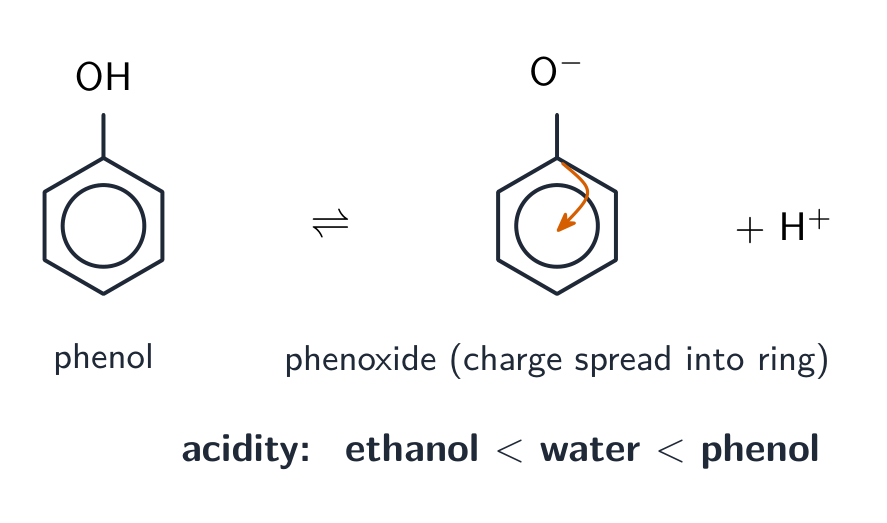
El fenol es ácido porque la carga del fenóxido se deslocaliza en el anillo
Unlike an ordinary alcohol, phenol reacts with NaOH(aq). This shows phenol is: · A diferencia de un alcohol ordinario, el fenol reacciona con NaOH(aq). Esto muestra que el fenol es:
Phenol is acidic enough to react with NaOH, forming sodium phenoxide; alcohols are not. · El fenol es lo suficientemente ácido para reaccionar con NaOH, formando fenóxido de sodio; los alcoholes no lo son.
Phenol with bromine water at room temperature (no catalyst) gives: · Fenol con agua bromada a temperatura ambiente (sin catalizador) da:
The activated ring reacts readily, brominating positions 2, 4 and 6 to give a white precipitate. · El anillo activado reacciona fácilmente, bromando las posiciones 2, 4 y 6 para dar un precipitado blanco.
Match each term to its meaning. · Asocia cada término con su significado.
Each item links the term to its correct meaning. · Cada elemento vincula el término con su significado correcto.
Acidity and the activated ring
- Phenol loses $\text{H}^+$ to a phenoxide ion, stabilised because the charge spreads into the ring. So acidity is:
$$\text{ethanol} < \text{water} < \text{phenol}$$
- A lone pair on the oxygen is partly delocalised into the ring, making it electron-rich — so phenol reacts under milder conditions than benzene (no catalyst, dilute reagents, room temperature). The –OH directs to 2, 4, 6.
The activated ring lets phenol brominate in cold bromine water — no catalyst — to 2,4,6-tribromophenol
Carbolic soap contains phenol, once widely used as an antiseptic.
Acidez y anillo activado
- El fenol pierde $\text{H}^+$ para formar un ión fenóxido, estabilizado porque la carga se deslocaliza en el anillo. Por lo tanto, la acidez sigue este orden:
$$\text{ethanol} < \text{water} < \text{phenol}$$
- Un par de electrones libres del oxígeno se deslocaliza parcialmente hacia el anillo, haciéndolo rico en electrones; por ello, el fenol reacciona bajo condiciones más suaves que el benceno (sin catalizador, reactivos diluidos, temperatura ambiente). El grupo –OH dirige la sustitución a las posiciones 2, 4 y 6.
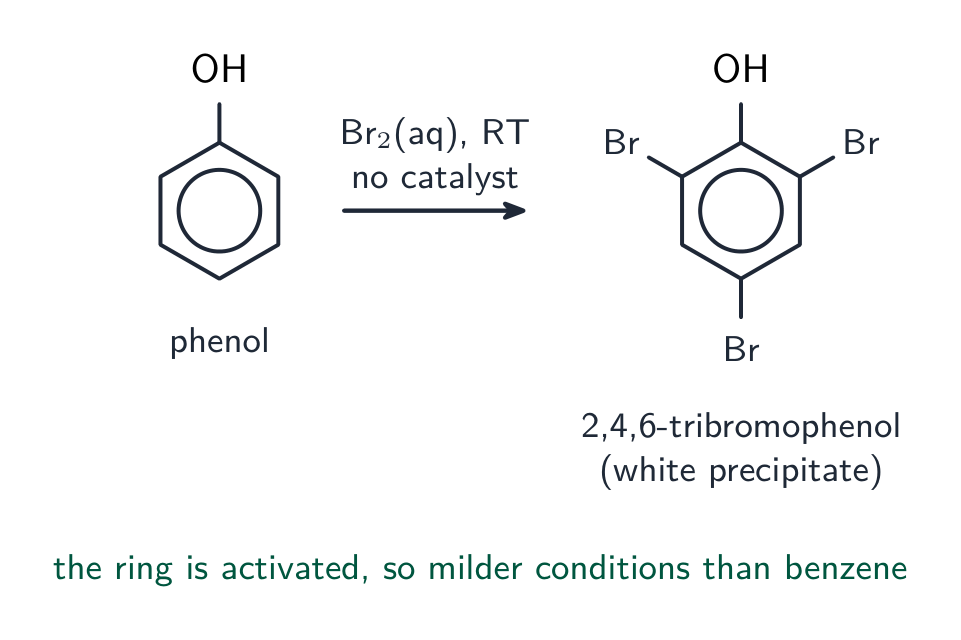
El anillo activado permite que el fenol se bromine en agua bromada fría —sin catalizador— formando 2,4,6-tribromofenol
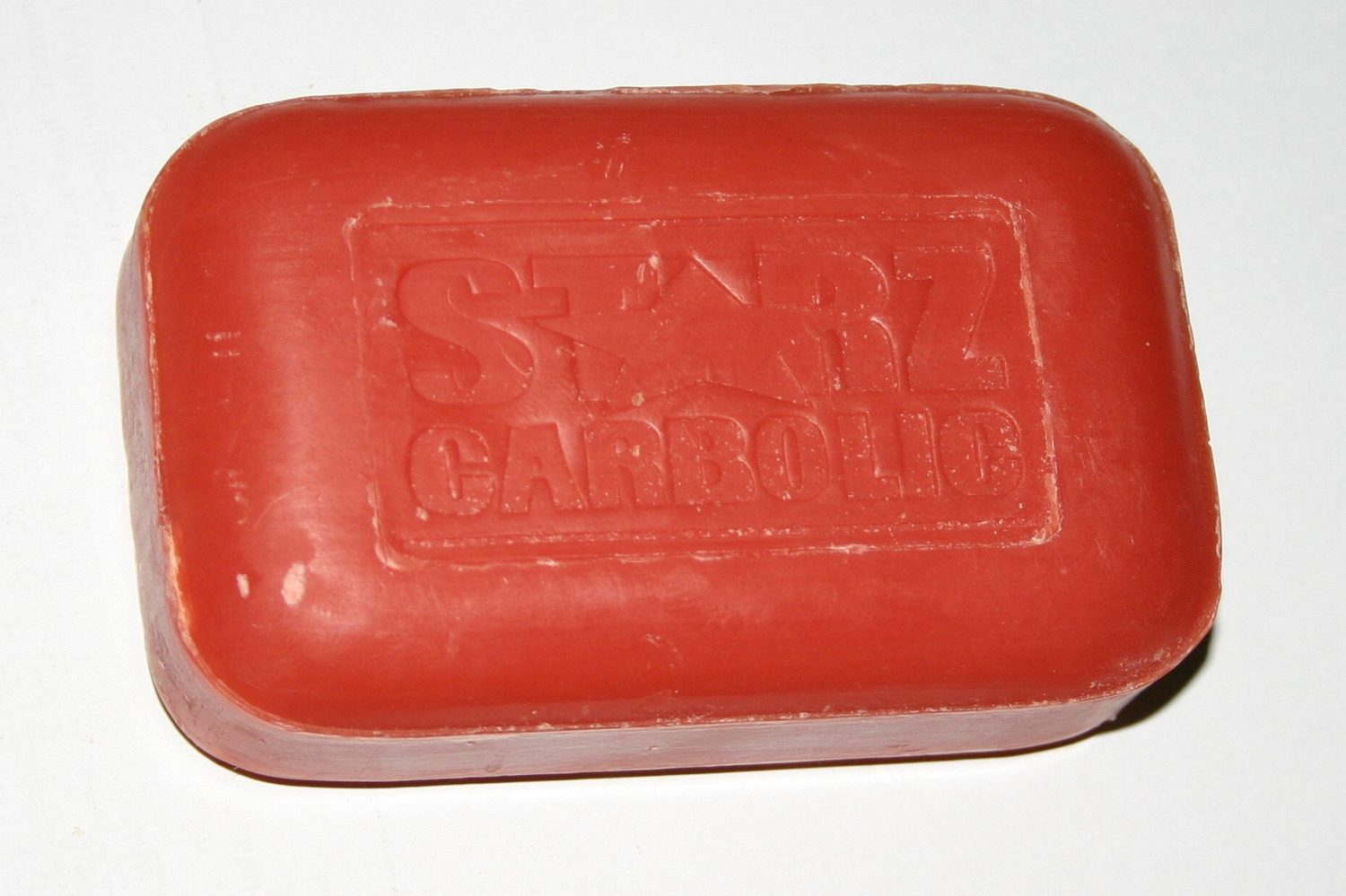
El jabón carbólico contiene fenol, que antaño se usaba ampliamente como antiséptico.
The acidity order is: · El orden de acidez es:
Phenol is the most acidic of the three because the phenoxide charge is delocalised into the ring. · El fenol es el más ácido de los tres porque la carga del fenóxido se deslocaliza hacia el anillo.
Phenol's reactions
- Phenol reacts with sodium hydroxide (it is acidic) and with bromine water (the ring is activated).
- Bromine water decolourises and a white precipitate forms — no UV needed.
Phenol is a low-melting solid that turns pink as it oxidises in air.
Reacciones del fenol
- El fenol reacciona con hidróxido sódico (porque es ácido) y con agua bromada (el anillo está activado).
- El agua bromada se decolora y se forma un precipitado blanco —no se necesita luz UV.
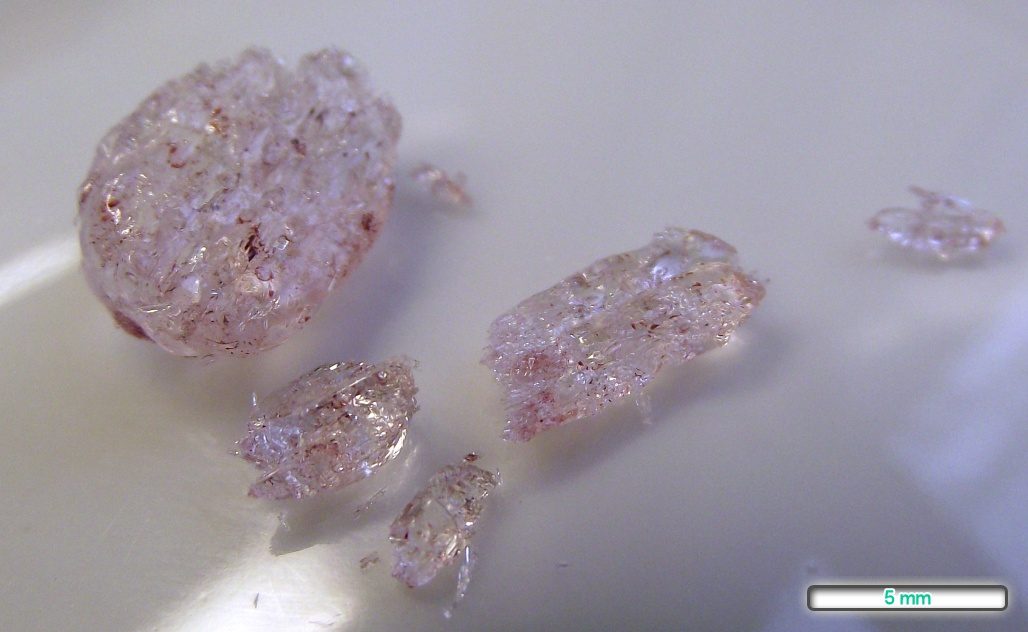
El fenol es un sólido de bajo punto de fusión que se torna rosado al oxidarse en el aire.
You've got it
- phenol = –OH directly on a benzene ring
- it reacts with NaOH (more acidic than an alcohol); bromine water → 2,4,6-tribromophenol (white ppt, no catalyst)
- acidity: ethanol < water < phenol (phenoxide stabilised by the ring)
- the ring is activated (lone pair delocalised in), so phenol reacts under milder conditions than benzene
Ya lo tienes
- fenol = grupo –OH unido directamente a un anillo de benceno
- reacciona con NaOH (más ácido que un alcohol); agua bromada → 2,4,6-tribromofenol (precipitado blanco, sin catalizador)
- acidez: etanol < agua < fenol (el ion fenóxido se estabiliza por el anillo)
- el anillo está activado (par de electrones libres deslocalizado hacia él), por lo que el fenol reacciona bajo condiciones más suaves que el benceno