Arenes and their reactions · Arenas y sus reacciones
| English | Español |
|---|---|
| arene/ˈæren/ | areno |
| electrophilic substitution/ɪˌlektrəʊˈfɪlɪk ˌsʌbstɪˈtjuːʃn/ | sustitución electrofílica |
| halogenation/həˌlɒdʒəˈneɪʃn/ | halogenación |
| nitration/naɪˈtreɪʃn/ | nitración |
| Friedel–Crafts/ˈfriːdl kræfts/ | Friedel–Crafts |
The chemistry of the ring
- Arenes 芳烃 are aromatic hydrocarbons, built on the benzene ring.
- The stable, electron-rich ring reacts mostly by electrophilic substitution 亲电取代.
- This keeps the ring, rather than destroying it by addition.
La química del anillo
- Arenas 芳烃 son hidrocarburos aromáticos, construidos sobre el anillo de benceno.
- El anillo estable y rico en electrones reacciona principalmente mediante sustitución electrofílica 亲电取代.
- Esto preserva el anillo, en lugar de destruirlo mediante adición.
Arene substitution route · Ruta de sustitución del areno
Follow electrophilic substitution on benzene. · Seguir la sustitución electrofílica en el benceno.
Benzene reacts mostly by electrophilic substitution because: · El benceno reacciona principalmente por sustitución electrofílica porque:
Substitution preserves the aromatic stabilisation; addition would break up the delocalised system. · La sustitución preserva la estabilización aromática; la adición rompería el sistema deslocalizado.
Arenes such as benzene typically react by: · Las arenas como el benceno típicamente reaccionan por:
Substitution keeps the stable ring intact. · La sustitución mantiene el anillo estable intacto.
Reactions of benzene
| Reaction | Reagents | Product |
|---|---|---|
| halogenation 卤化 | $\text{Cl}_2$/$\text{Br}_2$ + $\text{AlCl}_3$ | a halogenoarene |
| nitration 硝化 | conc. $\text{HNO}_3$ + conc. $\text{H}_2\text{SO}_4$ | nitrobenzene |
| Friedel–Crafts 傅-克反应 | $\text{RCl}$ or $\text{RCOCl}$ + $\text{AlCl}_3$ | adds an alkyl/acyl group |
| side-chain oxidation | hot alkaline $\text{KMnO}_4$ | benzoic acid |
| hydrogenation | $\text{H}_2$, Pt/Ni | cyclohexane |
The main reactions of benzene
Reacciones del benceno
| Reacción | Reactivos | Producto |
|---|---|---|
| halogenación 卤化 | $\text{Cl}_2$/$\text{Br}_2$ + $\text{AlCl}_3$ | una haloareno |
| nitración 硝化 | $\text{HNO}_3$ conc. + $\text{H}_2\text{SO}_4$ conc. | nitrobenceno |
| Friedel–Crafts 傅-克反应 | $\text{RCl}$ o $\text{RCOCl}$ + $\text{AlCl}_3$ | añade un grupo alilo/acilo |
| oxidación de la cadena lateral | $\text{KMnO}_4$ alcalino caliente | ácido benzoico |
| hidrogenación | $\text{H}_2$, Pt/Ni | ciclohexano |
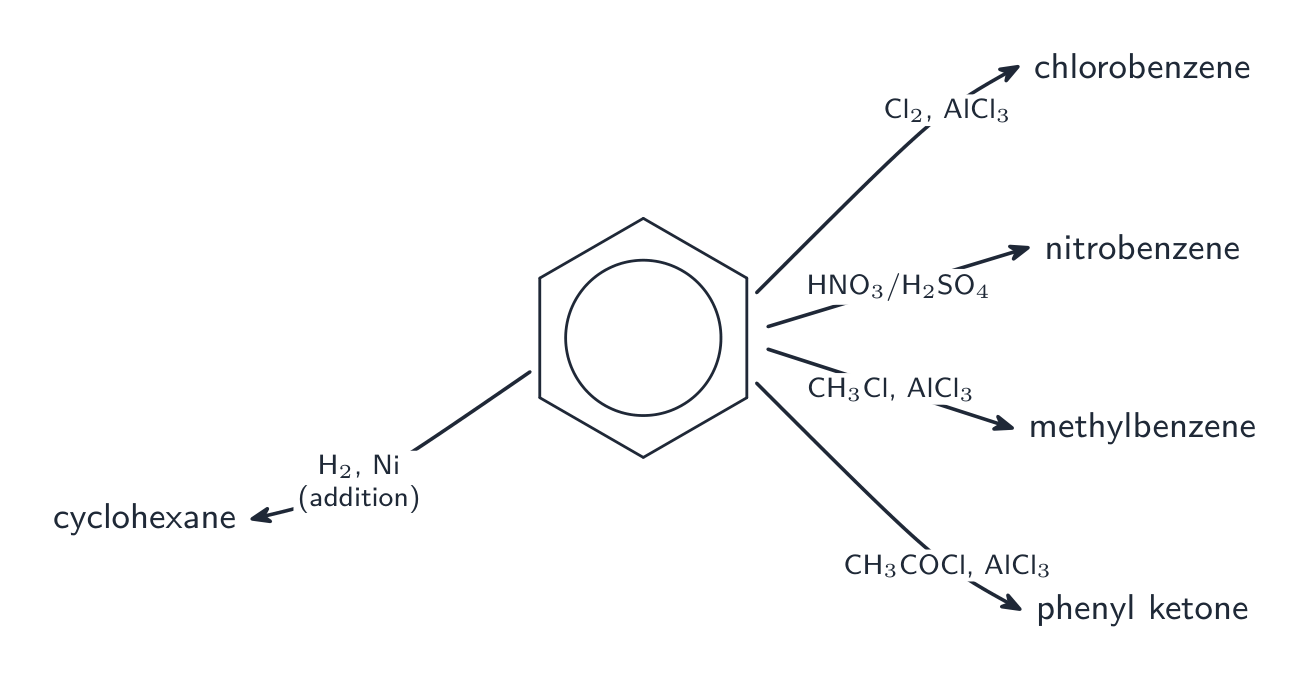
Las principales reacciones del benceno
Nitration of benzene uses: · La nitración del benceno usa:
The conc. acid mixture generates the NO₂⁺ electrophile, giving nitrobenzene. · La mezcla ácida concentrada genera el electrófilo NO₂⁺, dando nitrobenceno.
A Friedel–Crafts reaction (with AlCl₃) is used to: · Una reacción de Friedel–Crafts (con AlCl₃) se usa para:
Friedel–Crafts alkylation/acylation adds a carbon-based group to benzene. · La alquilación/acilación de Friedel–Crafts añade un grupo basado en carbono al benceno.
Match each term to its meaning. · Empareja cada término con su significado.
Each item links the term to its correct meaning. · Cada elemento vincula el término con su significado correcto.
Benzene reacts mainly by electrophilic substitution, not addition, because that keeps its stable delocalised ring intact. · El benceno reacciona principalmente por sustitución electrofílica, no por adición, porque eso mantiene su anillo estable deslocalizado intacto.
Addition would break the delocalised ring and lose its stability, so substitution (swapping an H) is favoured. · La adición rompería el anillo deslocalizado y perdería su estabilidad, por lo que la sustitución (intercambiar un H) es favorecida.
The mechanism (nitration)
- The acid mix makes the electrophile $\text{NO}_2^+$.
- the ring's delocalised electrons bond to the electrophile → an unstable intermediate.
- an $\text{H}^+$ is lost, restoring the stable ring.
- Substitution wins because it keeps the delocalisation; addition would destroy it.
Naphthalene, used in mothballs, is a simple arene of two fused benzene rings.
El mecanismo (nitración)
- La mezcla ácida genera el electrófilo $\text{NO}_2^+$.
- los electrones deslocalizados del anillo se unen al electrófilo → forma un intermediario inestable.
- se pierde un $\text{H}^+$, restaurando el anillo estable.
- La sustitución gana porque mantiene la deslocalización; la adición la destruiría.
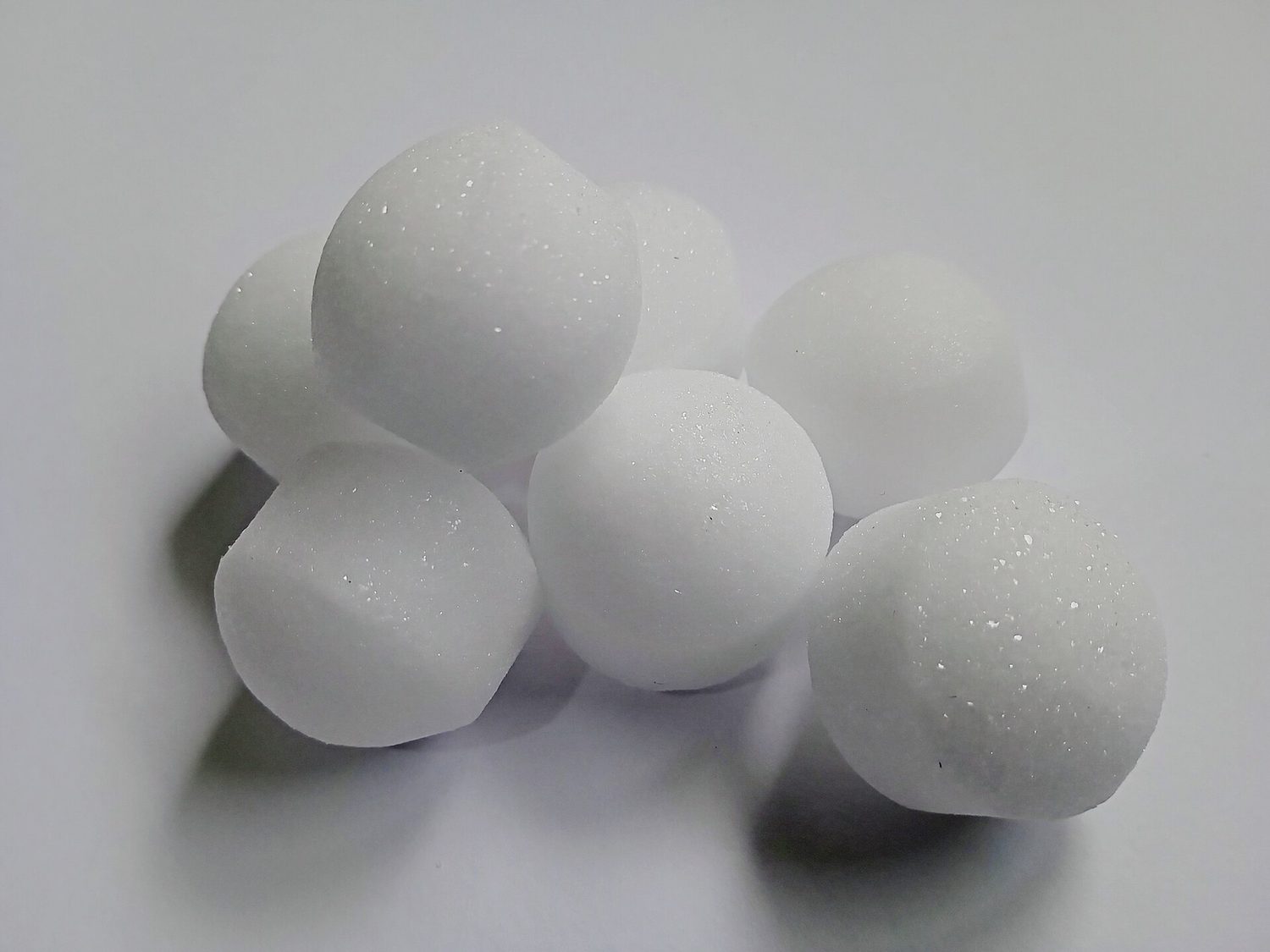
Naftaleno, utilizado en bolas contra polillas, es una arena simple formada por dos anillos de benceno condensados.
In electrophilic substitution, after the ring bonds to the electrophile: · En la sustitución electrofílica, después de que el anillo se une al electrófilo:
Losing H⁺ from that carbon restores the delocalised ring, completing the substitution. · Perder H⁺ de ese carbono restaura el anillo deslocalizado, completando la sustitución.
Why substitution, not addition
- Benzene reacts by substitution to preserve its stable delocalised ring.
- Addition would destroy the extra stability, so it is not favoured.
Friedel-Crafts: alkylation adds an alkyl group, acylation an acyl group
¿Por qué sustitución, no adición?
- El benceno reacciona mediante sustitución para preservar su anillo estable y deslocalizado.
- La adición destruiría esa estabilidad extra, por lo que no es favorecida.

Friedel-Crafts: la alquilación añade un grupo alilo, la acilación un grupo acilo
You've got it
- arenes react by electrophilic substitution (keeping the ring)
- key reactions: halogenation, nitration, Friedel–Crafts (add alkyl/acyl), side-chain oxidation (→ benzoic acid), hydrogenation
- mechanism: ring attacks the electrophile → intermediate → loses H⁺ to restore the ring
Ya lo dominas
- Las arenas reaccionan mediante sustitución electrofílica (manteniendo el anillo).
- Reacciones clave: halogenación, nitración, Friedel–Crafts (añade alilo/acilo), oxidación de la cadena lateral (→ ácido benzoico), hidrogenación.
- Mecanismo: el anillo ataca al electrófilo → intermediario → pierde H⁺ para restaurar el anillo.