Ionic bonding · Enlace iónico
| English | Español |
|---|---|
| ionic bonding/aɪˈɒnɪk ˈbɒndɪŋ/ | enlace iónico |
| electrostatic attraction/ɪˌlektrəʊˈstætɪk əˈtrækʃn/ | atracción electrostática |
| cation/ˈkætaɪən/ | catión |
| anion/ˈænaɪən/ | anión |
| lattice/ˈlætɪs/ | red · roja |
| molten/ˈməʊltn/ | fusa |
Giving electrons away
- Ionic bonding 离子键 is the electrostatic attraction 静电引力 between oppositely charged ions.
- Positive cations 阳离子 attract negative anions 阴离子.
- The ions pack into a giant lattice 晶格.
Donar electrones
- Enlace iónico is the atracción electrostática entre iones con cargas opuestas.
- Los cationes positivos atraen a los aniones negativos.
- Los iones se empaquetan en una red gigante.
Ionic bonding is the electrostatic attraction between oppositely charged ions. · El enlace iónico es la atracción electrostática entre iones con cargas opuestas.
It forms by transferring electrons from a metal to a non-metal. · Se forma mediante la transferencia de electrones desde un metal hacia un no metal.
Ionic bonding is: · El enlace iónico es:
Ionic bonding is the attraction between positive cations and negative anions. · El enlace iónico es la atracción entre cationes positivos y aniones negativos.
How it forms
- A metal gives electrons to a non-metal — e.g. $\text{NaCl}$, $\text{MgO}$, $\text{CaF}_2$.
- The ions form a regular giant lattice, held by attraction in every direction.
A salt crystal's cubic shape comes straight from the giant ionic lattice inside.
Cómo se forma
- Un metal transfiere electrones a un no metal — p. ej., $\text{NaCl}$, $\text{MgO}$, $\text{CaF}_2$.
- Los iones forman una red gigante y regular, mantenida por la atracción en todas las direcciones.
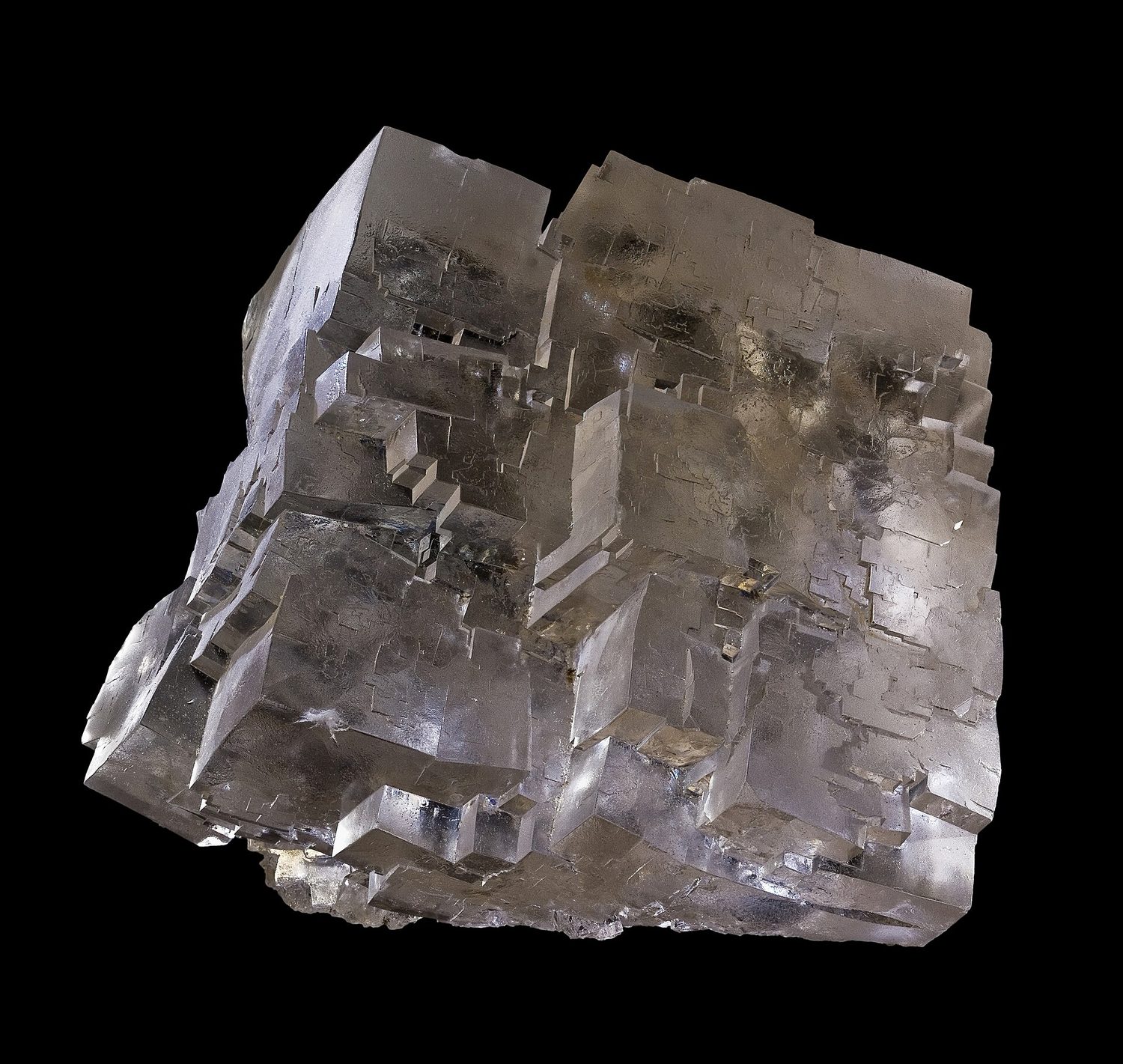
La forma cúbica de un cristal de sal proviene directamente de la red iónica gigante en su interior.
Forming an ionic bond (NaCl) · Formación de un enlace iónico (NaCl)
Step through it. A metal hands its outer electron to a non-metal; the oppositely charged ions then attract in a giant lattice. · Paso a paso. Un metal transfiere su electrón externo a un no metal; los ones con cargas opuestas se atraen entonces en una red gigante.
Ionic bonding forms when: · El enlace iónico se forma cuando:
A metal transfers electrons to a non-metal, making oppositely charged ions (e.g. NaCl). · Un metal transfiere electrones a un no metal, formando iones con cargas opuestas (p. ej., NaCl).
In an ionic solid the ions are packed into a regular giant ______, held by attraction in every direction. · En un sólido iónico, los iones están empaquetados en una red gigante regular ______, mantenida por la atracción en todas las direcciones.
Each ion is surrounded by oppositely charged neighbours, so the structure is very strong. · Cada ion está rodeado por vecinos con carga opuesta, por lo que la estructura es muy fuerte.
In an ionic solid, the ions are arranged in: · En un sólido iónico, los ones están dispuestos en:
Ions pack into a giant lattice, with each ion attracted to oppositely charged neighbours all around. · Los iones se empaquetan en una red gigante, donde cada ion es atraído por vecinos con carga opuesta en todas direcciones.
Dot-and-cross
- In $\text{NaCl}$, sodium transfers its single outer electron to chlorine.
- This gives $\text{Na}^{+}$ and a full-octet $\text{Cl}^{-}$, drawn with dots and crosses.
Sodium gives its single outer electron to chlorine, forming Na⁺ and a full-octet Cl⁻.
Diagrama de puntos y cruces
- En el $\text{NaCl}$, el sodio transfiere su único electrón externo al cloro.
- Esto da lugar al $\text{Na}^{+}$ y al $\text{Cl}^{-}$ con octeto completo, dibujados con puntos y cruces.

El sodio cede su único electrón externo al cloro, formando Na⁺ y un Cl⁻ con octeto completo.
In the NaCl dot-and-cross diagram: · En el diagrama de puntos y cruces del NaCl:
Sodium loses one electron to chlorine, forming Na⁺ and a full-octet Cl⁻. · El sodio pierde un electrón para el cloro, formando Na⁺ y un Cl⁻ con octeto completo.
Put the formation of an ionic bond in order. · Ordena la formación de un enlace iónico.
Transfer the electron → make ions → they attract → giant lattice. · Transferir el electrón → formar iones → atraerse → red gigante.
Properties from ionic bonding
- Ionic compounds have high melting points (strong attractions in a giant lattice).
- They conduct only when molten 熔融 or dissolved, when the ions are free to move.
Rock salt (halite): an ionic compound held in a giant lattice
Propiedades derivadas del enlace iónico
- Los compuestos iónicos tienen puntos de fusión altos (fuertes atracciones en una red gigante).
- Conducen electricidad solo cuando están fundidos o disueltos, momento en el que los iones quedan libres para moverse.
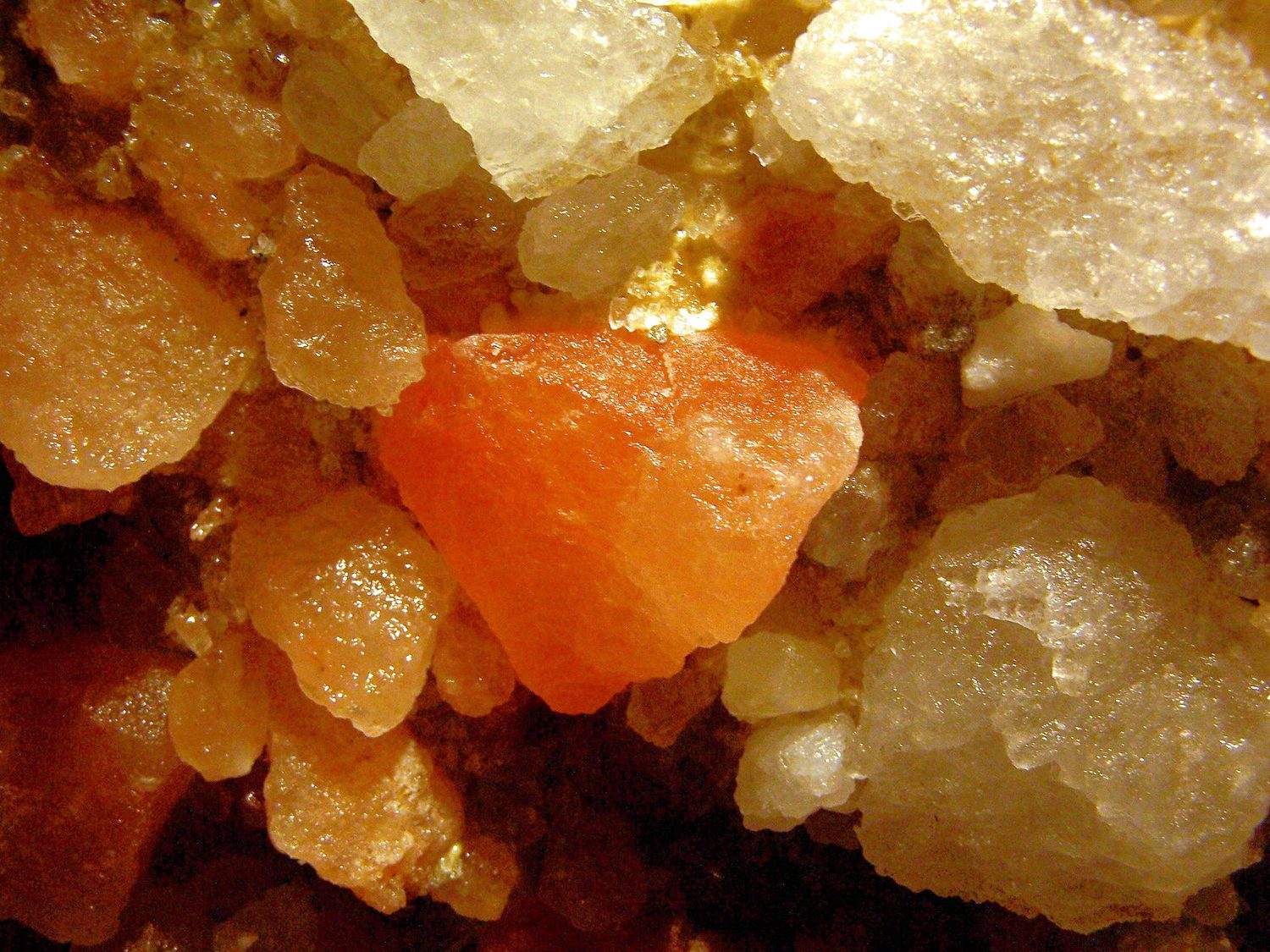
Sal de roca (halita): un compuesto iónico mantenido en una red gigante
You've got it
- ionic bonding = electrostatic attraction between cations and anions
- forms when a metal transfers electrons to a non-metal ($\text{NaCl}$, $\text{MgO}$, $\text{CaF}_2$)
- the ions form a giant lattice held in every direction
Ya lo tienes
- enlace iónico = atracción electrostática entre cationes y aniones
- se forma cuando un metal transfiere electrones a un no metal ($\text{NaCl}$, $\text{MgO}$, $\text{CaF}_2$)
- los iones forman una red gigante mantenida en todas las direcciones