Saltar al contenido
Temas

Gramática Inglesa · B1

  • 1 Present perfect vs past simple
    1.1

    Pasado simple vs. Presente perfecto

    Pasado simple vs. Presente perfecto

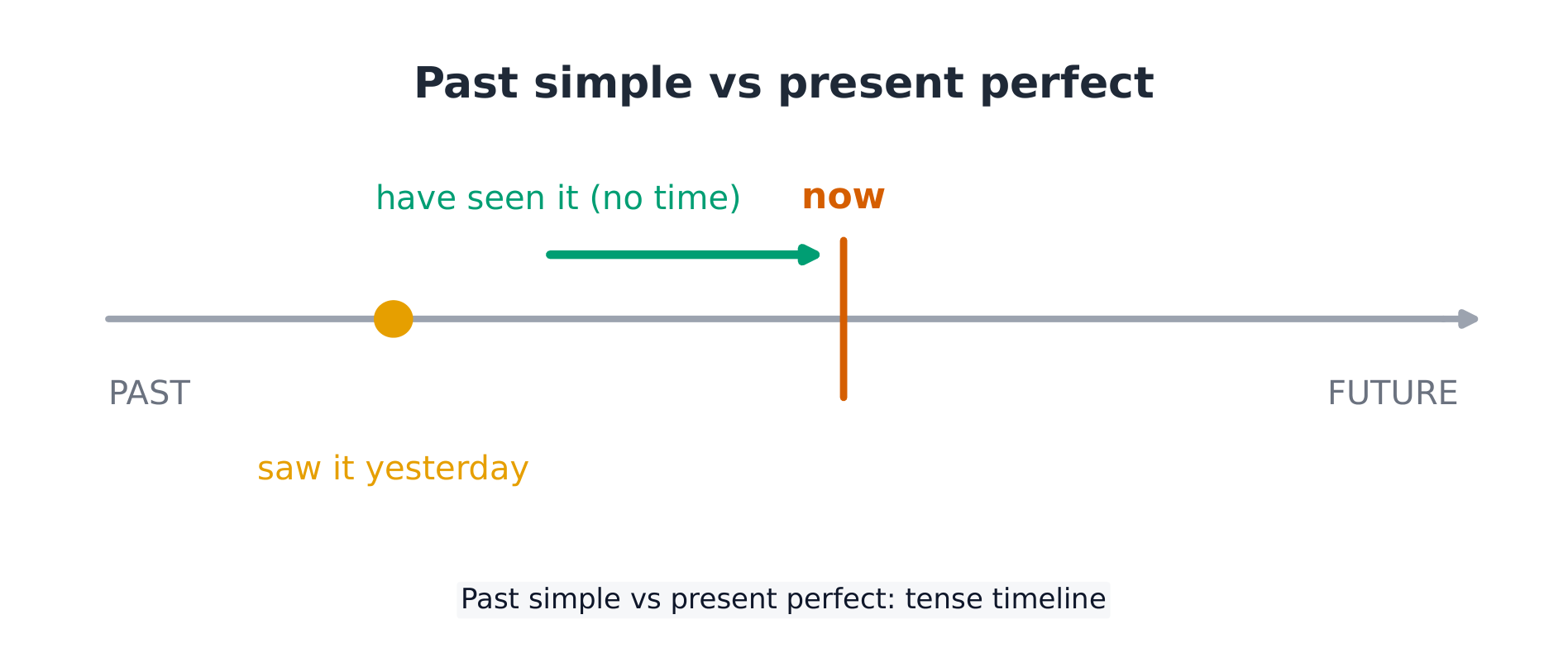
    Lo vi ayer. (Hora determinada → Pretérito simple)

    • Pasado simple (past simple): La acción se completó en un tiempo pasado determinado y no tiene relación con el presente.
    • Presente perfecto (present perfect): No se especifica el tiempo, sino que se enfatiza la influencia sobre el presente o la experiencia vivida.

    我I 看saw 他him 昨天yesterday.

    He visto esa película. (Experiencia, no se dice cuándo → Presente perfecto)

    我I (完成时)have 看seen 那部that 电影film.

    He visto esa película. (Experiencia, sin fecha específica → Presente perfecto)

    Nota: Una vez que aparecen tiempos pasados definitivos como yesterday, last week, in 2019, ago, etc., se usa el pasado simple, no el perfecto.

    1.2

    Palabras clave

    Ha estado en Japón. (Ha ido y ha vuelto)

    • Pasado simple: yesterday, last night, … ago, in 2019, then, when.
    • Presente perfecto: just (acaban de / apenas), already (ya), yet (todavía / aún), ever (alguna vez), never (nunca), so far (hasta ahora), recently (recientemente), since (desde), for (durante).

    她She (完成时)has 刚刚just 到达arrived.

    Acaba de llegar. (just → Presente perfecto)

    他们They 离开left 一an 小时hour 前ago.

    Se fueron hace una hora. (ago → Pasado simple)

    Nota: No mezcle ambos tiempos en la misma oración: ~~I have seen him yesterday~~ ✗ → I saw him yesterday ✓.

    1.3

    *been* y *gone*

    Ambas son formas relacionadas con go, pero tienen significados distintos:

    • have been to: Ha visitado (y ha vuelto) — indica experiencia.
    • have gone to: Se fue (y sigue allí / está en camino).

    他He (完成时)has 去过been (介词)to 日本Japan.

    Ha ido al banco. (No está ahora, sigue allí)

    她She (完成时)has 去了gone (介词)to (冠词)the 银行bank.

    microscopio

    Nota: Para decir "ha visitado un lugar" use been to; para decir "se fue a un lugar y no ha regresado" use gone to.

    Te llamaré esta noche.

    • ❌ ~~When have you arrived?~~ → ✓ When did you arrive? — when pregunta por un tiempo específico en el pasado, por lo que debe usarse obligatoriamente el pasado simple.
    • ❌ ~~I have finished it just now.~~ → ✓ I finished it just now. / I have just finished it. — just now (hace un momento) va con el pasado simple; just (acaban de) va con el presente perfecto.
    • ❌ ~~I lost my keys — can you help me look?~~ → ✓ I have lost my keys… — Las llaves aún no se han encontrado y esto afecta el presente, por lo que el presente perfecto es más preciso.
    • ❌ ~~This is the first time I go there.~~ → ✓ This is the first time I have been there. — Las estructuras fijas como "la primera vez" o "la mejor" van siempre con el presente perfecto: the first time / the best film I have ever seen.
  • 2 Presente perfecto continuo
    2.1

    Estructura (have been + V-ing)

    现在完成进行时:持续到现在

    El presente perfecto continuo (present perfect continuous) enfatiza una acción que comenzó en el pasado y continúa hasta ahora, y que a menudo aún está en curso.

    结构: 主语 + have / has + been + 动词-ing

    我I (完成时)have (进行)been 等待waiting (持续)for 一an 小时hour.

    我已经等了一个小时了。(可能还在等)

    (天气it)It (完成时)has (进行)been 下雨raining 整all 天day.

    雨已经下了一整天了。

    Nota: Negativo: haven't / hasn't been + V-ing. Interrogativo: Have / Has + sujeto + been + V-ing?

    2.2

    持续到现在

    Este tiempo verbal se centra en el proceso de duración y la longitud del tiempo, y suele usarse con for y since:

    • for + período de tiempo: for two hours (durante dos horas).
    • since + punto de partida: since this morning (desde esta mañana).

    她She (完成时)has (进行)been 学习studying 自从since 九点nine.

    她从九点起就一直在学习。

    与现在完成时的区别:

    • Presente perfecto continuo: enfatiza el proceso / la duración (I have been reading — he estado leyendo).
    • Presente perfecto simple: enfatiza el resultado / la conclusión (I have read it — lo he leído).

    Nota: Los verbos de estado (como know, like, be) generalmente no se usan en tiempos continuos: ~~I have been knowing~~ ✗ → I have known ✓.

    常见错误

    • ❌ ~~I am waiting for an hour.~~ → ✓ I have been waiting for an hour. — Para expresar "he esperado una hora y sigo esperando" se debe usar el presente perfecto continuo; el presente simple no puede indicar cuánto tiempo ha durado la acción.
    • ❌ ~~How long are you living here?~~ → ✓ How long have you been living here? — How long pregunta por la duración, por lo que requiere un tiempo perfecto (o perfecto continuo).
    • ❌ ~~She has been finished her essay.~~ → ✓ She has finished her essay. — En voz activa se usa directamente has/have + participio pasado (has finished), sin añadir been. Been se utiliza en tiempos continuos (has been studying) o en voz pasiva (Her essay has been finished, sin objeto directo), pero nunca en el presente perfecto activo con objeto directo.
    • ❌ ~~I have been reading three books this week.~~ → ✓ I have read three books this week. — Para expresar "cantidad de cosas completadas" se usa el presente perfecto simple; el tiempo continuo solo enfatiza el proceso, no los resultados.
  • 3 Past perfect
    3.1

    Estructura (had + participio pasado)

    过去完成时:过去的过去

    El pretérito pluscuamperfecto (past perfect) expresa "el pasado del pasado": una acción que ya se completó antes de un momento específico en el pasado.

    结构: 主语 + had + 过去分词(所有人称都一样)

    当...时When 我I 到达arrived (冠词), the 火车train (过去完成)had 离开left.

    我到的时候,火车已经开走了。(先开走,后到)

    她She (过去完成)had 完成finished 她的her 工作work 在...之前before 午饭lunch.

    她在午饭前就把工作做完了。

    Nota: Abreviaturas: I'd, she'd, they'd (= had).

    3.2

    两个过去动作中更早的那个

    过去完成时常和一般过去时一起用,表明两件过去的事谁先谁后:

    • La que ocurrió primero → pretérito pluscuamperfecto (had done).
    • La que ocurrió después → pretérito simple (did).

    (冠词)The 电影film (过去完成)had 开始started 当...时when 我们we 到达got 那里there.

    我们到那儿时,电影已经开始了。

    Línea de tiempo comparada: had started (más temprano) → got there (más tarde).

    注意 只有当需要强调先后顺序时才用过去完成时;按顺序叙述的事可以都用一般过去时。

    常见错误

    • ❌ ~~After he had left, I had cleaned the room.~~ → ✓ After he had left, I cleaned the room. — Solo la acción más temprana lleva pluscuamperfecto, no ambas.
    • ❌ ~~When I had arrived, the train left.~~ → ✓ When I arrived, the train had left. — Quien ocurrió primero usa had done; si se invierte, el orden cronológico también se invierte.
    • ❌ ~~I had seen this film.~~ (oración aislada) → ✓ I have seen this film. — El pluscuamperfecto requiere un "punto de referencia" en el pasado; sin él, use presente perfecto o pretérito simple.
    • Recuerde la señal clave: by the time + pretérito simple, la oración principal suele ir en pluscuamperfecto: By the time we arrived, the film had started.
  • 4 used to
    4.1

    过去的习惯与状态

    used to: hábitos en el pasado

    used to indica hábitos que se realizaban con frecuencia en el pasado pero ya no se realizan, o estados pasados.

    结构: 主语 + used to + 动词原形

    我I 过去常used to 踢play 足球football.

    我过去常踢足球。(现在不踢了)

    (有)There 过去used to 有be 一家a 电影院cinema 这里here.

    这里以前有一家电影院。

    Nota: used to solo se refiere al pasado. Para hablar de hábitos actuales, utilice el presente simple (I play football now).

    4.2

    否定与疑问

    Para formar negaciones e interrogativos, se utiliza el auxiliar did, y used vuelve a su forma base use:

    • Negación: didn't use to + infinitivo del verbo.
    • Interrogativo: Did + sujeto + use to + infinitivo del verbo ?

    我I (否定)didn't 过去use to 喜欢like 咖啡coffee.

    我以前不喜欢咖啡。

    (助动词)Did 你you 过去use to 住live 这里here?

    你以前住在这里吗?

    Nota: En las formas negativas e interrogativas es use to (sin la d): ~~didn't used to~~ ✗ → didn't use to ✓.

    常见错误

    • ❌ ~~I am used to play football.~~ → No mezcle dos estructuras distintas: ✓ I used to play football (solía jugar, ya no lo hace) vs. ✓ I am used to playing football (estoy acostumbrado a jugar)— en este último caso, to es una preposición seguida de -ing; también existe get used to (acostumbrarse progresivamente).
    • ❌ ~~I use to get up early.~~ (para expresar un hábito actual) → ✓ I usually get up early. — use to no tiene tiempo presente; para hábitos actuales utilice usually.
    • ❌ ~~She used to living in Shanghai.~~ → ✓ She used to live in Shanghai. — después de used to debe ir el infinitivo del verbo.
  • 5 Repaso de formas futuras
    5.1

    will vs be going to

    Formas del futuro: will / going to / presente continuo

    Para hablar del futuro, will y be going to tienen matices distintos:

    • will: decisiones espontáneas, predicciones y promesas.
    • be going to: planes ya existentes o predicciones con evidencia actual.

    我I 觉得think (天气it)it 会will (是)be 冷cold.

    Pienso que hará frío. (Predicción → will)

    我们We (be)are 打算going to 搬move 家house.

    Vamos a mudarnos de casa. (Plan → be going to)

    Nota: Las decisiones espontáneas siempre requieren will: The bag is heavy — I'll carry it. (La bolsa es pesada — la llevaré).

    5.2

    现在进行时表安排

    现在进行时可表示已经约好的将来安排(常有明确时间 / 地点):

    我I (be)am 见meeting (冠词)the 医生doctor 在at 三点three.

    我三点要见医生。(已约好)

    Nota: Be going to enfatiza la "intención", mientras que el presente continuo enfatiza la "programación concreta"; ambos suelen ser intercambiables en este contexto.

    5.3

    时间状语从句

    En cláusulas temporales introducidas por when, as soon as, before, after, until, aunque se refiera al futuro, se utiliza el presente simple:

    我I 会will 打电话call 你you 当...时when 我I 到达arrive.

    我到了就给你打电话。

    等Wait 这里here 直到until (冠词)the 雨rain 停stops.

    在这儿等到雨停。

    Nota: En las cláusulas temporales no se usa will: ~~when I will arrive~~ ✗ → when I arrive ✓.

    常见错误

    • ❌ ~~I will meeting him tomorrow.~~ → ✓ I will meet him. / I am meeting him. — Will + infinitivo, be + -ing; no se deben combinar ambas estructuras.
    • ❌ ~~What will you do tonight?~~ (preguntando sobre sus planes) → ✓ What are you doing tonight? — Para preguntar sobre planes establecidos, el presente continuo suena más natural.
    • ❌ ~~I'll go to the dentist tomorrow — I booked it last week.~~ → ✓ I am going to the dentist tomorrow. — Si algo ya está reservado, no requiere la decisión espontánea que implica will.
    • Para hacer sugerencias con preguntas, utilice Shall: Shall we go? (¿Te parece si vamos?) / Shall I open the window? (¿Abro la ventana?).
  • 6 Condicionales
    6.1

    零条件句与第一条件句

    第一与第二条件句
    • 零条件句(普遍真理):If + 一般现在时, 一般现在时。
    • 第一条件句(将来真实可能):If + 一般现在时, will + 动词原形。

    如果If 你you 加热heat 水water (它), it 沸腾boils.

    如果加热水,水就会沸腾。(普遍真理)

    如果If (天气it)it 下雨rains 我们, we 将will 留stay (在内)in.

    如果下雨,我们就待在家里。(将来可能)

    Nota: En la cláusula con if se usa Presente Simple, incluso cuando se habla del futuro: ~~If it will rain~~ ✗ → If it rains ✓.

    6.2

    第二条件句

    第二条件句讲现在 / 将来不真实或不太可能的假设:

    结构: If + 一般过去时, would + 动词原形

    如果If 我I 有had (冠词)a 很多lot (的)of 钱money 我, I 会would 旅行travel.

    如果我有很多钱,我就会去旅行。(其实没有)

    Nota: En el Segundo Condicional, el verbo to be suele usarse como were en todas las personas: If I were you, I would rest. (Si yo fuera tú, descansaría).

    6.3

    unless

    unless significa "a menos que / si no", equivale a if … not:

    你You 会will (是)be 迟到late 除非unless 你you 快点hurry.

    Estarás tarde a menos que te apresures. (= if you don't hurry)

    Nota: unless ya contiene una negación implícita, por lo tanto no se añade not después: ~~unless you don't hurry~~ ✗.

    常见错误

    • ❌ ~~If I would be rich, I would travel.~~ → ✓ If I were rich, I would travel. — would solo aparece en la oración principal; en la cláusula con if se usa pasado simple.
    • ❌ ~~If it rains, we would stay home.~~ → ✓ If it rains, we will stay home. / If it rained, we would stay home. — No se pueden mezclar Primer y Segundo Condicionales en la misma oración; deben ir parejos.
    • ❌ ~~If I was you, I would rest.~~ → Se puede escuchar en el habla coloquial, pero para exámenes y escritura se prefiere ✓ If I were you.
    • Regla de la coma: Si la cláusula con if va al inicio, lleva coma (If it rains,* we stay in.*); si va al final, no lleva (We stay in if it rains.).
  • 7 La voz pasiva
    7.1

    一般现在 / 过去时的被动

    主动 → 被动

    El pasivo (the passive) coloca al receptor de la acción en la posición del sujeto, poniendo el énfasis en "qué se hace" o "cómo se recibe la acción", en lugar de quién la realiza.

    Estructura: 主语 + be + 过去分词 (el tiempo verbal de be determina el tiempo de la oración).

    • Pasivo en presente simple: am / is / are + participio pasado.
    • Pasivo en pasado simple: was / were + participio pasado.

    英语English (被动)is 说spoken 这里here.

    这里(被)说英语 / 这里讲英语。

    (冠词)The 窗户window (被动)was 打破broken.

    窗户被打破了。

    Nota Al pasar de activo a pasivo: el objeto avanza para convertirse en sujeto y el verbo cambia a be + participio pasado. They built it. → It was built.

    7.2

    por + agente

    Si deseas especificar "por quién" se realizó la acción, utiliza by + agente:

    这This 书book (被动)was 写written 被by 鲁迅Lu Xun.

    这本书是鲁迅写的。

    什么时候用被动?

    • No se sabe quién lo hizo, o no es relevante: The road was repaired. (La carretera fue reparada.)
    • Se desea enfatizar al receptor de la acción: The painting was bought by a museum. (El cuadro fue comprado por un museo.)

    Nota Si el agente no es importante, suele omitirse by …: The shop is closed. (La tienda está cerrada.)

    常见错误

    • ❌ ~~The window was broke. / The book was wrote by him.~~ → ✓ was broken / was written — En pasivo se usa el participio pasado, no el pasado simple; es necesario memorizar bien la tercera columna de los verbos irregulares.
    • ❌ ~~It was happened last night.~~ → ✓ It happened last night. — Verbos intransitivos como happen, appear y die no tienen forma pasiva.
    • ❌ ~~My phone was stolen by someone.~~ → ✓ My phone was stolen. — By someone / by people son redundantes; simplemente omítalos.
    • En chino se dice "nacer en..." con voz activa, pero en inglés siempre se usa pasivo: ✓ I was born in Chengdu.
  • 8 Discurso indirecto
    8.1

    转述陈述句

    直接 → 间接引语

    间接引语 (reported speech) 用来转述别人说过的话,不用引号。常用 said 或 told:

    • say 后面不接听话人: He said (that) …
    • tell 后面要接听话人: He told me (that) …

    他He 说said (连词)that 他he (过去)was 累tired.

    他说他累了。(原话:"I am tired.")

    注意 that 可省略: He said he was tired. 意思一样。

    8.2

    时态后移

    转述时,如果引述动词是过去时 (said / told),从句的时态通常往后退一步:

    • am / is → was; are → were; do / does → did。
    • will → would; can → could; 现在完成 / 一般过去 → 过去完成。

    直接引语: "I will help you," she said. (原话)

    间接引语:

    她She 说said 她she 会would 帮help 我me.

    她说她会帮我。(will → would, I → she, you → me)

    人称和时间词也要变: I → he / she, now → then, today → that day, tomorrow → the next day。

    注意 如果转述的是普遍真理,时态可以不后移: He said the sun rises in the east.

    常见错误

    • ❌ ~~He said me the truth.~~ / ~~He told that he was busy.~~ → ✓ He told me… / He said (that)… — say 不接听话人,tell 必须接听话人,正好相反。
    • ❌ ~~He asked me where did I live.~~ → ✓ He asked me where I lived. — 转述疑问句要变回陈述语序,did 消失。
    • ❌ ~~She asked me that I was hungry.~~ → ✓ She asked me if / whether I was hungry. — 转述一般疑问句用 if / whether,不用 that。
    • ❌ ~~He said he will come tomorrow.~~ → ✓ He said he would come the next day. — 时态和时间词要一起后移。
  • 9 Oraciones relativas
    9.1

    who 与 which / that

    关系代词:who/which/where/whose

    Las oraciones de relativo (relative clauses) sirven para complementar el sustantivo anterior. Se introducen con un pronombre relativo:

    • who: se refiere a personas.
    • which: se refiere a cosas.
    • that: puede referirse tanto a personas como a cosas (muy común en la lengua hablada).

    (冠词)The 女人woman (关系代词)who 住lives 隔壁next door 是is 一名a 医生doctor.

    La mujer que vive al lado es doctora.

    这This 是is (冠词)the 书book (关系代词)which 获得won (冠词)the 奖prize.

    Este es el libro que ganó el premio.

    Nota: El pronombre relativo se coloca inmediatamente después del sustantivo al que hace referencia, introduciendo la información complementaria.

    9.2

    where, when, whose

    • where: se refiere a un lugar. when: se refiere a un tiempo. whose: indica posesión ("de...").

    那是That's (冠词)the 镇town (在那里)where 我I 长大grew up.

    Aquel es el pueblo donde crecí.

    她是She's (冠词)the 作家writer (谁的)whose 书books 我I 喜爱love.

    Ella es la escritora cuyos libros me encantan.

    Nota: Después de whose va directamente un sustantivo (whose books), lo que significa "los libros de esa persona".

    9.3

    Omisión del pronombre relativo

    Cuando el pronombre relativo funciona como objeto dentro de la oración de relativo, puede omitirse (esto es frecuente tanto en el habla como en la escritura):

    (冠词)The 电影film 我们(that) we 看saw (是)was 很棒great.

    La película que vimos fue genial. (se puede omitir 'that')

    Método de identificación:

    • Si el pronombre relativo funciona como sujeto (va seguido inmediatamente de un verbo) → no se puede omitir.
    • Si el pronombre relativo funciona como objeto (va seguido de "sujeto + verbo") → se puede omitir.

    Nota: Cuando funciona como sujeto, debe conservarse: the man who called (no se puede omitir who).

    Errores comunes

    • ❌ ~~The man which lives next door…~~ → ✓ The man who / that… — No se usa which para referirse a personas.
    • ❌ ~~The book what I read…~~ → ✓ The book that / which I read… — En inglés no existe el uso de what como pronombre relativo.
    • ❌ ~~This is the house which I live.~~ → ✓ …the house where I live / …the house which I live in. — Cuando falta una preposición en la oración de relativo, se debe usar where o recuperar la preposición (in).
    • ❌ ~~The friend who I met him yesterday…~~ → ✓ The friend who I met yesterday… — Como el pronombre relativo ya ha sustituido al objeto, no se puede incluir him / it nuevamente en la oración de relativo.
  • 10 Modales de deducción
    10.1

    must 与 can't (certeza)

    推测情态动词:确定程度

    情态动词也能表示推测。当你很确定时:

    • must: debe ser / tiene que ser (deducción afirmativa segura).
    • can't: no puede ser / no es posible (deducción negativa segura).

    她She 一定must 是be 累tired.

    她一定很累。(很确定)

    他He 不可能can't 是be 饿hungry 他; he 刚just 吃ate.

    他不可能饿,他刚吃过。

    Nota: Para expresar una deducción negativa se usa can't (imposible), no mustn't (que significa "prohibición").

    10.2

    might, may, could (posibilidad)

    当你不太确定、只是觉得有可能时:

    • might / may / could: podría / puede que / tal vez.

    (天气it)It 可能might 下雨rain 稍后later.

    待会儿可能会下雨。

    他们They 可能may 在be (在)at 家home.

    他们可能在家。

    确定程度对照:

    • Muy seguro: must (sí) / can't (no).
    • No tan seguro: might / may / could (podría).

    Nota: Todos estos verbos modales van seguidos de un verbo en infinitivo: might be, must be (no might is).

    常见错误

    • ❌ ~~It can be John at the door.~~ → ✓ It could / might be John. — Para una deducción sobre una situación específica se usa could / might; can solo indica posibilidad en general.
    • ❌ ~~He might not can come.~~ → ✓ He might not be able to come. — No se pueden usar dos verbos modales juntos; el segundo se sustituye por be able to o have to.
    • ❌ ~~Maybe he be late. / It may be rain.~~ → ✓ Maybe he is late. / It may rain. — Maybe es un adverbio y la oración sigue su estructura normal; may es un modal y va seguido del infinitivo. No los confundas.
    • ❌ ~~She must is tired.~~ → ✓ She must be tired. — Después de un verbo modal siempre va el infinitivo.
  • 11 Gerundios e infinitivos
    11.1

    Verbo + -ing

    Verbo seguido de: -ing o to

    Algunos verbos van seguidos de un gerundio (verbo en -ing). Los más comunes son: enjoy, like, love, hate, finish, stop, mind, suggest, avoid.

    我I 喜欢enjoy 阅读reading.

    我喜欢阅读。

    她She 完成finished 做doing 她的her 作业homework.

    她做完了作业。

    Nota: El gerundio (gerund) funciona como un sustantivo; su forma es verbo-ing.

    11.2

    动词 + 不定式

    Otros verbos van seguidos de un infinitivo (to + verbo en forma base). Los más comunes son: want, need, decide, hope, promise, learn, would like, plan.

    我I 想want (不定式)to 学learn 英语English.

    我想学英语。

    他们They 决定decided (不定式)to 留下stay.

    他们决定留下来。

    Nota: Algunos verbos pueden llevar ambas formas con significado similar: like, love, start, begin. I like swimming. = I like to swim.

    11.3

    Preposición seguida de -ing

    Después de una preposición (in, on, at, of, about, for, good at, interested in…), el verbo debe ir en la forma -ing:

    她She's 擅长good at 画画drawing.

    她擅长画画。

    谢谢Thank you 因为for 帮助helping 我me.

    谢谢你帮我。

    Nota: Nunca va un verbo en forma base después de una preposición: ~~good at draw~~ ✗ → good at drawing ✓.

    常见错误

    • ❌ ~~I enjoy to read.~~ / ~~I want reading.~~ → ✓ I enjoy reading. / I want to read. — La combinación de qué verbo va con qué forma es fija; memoriza las parejas y no las intercambies.
    • Diferencia los dos significados de stop: He stopped smoking.(dejó de fumar) vs He stopped to smoke.(se detuvo para fumar) — Significan cosas completamente distintas.
    • ❌ ~~I look forward to see you.~~ → ✓ I look forward to seeing you. — En esta expresión, to es una preposición y va seguido de -ing.
    • ❌ ~~Swim is good exercise.~~ → ✓ Swimming is good exercise. — Cuando el verbo actúa como sujeto, debe ir en la forma -ing.
  • 12 too, enough, so, such
    12.1

    too 与 enough

    too 与 enough

    too y enough expresan grado, pero tienen diferente posición y significado:

    • too + adjetivo = "demasiado…" (exceso negativo), se coloca antes del adjetivo.
    • enough = "suficiente", se coloca después del adjetivo y antes del sustantivo.

    这This 咖啡coffee 是is 太too 烫hot.

    这咖啡太烫了。

    他He 不够isn't 大old 足够enough (不定式)to 开车drive.

    他还不够大,不能开车。

    Nota: enough va después del adjetivo (old enough), pero antes del sustantivo (enough money).

    12.2

    so 与 such

    so y such significan "tan" o "tan… que", y se usan para intensificar el tono:

    • so + adjetivo / adverbio: so hot, so quickly.
    • such + (a/an) + (adjetivo) + sustantivo: such a hot day.

    (冠词)The 电影film (是)was 如此so 无聊boring.

    那部电影太无聊了。

    (这)It 是was 如此such 一个a 好good 主意idea.

    那真是个好主意。

    Nota: so va seguido de un adjetivo (so good), mientras que such va seguido de un grupo nominal (such a good idea).

    常见错误

    • ❌ Querer decir "¡Qué feliz!" pero decir ~~I'm too happy!~~ → ✓ I'm so happy! — too tiene un significado implícito de negación ("demasiado como para ser posible"); para elogios y exclamaciones use so.
    • ❌ ~~The box is too much heavy.~~ → ✓ The box is much too heavy. — Para intensificar too use much too, y el orden es much antes.
    • ❌ ~~The tea is too hot to drink it.~~ → ✓ The tea is too hot to drink. — En la estructura too…to, el sujeto de la oración actúa como objeto directo del verbo; no se debe escribir it.
    • ❌ ~~It was so a good idea.~~ → ✓ It was such a good idea. / The idea was so good. — Cuando hay un sustantivo, utilice such.

Iniciar sesión o crear cuenta

IGCSE, A-Level & AP