1-D arrays (lists)
This page needs a recent browser (with SharedArrayBuffer support). Please update Chrome, Edge, Firefox or Safari to the latest version.
A list holds many values
- A Python list stores many values under one name. We use it here to model an exam array.
- Write the items in square brackets, separated by commas.
- A Cambridge array has fixed declared bounds and elements of one data type. Python lists can grow and contain mixed types; they are not the same data structure.
scores = [40, 55, 72, 90]
print(scores)
Reach an item by its index
- Each item has a position number called its index.
- Python counts from 0, so the first item is
scores[0].
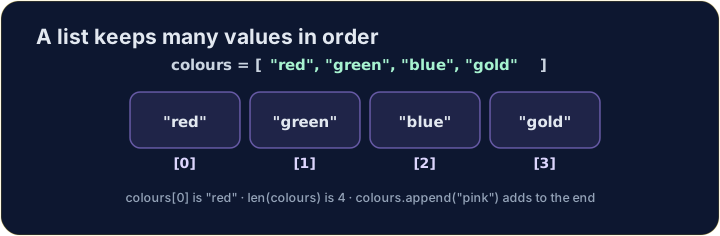
scores = [40, 55, 72, 90]
print(scores[0])     # 40
print(scores[2])     # 72
Explore
Index and change a list
Items are numbered from 0; scores[0] is the first item.
Change an item
- Assign to an index to replace that one item.
scores = [40, 55, 72, 90]
scores[1] = 99
print(scores)        # [40, 99, 72, 90]
Length and looping
len(scores)gives how many items there are.- A
forloop visits each item in turn.
scores = [40, 55, 72, 90]
print(len(scores))   # 4
for s in scores:
    print(s)
In the exam: use the declared bounds
- Cambridge pseudocode states the lower and upper index bounds. A lower bound of 1 is usual, but not compulsory:
ARRAY[0:3]also has four cells, indexed 0 to 3.
DECLARE Scores : ARRAY[1:4] OF INTEGER
Scores[1] ← 40
OUTPUT Scores[1]
Common mistakes
- Python lists start at
0; the last non-negative index islength - 1. Cambridge arrays use their declared bounds. - Going past the end gives an index error.
Now you try
- Use an index, or a loop, on each list.
- Press Check answer to test your code.
Difficulty 2/5 · 140 coins + a small bonus on first completion today
The list colours is set for you. Store its second item in a variable called second (remember Python counts from 0).
Click Run to see the output here.
Difficulty 2/5 · 140 coins + a small bonus on first completion today
Change the first item of the list nums to 99.
Click Run to see the output here.
Difficulty 2/5 · 140 coins + a small bonus on first completion today
Use a loop to add up every number in nums and store the result in total (the answer is 43).
Click Run to see the output here.